
High-stage locations: top 10 for runners and top 10 for cyclists
Published 15 January 2013 · 10 min read
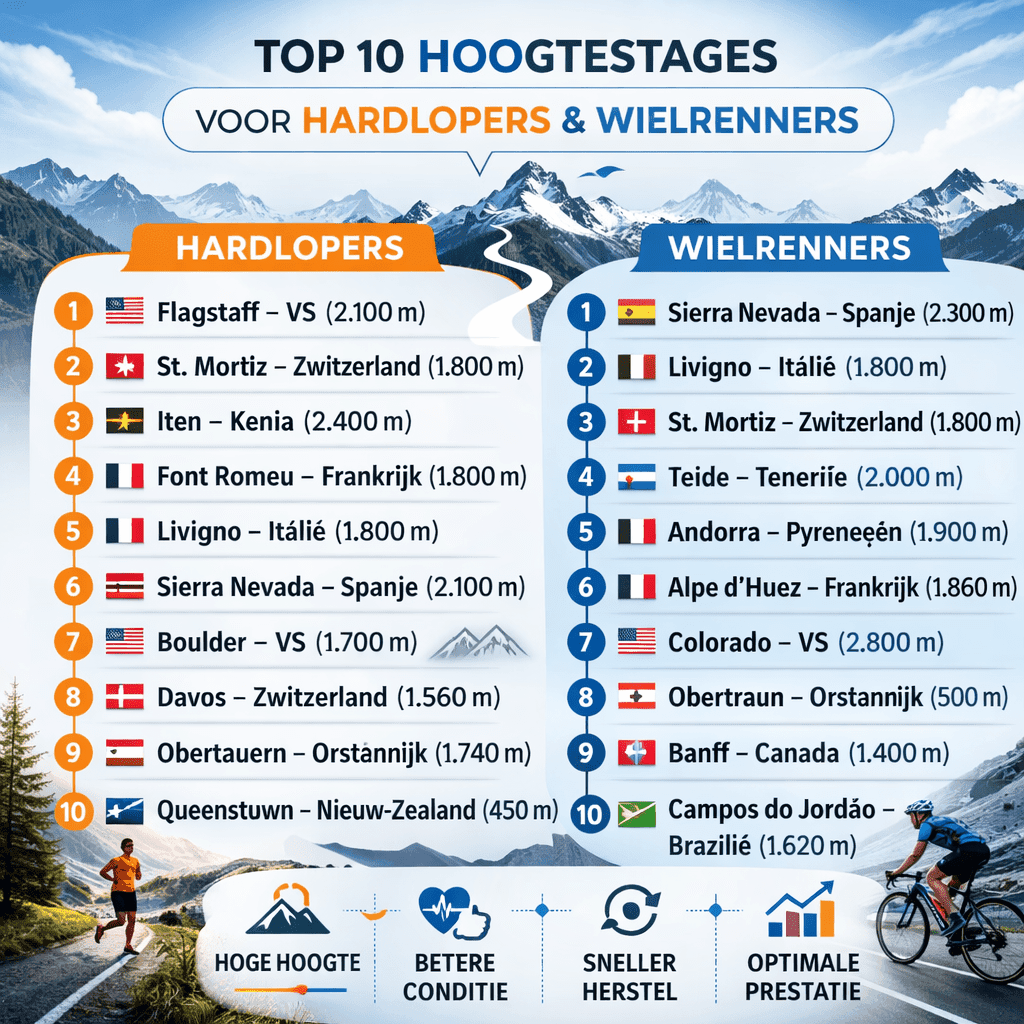
The right altitude training locations choosing is the difference between a smart training stimulus and a stage that demolishes your training quality. Many athletes choose a well-known mountain spot, but just lack the infrastructure to actually train well. In this article, you get two substantiated top 10 lists: one for runners and one for cyclists, plus a practical alternative via LHTL without travelling.
The essentials in 30 seconds
Conclusion: The best altitude training locations combine a sleeping altitude around 1,800 to 2,500 metres with the ability to maintain quality training.
Nuance: Higher is not automatically better. Too much hypoxic stress often lowers your training output and recovery.
Practical lead: Choose a place where you sleep high and train lower or use LHTL via normobaric hypoxia so that your intensity and volume at sea level remain intact.
Why altitude training locations are often chosen incorrectly
The most common fallacy is simple: you choose a location at altitude and automatically expect performance improvement. In practice, you then often get the opposite. You run or cycle slower, you sleep worse and your recovery shifts. As a result, exactly the training quality you need disappears.
Therefore, it is useful to understand the logic of Live High Train Low to use as a capstone. The goal is not “being high”, but “sleeping high enough for adaptation and training low enough for quality”.
📊 Research shows
The greatest gains usually come from a combination of sufficient hypoxic stimulus and maintenance of training intensity. Once intensity is structurally lost, the stage becomes a fatigue block rather than a performance trigger. Therefore, location selection is primarily a quality question, not just an altitude question.
How these top 10 lists are ranked
Each location scores on the same points. This also allows you to compare them fairly.
- Sleeping height: preferably 1,800 to 2,500 metres for a workable incentive
- Quality training: possibility for intervals or pacing without “breaking down” everything
- Infrastructure: track, trails, safe roads, long climbs, nutrition and recovery
- Logistics: accessibility, stability of conditions, practical simplicity
- Risk of overload: how likely are you to start too fast or go too high
💡 Did you know?
Many athletes interpret “feeling good at altitude” as proof that it works. However, objective data often show that the training stimulus is only valuable if your recovery and training output remain stable. Therefore, a location with slightly less altitude is sometimes better than one with more altitude.
Top 10 altitude training locations for runners
This list is explicit for runners. Running quality requires flat stretches, a track or well-measured segments. Surface also counts, as your tendons and calves already get extra stimulation at altitude.
1. Flagstaff, United States
- Why top: sleeping height around 2,100 metres with lots of walking infrastructure
- What works well here: combination of trails, track opportunities and running culture
- Note: start conservatively because intensity becomes “expensive” faster
2. Iten, Kenya
- Why top: constant stimulus around 2,400 metres and strong training environment
- What works well here: endurance volume, aerobic blocks, rhythm and routine
- Note: pace work requires more discipline because everything feels heavier
3. Sierra Nevada, Spain
- Why top: clear height incentive around 2,300 metres and sports centre environment
- What works well here: controlled training setting with focus on recovery
- Note: Running speed often drops in week 1, plan your quality blocks later
4. Sankt Moritz, Switzerland
- Why top: stable altitude around 1,800 metres with a proven tanning ecosystem
- What works well here: Balance between incentive and quality retention
- Note: Booking and planning are important during busy periods
5. Font Romeu, France
- Why top: around 1,800 metres with clear sports infrastructure
- What works well here: measurable training and controlled build-up
- Note: choose routes smartly, because intensity piles up faster than you think
6. Livigno, Italy
- Why top: around 1,816 metres with wide endurance infrastructure
- What works well here: combination of duration, strength and recovery
- Note: lots of hill work can put extra strain on your calves at altitude
7. Mammoth Lakes, United States
- Why top: higher endurance hub around 2,400 metres
- What works well here: aerobic blocks and robust endurance work in a quiet environment
- Note: higher is heavier, so monitor your sleep and your overall training stress
8. Park City, United States
- Why top: sleeping height around 2,100 metres with good access to training routes
- What works well here: endurance volume and tempo blocks with relatively high control
- Note: Combine with lower training times if you want to protect intensity
9. Boulder, United States
- Why top: mild altitude around 1,650 metres, therefore often easier to sustain
- What works well here: preservation of quality, ideal for those sensitive to height
- Note: the hypoxic stimulus is more subtle, focus on consistency
10. Bogota, Colombia
- Why top: higher stimulus around 2,600 metres and strong endurance stimulus
- What works well here: aerobic blocks and robust adaptation when properly supervised
- Note: higher means more sleep stress, so periodisation is everything
⚠️ Reality check
A running workout is often started “too hard” because sea level paces remain as a reference. As a result, fatigue accumulates and training quality drops. A good location helps, but your discipline determines whether you get adaptation or just stress.
Altitude Dream alternative for runners: LHTL training stage without travelling
Want to apply the LHTL logic without going abroad for weeks? Then a high altitude tent is a practical alternative. You use normobaric hypoxia, in which the oxygen percentage is reduced. Sleep is the primary stimulus. You build up incrementally and adjust based on data.
An altitude tent is no substitute for acclimatisation, but it will significantly reduce the risk of altitude sickness. For sports performance, it is mainly about controlled adaptation without losing your training quality.
Read also: altitude tent use complete guide and what is the optimum height at LHTL.
-> Check out the running LHTL package and plan your internship
-> How did other runners experience our height tent hire service: Read it here
Top 10 altitude training locations for cyclists
This list is for cyclists. Here, safe routes, long climbs and the ability to create volume often outweigh track facilities. At the same time, protecting intensity is crucial. Therefore, a location scores higher if you can actually maintain quality there.
1. Sierra Nevada, Spain
- Why top: strong altitude push around 2,300 metres, lots of long climbs
- What works well here: robust endurance volume and climb-specific blocks
- Note: plan your real intensity lower or later in the internship
2. Teide, Tenerife
- Why top: training above 2,000 metres with stable climate
- What works well here: long steady climbs, perfect for aerobic blocks
- Note: the combination of altitude and climbing makes it tougher than it looks
3. Livigno, Italy
- Why top: around 1,816 metres, therefore often more compatible with quality
- What works well here: balance between volume, climbing and recovery
- Note: monitor total training load, as hills pile up stress
4. Sankt Moritz and Engadin, Switzerland
- Why top: around 1,800 metres with lots of quiet roads and climbs in the region
- What works well here: Controlled duration stimulus and solid recovery setting
- Note: intensity is possible, but requires tight planning
5. Tignes and Val d'Isere, France
- Why top: sleeping altitude around 2,000 metres and many long mountain passes
- What works well here: climb-specific structure and aerobic capacity
- Note: altitude can disrupt sleep, so recovery planning is essential
6. Les Deux Alpes and Alpe d'Huez region, France
- Why top: sleeping altitude around 1,650 to 1,860 metres with iconic climbs
- What works well here: volume and climbing while relatively maintaining training quality
- Note: busy season can make routes less safe
7. Andorra (high altitude valleys plus high passes)
- Why top: you can sleep at medium height and train on many different passes
- What works well here: flexibility: incentive without maximising everything
- Note: consciously choose your sleeping height and avoid turning every ride into a climbing ride
8. Park City, United States
- Why top: around 2,100 metres with many training routes
- What works well here: endurance volume and strength at altitude
- Note: combine with lower-intensity days for recovery
9. Boulder, United States
- Why top: mild altitude around 1,650 metres and good cycle network in the region
- What works well here: maintaining intensity and duration, ideal when sensitive to altitude
- Note: the incentive is smaller, so consistency is key
10. Colombian plateau (Boyaca region, Tunja, Paipa)
- Why top: sleeping around 2,500 metres with many long, controlled climbs
- What works well here: robust aerobic adaptation and climbing ability
- Note: height makes sleep monitoring especially important
Altitude Dream alternative for cyclists: LHTL training stage while maintaining intensity
Cyclists often want one thing: altitude stimulation without their intervals and power blocks collapsing. Then an LHTL approach with altitude training makes sense. You sleep high via normobaric hypoxia, but train at sea level during the day. This keeps your quality intact and makes the stimulus more dosable.
For monitoring, it is useful to understand how your SpO2 behaves at altitude. Read: oxygen saturation at altitude.
-> Check out the cycling LHTL package and plan your internship
-> How did other cyclists experience our altitude tent hire service: Read it here
Checklist: how to quickly choose the right altitude training location
- Choose your sport focus: running requires measurable segments, cycling requires safe long climbs.
- Fix your sleeping altitude between 1,800 and 2,500 metres.
- Check that your quality training remains achievable without everything feeling “max”.
- Plan the first 72 hours as a gentle build-up, not a training week.
- Save intensity for week 2, when sleep and recovery become more stable.
- Choose an exit strategy: lower training option or LHTL alternative as backup.
First 72 hours: the smart start that pays big dividends
The first 72 hours often define your entire internship. If you start too hard, your sleep quality drops and you end up in a fatigue pit. If you start in a controlled way, your system stabilises faster and you can deliver quality later.
- Day 1: quiet volume, short stimulus, lots of hydration
- Day 2: aerobic duration, no aggressive intervals
- Day 3: first controlled blocks, but stop before it gets “heavy”
🧭 In practice
Many athletes actually feel energy on day 2. This is insidious. Real fatigue often comes after 48 to 72 hours, when sleep and hypoxic stress add up. That's why a conservative start works better, even if you feel good.
Feeling versus objective data: how to avoid self-deception?
At altitude, feeling misleads more often than at sea level. A gentle endurance workout can suddenly feel “hard”. At the same time, a good day can get you too excited. This is why it works better to steer your stage with objective cues rather than emotion.
- Feeling: heavy, light, sleepy, irritable, “no sense”
- Dates: sleep quality, resting heart rate, exercise output, SpO2 trend
If you want to read up on the physiological basics, go back to how altitude training works. That makes it easier to interpret your signals correctly.
This is how to monitor height loads without complicated systems
You don't need a lab. You just need consistent measurements and a simple decision rule.
- SpO2 trend: look at progression over 4 to 7 nights, not one measurement. A work zone around 92 per cent during sleep can be useful for many athletes if sleep and recovery remain good.
- Sleep quality: number of awakenings and subjective sleep score are often more useful than perfect data.
- Training output: pace, power or heart rate response at the same effort. Big drop means too much stress.
Concrete decision rule: if your SpO2 trend drops for three nights and your sleep quality gets worse at the same time, lower your altitude stimulus or scrap your intensity until the trend stabilises.
When to choose LHTL instead of physical altitude training?
Sometimes an altitude training location is not the best solution, even if you can go there. LHTL is especially interesting in these situations:
- you want to protect intensity and quality
- you have limited time or logistical space
- you want to build and adjust in a controlled way with data
- you react sensitively to altitude with sleep disturbance
So for many athletes, it is not a choice between “altitude or not altitude”, but a choice between “controllable or unpredictable”. If you want to spar which route suits you best, feel free to contact us at Altitude Dream.
External source
For a general explanation of benefits and limitations of training at altitude, you can also read this overview: World Athletics: basics, benefits and limits of altitude training.
Mini-FAQ on altitude training locations
What is the best altitude for altitude training locations?
For many athletes, 1,800 to 2,500 metres works best. You get stimulus without sleep and training quality dropping too hard. Higher locations can, but require tighter doses.
Why do runners need different venues than cyclists?
Runners need measurable surfaces and often a track. Cyclists need safe routes and long climbs. This is why the same location sometimes scores very differently for each sport.
Can I get the same effect without travelling?
Often yes. With LHTL via normobaric hypoxia, you sleep high but train at sea level. That maintains your intensity.
How do I know if the altitude is too aggressive?
Pay attention to the combination of falling SpO2 trend and worse sleep. If the two worsen together, your stimulus is too high or your build-up too fast. Then lowering or temporising works better than pushing through.


