Kilimanjaro without altitude sickness: what the data says about success
Published 18 March 2026 · 3 min read
Climbing Kilimanjaro without altitude sickness is possible, but not obvious. Every year, thousands of people try to reach the 5895-metre summit, and a large proportion do not make it due to acclimatisation problems. The chances of success turn out to be highly dependent on route, pace, preparation and individual sensitivity to altitude.
If you look at the figures, you will see a clear pattern: the better the acclimatisation, the higher the chances of making it to the summit without complaints. In this article, we look at what the data says about success on Kilimanjaro, what factors make the difference, and how to minimise the risk of altitude sickness.
First, also read the basics about preventing altitude sickness and the best acclimatisation schedule for Kilimanjaro in preparation.
🧭 The essentials in 30 seconds
- 30-50% of climbers get complaints on Kilimanjaro
- Success rate ranges from 40% to 80% per route
- Slow routes have significantly higher summit probability
- Pre-acclimatisation greatly increases success
- Altitude sickness occurs mainly above 3,500 metres
📊 What do the numbers say about success on Kilimanjaro?
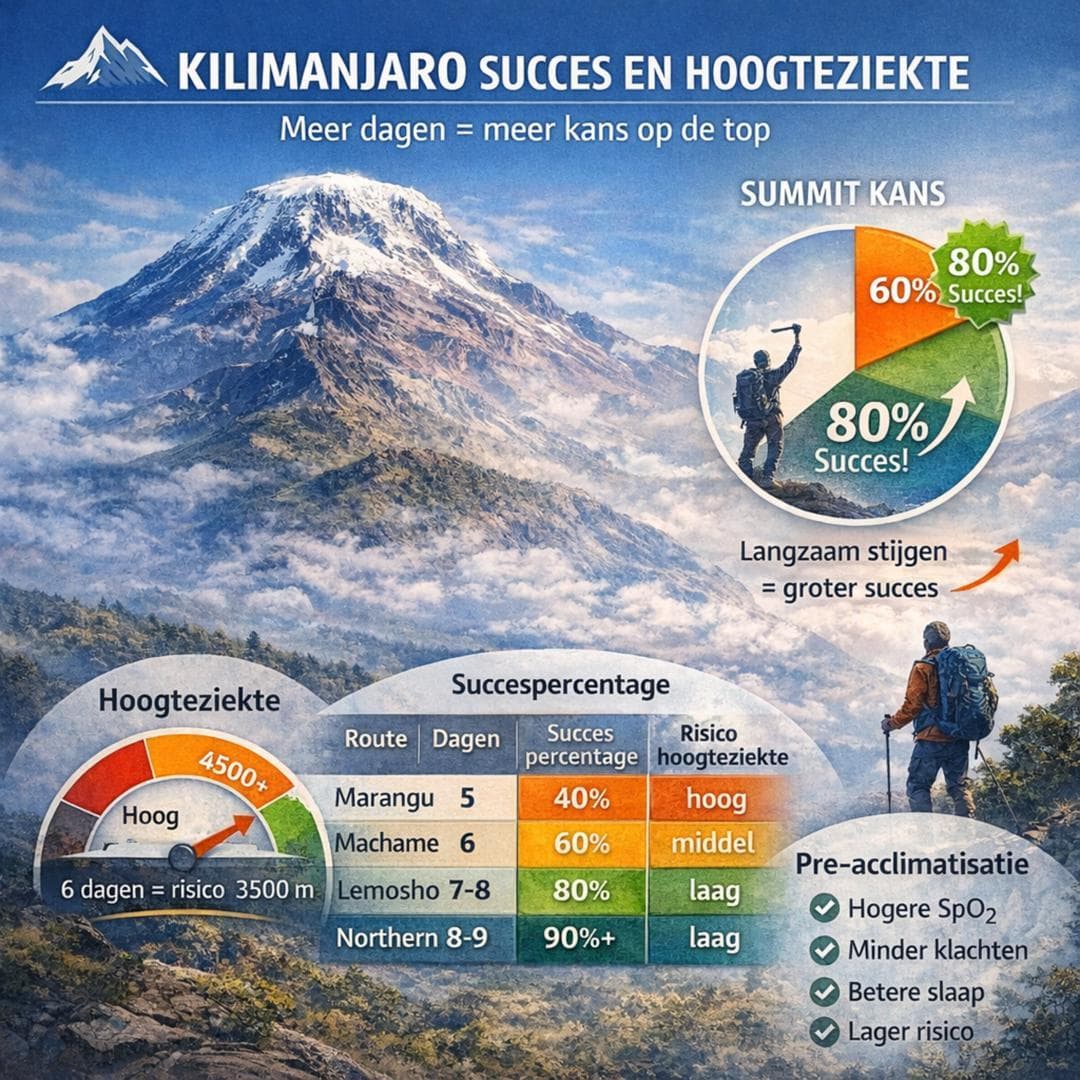
Expedition data from various guide organisations show a clear link between acclimatisation and success.
| Route | Days | Success rate | Risk of altitude sickness |
|---|---|---|---|
| Marangu 5 days | 5 | 40% | high |
| Machame 6 days | 6 | 60% | resource |
| Lemosho 7-8 days | 7-8 | 80% | low |
| Northern Circuit | 8-9 | 90%+ | low |
The difference is almost entirely explained by acclimatisation time.
⛰ Why does altitude sickness on Kilimanjaro occur so often?
Kilimanjaro is a relatively fast mountain. You go from sea level to almost 6000 metres in less than a week. The body normally needs 10-14 days to adapt properly.
Key factors:
- rise too fast
- insufficient sleep at altitude
- no previous experience above 3000 m
- low oxygen saturation
- genetic susceptibility
Read also what happens in the first days at altitude:
first 72 hours at altitude
📊 From what altitude does the risk really start?
| Height | Oxygen | Risk |
|---|---|---|
| 2500 m | ~75% | light |
| 3500 m | ~65% | clearly |
| 4500 m | ~58% | high |
| 5895 m | ~50% | very high |
Therefore, most of the problems on Kilimanjaro arise between day 3 and day 6.
💡 What makes the difference between success and dropping out?
Data from expeditions show that four factors are most important.
1. Route length
More days = more acclimatisation.
2. Sleep height
Sleeping at altitude encourages adaptation.
3. Rise rate
Rising too fast increases risk of AMS.
4. Acclimatise in advance
Pre-acclimatisation significantly reduces complaints.
🏕 Does pre-acclimatisation really work according to the data?
In climbers who acclimatise beforehand, we often see:
- higher SpO2 at altitude
- fewer headaches
- better sleep
- less use of Diamox
- higher summit rate
This is because the body already increases EPO, ventilation and oxygen transport before.
See also:
acclimatising at home before expeditions
📊 This is how you monitor this lens
Don't use feelings, but trends.
- SpO2 trend per day
- sleep quality
- resting heart rate
- headache/nausea
- recovery after exercise
Important:
- SpO2 should rise slowly during acclimatisation
- sudden drop = risk
- poor sleep = warning
⚠️ Misconceptions about Kilimanjaro without altitude sickness
- Good fitness does not prevent altitude sickness
- Young people also get AMS
- Diamox is not a guarantee
- Fast routes are not safer
- Training at sea level is not enough
🧭 Practical strategy with highest success
- Choose route of 7+ days
- Start slowly
- Drink enough
- Sleep as low as possible but rise gradually
- Use pre-acclimatisation if possible
- Measure SpO2
- Don't force the summit
❓ FAQ
How many people get altitude sickness on Kilimanjaro?
About 30-50% gets mild complaints.
Can you climb Kilimanjaro without altitude sickness?
Yes, with proper acclimatisation and enough days.
Which route has highest success?
Lemosho and Northern Circuit.
Does a high altitude tent help?
Pre-acclimatisation can increase the chances of success.
🏔 Want to maximise your chances of success on Kilimanjaro?
View Kilimanjaro pre-acclimatisation programme
Or read altitude tent experiences of Kilimanjaro climbers