Kilimanjaro: with or without Diamox? What the data and experienced guides say
Published 13 May 2026 · 15 min read
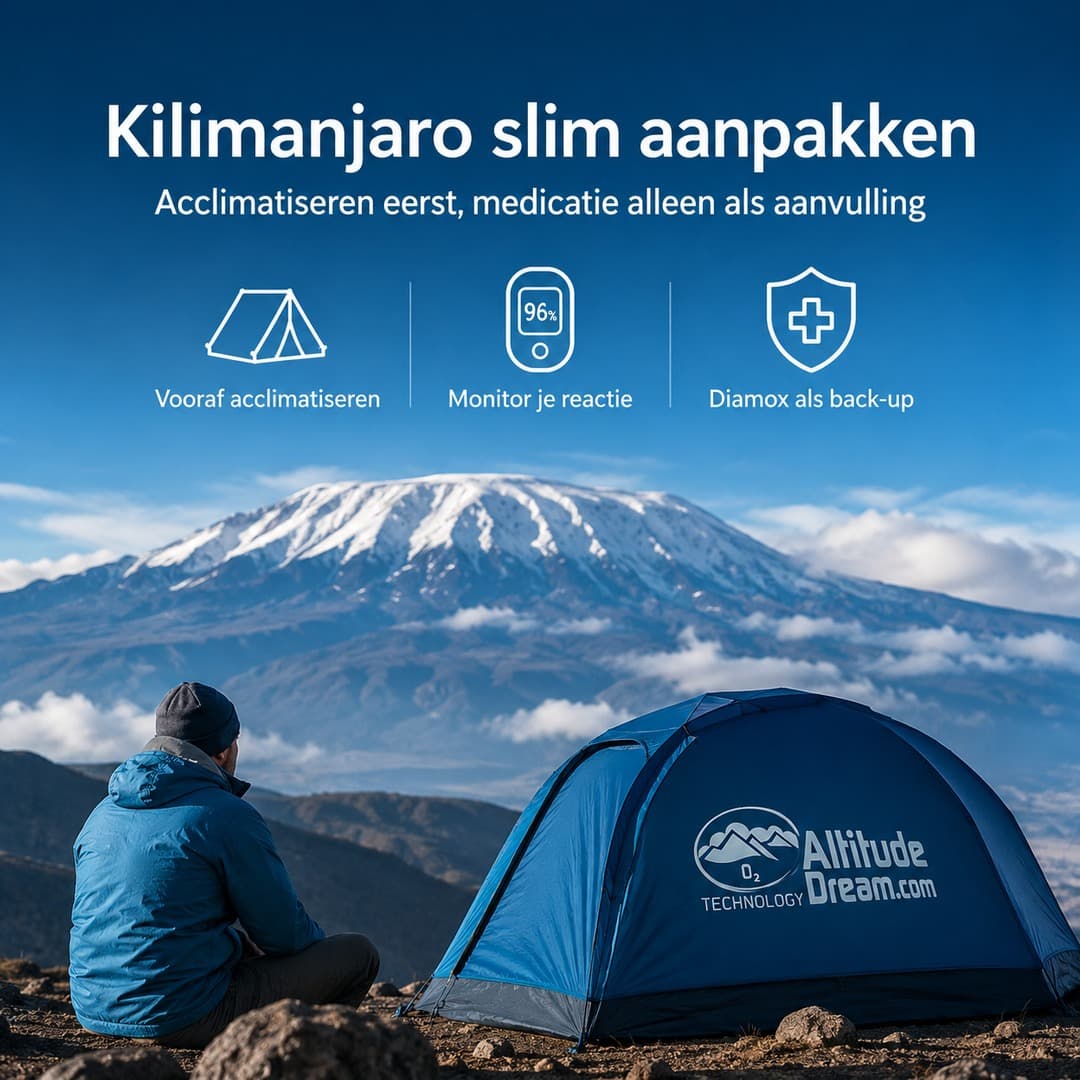
Kilimanjaro with or without Diamox is one of the most frequently asked questions during preparation for a climb. The honest answer is: Diamox can help, but it is not the basis of a safe Kilimanjaro strategy. The basis remains a quiet route, smart pacing, good monitoring, and above all, sleeping in a height tent beforehand. This makes acclimatisation more controlled, measurable and planable. Therefore, for many well-prepared climbers, Diamox is usually not needed as a standard measure, but rather as medical backup that you discuss with a doctor beforehand.
Kilimanjaro is not a technical mountain, but physiologically it is serious. You ascend from lowlands to Uhuru Peak at 5,895 metres in a few days. That is precisely why acclimatising at home for mountain expeditions is so valuable. Your body receives an oxygen stimulus even before departure, while you are still sleeping safely at home, eating normally and your reaction can be measured.
Short answer: Do not climb Kilimanjaro with the idea that Diamox replaces preparation. Opt first for a longer route, sleep in a high-altitude tent for several weeks beforehand, and monitor your SpO2 trend, sleep, and symptoms. Diamox can be beneficial for increased risk, previous altitude sickness, a shorter route, or medical indication, but always discuss this with a doctor.
Conclusion: For Kilimanjaro, pre-acclimatisation is more important than standard Diamox use.
Nuance: Diamox can reduce symptoms, but it does not replace route choice, pace, or acclimatisation.
Practical hook: Sleeping well in a altitude tent beforehand significantly reduces the chance of altitude sickness.
Kilimanjaro with or without Diamox: the short conclusion
The choice of whether to take Diamox for Kilimanjaro should not start with medication. The first question is: how much acclimatisation does your body get before and during the climb?
The order that guides usually follow
Experienced guides usually look at the same three factors. Firstly: which route do you choose? Secondly: how quickly do you ascend? And thirdly: how do you react to the altitude in the first few days? Diamox only comes into play after that. That makes sense. Acetazolamide, the active ingredient in Diamox, can speed up the acclimatisation process. However, it doesn't change the fact that your body needs time to adjust to lower oxygen availability.
On Kilimanjaro, the pace is particularly treacherous. Many travellers land at a relatively low altitude, start hiking quickly, and within a short time, are sleeping above 3,000 metres. Then comes summit night, where you ascend from around 4,600 to 4,800 metres to 5,895 metres and then descend again. That is a severe challenge, even for fit people.
In practice: Fitness does not automatically protect against altitude sickness. A good level of fitness helps you to walk, recover and stay warm. However, susceptibility to altitude is primarily related to individual response, ascent profile, sleeping altitude and previous exposure to altitude.
Why Kilimanjaro so often leads to altitude sickness
Kilimanjaro is sometimes marketed as an accessible trek. That's technically true, but not physiologically. The mountain is almost 5,900 metres high. Furthermore, the climb starts from a relatively low-lying environment. As a result, your body often misses out on the gradual acclimatisation you sometimes get in the Alps, Andes or Himalayas.
The real problem is the gradient
The greatest risk lies not only in the altitude of the summit. It is mainly in the combination of limited time, multiple nights above 3,000 metres, a short recovery period and a long summit night. Therefore, Kilimanjaro route and acclimatisation So important. A longer route gives your body more opportunities to react, adjust, and build up ventilation.
What Kilimanjaro data shows
Research on Kilimanjaro shows high percentages of acute mountain sickness, especially on shorter routes. In a well-known study of trekkers on the Marangu route, a large proportion of participants developed symptoms of AMS. Acetazolamide showed benefit, especially in climbers with a slightly slower profile. Therefore, the main lesson is not: always take Diamox. The lesson is: do not make the climb dependent on Diamox.
| Factor | What it means | Practical conclusion |
|---|---|---|
| Route | Shorter routes give less time to acclimatise. | Prefer 7 or 8 days over 5 or 6 days. |
| Preparation | Pre-sleep hypoxia provides a controlled oxygen stimulus. | Ideally, start a few weeks before departure with a height tent. |
| Diamox | Can support acclimatisation, but does not mask a poor ascent profile. | See it as a medical aid, not a primary strategy. |
| Monitoring | Trends in complaints, sleep, and SpO2 provide direction. | Look for a pattern, not a single measurement. |
What it means: Shorter routes give less time to acclimatise.
Practical conclusion: Prefer 7 or 8 days over 5 or 6 days.
What it means: Pre-sleep hypoxia provides a controlled oxygen stimulus.
Practical conclusion: Ideally, start a few weeks before departure with a height tent.
What it means: Can support acclimatisation, but does not mask a poor ascent profile.
Practical conclusion: See it as a medical aid, not a primary strategy.
What it means: Trends in complaints, sleep, and SpO2 provide direction.
Practical conclusion: Look for a pattern, not a single measurement.
What Diamox does and what it doesn't do
Diamox is the brand name for acetazolamide. The medicine stimulates breathing by creating a mild metabolic stimulus. This can help your body acclimatise to altitude more quickly. Simply put: you will breathe a bit more actively, especially during sleep. This can improve your oxygen uptake.
Why this can be useful
The effect might be relevant on Kilimanjaro, as the ascent is relatively fast. Nevertheless, Diamox has clear limitations. It does not make you immune to altitude sickness. Nor does it provide strong legs, a better sleep routine, or a safer summit night. Moreover, it can cause side effects, such as tingling, more frequent urination, stomach problems, or an altered taste for carbonated drinks.
Anyone who wants to know more about dosage, timing and the difference between 125 mg and 250 mg can delve into the Diamox Dosage Protocol. In this article, we are consciously focusing on Kilimanjaro: when does Diamox fit into the overall strategy and when is pre-acclimatisation the smarter first step?
Diamox versus altitude tent: not competitors, but different functions
An altitude tent Your body is given repeated nights with less oxygen before departure. This makes the poke predictable, measurable, and gradual. You can build up calmly and adjust based on your reaction.
Diamox is medical support. It can be useful with an increased risk or limited acclimatisation time, but should not be the first line of defence if you still have weeks of preparation time.
Why sleeping in a high-altitude tent beforehand is so important
With an altitude tent, you lower the oxygen percentage around your sleeping environment. The air pressure remains normal. This is called normobaric hypoxia. This is interesting for Kilimanjaro, because your body repeatedly learns to cope with less available oxygen, without you already being on your travels.
The power lies in repetition
One night helps little. Several weeks give your body time to gradually adjust ventilation, sleep response, and oxygen transport. As a result, you won't set off completely unprepared for the first nights at altitude.
For Kilimanjaro, this is practically strong. You can train, work and recover as normal in the Netherlands or Belgium, while receiving a controlled altitude stimulus at night. This means you don't have to spend an extra week in the Alps, Mount Meru or another acclimatisation spot first. You can, of course, but it's not feasible for everyone.
What the altitude tent does and does not promise
An altitude tent is no substitute for acclimatisation on the mountain. However, it does make the process controlled, measurable and predictable. It can significantly reduce the risk of altitude sickness, but offers no 100% guarantee. That is why it remains essential to listen carefully to your guide and your body.
Practical approach to Kilimanjaro
Phase 1: Start gently. Let your body get used to sleeping with less oxygen. The first few nights are all about tolerance, sleep quality, and acclimatisation.
Phase 2: Build up gradually. Increase the simulated altitude step-by-step, based on sleep, morning feeling and SpO2 trend.
Phase 3: Stabilize. In the final phase, you don't want to create unnecessary stress. The goal is a fresh start, not to arrive exhausted.
Kilimanjaro with or without Diamox: decision rules per profile
The best choice depends on your profile. Someone who has previously suffered from altitude sickness at 3,500 metres, takes a shorter route, and does not undertake pre-acclimatisation, falls into a different category than someone who sleeps in a high-altitude tent for 4 weeks beforehand and chooses an 8-day route.
| Profile | Risk assessment | Logical strategy |
|---|---|---|
| Well prepared | Longer route, altitude tent beforehand, no previous altitude sickness. | Diamox often not standardly needed, but should be discussed as a back-up. |
| Medium risk | Limited experience, 6 or 7 days, unsure about reaction to altitude. | Altitude tent strongly recommended, discuss Diamox with doctor. |
| Increased risk | Previous AMS, faster route, little preparation or medical factors. | Consult arts, Diamox often more logical as part of the plan. |
| Complaints on the mountain | Headache with nausea, dizziness, or clear deterioration. | Do not ascend further, inform guide, follow medical protocol. |
Risk assessment Longer route, altitude tent beforehand, no previous altitude sickness.
Logical strategy Diamox often not standardly needed, but should be discussed as a back-up.
Risk assessment Limited experience, 6 or 7 days, unsure about reaction to altitude.
Logical strategy Altitude tent strongly recommended, discuss Diamox with doctor.
Risk assessment Previous AMS, faster route, little preparation or medical factors.
Logical strategy Consult arts, Diamox often more logical as part of the plan.
Risk assessment Headache with nausea, dizziness, or clear deterioration.
Logical strategy Do not ascend further, inform guide, follow medical protocol.
How guides look at this choice
This is precisely what experienced guides pay close attention to. They don't just look at whether you have a pill with you. They monitor your pace, appetite, mental clarity, sleep, headaches, stride, and recovery. A good guide primarily wants to prevent you from pushing on for too long while your symptoms worsen.
When Diamox becomes logical again
Diamox is more likely to be considered if you've previously had clear symptoms of altitude sickness, if your route is short, if you haven't done any pre-acclimatisation, if you quickly develop symptoms above 3,500 metres, or if a doctor advises it based on your medical profile.
The choice of route determines more than many travellers think.
For Kilimanjaro, the route is often more important than whether you take Diamox. A longer route gives your body more time. It also gives guides more room to assess your reaction. For this reason, many experienced guides prefer to opt for 7 or 8 days rather than a shorter programme.
Waarom langer meestal slimmer is
The Lemosho route and longer Machame variants are popular because they often better fit the “climb high, sleep low” principle. Your body gets a higher stimulus during the day while you sleep at a lower altitude. This aids acclimatisation. However, summit night remains tough, even with a good route.
An altitude tent beforehand means you don't start acclimatising to oxygen deprivation on the mountain itself. This is especially valuable for travellers from the Netherlands or Belgium who have little natural altitude exposure. You will then arrive at the foot of the mountain with a better starting position.
This is how you monitor this lens
Monitoring must remain practical. A pulse oximeter is not a magic solution. Nevertheless, it can be useful for tracking trends. This is particularly valuable in an altitude tent, as you are taking measurements under controlled conditions.
Always measure the trend, not one value.
Ideally, measure your SpO2 at fixed times. For example, in the morning after waking up, while resting, with warm hands and without haste. Do not focus on a single value. Above all, assess the pattern over multiple days. Combine this with sleep quality, feeling of rest, headaches, appetite, and recovery.
For practical interpretation of measurements, you can delve into saturation in the altitude tent. The most important thing remains: SpO2 is a trend instrument, not a licence to ignore symptoms.
Objective signals to follow
- SpO2 trend: Does it decrease extremely or does it recover slowly with adaptation?
- Sleep quality: Do you repeatedly wake up, or are you sleeping more stably?
- Morning feeling: Are you feeling bright and alert, or rather heavy and headachey?
- Recovery: Does your energy level stay normal during the day, or does fatigue build up?
- Complaints: Please pay particular attention to headaches in combination with nausea, dizziness, or loss of appetite.
The same logic applies on the mountain, but with more caution. Low SpO2 can occur at altitude. A declining trend combined with increasing symptoms is more relevant than a single measurement. If symptoms worsen, continuing to ascend is unwise. Then the guide's judgment and the medical protocol carry more weight than summit ambition.
Common misunderstandings about Diamox on Kilimanjaro
Misconception 1: You don't get altitude sickness with Diamox
That's not correct. Diamox can reduce the chance of AMS and support acclimatisation, but it doesn't guarantee the prevention of altitude sickness. You can still get symptoms with Diamox, especially with rapid ascent, poor sleep, dehydration, infection, or personal sensitivity.
Misunderstanding 2: Elite athletes don't need preparation
That's also not right. Fitness helps you with the exertion of hiking, but altitude sickness isn't a test of fitness. Many fit people go too fast because they feel strong. As a result, they ignore subtle signs in the first few days.
Misunderstanding 3: a hypoxia tent is only for extreme expeditions
Indeed, Kilimanjaro is a logical application. The mountain is high, the travel duration is limited, and many travellers have little previous altitude experience. Sleeping in a height tent beforehand makes the preparation concrete and measurable.
Misunderstanding 4: if you take Diamox, you don't need to monitor
This is dangerous. Medication does not change the basic rule: take symptoms seriously. Headaches with nausea, dizziness, loss of coordination, extreme fatigue or shortness of breath require action. Not just carrying on regardless.
Practical approach for Kilimanjaro
A strong Kilimanjaro approach begins 4 to 6 weeks before departure. You don't need to do everything perfectly. But you want to avoid the big mistakes: starting too late, choosing too short a route, not using monitoring, and seeing Diamox as a replacement for acclimatisation.
Outline preparation protocol
4 to 6 weeks in advance: Plan your route, check your medical history, and discuss medication with a doctor if you've had altitude sickness before.
3 to 5 weeks in advance: Start sleeping in a height tent and gradually build up based on sleep, recovery, and SpO2 trend.
Last week: Stabilise. Avoid aggressive build-up, sleep deprivation, and heavy training stimuli. Starting fresh is more important than providing any extra stimulation.
On the mountain Pace yourself, eat consistently, avoid alcohol, discuss issues early and follow your guide's judgment.
The combination that's usually strongest
If you want to seriously prepare for Kilimanjaro, the combination is usually clear: choose a longer route, sleep in a hyperbaric chamber beforehand, bring a pulse oximeter, discuss Diamox with a doctor, and make prior arrangements about when not to ascend further.
Reality check: Diamox can be a useful tool, but it should never be a reason to accept an overly aggressive route or poor preparation. The best preparation lowers the risk before you even take your first step on the mountain.
When you need to be extra careful
Extra caution is advisable if you have previously suffered from altitude sickness, are sleep-deprived, have recently been ill, have asthma or other respiratory ailments, have sleep apnoea, or are taking medication that affects breathing, fluid balance, or recovery. In these cases, personalised medical advice is important.
Do not test medication for the first time on the mountain
Even if you're unsure about Diamox, the following applies: don't try it for the first time on the mountain without consultation. Discuss with a doctor whether the medication is suitable for you, what dosage is appropriate, and when you should start or stop. This is particularly important for allergies, kidney problems, pregnancy, complex medication, or previous side effects.
For most healthy travellers, the core remains simpler. Prepare your body for less oxygen. Don't choose an unnecessarily short route. Monitor trends. And consider Diamox a tool to enhance your plan, not the plan itself.
Sources and medical context
This article is based on general high-altitude medical guidelines and Kilimanjaro-specific research data. Key references include the CDC Yellow Book on high-altitude travel, the Wilderness Medical Society 2024 altitude summary, and Kilimanjaro research on acute mountain sickness and summit success.
Preparing Kilimanjaro with more certainty
Going to Kilimanjaro and don't want to rely solely on Diamox? With a high-altitude tent, you can acclimatise to less oxygen in a controlled way beforehand, measure your response, and start the mountain with more confidence.
Conclusion: acclimatise first, then medication as a supplement.
The question is not simply: Kilimanjaro with or without Diamox? The better question is: how strong is your total acclimatisation plan?
If you choose a longer route, sleep in a hyperbaric chamber for several weeks beforehand, monitor your SpO2 trend, and take symptoms seriously, you significantly reduce the chance of altitude sickness. In this scenario, Diamox is usually not a standard necessity for many climbers. However, it can be wise to discuss it with your doctor as a backup, especially if you have had previous symptoms or have an increased risk profile.
Those who want to tackle Kilimanjaro properly, therefore, do not start with medication. They start with preparation. Because at 5,895 metres, it's not the most hurried climber who wins, but the one who has allowed their body to acclimatise in good time.
Frequently asked questions about Kilimanjaro and Diamox
Do I need to take Diamox for Kilimanjaro?
Not automatically. Diamox can be useful with increased risk, previous altitude sickness, or a shorter route. With good pre-acclimatisation using a height tent and a longer route, it is often primarily a backup to discuss with your doctor.
Is a height tent better than Diamox?
These are different methods. An altitude tent trains your body beforehand with a controlled oxygen stimulus. Diamox is medication that can support acclimatisation. For Kilimanjaro, acclimatising to altitude beforehand is usually the more logical basis.
I can't prevent altitude sickness entirely with a **hypoxic tent**.
No. An altitude tent can significantly reduce the risk of altitude sickness, but it does not offer a 100% guarantee. Route choice, pace, sleep, recovery, hydration and listening to guides remain important.
When should I discuss Diamox with a doctor?
Definitely discuss Diamox if you have previously had altitude sickness, are undertaking a short route, have any medical conditions, are concerned about side effects, or have limited time for acclimatisation beforehand.
Wat is belangrijker op Kilimanjaro: de route of medicatie?
Route and acclimatisation are more important than medication. Diamox can help, but raising your altitude too quickly remains a risk. A longer route and pre-acclimatisation give your body more time.