Diamox dosage protocol: 125 mg vs 250 mg for trekking, skiing and expeditions
Published 11 May 2026 · 14 min read
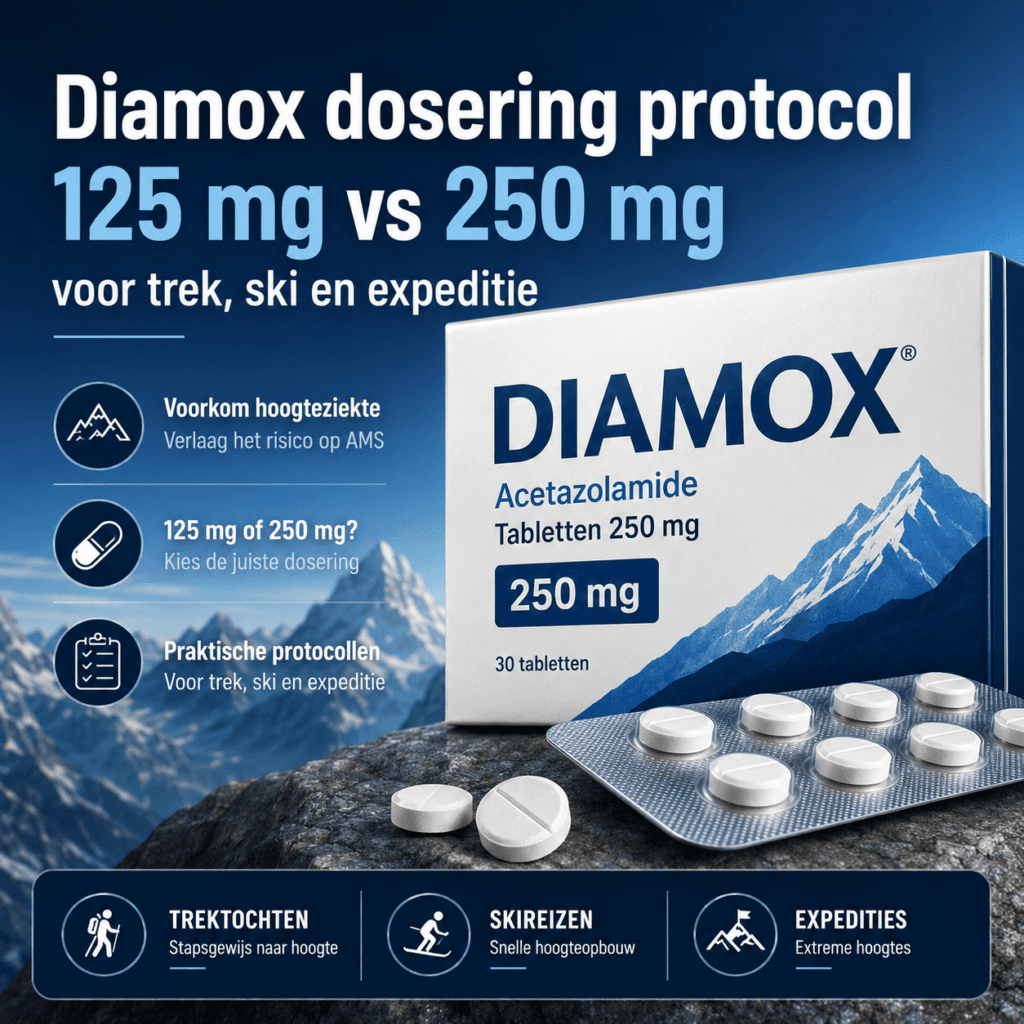
A good Diamox dosage protocol It's not about whether 125 mg or 250 mg is stronger. It's about your risk: how quickly you ascend, the altitude at which you sleep, how you've reacted to altitude previously, and how far you are from medical help. General guidelines often mention 125 mg twice a day primarily for prevention. The 250 mg twice-a-day dose is more commonly cited for treating acute altitude sickness, or in specific high-risk situations under medical supervision.
This makes Diamox no standard solution for every trek, ski holiday, or expedition. It's a tool within a larger plan: ascend slowly, take sufficient acclimatisation days, recognise symptoms and monitor objectively. Therefore, those who wish to prepare well do not start with medication alone, but with preventing altitude sickness as a total strategy.
Short answer: When used preventatively, guidelines usually mention 125 mg of acetazolamide twice a day, often starting the day before rapid ascent. 250 mg twice a day is more commonly used for treating acute altitude sickness, or sometimes for high-risk profiles. Only use Diamox after consulting a doctor or travel clinic.
Conclusion: 125 mg twice daily is usually the preventative starting point.
Nuance: 250 mg does not automatically mean better prevention and more frequently causes side effects.
Practical hook: choose the protocol based on the ascent profile, previous complaints and medical context.
Diamox dosage protocol: what's the choice really about?
Diamox is the brand name for acetazolamide. The medication affects the acid-base balance and thereby stimulates respiration. At altitude, this can help to acclimatise faster, especially during the night. Nevertheless, it is important to put the role of Diamox in proper perspective. The medication does not replace a gradual ascent profile, a rest day, or a descent in case of clear warning signs.
In practice, a lot of confusion arises because travellers talk about “half a tablet” or “a whole tablet”. Many tablets contain 250 mg. Therefore, 125 mg often equates to half a tablet and 250 mg to a whole tablet. But the medical question is not how much of a tablet you take. The real question is: are you using it preventatively, reactively, or as part of a treatment plan for symptoms?
Those who wish to learn more about the workings, timing, and context of acetazolamide can also refer to our guide on Diamox for altitude sickness. This article deals more specifically with the dosing logic and the decision-making framework per scenario.
Medical reality check: This article is intended as an educational framework, not as personal advice. Acetazolamide is medication. Discuss its use beforehand with your GP, pharmacist, sports doctor, or travel clinic, especially if you are pregnant, have kidney problems, liver problems, a history of severe allergies, diabetes, sleep apnoea, heart rhythm disorders, or are taking other medication.
125 mg versus 250 mg: the practical difference
The most useful way to compare 125 mg and 250 mg is not “low” versus “high.” It's better to consider prevention versus treatment. In prevention, you want to support the body's acclimatisation with as few side effects as possible. Treatment pertains to symptoms that are already present. The context is different then, and it should be accompanied by a clearer medical plan.
| Dose | Usual context | Practical significance | Important nuance |
|---|---|---|---|
| 125 mg twice a day | Prevention for increased risk | Helps with acclimatisation, usually with fewer side effects | No free pass for climbing faster |
| 250 mg twice a day | Treatment of acute altitude sickness or specific high-risk context | More focused on complaints that have already arisen | Always link to rest, evaluation and, if necessary, descent. |
| No Diamox | Low risk and good growth potential | Quiet route, acclimatisation days and monitoring remain leading | Ensure you have a plan for dealing with any issues on the go. |
Context: Prevention in case of increased risk.
Significance: supports acclimatisation with usually fewer side effects.
Nuance: no free pass to rise faster.
Context: treatment of acute altitude sickness or specific high-risk context.
Significance: more focused on complaints that have already arisen.
Nuance: Always link to rest, evaluation and, if necessary, descent.
Context: low risk and good growth potential.
Significance: route, acclimatisation days and monitoring remain paramount.
Nuance: Take a plan for dealing with problems encountered on the journey.
An important point: more is not automatically better. A higher dose can lead to more tingling, taste changes, stomach upset, more urination, or fatigue. Therefore, 125mg twice a day is often seen as a logical preventive starting point. The goal is not to suppress every symptom, but to support your acclimatisation process.
Protocol for situation: trekking, skiing and expedition
The correct Diamox dosage protocol is highly dependent on the type of trip. A slow mountain trek in the Alps is different from flying to La Paz, skiing at 3,000 metres, or an expedition with camps above 5,000 metres. Below is a practical framework to make your discussion with your doctor or travel clinic more concrete.
| Scenario | Typical risk | Decision-making frameworks | What you discuss beforehand |
|---|---|---|---|
| Trek | Climbing for several days, often sleeping above 3,000 metres | Prevention is especially to be considered with a fast route, earlier AMS or few rest days | Start time, stop time, complaint plan and descent |
| Skiing | Rapid ascent to altitude, cold, exertion, and sometimes alcohol | First, look at the route, rest day and sleeping altitude. Medication is not a solution for overexertion. | Side effects, driving, alcohol, sleep and building up exercise |
| Expedition | High sleeping altitudes, rotations, summit push, and limited medical assistance | Agree protocol in advance with doctor, guide or expedition doctor | Prevention, emergency medication, oxygen plan, descent and team communication |
Risk: multiple days of ascent, often sleeping above 3,000 metres.
Decision-making frameworks Prevention should be primarily considered with a fast route, previous AMS or few rest days.
Discuss in advance: startmoment, stopmoment, klachtenplan en afdaling.
Risk: Rapid ascent to altitude, cold, exertion and sometimes alcohol.
Decision-making frameworks First, check the route, rest day and sleeping elevation.
Discuss in advance: Side effects, driving, alcohol, sleep and building up exertion.
Risk: high sleeping altitudes, rotations, summit push and limited medical aid.
Decision-making frameworks Arrange protocol with doctor, guide, or expedition doctor in advance.
Discuss in advance: prevention, emergency medication, oxygen protocol, descent and team communication.
Trek: when 125 mg makes more sense than 250 mg
When trekking, it's generally about prevention. Consider routes where you sleep above 3,000 metres within a short period, or where the route leaves little room for extra acclimatisation days. In such cases, a preventive approach of 125 mg twice daily is often closer to the guidelines than directly opting for 250 mg.
However, the route remains paramount. An extra rest day can sometimes provide more safety than medication. This is especially true for routes where you have influence over daily distances and sleeping altitude. Medication can help, but should never be the reason to push through a bad schedule.
Skiing: the underestimated height risk
When skiing, the problem often arises differently. You fly or drive quickly to a high-altitude ski resort, sleep immediately at altitude, and then engage in intensive activity the next morning. Add cold, dry air, moderate sleep, and après-ski, and the risk quickly becomes greater than many people expect.
A Diamox dosage protocol for skiing therefore begins with behavioural choices. Take it easier on the first day. Do not drink alcohol for the first 48 hours. Build up exertion. Sleep at a lower altitude than the highest slopes if possible. Only when travelling rapidly to altitude or if you have previously had clear symptoms does preventive medication become a concrete topic of conversation.
Expedition: protocol over improvisation
On expeditions, improvisation is risky. You have to contend with rotations, fixed camps, weather windows, and team pressure. This can lead to a tendency to rationalise ailments. A good protocol prevents this. Record in advance when you will start, when you will stop, which ailments you will take seriously, and when descent becomes mandatory.
At high altitudes, the proof for higher preventive dosages is less strong than many people think. That is precisely why an expedition plan should not just be about milligrammes. It should be about sleeping altitudes, rest days, rotations, oxygen strategy, team observation and decision rules for neurological symptoms.
Common misconceptions about Diamox
Misunderstanding 1: 250 mg prevents altitude sickness better than 125 mg
That is too simple. For prevention, 125 mg twice a day is often used as it provides a good balance between efficacy and tolerability. A higher dose may be discussed in certain situations, but it is not automatically better.
Misunderstanding 2: Diamox masks dangerous symptoms
Diamox aids acclimatisation. However, one can still develop AMS, HAPE or HACE. Headaches, nausea, coordination problems, confusion or shortness of breath at rest remain warning signs. Those who symptoms of altitude sickness Kent makes better decisions on the go.
Misunderstanding 3: Fit people don't need a plan
Fitness does not reliably protect against altitude sickness. A strong runner, skier or climber can still react badly to a rapid ascent. Previous altitude experience and ascent profile usually say more than your VO2 max or training status.
Establishing a safe Diamox dosage protocol
A strong protocol is short, concrete, and discussed in advance. It must be usable when you are tired, sleeping poorly, or feeling peer pressure. Use the structure below as a conversation aid with your doctor, not as a standalone prescription.
Step 1: determine your risk profile
Consider your first sleeping altitude, daily altitude gain, previous altitude sickness, planned rest days, and distance to medical assistance. A route that climbs quickly above 3,000 metres warrants more attention than a gradual ascent with extra nights.
Step 2: Determine the purpose of medication
Do you use Diamox preventatively, or do you only take it as part of a symptom management plan? That choice determines how you talk about 125 mg and 250 mg.
Step 3: Record start and stop
During prevention, it is often started before ascending to a greater altitude. Stopping depends on reaching the highest sleeping altitude, further ascent or descent. Agree this in advance.
Step 4: define alarm signals
Record any complaints that mean you will not be advancing further. Also record when you are descending. This will prevent arguments at a time when clear thinking becomes more difficult.
Step 5: test for prior intolerance
Many travellers discuss with their doctor whether a short trial run beforehand is worthwhile. This way, you won't only notice potential side effects such as tingling, stomach problems, altered taste, or unusually frequent urination when you are in the mountains.
This is how you monitor this lens
A protocol without monitoring remains vulnerable. You don't want to intervene only when someone is clearly ill. At the same time, measurements should not be overestimated. SpO2 in particular is useful as a trend, not as a standalone absolute truth. You can find more context on interpretation in our guide on oxygen saturation at altitude.
| Measuring point | What you are following | Practical interpretation | Decision rule |
|---|---|---|---|
| SpO2 trend | Morning value and drop from yourself | A declining trend in complaints is more relevant than a single isolated value | Do not rise further in case of complaints and clear deterioration |
| Sleep | Sleep duration, waking up, breathing, and recovery feeling | Poor sleep is normal, but worsening with headaches counts. | Consider a rest day as sleep and complaints worsen |
| Symptoms | Headache, nausea, dizziness, appetite, and fatigue | Combinations of symptoms are more important than one mild symptom | No further increase in increasing AMS complaints |
| Neurology | Balance, coordination, confusion and behaviour | Deviations are alarm signals, especially at high altitudes. | Organise transport and medical assistance |
Follow: morning value and fall in relation to yourself.
Interpretation: A downward trend with complaints is more relevant than a single value.
Decision rule: do not increase further in case of complaints and clear deterioration.
Follow: Sleep duration, waking up, breathing and recovery feeling.
Interpretation: Poor sleep is normal, but worsening with headaches counts.
Decision rule: Consider a rest day if sleep and symptoms worsen together.
Follow: Headache, nausea, dizziness, appetite and fatigue.
Interpretation: Combinations of symptoms are more important than a single mild symptom.
Decision rule: no further increase with increasing AMS complaints.
Follow: Balance, coordination, confusion and behaviour.
Interpretation: Deviations are alarm signals, especially at high altitudes.
Decision rule: organise adequate medical assistance.
Monitoring also requires honesty. If you're taking Diamox and feel better, it doesn't automatically mean you're fully acclimatised. Your body can still be vulnerable to further ascent, cold, heavy exertion, and lack of sleep.
When you need to slow down or descend
Do not rise further
Do not ascend further if increasing headache, nausea, dizziness, marked fatigue, poor sleep with worsening or a declining SpO2 trend in combination with symptoms.
Taking rest
Take a rest day if symptoms are mild but don't disappear. Drink normally, eat lightly, avoid alcohol and reassess. Medication should not be an excuse to push through.
Descend
Seek immediate medical attention if you experience confusion, coordination problems, breathlessness at rest, persistent vomiting, extreme drowsiness, blue lips, or a clear deterioration. Do not wait to “see how it is in the morning”.
This is also why a group protocol works better than individual assessment. Agree with your travel companion, guide or team that symptoms will be reported out loud. Altitude can sometimes make people quieter, slower or less critical of their own condition.
Special attention for athletes and skiers
For competitive athletes and controlled athletes, an additional layer comes into play. Acetazolamide is known in the anti-doping context as a diuretic and masking agent. Anyone subject to doping rules must check in advance whether a Therapeutic Use Exemption is required before use. This is certainly true for elite athletes, national squads, ski racers, trail runners, cyclists, and triathletes.
For recreational athletes, the most important rule remains: do not use Diamox to train harder at altitude. The aim is to support acclimatisation, not to increase performance pressure. Especially during the first 24 to 48 hours at altitude, moving more slowly remains sensible.
How pre-acclimatisation fits into this decision-making framework
Anyone planning a trek, ski trip, or expedition doesn't need to limit their preparation to medication. In some situations, a high-altitude tent can help to build up the hypoxic stimulus in a controlled, measurable, and planned way beforehand. This involves normobaric hypoxia at home: the oxygen percentage is reduced, not the air pressure.
This approach is no substitute for acclimatisation on the mountain. However, it can help you prepare better for the process. You’ll be able to see sooner how your body reacts to lower oxygen levels, how your sleep patterns change and how your SpO2 levels trend. This can significantly reduce the risk of altitude sickness, without ever offering a 100% guarantee.
When it comes to medical topics, the order is particularly important. First, discuss your route, risk profile, and any medication with a doctor. Then, use pre-acclimatisation as an extra layer in your preparation, not as an excuse to choose too aggressive a climbing profile.
Practical checklist for your doctor or travel clinic
Take your route profile with you: Note down daily sleep height, maximum altitude, rest days, and distance to medical assistance.
Tell me about your previous high-altitude experience: especially previous headaches, nausea, poor sleep, HAPE, HACE or forced descent.
Discuss your medication and conditions: Think about kidney problems, liver problems, diabetes, sleep apnoea, allergies, blood pressure medication and sports regulations.
Ask to start and stop: Set down when you start, when you stop, and what you do for missed doses or side effects.
Make a complaints plan Determine in advance when you will rest, stop climbing, descend, or seek medical help.
A good conversation with a doctor often takes less time when you have this information clearly prepared beforehand. This shifts the question from “May I have Diamox?” to “Which plan suits my route and my risk?”. This usually leads to better decisions.
FAQ about diamox dosage protocol
What is the standard preventative Diamox dosage?
Many guidelines mention 125 mg of acetazolamide twice a day as a preventative dose for adults. This should always be medically discussed in relation to your specific situation.
250 mg Diamox word gebruik vir die behandeling van 'n verskeidenheid van toestande wat insluit glaukoom, epilepsie en braking in verhouding met hoogte siekte.
250 mg twice a day is more often used for the treatment of acute altitude sickness, or in specific high-risk contexts. It is not automatically the best preventive choice.
Do I need to take Diamox for a skiing holiday?
Not standard. It depends on your sleeping altitude, speed of arrival, previous complaints, planned exertion, and medical background.
Can Diamox completely prevent altitude sickness?
No. Diamox can support acclimatisation and lower risk, but it does not guarantee the prevention of altitude sickness. Route, rest, monitoring and descent remain essential.
May I use Diamox as a competitive athlete?
Only after checking doping regulations and, if necessary, with a valid TUE. Acetazolamide is relevant within the doping context.
Prepare your altitude plan more broadly than medication alone
Diamox can play a role, but your preparation hinges on route selection, monitoring, sleeping altitude and acclimatisation. If you want to get used to lower oxygen availability in a controlled manner beforehand, consider how acclimatising at home fits into your overall plan.
See how acclimatising at home for a mountain expedition works
Conclusion: don't choose a dose, choose a protocol
The choice between 125 mg and 250 mg of Diamox is not a simple power struggle. In a responsible Diamox dosing protocol, 125 mg twice a day mainly plays a preventative role. 250 mg twice a day is more often used for the treatment of acute altitude sickness, or in specific situations that you discuss with a doctor beforehand.
For trekkers, skiers, and expedition climbers, the same hierarchy applies: first a sensible ascent profile, then objective monitoring, then a clear plan for dealing with problems, and only then medication as an additional layer. Those who respect this order make better choices at altitude.
Medical editorial context: The dosage line in this article is aligned with current guidelines regarding acetazolamide for acute mountain sickness, including the CDC Yellow Book, Wilderness Medical Society, and TravelHealthPro. Anti-doping control is necessary for competitive athletes. Always consult a doctor for personal use.