Altitude training and acclimatisation: how your body adapts to altitude
Published 14 August 2012 · 6 min read
Altitude training acclimatisation revolves around 1 thing: preparing your body for less available oxygen so that you function better at altitude. Whether you go trekking above 3,000 metres, want to reach a summit above 5,000 metres or want to perform smarter as an endurance athlete, acclimatisation often determines whether your trip or race goes smoothly.
This article gives you a practical and medically based overview: what exactly happens in your body, what approach works, what mistakes to avoid and how to support this process in a controlled way at home. Want to know immediately what altitude does to oxygen? Then also check out the height-to-oxygen table.
The essentials in 30 seconds
- At altitude, oxygen in the air remains around 20.9%, but air pressure drops, so you take in less oxygen per breath.
- Acclimatization is the natural adaptation process (faster breathing, better oxygen uptake, more red blood cells).
- Height training is a way to stimulate that adaptation in advance, for example with a high altitude tent (normobare hypoxia).
- Rising calmly and sleeping well are at least as important as persevering.
- For true altitude safety, on-site acclimatisation remains necessary. Height training makes the process controlled, measurable and planable, significantly lowers your risk, but does not guarantee 100%.
Why height feels so heavy
The air contains roughly the same amount of oxygen at all altitudes (around 20.9%). Yet breathing at altitude feels heavier. This is because air pressure decreases: there are fewer oxygen molecules in each breath. As a result, oxygen pressure drops in your lungs and eventually in your blood.
From about 2,000 to 2,500 metres, many people notice it for the first time, especially on exertion and during sleep. Typical early signs:
- faster out of breath at a pace that normally feels easy
- higher resting heart rate
- lighter or restless sleep
- faster fatigue and less recovery
What is acclimatisation?
Acclimatization is your body's natural adaptation to altitude. Your system tries to get the same amount of oxygen to your muscles and organs, despite the lower oxygen pressure. This happens in stages, and those stages take time.
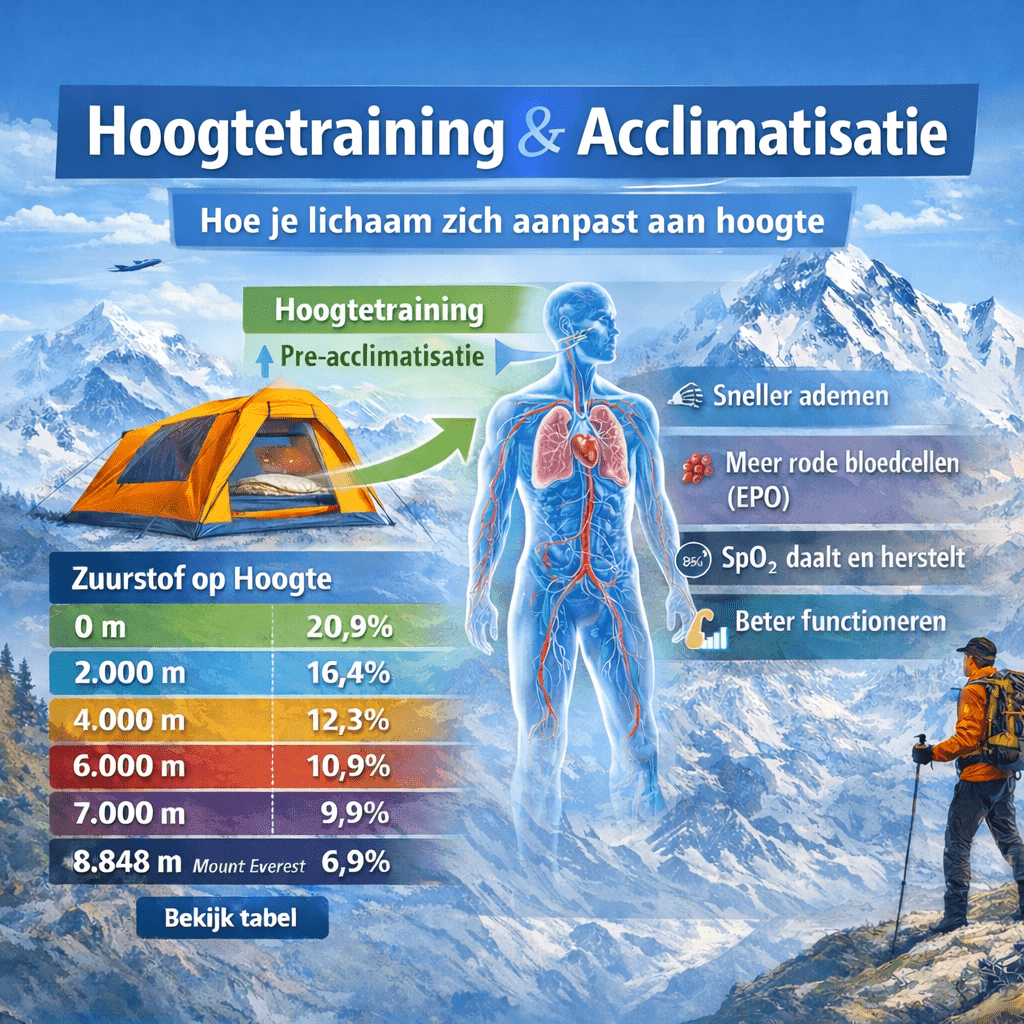
Stage 1: faster breathing (hours to days)
Your breathing frequency and breathing depth increase. This is a quick, immediate reaction to take in more oxygen. Many people also notice this at night: your breathing becomes more restless and your sleep may become more shallow.
Phase 2: more efficient oxygen transport (days to weeks)
After a few days, EPO (erythropoetin) plays a role in the production of red blood cells. This allows your blood to carry more oxygen. At the same time, other systems adapt, such as the distribution of blood flow and oxygen delivery in tissues.
Phase 3: better functioning at altitude (weeks)
With enough time, your tolerance improves: exertion feels less strenuous, your recovery stabilises and your sleep can improve. This is the zone where you notice the difference between “surviving” and “performing” at altitude.
What is altitude training?
Height training is the deliberate exposure of your body to low-oxygen air to encourage acclimatisation. This can be done at natural altitude or at home via simulated altitude.
- Natural height: hypobaric hypoxia (lower air pressure).
- Altitude tent: normobaric hypoxia (air pressure equal, oxygen percentage down).
Want to know practically which height setting suits your purpose? Then read: how to choose the right height in your altitude tent.
Sleep high, train low: why this works
A proven sports strategy is sleep high, train low. You sleep in hypoxia (giving your body the adaptation stimulus), but you train at lower altitude (maintaining intensity and quality). This is exactly why sleeping in an altitude tent can be so effective: you combine adaptation with normal training.
Pre-acclimatisation for trekkers and expedition climbers
For trips to 3,500 to 6,500 metres, it is pre-acclimatisation often the biggest difference between an enjoyable trip and a fight against complaints. Especially if your travel schedule allows for few rest days or if you ascend relatively quickly, preparing at home makes sense.
For the full framework around risk and approach, you can also read: Preventing altitude sickness: rent, buy or apply?
Oxygen percentage by altitude
This section often ranks highly in Google because people search for terms such as oxygen at 6000 metres, oxygen at 7000 metres and oxygen level everest. Important to understand clearly: the oxygen percentage in air remains around 20.9%, but lower air pressure reduces the effective oxygen availability. The values below are practical guide values (equivalent oxygen percentage).
Source for these guideline values: height-to-oxygen table.
| Height | Effective oxygen (%) | What you usually notice |
|---|---|---|
| 0 m | 20,9% | Sea level |
| 1,000 metres | 18,6% | Faster out of breath at pace |
| 2,000 metres | 16,4% | Start acclimatisation, recovery slightly slower |
| 2,500 metres | 15,3% | Initial sleep effects possible |
| 3,000 metres | 14,3% | Performance drops noticeably |
| 4,000 metres | 12,3% | Risk of altitude sickness during rapid ascent |
| 5,000 metres | 10,9% | Heavy exertion becomes difficult |
| 6,000 metres | 9,9% | High load, recovery and sleep under pressure |
| 7,000 m | 8,9% | Extremely difficult conditions |
| 8,000 m | 7,9% | Death zone begins |
| 8,800 metres | 6,9% | Mount Everest, extreme |
Want all values per 500 metres including additional explanations and examples? Go to the complete height-to-oxygen table.
When does the risk of altitude sickness increase?
The risk of symptoms increases the higher you get, the faster you climb and the more tired you are. Altitude sickness is not a sign of weakness, but a signal that your body is not keeping up with the speed. Symptoms of AMS (acute mountain sickness) often include:
- headache
- nausea
- dizziness
- poor sleep
Want to better interpret SpO2 values by altitude zone? Then read: oxygen saturation at altitude: values and interpretation.
Altitude training acclimatisation in practice
This is where things often go wrong: people want too high too soon. Whereas an achievable stimulus that you can sustain almost always works better than an extreme stimulus that wrecks your sleep.
Practical principle 1: build up slowly
Start conservatively. If you sleep in an altitude tent, 4 to 6 weeks with a gentle build-up often works better than short, aggressive blocks.
Practical principle 2: steer towards recovery and sleep
Poor sleep, increased resting heart rate and feeling “wrecked” in the morning are signals to take a step back. In altitude training, consistency always wins over ego.
Practical principle 3: measure trends, not just 1 value
SpO2 is especially useful as a trend: how does your value develop over days, and how do you feel about it? Combine this with resting heart rate and subjective recovery.
For whom is altitude training acclimatisation of interest?
- Trekkers and shippers who travel to 3,500m or higher.
- Endurance athletes who want an extra adaptation boost without losing training quality.
- People with little time at destination who cannot acclimatise for days.
Want to know whether renting or buying makes more sense for your situation? Read: buy or rent a high altitude tent.
Frequently asked questions about altitude training acclimatisation
From what altitude should you acclimatise?
Many people notice the difference from 2,000 to 2,500 metres. Above 2,500 metres, the risk of complaints increases, especially if you climb quickly.
Can you prevent altitude sickness with altitude training?
A good programme can significantly reduce the risk of altitude sickness, as your body makes adaptations beforehand. Nevertheless, sensible ascents and listening to complaints remain essential. An altitude tent is no substitute for on-site acclimatisation, but it does make the process controlled, measurable and planable.
How long do you need to sleep in an altitude tent for effect?
For many people, 4 to 6 weeks works best, with a gradual build-up. Shorter can give effect, but is usually less stable.
Which is better: high altitude mountaineering or an altitude tent?
Both can work. The advantage of an altitude tent is that you can maintain training intensity at sea level, while still getting the adaptation stimulus via sleep.
Conclusion
Altitude training acclimatisation is the difference between being “always behind the times” and being prepared in a controlled way. If you understand what altitude does to oxygen, build up calmly and take your recovery seriously, you increase your chances of having a strong, safe experience at altitude.
Want to acclimatise at home with guidance?
An altitude tent allows you to get used to altitude in a controlled way beforehand. We help you with a feasible set-up and practical guidance.