
Altitude tent for marathon runners: 6 weeks for a PR
Published 12 March 2026 · 10 min read
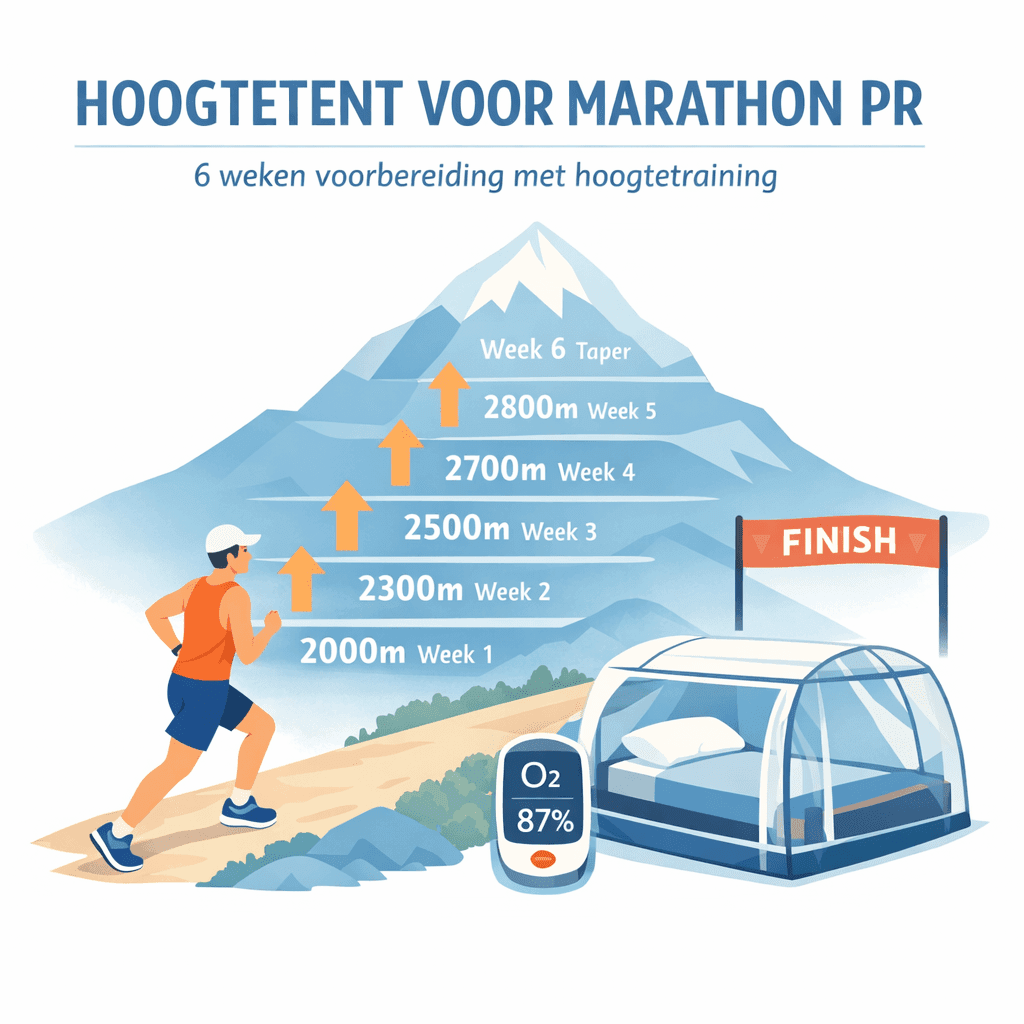
A altitude tent in marathon PR preparation can make the difference between coming up just short and finally running your personal record. For marathon runners, progression is often no longer just about running more miles, but about being smarter about oxygen, recovery and training quality. By sleeping in an altitude tent for 4-6 weeks, you give the body a controlled hypoxic stimulus while continuing to train at normal intensity during the day. This very combination makes an altitude tent interesting for runners seeking serious time improvement without scheduling a full altitude training session.
The gist is simple: you sleep in normobaric hypoxia, which reduces oxygen levels and causes your body to gradually adapt. This can lead to beneficial changes in oxygen transport, efficiency and endurance performance. At the same time, it is not a magic shortcut. Results depend on timing, build-up, sleep quality, iron status and how well you monitor the stimulus. In this article you will read what a 6-week approach looks like, who it works for and how to avoid starting too high, too fast or too chaotic.
The essentials in 30 seconds
- An altitude tent lowers the oxygen percentage, not the air pressure.
- For a marathon, 4 to 6 weeks is usually the most practical preparation.
- The best approach is: sleep at altitude, train at normal altitude.
- An altitude marathon PR approach works especially well with runners who already train structurally.
- Success depends on build-up, sleep quality, SpO2 trend and recovery.
- Starting too high or monitoring too little is the most common mistake made.
Why an altitude tent is interesting especially for marathon runners
The marathon is a typical endurance performance that involves oxygen transport, running economy and recovery. Many runners reach a plateau after a few years. They train faithfully, do their tempo runs, build up long endurance runs well, but the big jump in time does not happen. At that point, an additional incentive can become interesting. An altitude tent does not add extra kilometres, but changes the physiological context in which recovery and adaptation take place.
The advantage for marathon runners is that you don't have to choose between altitude stimulus and quality training. With the principle sleep high, train low you sleep in a hypoxic environment and train at normal altitude during the day. This allows you to maintain intensive sessions better than during a traditional altitude training session, where pace and power often drop temporarily.
For a runner aiming for a PR, this is attractive. You don't want to lose training quality in the final weeks towards the marathon, but instead want to make each session as specific as possible. An altitude tent can support that approach, provided you build it up properly and don't use it as an experiment in the last ten days before your race.
How an altitude tent works
A height tent simulates height via normobaric hypoxia. That means air pressure remains the same, but the oxygen percentage in the air is reduced. The effect is similar to sleeping at altitude: your body experiences less available oxygen and responds with adaptations. These adjustments do not happen overnight. Therefore, timing is crucial.
The stimulus arises mainly while sleeping, as you have several hours of continuous exposure. This makes an altitude tent practical for home use. During the day, you can continue to work, train and recover as usual. For many marathon runners, this is the biggest advantage over a training stage in the mountains.
Those who want to better understand the underlying physiology can also read our explanation of how altitude training works. For this article, it is especially important that the incentive remains controlled, measurable and planable.
Altitude marathon PR: why 6 weeks is often ideal
A 6-week block is the best balance between sufficient exposure and practicality for many marathon runners. Shorter than 3 weeks is often too limited to build up clear adaptation. Longer than 6 weeks can work well, but is not always logistically necessary or desirable in practice. Especially towards a peak race, you want to have enough time to build up, allow effects to emerge and tapering in a controlled way in the final phase.
The first 7 to 10 days are mainly about getting used to it. Your sleep may be more restless, your saturation sometimes reacts erratically and some runners feel temporarily heavier in the morning. Only after that, you often see a more stable response. So the real training value of an altitude tent does not arise in the first few nights, but in the weeks after.
For a marathon, this is advantageous because a classic schedule works anyway with a clear build-up towards peak load and taper. An altitude tent fits in well with that. You don't have to change your whole schedule, but add an extra physiological layer to an already structured preparation.
Practical 6-week schedule for marathon runners
The schedule below is a safe and workable basis for many recreational and ambitious marathon runners. Individual tuning remains important, but this reflects the logic of the build-up well.
| Week | Simulated altitude | Goal of the week | Focal point |
|---|---|---|---|
| Week 1 | 2000 m | Habituation to the sleep stimulus | Do not start too high |
| Week 2 | 2200 - 2300 m | Quiet build-up | Tracking sleep quality and SpO2 trend |
| Week 3 | 2400 - 2500 m | Stable adaptation | Maintaining training quality |
| Week 4 | 2500 - 2600 m | Work phase | No unnecessary extra stress |
| Week 5 | 2600 - 2800 m | Peak stimulus | Increase only if recovery remains good |
| Week 6 | 2400 - 2600 m | Taper preserving incentive | Don't force it in the final days |
Exact heights are not a contest in themselves. Higher is not automatically better. For marathon runners, it's all about a useful boost that doesn't undermine your sleep and training. Therefore, a moderate, incremental build-up is usually more effective than starting aggressively at 2800 metres.
What you can realistically expect
The biggest mistake is thinking that an altitude tent will automatically take minutes off your PR in six weeks. It doesn't work that way. An altitude tent reinforces an already good preparation, but does not replace it. The effect tends to be more subtle and consistent: you feel more stable in specific workouts, you can handle long tempo efforts better and you sink back less in the final stages of the marathon.
For runners who already train in a structured way, have their nutrition in order and recover sufficiently, just that little extra difference can be decisive. Not every improvement can be seen immediately in a laboratory test. Sometimes you notice it mainly in the way your marathon pace can be maintained longer or in the fact that you rebound faster after heavy blocks.
Therefore, the best mindset is this: a height tent increases the chances of performance improvement, but only if it is part of a beating whole.
High altitude tent and training quality: here's how to combine smartly
The biggest benefit of an altitude tent for marathon runners lies in the fact that you can basically keep training intensity normal during the day. That doesn't mean you don't have to adjust anything. In the first 7-10 days, it is smart not to stack heavy interval training with sleep deprivation or restless nights. Give your body a chance to adjust first.
After that, you can usually go back to your normal build-up, with, for example:
- 1 long endurance run per week
- 1 marathon-specific tempo training
- 1 qualitative threshold or interval stimulus
- other sessions calm and supportive
On the contrary, what you don't want is to simultaneously start a new nutrition protocol, add extra strength training and increase your altitude gain too quickly. The best approach is simple: keep the rest of your system stable so you can see what the hypoxic stimulus does.
This is how you monitor this lens
An altitude tent works better when you don't just sail by feel. Objective monitoring helps to make adjustments in time and prevents you from jumping to conclusions based on one bad night or one isolated saturation measurement.
1. SpO2 trend
Do not measure your oxygen saturation obsessively, but consistently. Important is the trend, not one isolated number. For example, look at several mornings in a row under similar conditions. If your saturation drops markedly and you continue to feel fine, then this could fit a normal stimulus. If the trend remains unfavourable and sleep or recovery deteriorate at the same time, then switching back is wise.
2. Sleep quality
The sleep stimulus is at the heart of the system. This is precisely why sleep quality should be taken seriously. Pay attention to falling asleep, sleeping through, restlessness, waking up at night and how rested you are in the morning. An altitude tent structurally at the expense of your sleep rarely provides net gains for marathon preparation.
3. Recovery feeling and symptom development
Briefly note daily how your legs feel, how your resting heart rate behaves and whether you experience headaches, unusual fatigue or loss of concentration. Marathon runners often tend to normalise fatigue. This is precisely why a simple daily score helps.
Concrete decision rule
If your sleep quality and sense of recovery continue to deteriorate for 2-3 days and your SpO2 trend also looks unfavourable, do not increase further and temporarily lower the simulated altitude if necessary.
Common mistakes with a high altitude tent for marathon runners
- Starting too high
Those who start out too ambitious right away often sabotage their sleep and thus their entire preparation. - Starting late
Deploying an altitude tent in the last two weeks before a marathon is usually too late for a stable effect. - Not doing any monitoring
Without SpO2 trend and sleep observation, you are steering blind. - Changing too much at once
New shoes, higher training volume, less carbs and an altitude tent at the same time gives noise. - Expecting the tent to do the job
The basis still remains a good marathon schedule.
Who does this work best for?
An altitude tent is particularly interesting for marathon runners who already have a stable training base and are focused on working towards a peak race. Think of runners who train several times a week, can handle their volume and are already pretty close to their current ceiling. For beginners, the biggest gains are usually still easier to make through training structure, nutrition, pacing and recovery.
An altitude tent is also attractive for busier athletes. Not everyone can go to the mountains for two or three weeks. Sleeping at home at altitude makes the incentive practical without having to give up work or family completely.
When a high altitude tent makes less sense
Not every marathon runner needs a high altitude tent at this point. If your sleep is already fragile, your iron status is unclear or your training base remains volatile, it is often wiser to strengthen those foundations first. A high altitude tent makes a good system better, but does not solve an unstable preparation.
Also, experimenting for the first time just before a marathon is usually not a good idea. You see the best results when the tent is part of a plan, not a last-minute guess.
The role of iron and recovery
Any hypoxic stimulus requires recovery capacity. In this, nutrition plays a bigger role than many runners think. Those who structurally get too little energy, sleep badly or are on the verge of iron deficiency get less out of exposure. Therefore, in the weeks before your altitude block, it pays to look not only at your kilometres, but also at recovery quality and nutrition.
For further depth, you can also visit our page on iron and nutrition during altitude training view. Especially with endurance athletes, this is not a detail, but a real prerequisite.
What does practice say in marathon runners?
In practice, we find that marathon runners particularly benefit when the altitude training fits with a clear race calendar. The best results usually occur with one concrete main goal, a tight 6-week period and a calm, consistent build-up. It works less well with runners who want to adjust altitude almost daily or change course each time based on loose measurements.
Consistency wins over perfection here. A slightly more conservative schedule that you keep for six weeks without any problems is almost always stronger than an aggressive schedule that collapses after just 10 days.
Conclusion
A high altitude marathon PR preparation is not hype, but a serious tool for runners seeking their last percentages. Especially for marathon runners, the combination of sleeping at altitude and training at normal altitude is interesting. You maintain training quality, add an extra physiological stimulus and can do the whole approach at home.
The key is not in going as high as possible, but in smart dosing. Those who build up for 4 to 6 weeks, follow sleep and SpO2 trends and embed the tent in a good marathon schedule, increase the chances of a better performance. Not automatically, but arguably smarter preparation.
In addition, read a neutral external explanation on altitude training for additional background.
Want to use an altitude tent towards your marathon?
Do you want to work towards a personal record with a controlled 4-6 week schedule? Then Altitude Dream will help you with a practical approach tailored to your race, training load and recovery.
See how a high altitude tent works
Read more about altitude training


