Altitude tents and insulin resistance: how does hypoxia affect blood sugar and fat burning?
Published 19 May 2026 · 12 min read
A hypobaric chamber for insulin resistance is a surprising new idea for many people. Yet, it logically fits within a broader search for better blood sugar control, more metabolic flexibility, and a body that manages energy more efficiently. Those living with insulin resistance or type 2 diabetes often know how frustrating it can be: you watch your diet, exercise more, try to sleep better, and yet blood sugar, weight, or energy levels sometimes fall short of what you expect.
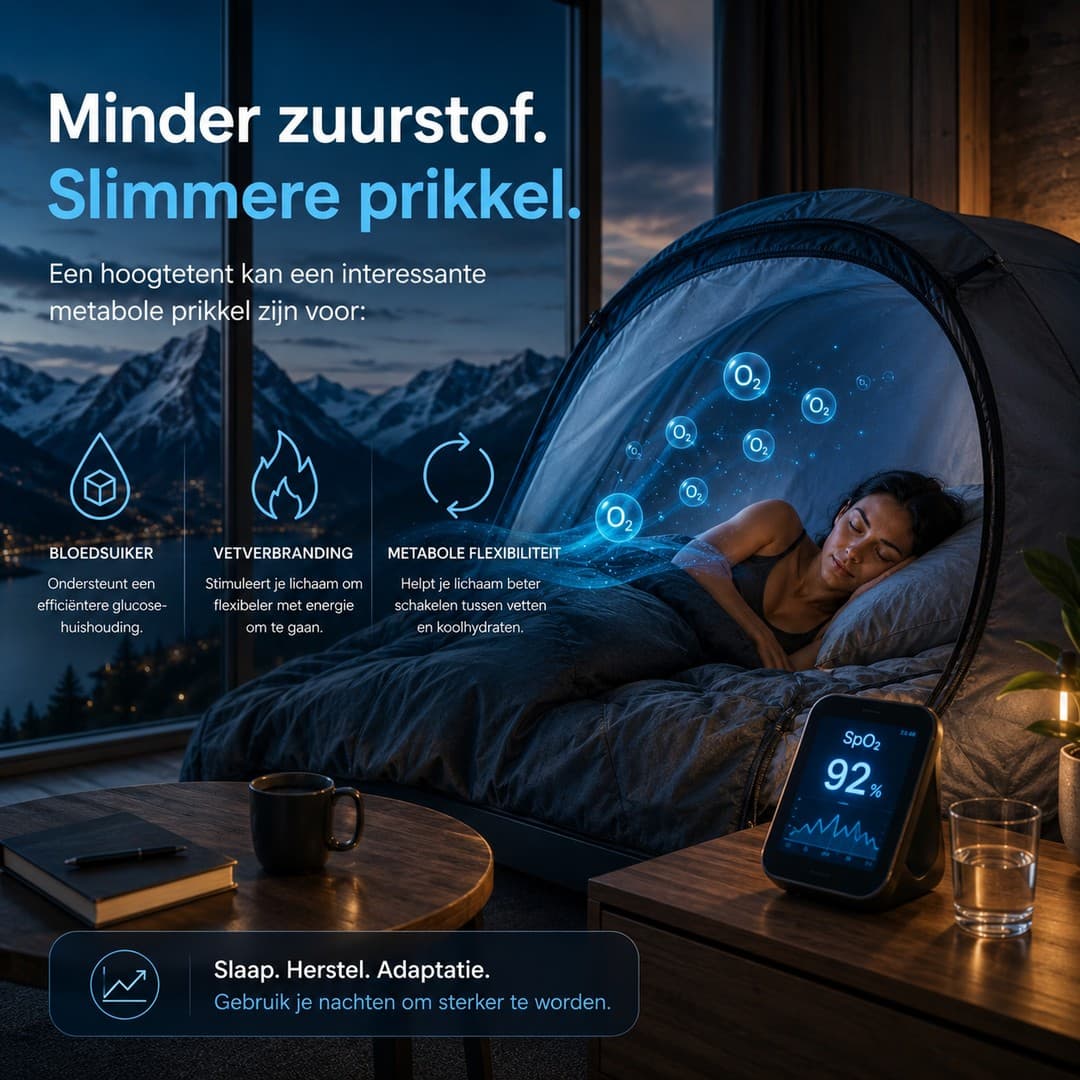
This is precisely why there's growing interest in controlled hypoxia. With a high-altitude tent, you temporarily sleep with less oxygen while the air pressure remains normal. This provides your body with an extra physiological stimulus night after night. Not as a replacement for a healthy lifestyle or medical guidance, but as a smart additional layer for people who actively want to improve their health and enjoy working with data.
Short answer: An altitude tent can be an interesting stimulus for glucose metabolism, fat burning, and metabolic flexibility through controlled normobaric hypoxia. The value lies primarily in repetition, measurability, and control: you use sleep as a moment when the body is gently challenged.
Conclusion: Hypoxia is a promising metabolic stimulus for people looking beyond standard lifestyle advice.
Nuance: A hypoxietent is not a cure, but it can be a clever additional stimulus.
Practical hook: Anyone who monitors sleep, SpO2 and glucose patterns can gradually build up the stimulus.
Why insulin resistance often feels like your body is working against you
Insulin resistance means your cells react less sensitively to insulin. Because of this, glucose is absorbed less easily into muscle, liver, and fat tissue. The body then has to work harder to keep blood sugar stable.
For many people, this remains invisible for a long time. Nevertheless, you can sometimes notice it through fluctuating energy levels, increased cravings after meals, difficulty losing fat, higher fasting glucose levels, or the feeling that your body is responding less flexibly to diet and exercise.
Therefore, tackling insulin resistance isn't just about eating less. It's mainly about metabolic flexibility: your body's ability to smoothly switch between carbohydrates and fats for fuel. Exercise, strength training, walking after meals, good sleep, and nutrition remain the foundation. But controlled hypoxia can add an extra physiological layer to that.
Anyone who wants to understand the broader basis can start with altitude training. This shows how the body reacts to less oxygen and why that reaction is not just relevant for athletes.
Why a height tent logically fits with metabolic health
A height tent works with normobaric hypoxia. This means that the air pressure remains normal, but the percentage of oxygen in the inhaled air is reduced. So you are simulating altitude without actually being in the mountains.
For metabolic health, the repeatable nature is particularly interesting. You don't have to train harder or make extra time. Instead, you change the environment in which you sleep. This creates a calm, long-lasting stimulus while your body is already in recovery mode.
This makes an altitude tent appealing to people who take their health seriously. Think of people who track their sleep, monitor their fasting glucose, use a continuous glucose monitor, want to improve their weight, or simply want to gain more control over their energy balance.
For that group, a high-altitude tent is not a gimmick. It's a controlled tool that challenges the body in a new way. Furthermore, it fits well with a modern, data-driven approach to health.
In practice: The power of an altitude tent lies in repetition. It's not one night that makes the difference, but several weeks of controlled exposure to less oxygen, combined with sleep, recovery and objective monitoring.
What hypoxia can do to blood sugar and glucose uptake
When oxygen becomes temporarily scarce, the body needs to manage energy more efficiently. Muscles, the liver and fatty tissue respond to this change. Consequently, hypoxia is increasingly being investigated in relation to glucose uptake, insulin sensitivity, energy expenditure, lactate production, mitochondrial signalling and fat metabolism.
This makes hypoxia interesting in insulin resistance. The body receives a signal that it must adapt. Subsequently, processes surrounding glucose utilisation and energy production can be stimulated.
For someone with insulin resistance, that idea is particularly appealing. You are not just looking to eat less sugar or move more. You are looking for ways to make your body respond better again. Controlled hypoxia ties in well with that, as it is a stimulus that works deeper than just behaviour.
The current literature predominantly supports a cautious but positive interpretation. Hypoxia is not a treatment in itself. However, research shows that hypoxia exposure is being seriously investigated as a stimulus for glucose homeostasis and metabolic health.
Research basis
Research into hypoxia and glucose metabolism shows that passive hypoxia, in particular, could be interesting for glucose homeostasis. Results from hypoxic training are more varied. This makes dosage, duration and form of hypoxia important.
Altitude tent versus IHT versus hypobaric training
Not every form of hypoxia works in the same way. This distinction is important when considering this topic in the context of insulin resistance or type 2 diabetes. An altitude tent uses sleep as a stimulus. Intermittent hypoxic training, often referred to as IHT, involves short periods of hypoxia. Training in hypoxia combines exercise with reduced oxygen levels.
For many people, the altitude tent is precisely what's interesting, as the barrier to entry is low. You don't have to schedule an extra training session. Nor do you need to exert yourself intensely. The stimulus occurs during the night, when recovery is already a priority.
| Form | How does it work? | Why interesting? |
|---|---|---|
| Altitude tent | Several hours of sleep with less oxygen. | A gentle, consistent stimulus that requires no extra training time. |
| IHT | Short periods of hypoxia interspersed with normal air. | Savoury stimulus often investigated in studies. |
| Hypoxic training | Exercising or training with less oxygen. | Interesting for condition, energy consumption and training adaptation. |
How does it work? Several hours of sleep with less oxygen.
Why interesting? A gentle, consistent stimulus that requires no extra training time.
How does it work? Short periods of hypoxia interspersed with normal air.
Why interesting? Savoury stimulus often investigated in studies.
How does it work? Exercising or training with less oxygen.
Why interesting? Interesting for condition, energy consumption and training adaptation.
Those who want to learn more about the shorter protocol forms can read further about intermittent hypoxic training. For this article, the focus is primarily on the altitude tent, as it best suits sleeping, recovery, and prolonged exposure.
Why fat burning and hypoxia are often mentioned in the same breath
Fat burning is a broad concept. It does not automatically mean that someone is losing fat. Nevertheless, the link between hypoxia and fat metabolism makes sense. When the body has less oxygen available, its energy balance changes.
This is relevant for people with insulin resistance. Many people recognise the feeling that their bodies are less able to burn fat. They exercise, eat more healthily and sleep better, but sometimes the results are still limited. So the logical question is: could an additional physiological stimulus help to make the body more adaptable again?
An altitude tent fits perfectly into that narrative. Not because you automatically lose fat while sleeping, but because you give the body a repeated adaptive stimulus. For people who already walk, exercise, do strength training, or improve their diet, that can be an interesting additional layer.
The right expectation
Not strong: “Sleep in a height tent and automatically lose fat.”
That’s impressive, though: “Use a height tent as a controlled hypoxic stimulus within a broader metabolic strategy.”
Not strong: “An altitude tent treats diabetes.”
That’s impressive, though: “Hypoxia is an interesting physiological stimulus for glucose metabolism and energy homeostasis.”
Altitude tent for type 2 diabetes: a modern additional strategy
Type 2 diabetes is a medical condition. Therefore, any new strategy must be considered wisely. At the same time, many people with type 2 diabetes are actively seeking additional ways to better support their bodies.
They are reading about strength training, post-meal walks, carbohydrate periodisation, sleep, stress, glucose monitoring and fat loss. Within that landscape, hypoxia fits as an innovative extra stimulus. Not as a replacement for existing care, but as a modern addition for people who take their metabolic health seriously.
An altitude tent is therefore particularly attractive to people who like control. You know what altitude you are simulating. You can monitor your SpO2. Additionally, you can monitor sleep quality, morning feeling, and possibly glucose patterns. This means you don't use hypoxia as a gamble, but as a measurable stimulus.
For mountain travellers with diabetes, there is also a separate context around Diabetes and altitude. In this article, the focus is not on travelling to altitude, but on the metabolic stimulus of controlled hypoxia at home.
Who is this of particular interest to?
A hypoxic tent for insulin resistance is particularly interesting for people who aren't waiting for a single miracle solution. It suits individuals who understand that metabolic health is achieved by addressing multiple layers simultaneously: training, nutrition, sleep, stress, body composition, and recovery.
For this group in particular, a height tent can be a valuable additional stimulus. Especially when you're already collecting data. Think about baseline glucose, glucose variability, HRV, sleep score, morning pulse, saturation, and subjective recovery.
A hypobaric tent is most suitable for you if
- you see insulin resistance as a signal to organise your lifestyle more smartly
- you are already working on nutrition, exercise, sleep and recovery
- you are interested in metabolic flexibility and energy management
- I like to meet and focus on trends
- you are looking for a controlled, calm stimulus without additional training load
How do you set up a height tent smartly?
The best approach is calm and methodical. You don't need to sleep at the highest possible altitude. A hyperbaric chamber works effectively when you build up the stimulus and give your body time to react.
For insulin resistance, that calm approach is extra interesting. Sleep is a key factor in metabolic health. So you want enough hypoxic stimulus to trigger adaptation, but not so much that your sleep quality drops.
Practical setup in four steps
Step 1: Start with a mild approach and look at sleep quality first.
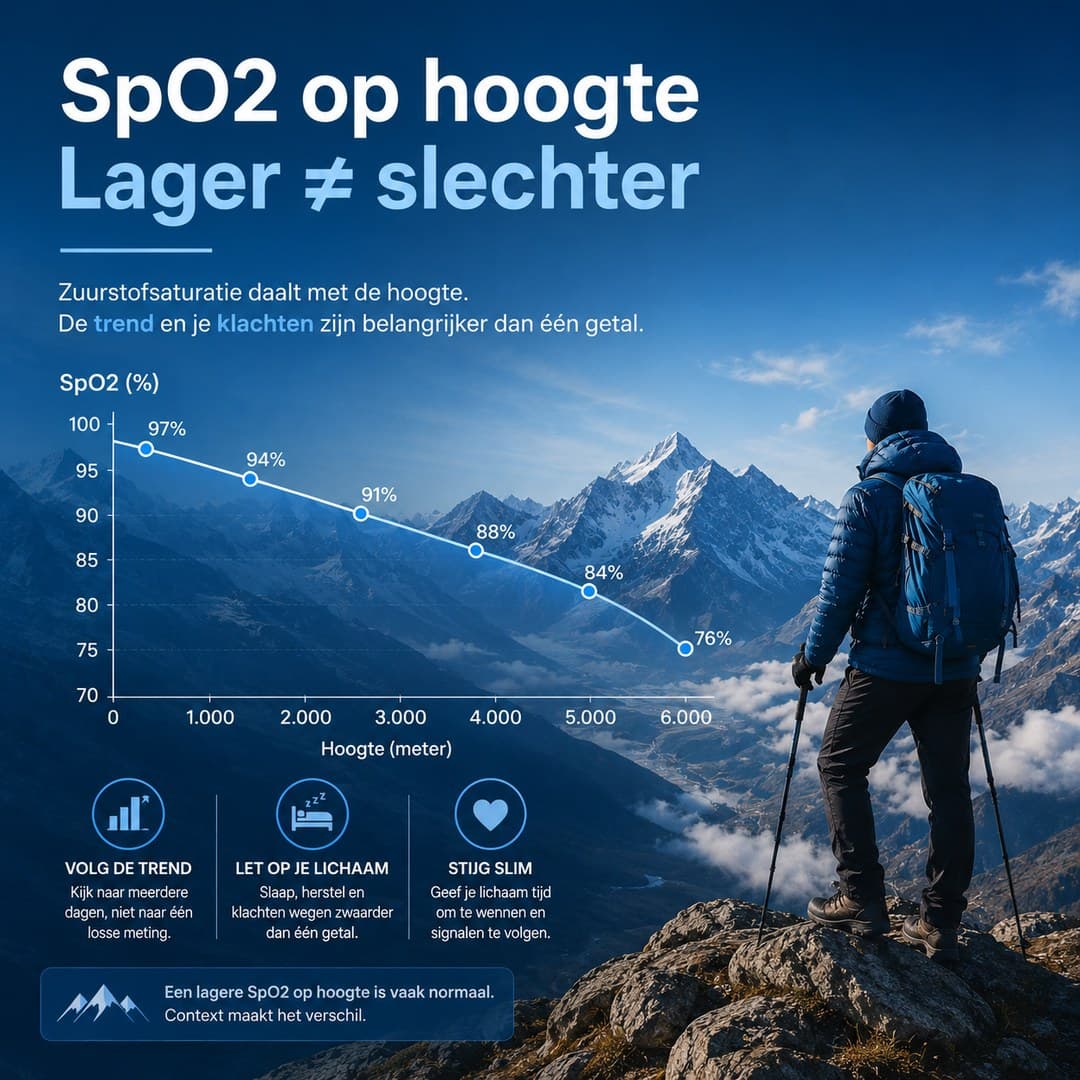
Step 2: Measure your morning SpO2 as a trend, not as a single daily value.
Step 3: Increase only when sleep, recovery, and morning feeling remain stable.
Step 4: stay multiple nights on the same level before building further.
Anyone who wants to understand how to do this practically can read further about to use a height tent. This explains how to gradually build up the stimulus and how to prevent going too high too quickly.
This is how you monitor this lens
The commercial strength of an altitude tent lies in control. You're not just working on instinct. You can measure how your body reacts. This means an altitude tent is well-suited for people who are serious about health, performance, and long-term improvement.
With insulin resistance, trends are particularly important. One night tells you little. A pattern over several weeks tells you much more. Therefore, look at SpO2, sleep quality, glucose values if available, feeling of recovery, and symptoms.
| Measuring point | What are you following? | What does that mean in practice? |
|---|---|---|
| SpO2 | Overnight trend. | Show how strong the hypoxic stimulus is. |
| Sleep | Door-sleeping, sense of rest, and duration of sleep. | Sleep needs to remain stable to support metabolic advantage. |
| Glucose | Fasting glucose or CGM trend. | Interesting to follow patterns alongside diet and exercise. |
| Recovery | Morning energy, HRV, resting heart rate and training readiness. | Helps determine if the stimulus is well-dosed. |
What are you following? Overnight trend.
Significance: show how strong the hypoxic stimulus is.
What are you following? Door-sleeping, sense of rest, and duration of sleep.
Significance: Sleep must remain stable to support metabolic advantage.
What are you following? Fasting glucose or CGM trend.
Significance: Interesting to follow patterns alongside diet and exercise.
What are you following? Morning energy, HRV, resting heart rate and training readiness.
Significance: helps to determine if the stimulus is well-dosed.
SpO2 is always viewed as a trend. A single value reveals little. It’s the combination of saturation, sleep quality, recovery, and how you feel during the day that matters. This is precisely why controlled hypoxia suits people who like to work data-driven.
Further background on the physiological response to oxygen deficiency can be found in the article about physical reactions to oxygen deprivation.
What can you realistically expect after a few weeks?
An altitude tent is not a quick fix. However, the experience can become quite concrete after a few weeks. Some users primarily notice that they gain more insight into their recovery. Others see that their sleep, morning feeling, or glucose patterns react differently when the hypoxic stimulus has been built up effectively.
The main benefit might not be a single value. The advantage lies in the process. You get an extra dial to turn. You can see how your body reacts to less oxygen, how your sleep responds to that, and how it fits into your broader health trajectory.
Interesting signals to follow
- More stable morning energy
- Better sleep continuity after the build-up phase
- change in fasting glucose or CGM trends
- more insight into recovery and load
- better understanding of your personal reaction to hypoxia
Frequently asked questions about altitude tents, insulin resistance, and blood sugar
Can a height tent help with insulin resistance?
A height tent is not a treatment, but it can be an interesting hypoxic stimulus within a broader approach to sleep, exercise, nutrition, and metabolic health.
Why would less oxygen affect blood sugar?
Reduced oxygen levels alter the body's energy demand, thereby stimulating processes related to glucose uptake, energy expenditure, and metabolic flexibility.
Does a height tent help with fat burning?
Especially as part of a wider strategy. An altitude tent is not a weight-loss aid, but it can give the body an additional physiological stimulus.
Do you need to measure blood sugar while using?
This can be valuable, especially with insulin resistance or type 2 diabetes. Look at trends over multiple days and combine them with sleep and recovery data.
Is this only for athletes?
No. Altitude training originates from sports and expedition preparation, but controlled hypoxia is also becoming increasingly interesting for health, recovery, and metabolic optimisation.
Would you like to start with a hypoxic tent in a controlled way?
A height tent works best when you gradually increase the stimulus and focus on sleep, SpO2, and recovery. This way, you don't use hypoxia as a gamble, but as a controlled added layer in your preparation or health strategy.
Conclusion: A premium stimulant for metabolic health
An altitude tent is particularly interesting for insulin resistance as it adds a new layer to metabolic health. Not by training harder or eating stricter, but by cleverly changing the environment in which you sleep.
The controlled hypoxic stimulus can be relevant for people looking beyond standard lifestyle advice. Especially when you are already working on nutrition, exercise, sleep, and recovery, a altitude tent can be a valuable additional stimulus. The strength lies in control: you can build up, measure, track, and adjust.
That's why this topic fits so well with Altitude Dream. A height tent makes hypoxia accessible, plannable, and measurable. Not as a miracle cure, but as a serious tool for people who want to understand their bodies better and stimulate them more intelligently.