Acute altitude sickness symptoms: what signs should you take seriously?
Published 19 April 2014 · 9 min read
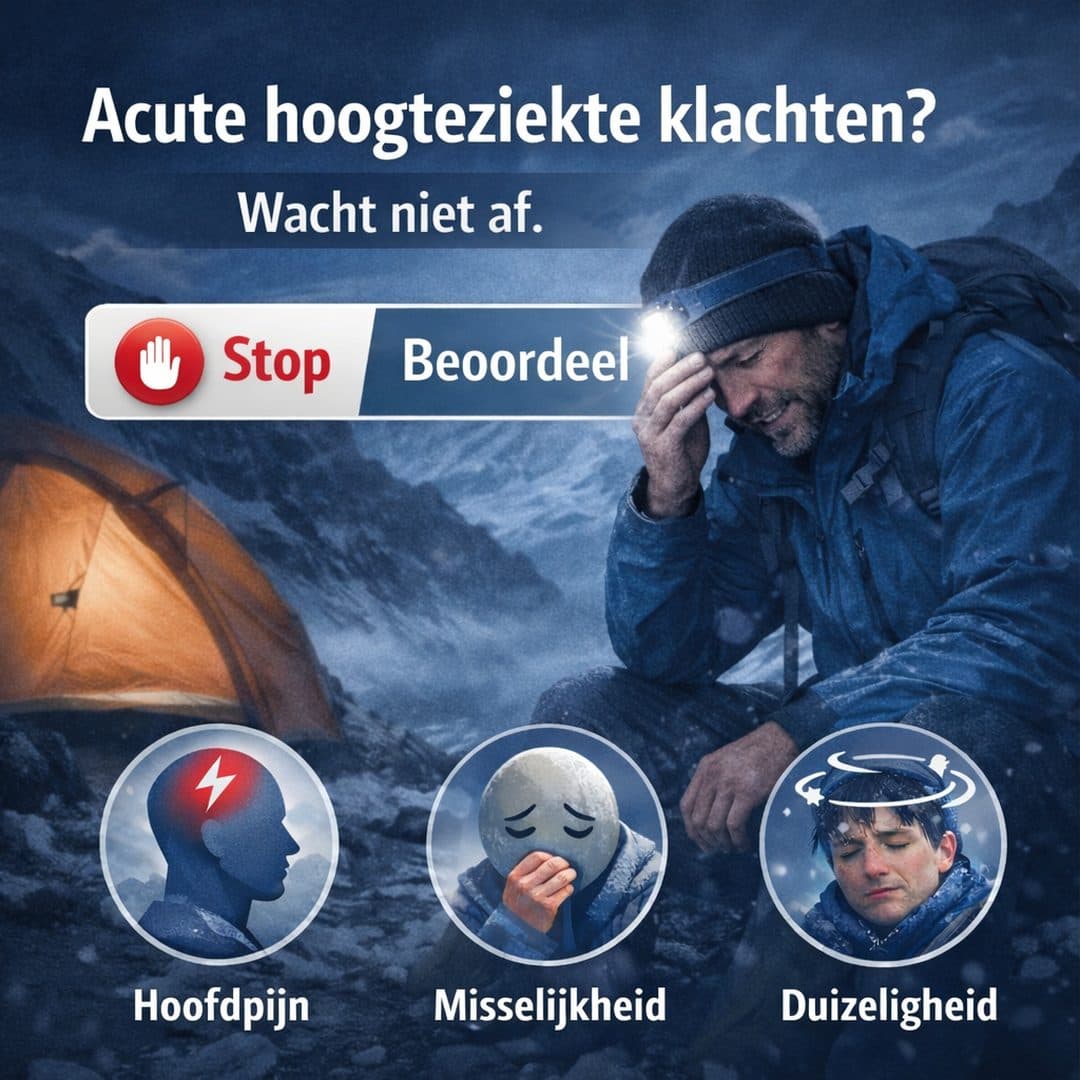
Acute altitude sickness symptoms often start subtly. First there is some headache, a restless night or a strange heavy feeling in the legs. This is precisely why the first signs are easily underestimated. Yet that is when you make a difference. Those who recognise complaints at altitude early and react calmly to them significantly reduce the chance of aggravation.
In this article, you will read which symptoms are typical of acute altitude sickness, when they can still be mild and when, on the contrary, they are an alarm signal. You will also get practical decision rules for en route, so that you know better when to stop, monitor or descend.
Conclusion: headache at altitude in combination with other complaints is always a serious signal.
Nuance: Not every complaint is immediately dangerous, but aggravation at the same level is never normal.
Practical hook: when in doubt, stop rising and assess your symptoms objectively first.
What exactly is acute altitude sickness?
Acute altitude sickness, also called AMS, is the most common form of altitude sickness. It occurs when your body is not given enough time to adjust to the lower oxygen pressure at altitude. The oxygen percentage in the air remains roughly the same, but less usable oxygen becomes available per breath. As a result, your body has to work harder to make the same effort.
The risk increases markedly above about 2,500 metres. Between 2000 and 2500 metres, some people may already experience mild symptoms, especially after rapid arrival or a high sleeping altitude. Those who understand how altitude sickness occurs, also sees why ascent rate plays such a big role: your physiology is always slightly behind your schedule.
The important thing is this: acute altitude sickness is neither a sign of weakness nor a lack of fitness. Even fit athletes and experienced mountain travellers can develop symptoms. The problem is not in motivation, but in adjustment time.
Which acute altitude sickness symptoms are most common?
Most symptoms appear within a few hours to a day after you start sleeping higher. They often involve a combination of vague signs at first. One isolated complaint does not say everything, but a cluster of symptoms after a rapid rise is suspicious.
Short answer for scan readers:
- Headache
- Poor or restless sleep
- Nausea or reduced appetite
- Dizziness or lightheadedness
- Unusual fatigue
- Drowsiness or less sharp thinking
Headache is key early signal
Headache is by far the complaint to take most seriously. Especially when it occurs after arriving at altitude and coincides with nausea, poor sleep or dizziness. Mild headaches that improve with rest and do not get worse need not yet be an emergency. But headaches that persist, increase or are especially noticeable at night and early morning deserve much more attention.
Sleep problems are common but not always harmless
Many people sleep more superficially at altitude. They wake up more often, dream more vividly or feel like they are barely sleeping deeply. This is partly because breathing becomes more restless at altitude. So a bad night alone is not directly dangerous. But if sleep disturbance is accompanied by headaches, nausea and marked fatigue, it does fit with incipient AMS.
Nausea and decreased appetite are important combination symptoms
Anyone who does not feel like eating at altitude, gets a rushed feeling in the stomach or gets nauseous should not dismiss it as just travel stress. Especially not when these symptoms occur together with headaches. Vomiting is a step more serious, as it puts an immediate strain on hydration and energy intake.
Dizziness, sluggishness and heavy legs
Dizziness, lightheadedness and a noticeably slow reaction can also fit acute altitude sickness. The brain is sensitive to lack of oxygen. As a result, you may feel less sharp, react more emotionally flat or make mistakes in simple actions. On its own, this need not be serious, but together with other symptoms it is relevant.
| Complaint | Often still mild | Do not rise further | Direct action |
|---|---|---|---|
| Headache | Light and stable | Remains present with additional symptoms | Fierce and increasing |
| Sleep disorder | Restless night without other complaints | Along with headache or nausea | No immediate urgency, but monitoring |
| Nausea | Light and short-term | With headaches and fatigue | Vomiting and rapid deterioration |
| Fatigue | Matching the effort | Unusually heavy at the same height | Extreme weakness or shortness of breath at rest |
⚠️ Reality check
Good fitness does not automatically protect against acute altitude sickness symptoms. On the contrary, fit mountain athletes sometimes feel too good in the first few hours and climb too fast as a result. The bill often only follows later, when night, sleep altitude and oxygen pressure begin to show their effects.
When do acute altitude sickness symptoms become dangerous?
AMS is often mild, but not always. The real danger arises when symptoms worsen while staying at the same altitude, or when they progress to signs consistent with pulmonary oedema or cerebral oedema. These are rarer but life-threatening complications.
Red flags for the lungs
In case of shortness of breath at rest, markedly deteriorating exercise tolerance, persistent cough or a feeling that you are running out of air, you should be alert immediately. For more context on this pattern, the explanation of altitude pulmonary oedema relevant, as this is precisely where the distinction between normal shortness of breath and a dangerous situation becomes clear.
Red flags for the brain
Unsteady walking, loss of coordination, confusion, strange behaviour, drowsiness or inability to perform simple tasks clearly are alarm signals. This is no longer the domain of wait and see. Here you have to think of descending immediately and organising medical help.
The main rule you should never ignore
Are symptoms getting worse while you don't continue to rise? Then something is wrong. That is exactly the moment when many people make the mistake of walking on anyway or grabbing the next sleeping spot. At altitude, physiology always wins out over willpower.
This is how you assess complaints in practice
In practice, a simple traffic light model works better than endless discussion. You don't have to diagnose everything perfectly along the way. Above all, you need to make good decisions.
Green - mild and stable
Mild headache, a little worse sleep or a little less appetite, with no obvious worsening. You function normally and the symptoms remain the same or decrease. Action: slow down, drink enough, eat well and don't increase further that day.
Orange - matching AMS
Headache plus at least one other symptom such as nausea, dizziness, poor sleep or unusual fatigue. Action: stop ascending, schedule a rest day and assess how symptoms develop. For a concrete emergency plan, also read what to do immediately.
Red - potentially life-threatening
Chest tightness at rest, confusion, loss of coordination, extreme exhaustion or rapidly increasing symptoms. Action: descend immediately and seek medical attention. No discussion, no heroism, no schedule to be finished.
This is how you monitor this lens
Objective monitoring helps remove emotion from your decision. This is especially valuable in a group, as people often minimise or overdramatise complaints. Therefore, always look for a combination of signals.
- SpO2 trend: Use a saturation gauge only as a trend, not as an isolated truth. A decreasing trend along with more complaints is more important than one random measurement.
- Sleep quality: look at several nights. A bad first night may still fit with normal adjustment, but persistent poor sleep plus symptoms deserves action.
- Recovery: Do you feel better, equal or worse after resting, eating and drinking? No recovery at the same altitude is an important signal.
- Symptom cluster: headache plus at least one other symptom outweighs one isolated complaint.
Practical decision rule: If two parameters deteriorate at the same time, e.g. more headache and worse SpO2 trend, you don't climb any further. If it does not improve after rest, you descend.
📊 Research shows
At altitude, one isolated measurement is rarely enough to make a good decision. Trend information is more valuable. This applies to SpO2, but also to sleep, appetite and recovery. It is precisely the combination of objective and subjective signals that makes your assessment much stronger.
Common misconceptions around acute altitude sickness symptoms
“I don't have a headache, so it won't be too bad”
Headache is the classic signal, but its absence does not completely rule out problems. Especially with more severe complications, tightness of breath, confusion or loss of performance may be paramount.
“It's probably just dehydration”
They can. But dehydration and altitude sickness also reinforce each other. Therefore, it is not a smart excuse to ignore symptoms. You need to take both seriously.
“If I am fit enough, I can have this”
No. Condition helps you move at altitude, but says little about how quickly your body acclimatises. Especially strong athletes sometimes go up too fast.
“After one good night, I am safe”
That too is too simple. Adjustment to height comes in stages. A reasonable first night is nice, but no guarantee that the next sleep height will also be good.
What can you do to prevent acute altitude sickness symptoms?
The basics remain simple: ascend slowly, plan conservatively and respect your sleeping altitude. Above about 2,500 metres, it is smart to look not only at what you achieve during the day, but especially at where you sleep. That's often where the difference is between a great trek and a failed schedule.
In addition, it helps not to move too aggressively in the first few days. Eat enough, drink consistently and avoid alcohol and substances that can suppress breathing. This sounds basic, but these very basics are often underestimated on mountain treks.
For fixed itineraries or expeditions with a rapid initial sleep altitude, pre-acclimatisation at home can be useful. With an altitude tent, you work with normobaric hypoxia: air pressure remains the same, but the oxygen percentage in inhaled air is reduced. This does not replace true acclimatisation in the mountains, but it can make preparation controlled, measurable and planable. It often lowers the likelihood of complaints, without ever becoming a 100 per cent guarantee.
Mini-FAQ
From what height do you usually get complaints?
The risk becomes really relevant from around 2,500 metres, although sensitive people may notice slight signals lower down.
Is insomnia alone a sign of altitude sickness?
No, not necessarily. Poor sleep is common at altitude. The combination with headaches, nausea or dizziness makes it more suspicious.
How quickly should you descend in case of severe symptoms?
As soon as safely possible. With red flags, descending is not an option for later in the day, but immediately part of the treatment.
Is diarrhoea also altitude sickness?
No. But it does increase your risk, as fluid loss and lack of energy make your adaptation to altitude more difficult.
Want to reduce the risk of altitude sickness?
First, immerse yourself in the main risk factors, prevention strategies and decision rules. That way, you will leave better prepared and recognise symptoms earlier.
Conclusion
Acute altitude sickness symptoms are rarely dramatic at first. This is precisely why they are too often taken seriously too late. Headaches, poor sleep, nausea, dizziness and unusual fatigue are not details when they occur after ascending to altitude. They are the signal that your body needs more time.
The best approach is down-to-earth and simple: stop rising, look at the trend, combine complaints with objective signals and intervene in time. At altitude, adjusting early is almost always smarter than correcting late.