Climbing Huayna Potosí: acclimatisation for 6088 metres
Published 29 April 2026 · 13 min read
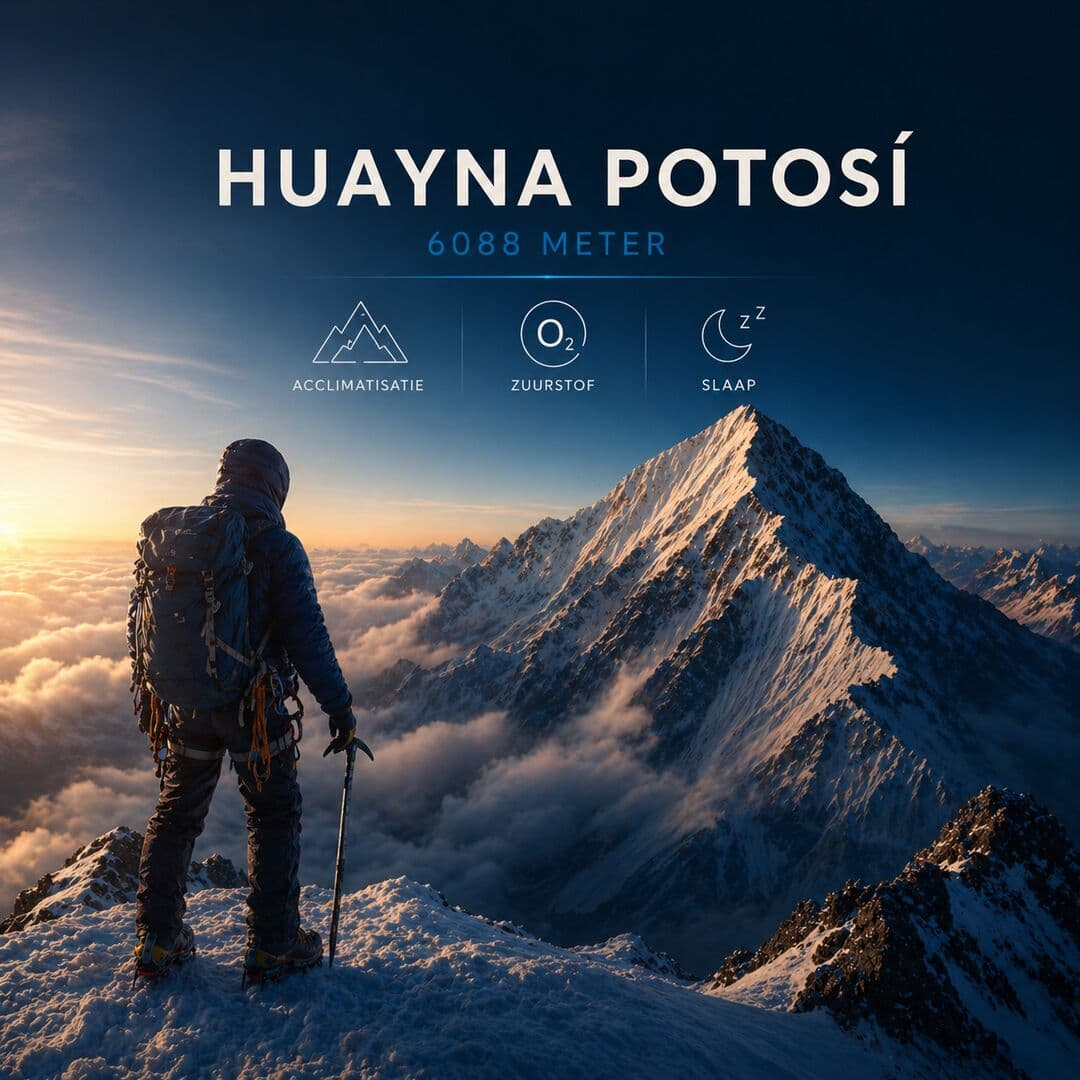
Climbing Huayna Potosí sounds like a viable first 6,000-metre mountain to many travellers. The mountain is close to La Paz, is often offered in two or three days and has a reputation as an accessible alpine ascent. Yet that is precisely where the risk lies. At 6088 metres, the decisive factor is not technique but, above all, altitude. Those who sleep in an altitude tent at home beforehand can significantly reduce the risk of altitude sickness and start the climb with more control.
Conclusion: Climbing Huayna Potosí is primarily an acclimatisation issue, not a classic technical expedition question.
Nuance: An altitude tent significantly reduces the risk of altitude sickness, but does not guarantee 100%.
Practical hook: Combine pre-acclimatisation at home with a few quiet days in La Paz and preferably choose a three-day programme.
Why climbing Huayna Potosí is different from what it looks like
Huayna Potosí is often described as one of the most accessible 6,000-metre mountains in the world. This is understandable. The mountain is relatively close to La Paz, the normal route is logistically manageable and many local agencies offer the climb as a short guided climb.
Yet “accessible” is not the same as “easy”. The normal route is relatively achievable for a 6,000-metre mountain, but you are moving on glacier terrain, often in the dark and at extreme altitude. The summit is at 6088 metres. That's an altitude at which your body has significantly less oxygen available.
As a result, your exercise capacity drops. Your sleep often becomes lighter. Your recovery is slower. Moreover, the summit push usually starts in the middle of the night. So you climb at a time when your body is cold, tired and often already moderately rested.
For those flying directly to Bolivia from Europe, the transition is big. La Paz itself is already high. That partly helps, but it can also be misleading. Many people feel pretty good after two days in the city and then think they are done.
Then they sleep at higher mountain huts, move above 5,000 metres and have to continue overnight to 6088 metres. There, it will become clear whether acclimatisation is really deep enough.
Therefore, this topic fits strongly within Altitude Dream's expertise. It's not just about being fit. It's about being smart about oxygen deprivation, sleep, timing and measurable preparation. For the wider context, also read our guide on acclimatising at home for mountain expeditions.
The name Huayna Potosí is often translated as “young mountain” from the Aymara language. As a result, the mountain has not only sporting but also cultural significance in the region around La Paz and the Cordillera Real.
Climbing Huayna Potosí with pre-acclimatisation: the smart sequence
The best preparation for Huayna Potosí does not start only in Bolivia. Precisely because many programmes are short, you gain a lot by already building up a hypoxic stimulus at home. An altitude tent involves normobaric hypoxia. Air pressure remains normal, but oxygen levels are reduced. Thus, the system mimics a stay at altitude while you sleep at home.
That sleep is important. Not because one extreme stimulus makes you “stronger” in a tent, but because your body learns to cope with less oxygen repeatedly and in a controlled way. In a good build-up, you look not only at the set altitude, but especially at your trend in oxygen saturation at altitude, sleep quality, sense of recovery and any complaints.
For a mountain like Huayna Potosí, it does not make sense to immediately sleep extremely high at home. The goal is not to mimic 6088 metres in your bedroom. The goal is to build prior ventilatory adaptation, sleep comfort under hypoxia and tolerance to oxygen deprivation.
As a result, you will arrive in La Paz better prepared. You also reduce the chance that the first days in Bolivia will be completely consumed by acclimatisation complaints.
An altitude tent does not replace on-site acclimatisation. It does, however, make the process controlled, measurable and planable. Especially on a short trip to Bolivia, this can make a big difference. It significantly reduces the risk of altitude sickness, while still requiring you to ascend sensibly, sleep well and take complaints seriously.
What makes 6088 metres physiologically demanding?
At 6088 metres, almost everything works against your pace. Your heart rate increases faster, your breathing becomes more shallow or restless, your sleep quality often decreases and small technical actions take more energy.
Think fastening crampons, changing gloves, drinking from a half-frozen bottle or staying focused on a narrow snow ridge. These are details at sea level. At 6,000 metres, they become energy demands.
Therefore, Huayna Potosí is a good example of a mountain where fitness alone is not enough. A fit runner or cyclist can still have problems if acclimatisation is not right. Conversely, someone with less pure fitness, but with better altitude preparation, can climb more calmly and efficiently.
Those who delve into acclimatising for 6000 metres, sees that it is mostly about time, repeated exposure and monitoring. The biggest mistake is thinking that one or two nights in La Paz are automatically enough. La Paz helps, but the step to a 6,000-metre summit remains large.
| Phase | Typical height | What this means | Practical choice |
|---|---|---|---|
| La Paz | approximately 3600 m | Your body immediately gets a serious altitude boost. | Plan quiet days. No heavy training on day one. |
| Base camp | approximately 4700 m | Sleep and appetite may decrease. | Drink slowly, eat lightly and avoid rushing. |
| High camp | approximately 5100 to 5200 m | The night before the summit is often short and unsettled. | Accept poor sleep, but watch out for headaches and nausea. |
| Summit | 6088 m | Each step feels heavier. Concentration becomes more important. | Climb slowly, consistently and without spikes in effort. |
Significance: immediately a serious height boost.
Choice: plan quiet days and no heavy training on day one.
Significance: sleep and appetite may decrease.
Choice: drink slowly, eat lightly and avoid rushing.
Significance: the night before the summit is often short and unsettled.
Choice: accept poor sleep, but take complaints seriously.
Significance: effort and concentration become heavier.
Choice: climbing slowly, consistently and without peaks.
A practical schedule for at home and on site
Good preparation has two layers. The first layer is sleeping at home in an altitude tent. The second layer is sensible acclimatisation in Bolivia. Together, they give the most control.
Ideally, start sleeping in the altitude tent 3-5 weeks before departure. Build up gradually, steering by SpO₂ trend and sleep quality, and use the last few days before departure to stabilise. After arriving in La Paz, plan at least a few quiet days before heading to the mountain.
Phase 1: getting used to hypoxia at home
Don't start too high. The first nights are meant to get used to sleeping with lower oxygen availability. It is normal for your breathing to change slightly. You are not supposed to sleep badly, wake up startled or wake up structurally with a severe headache.
A practical build-up is to find a comfortable stimulus first. Then increase only when you sleep stably for several nights. The morning trend of your SpO₂ is more useful in this regard than one single measurement. Also look at your sense of recovery. Do you wake up refreshed, or do you feel drained every morning?
Phase 2: building towards relevant tolerance
In the second phase, the stimulus becomes more specific. You don't need to sleep extremely high. Indeed, building up too aggressively can disrupt your recovery. For Huayna Potosí, it makes more sense to have enough nights with a well-tolerated hypoxic stimulus than to sleep way too high some nights.
Here lies the power of a measurable programme. You steer by response. With good sleep, stable SpO₂ trend and few complaints, you can build up. With restless sleep, obvious headaches or declining recovery, you stay longer at the same setting or take a step back.
Stage 3: arriving in Bolivia in no hurry
Even with pre-acclimatisation, it is wise not to underestimate La Paz. Use the first few days for leisurely exercise, light food and good sleep. A short acclimatisation hike can be useful, but avoid performance hikes.
The goal is not to prove you are fit. The goal is to give your body time to push through the home-built stimulus to real heights.
Misconceptions about Huayna Potosí and altitude sickness
A first misconception is that Huayna Potosí would be “beginner proof”. The normal route is indeed relatively accessible for a 6,000-metre mountain, but you do walk over glacier terrain with crampons, ice axe and rope. In windy, cold or bad snow conditions, the margin narrows quickly.
A second misconception is that La Paz automatically gives enough acclimatisation. La Paz helps, but the summit is still over 2,400 metres higher than the city. Moreover, during the climb you sleep higher than many people have ever been. That night of sleep at high camp is often the real test.
A third misconception is that altitude sickness only affects people with poor fitness. This is not true. Individual susceptibility, rate of ascent, lack of sleep, hydration, previous acclimatisation and exercise spikes all play a role. It is therefore wise not to think of altitude sickness as weakness, but as a physiological response to oxygen deprivation. Find more background in our guide on altitude sickness.
Those wishing to look further into altitude sickness and acclimatisation medically can read the guidelines of the CDC Yellow Book on altitude sickness consult. These confirm that hypoxia is the central factor in high-altitude travel.
Coca tea, willpower and good basic fitness do not replace acclimatisation. They may give comfort, but they do not fundamentally change the physiological reality of 6088 metres. A gentle build-up remains more important than mental toughness.
This is how you monitor this lens
Objective monitoring prevents your preparation from running on feeling alone. Feeling is valuable, but at altitude, feeling is sometimes delayed or misleading. That's why you look at trends.
- SpO₂-trend: Preferably measure at the same time, such as immediately after waking up.
- Sleep quality: Note whether you sleep through, wake up often or get up with a headache.
- Recovery: note morning feeling, resting heart rate and fatigue over several days.
- Symptoms: follow headache, nausea, dizziness, appetite and coordination.
- Loadability: see if light exertion continues to feel normal.
With a high altitude tent, the SpO₂ is not a competition score. A lower value is not automatically better. It's about getting the right stimulus without unnecessarily worsening your sleep and recovery. When the trend remains stable and you sleep well, this is a positive signal. When the trend drops sharply and symptoms increase, that's a reason to switch back.
Even on the mountain, monitoring remains important. A mild headache on high camp is common, but a headache combined with nausea, poor walking, confusion or increasing shortness of breath is something else. Then the guide should be called in and descent may be necessary.
Decision rules: when to do, when not to do?
- you already have some mountain experience or are comfortable with cold and long days;
- you are prepared to take acclimatisation seriously;
- you choose a three-day programme if you do not have an ample acclimatisation history;
- you want to work on measurable preparation beforehand with a height tent.
Be more careful if:
- you have little time in Bolivia;
- you got height complaints quickly before;
- you sleep badly at altitude;
- you see the climb as a short tourist activity rather than a real 6000-metre climb.
A practical rule of thumb: the shorter your itinerary, the more valuable pre-acclimatisation becomes. Not because it eliminates all risks, but because it allows you to partially make up for the lack of acclimatisation time.
Insights you don't read everywhere
The first useful insight: the descent deserves as much attention as the summit. Many climbers focus on sunrise at 6088 metres. Yet mistakes often happen on the way back. Then you are tired, the snow changes and concentration drops. So a quiet summit day also means saving energy for the descent.
The second insight: material comfort is not a detail. Rental shoes, crampons and gloves can make the difference between controlled climbing and constant energy leakage. Test everything beforehand. Cold feet and ill-fitting shoes in particular can cause a lot of stress on a night summit push.
The third insight: a two-day programme is often logistically attractive but physiologically cramped. Those who have been travelling through the Andes for weeks can sometimes get away with it. Those just arriving from Europe are usually wiser to opt for three days and extra acclimatisation beforehand.
The fourth insight: the weather around Huayna Potosí can change quickly. A “technically easy” route feels different in high winds, poor visibility or fresh snow. Therefore, a good guide is not a formality. Choose one that not only wants to get to the top, but also dares to turn around.
The fifth insight: appetite on high camp is often low. Therefore, don't wait until you get hungry. Choose simple, light food that you can get rid of even with little appetite. At 5100 metres, eating is not a culinary choice, but energy management.
Common mistakes when climbing Huayna Potosí
The biggest mistake is starting acclimatisation too late. Those who only start in La Paz have little margin. A second mistake is ascending too fast in the altitude tent. That seems ambitious, but can undermine your sleep quality. A third mistake is underestimating summit day because the route is commercially popular.
In addition, many people see drinking as the solution to everything. Hydration helps, but does not solve oxygen deprivation. Diamox is also sometimes seen as quick insurance. Medication can be useful in certain situations, but belongs in consultation with a doctor and does not replace planned acclimatisation.
Finally, there is the error of social comparison. If someone else feels good in La Paz, that says little about your response. High sensitivity is individual. Therefore, personal, SpO₂-driven preparation works better than standard advice.
Prepare Huayna Potosí measurably
If you are heading towards 6000 metres, sleeping in an altitude tent beforehand is one of the most controlled ways to get your body used to oxygen deprivation in advance. It significantly lowers the risk of altitude sickness and helps you start the climb with more rest and margin.
Conclusion: Huayna Potosí demands respect for altitude
Climbing Huayna Potosí is a wonderful and logical ambition for those seeking a first or next 6000-metre mountain. The mountain is accessible, iconic and less technical than many other peaks in the Andes. Still, 6088 metres remains extremely high for a body emerging from sea level.
Therefore, the best preparation is not to train harder, but to plan smarter. Start at home with controlled pre-acclimatisation in an altitude tent. Build up gradually. Follow your SpO₂ trend, sleep quality and complaints. Then take enough time in Bolivia to calmly process La Paz, base camp and high camp.
Thus, Huayna Potosí will not be a gamble on character, but a well-prepared ascent with more control, more rest and a significantly lower risk of altitude sickness.
FAQ about climbing Huayna Potosí
How high is Huayna Potosí?
Huayna Potosí is 6088 metres high. This puts the mountain clearly in the extreme altitude category, even though the normal route is often described as accessible.
Is Huayna Potosí suitable as the first 6,000-metre mountain?
It can be done, but only with proper guidance, sufficient acclimatisation and realistic expectations. The altitude remains the biggest challenge.
How many days do you need for Huayna Potosí?
Many programmes last two or three days. For those who are not already well acclimatised, three days is usually wiser than two.
Will an altitude tent help at Huayna Potosí?
Yes. Sleeping in an altitude tent beforehand can significantly reduce the risk of altitude sickness. However, it is still important to acclimatise calmly on site as well.
Do you need to be able to climb technically?
You don't need to be an expert alpinist, but you should be comfortable with cold, crampons, ice axe, rope use and moving for long periods at altitude.