Altitude sickness in children: risks and guidelines
Published 16 April 2026 · 11 min read
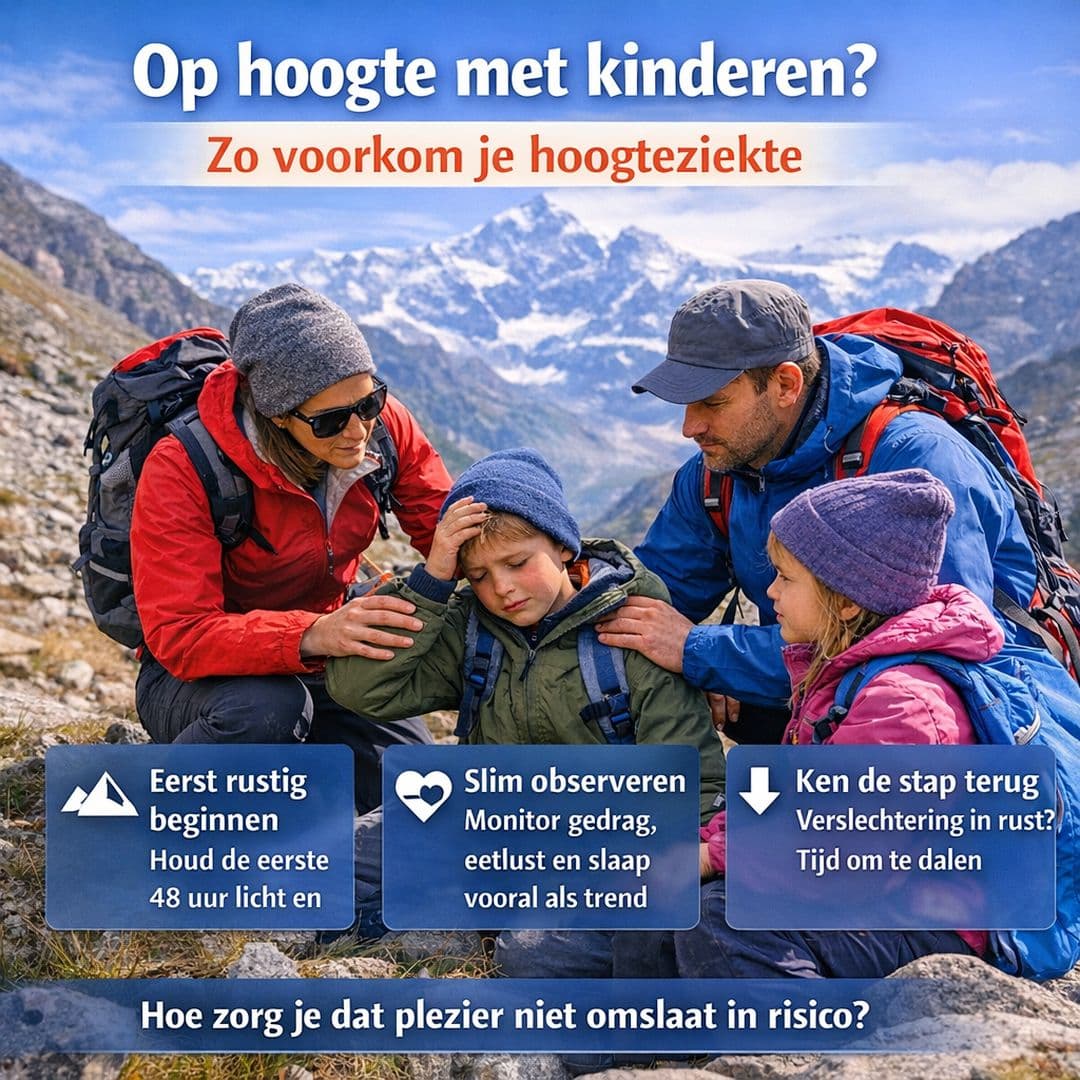
Altitude sickness in children usually does not require panic, but it does require a tighter plan than many parents think beforehand. In fact, children are broadly as susceptible to acute altitude sickness as adults. The difference is mainly in recognition. An adult says he has a headache or nausea. A young child becomes listless, sleeps badly, does not want to eat or is suddenly noticeably irritable. In this article you will therefore read not only what the risk is, but especially how to decide as a parent: when can you continue calmly, when should you slow down and when is descending the right choice.
Direct response
- The risk of altitude sickness increases especially from around 2,500 metres, especially with rapid increases in sleep altitude.
- In children, it is not age but mainly observation that is decisive: behaviour, appetite, sleep, workload and symptom progression count more than a single saturation measurement.
- If symptoms become markedly worse at rest, or you see shortness of breath, confusion, loss of coordination or noticeable drowsiness, then descending is not a prudent option but the right step.
Conclusion: travelling to altitude with children can often be done safely, as long as you build up the ascent gently and take behaviour as seriously as classic symptoms.
Nuance: young children indicate symptoms less clearly, so you need to focus on trends and context rather than individual readings.
Practical hook: Plan conservatively especially for the first 48 to 72 hours and make clear descent rules beforehand.
Altitude sickness in children: what is the real risk?
The real risk is often misjudged. Parents regularly think that children are either automatically more vulnerable or, on the contrary, that they walk through it automatically. Both assumptions are too simplistic. What mainly determines the risk in practice is the combination of sleep altitude, ascent rate, previous susceptibility and room to make timely adjustments. Those who move quickly from lowlands to 3,000 metres or higher and sleep there immediately, clearly increase the risk. Those who build up more calmly, include a stopover and keep calm for the first few days, noticeably lower that risk.
Especially on family trips, sleeping altitude is more important than the day trip. Arriving briefly higher during the day and sleeping lower usually gives less strain than arriving directly high and spending the night there. This is relevant for popular itineraries where, for example, you travel from a low-altitude city to Cusco, La Paz or a high-altitude mountain village in one trip. Hypoxic stress is also greatest during sleep. As a result, the first nights in particular can cause a lot of anxiety, even if the day itself still seemed to go well.
Therefore, it is wise to look at the full route early in your preparation. Not just the highest point, but especially where your child sleeps, how many metres you gain per day and whether there are any real rest days possible. Parents who plan this well in advance often remove the main risk factor already. You can find a broader basis on prevention in our guide on preventing altitude sickness.
⚠️ Reality check
A child who still looks cheerful on arrival is not automatically well acclimatised. Many complaints only arise hours later or during the first night. For this very reason, the first 24 to 72 hours are not a phase to test how much can still be done, but to cleverly observe and consciously leave room for recovery.
Recognising altitude sickness in children: what signs really count?
In older children, the picture often still resembles that of adults. Think headache, nausea, dizziness, loss of appetite and unusual fatigue. In young children, things get trickier. They may become especially irritable, want to eat less, sleep poorly, become quiet, play less or be inconsolable. This makes observation more important than perfect diagnosis. As a parent, you don't have to name exactly whether something is formally acute mountain sickness. You do need to notice that a child is no longer himself after the rise.
A second nuance is that poor sleep at altitude is not in itself a firm diagnosis of acute altitude sickness. Yet you should not dismiss sleep change in children. Not because it is evidence of AMS, but because it often coincides with the overall burden. Poor sleep plus listlessness, less eating and declining activity is much more clinically relevant than one symptom on its own.
Normal adjustment or reason to stop?
Often still appropriate at first adaptation
- a little less energy on the first day
- shorter appetite dip without obvious deterioration
- mild headache that improves with rest and drinking
- sleep slightly more restlessly, but still function reasonably well during the day
Do not wait
- clearly getting worse at rest
- persistent vomiting or unwillingness to drink
- shortness of breath, rapid breathing or coughing at rest
- confusion, drowsiness, unsteady walking or noticeably different behaviour
You can read more background on the mechanism behind those complaints in our article on how altitude sickness is caused. In practice, this mainly helps parents focus less on loose theory and more on taxability.
Practical guidelines for parents before departure and during the trip
A good plan does not start on the mountain, but at home. The first question is not whether your child is tough enough. The first question is whether your itinerary leaves room for a slow start. That means: no full programme on the arrival day, no heavy hike in the first 24 hours and preferably an intermediate altitude or extra night if you are going to sleep above about 2,500 metres.
Pre-departure checklist
- Check the first sleeping height, not just the highest point of the journey.
- Plan the first 48 hours as quiet observation phase.
- Discuss in advance who decides on pause, rest day or descent.
- Take a reliable thermometer, simple pain relief and a saturator if necessary with it, but only use that meter as a tool.
- Have a doctor look in if your child has a relevant heart, lung or haematological disease has or previously had serious height problems.
Children with pre-existing lung diseases or certain underlying problems require extra preparation. In general, prior medical consultation is wise in case of relevant heart or lung disease. For some conditions, such as severe pulmonary hypertension or sickle cell anaemia, travelling to high altitude is often not appropriate. This does not mean that every child with asthma or a history of it can automatically not go along, but it does mean that individual assessment becomes important as soon as ordinary altitude exposure is combined with limited oxygen reserve.
Practical build-up protocol for families
| Zone | What this means | Practical approach | What you pay attention to |
|---|---|---|---|
| Up to 2500 m | Usually low-risk, but rapid arrival can still cause symptoms in susceptible children. | Quiet first day, observe well, don't plan an unnecessary summit day. | Headache, appetite, energy, sleep. |
| 2500 to 3000 m | This is where the classic risk zone for acute altitude sickness starts to come into play more clearly. | Keep the arrival day light and plan a stopover or extra night if possible. | Behaviour change, nausea, lethargy, playing less. |
| 3000 to 3500 m | Above all, ascent rate and sleep height now become decisive. | Preferably do not increase the sleep altitude by more than 500 m per day and take a rest day every 3-4 days. | Trend of complaints over 24 hours, not just snapshot. |
| Above 3500 m | More margin in the schedule is essential, especially with young children. | Only do it with clear plan, descent options and low threshold to adjust pace or route. | Shortness of breath, drowsiness, shaky gait, worsening at rest. |
Up to 2500 m
What this means: usually low risk, but rapid arrival can still cause symptoms in susceptible children.
Practical approach: calm first day, observe well, don't plan an unnecessary summit day.
What you pay attention to: headache, appetite, energy, sleep.
2500 to 3000 m
What this means: this is where the classic risk zone for acute altitude sickness starts to come into play more clearly.
Practical approach: Keep arrival day light and plan a stopover or extra night if possible.
What you pay attention to: behavioural change, nausea, lethargy, playing less.
3000 to 3500 m
What this means: especially the rate of ascent and sleeping height now become decisive.
Practical approach: preferably do not increase sleep altitude by more than 500 m per day and take a rest day every 3 to 4 days.
What you pay attention to: trend of complaints over 24 hours, not just snapshot.
Above 3500 m
What this means: more margin in the schedule is essential, especially with young children.
Practical approach: do only with clear plan, descent options and low threshold to adjust pace or route.
What you pay attention to: tightness, drowsiness, shaky gait, worsening at rest.
This is how you monitor this lens
Objective monitoring does not mean turning your holiday into a medical record. It means consciously looking at four things every morning and evening: SpO2 trend, sleep quality, recovery and activity and symptoms. The emphasis is on trend. A saturation gauge can be useful, but normal values at altitude are in a range and small differences often say little. You don't need to put the brakes on a child who looks clinically well, drinks well and functions normally on one abnormal number. The reverse is also true: a nice SpO2 does not rule out relevant symptoms.
What you look at every day
Trend that reassures
- child is approachable and plays reasonably well
- drinking and eating slightly better again than the day before
- sleeps more peacefully
- any SpO2 remains stable or improves slightly
Trend calling for action
- more complaints after a night at the same altitude
- drinking or eating less and less
- more lethargy or less coordination
- SpO2 significantly lower than expected AND child looks clinically worse
Anyone using a saturation gauge would do well to link it to context. Measure on warm hands, at rest, preferably at similar times. If you see a lower value, look at the whole picture first. Decisions at altitude are not made on minute SpO2 differences. This also fits well with children, for whom behaviour and load capacity often say something rather than single numbers. For more context on normal ranges at altitude, you can also read about saturation at altitude and what is normal.
When to descend immediately or seek help
This is the part that parents need to be clear about beforehand. Not all complaints call for an emergency scenario. But some signs do call for immediate action. If a child becomes stuffy at rest, you see a distinct dry or wet-sounding cough that increases, is unusually drowsy, confused or shaky, or you see that he or she can no longer function well for himself or herself, then serious altitude problems should be considered. The rule then is: do not go higher, do not wait until morning, but descend and seek medical attention.
Descending may also be the best decision without a classic emergency picture. For example, if headache, nausea and lethargy do not improve or increase after rest. The core rule is simple: if a child gets worse at rest, this is not normal acclimatisation. Then the question changes from can we continue to how far down do we have to go to make room for recovery again. In many situations, sleeping 500 to 1,000 metres lower is already a very useful intervention.
A practical follow-up piece on this can be found in recognising altitude sickness and how to act. That article fits well when you are looking for a concrete framework for action in particular.
Is medication or pre-acclimatisation in children useful?
For most families, slow build-up the first and best strategy. Medication is no substitute for a good schedule. Acetazolamide is sometimes used when a gentle rise is not logistically feasible, but that is something for consultation with a doctor familiar with high medicine. Routinely experimenting with medication yourself in children is not a sensible route.
Pre-acclimatisation with an altitude tent or other normobare hypoxia buildup is in children can significantly reduce the risk of altitude sickness even in children. In specialist contexts, it can be a controlled, measurable and plannable support when an itinerary is fixed and exposure is high. For families, it is usually only relevant when the itinerary leaves little margin and the goal is clearly higher or more ambitious than a typical mountain stay.
🧭 In practice
The best decision is often surprisingly simple: build an itinerary that is safe enough even without medication or technology. Anything you add after that is support. Not the basics. That order prevents overestimation and makes your choices as a parent calmer and clearer.
Common thinking mistakes of parents
The first mistake is thinking that fitness protects. An athletic child can still get altitude sickness. The second mistake is ascending too fast because things went well yesterday. Precisely complaints that appear after the first night or second day are therefore missed. The third mistake is relying too much on one saturation measurement. And the fourth mistake is explaining everything from fatigue, jet lag or low appetite. Sometimes this is true. But at altitude, you should always first rule out that the rise itself is the problem.
FAQ
Can a child get altitude sickness as early as 2,500 metres?
Yes. That's about the height at which classical risk begins to rise more clearly, especially with rapid arrivals and high first sleep heights.
Are children more sensitive than adults?
Not necessarily. The big difference is that young children cannot name complaints as precisely, making observation more important.
Is a saturation gauge enough to decide?
No. Use SpO2 as a trend alongside behaviour, sleep, appetite, complaints and load capacity. Not as the only decision rule.
When should you descend immediately?
If deterioration at rest, shortness of breath, drowsiness, confusion, shaky gait or marked decline in functioning.
Continue reading for a safer plan at height
If you want to take the next step after this article, it helps to also calmly review the general prevention rules and risk factors alongside your itinerary. This will help you make better choices about pace, sleep level and observation in advance.
Conclusion
Altitude sickness in children is rarely a reason to avoid mountain travel altogether, but a clear reason to plan smarter. The main gain is usually not in extra tools, but in a conservative first sleep altitude, calm first days and clear decision rules. If you see a child not recovering well at altitude, reacting differently than usual or deteriorating at rest, then timely slowing down or descending is not a failure of the trip. It is exactly what responsible mountain travelling with children requires.