
TÆRU, Belgium’s very first height hotel with more than 10 height rooms
Published 2 November 2022 · 13 min read
The core question isn't just whether a high-altitude hotel is special. The better question is: when does such a location truly make sense, who is it suitable for, and how do you use simulated altitude without it becoming a gimmick? This article will help you make that assessment.
Short answer: TÆRU Height Hotel Erezée is particularly interesting for sports teams and endurance athletes looking for a compact training camp with accommodation, training, recovery, and sleeping at simulated altitude. The added value is not only in the altitude chambers but in the combination of the Ardennes terrain, team facilities, measurable hypoxic stimulus, and practical logistics.
Conclusion: TÆRU makes a high-altitude internship in Belgium more practical, shorter and better planned.
Nuance: Simulated altitude only works well with a well-considered construction and monitoring.
Practical hook: Determine beforehand whether your goal is performance, recovery, team stage, or acclimatisation.
Why TÆRU height hotel Erezée is relevant
A classic altitude training camp requires time. You travel to a location at altitude, adapt your training, sleep at the higher elevation for several weeks, and try to combine the stimulus with quality training sessions. This works well for many athletes, but it's not always practical. Travel time, costs, weather, team logistics, and training facilities make such a camp complex.
That's why a height hotel in Belgium is interesting. TÆRU brings the principle of altitude training to an environment where athletes can indeed train intensively, but without the logistical hurdle of a distant altitude training camp. The Ardennes offer hills, quiet roads, trail possibilities, technical cycling routes and sufficient variety for endurance training.
The altitude chambers add an extra layer to that. The room itself is not the goal, but the physiological stimulus. By making less oxygen available during sleep, a controlled form of normobaric hypoxia is created. This means the air pressure remains normal, but the oxygen percentage is lowered. In this way, the body can get used to an environment that resembles altitude.
Practice interpretation: A high-altitude hotel is not a quick fix. It is particularly valuable when sleeping, training, nutrition, recovery, and monitoring are organised together. It is precisely this combination that determines whether the training camp is truly effective.
TÆRU height hotel Erezée is particularly interesting for:
TÆRU is not only relevant for elite athletes. The location can also be valuable for ambitious recreational athletes, clubs, and teams who want to train professionally without having to go abroad. However, it is not the best choice for everyone.
The greatest added value lies with athletes who want to combine multiple training stimuli. Think of endurance, climbing, technique, recovery, and group dynamics. A height hotel is less logical for a single overnight stay. It becomes much more interesting for a well-planned multi-day training camp or training block with a clear objective.
| Target audience | Why interesting | What to look out for |
|---|---|---|
| Cycling teams | Hilly terrain, team logistics, and recovery in one location. | Ensure that intensive blocks do not clash with the height stimulus. |
| Triathletes | A combination of cycling, walking, swimming, strength training, and recovery. | Plan adequate rest between disciplines. |
| Loopteams | Trail running, hill training and controlled altitude sleep. | Build up the loop load gradually. |
| Coaches | Measurable stimulus and clear team structure. | Monitor SpO2, sleep and recovery daily. |
Why interesting: hilly terrain, team logistics and recovery in one place.
What to watch out for: intensive blocks must not clash with the height stimulus.
Why interesting: Combination of cycling, running, swimming, strength and recovery.
What to watch out for: plan sufficient rest between disciplines.
Why interesting: trail, hill training and controlled sleep at altitude.
What to watch out for: Build up the loading gradually.
Why interesting: measurable incentive and clear team structure.
What to watch out for: Monitor SpO2, sleep and recovery daily.
What makes a high-altitude hotel different from a classic altitude training camp?
With a classic altitude training camp, you stay at a natural altitude. The environment largely determines the stimulus. You sleep, live, and recover at altitude. Training often takes place at the same altitude or slightly lower, depending on the location.
With a height hotel like TÆRU, it works differently. The environment is not at true altitude, but the rooms simulate altitude. This allows you to train in normal oxygen conditions and then sleep in a hypoxic environment. This aligns with the principle of sleep high, train lowsleeping with a height stimulus, training with sufficient oxygen quality.
This can be a significant practical advantage. Athletes can train outdoors with good quality, without every interval or endurance session becoming harder due to thin air. At the same time, the body receives repeated stimuli during the night. This separation is particularly interesting for endurance athletes.
Classic altitude training versus altitude hotel
Classic altitude training natural elevation, strong overall incentive, but more travel time and less control over circumstances.
Height hotel simulated altitude during wakefulness or sleep, better planning, closer to home and easier to combine with qualitative training.
Important difference: A high-altitude hotel requires active management. The altitude setting, sleep quality, and training load must be aligned.
Hoe gebruik je TÆRU hoogtehotel Erezée slim?
The biggest mistake with simulated altitude is wanting to go too high too quickly. Athletes sometimes think that more altitude is automatically better, but that's not how it works in practice. Too heavy a stimulus can disrupt sleep, reduce recovery, and put training quality under pressure.
A good approach starts with the objective. Do you want to organise a team training camp? Then training quality is paramount. Do you want to do a block leading up to a competition? Then you'll look at timing, load, and recovery. Do you want to acclimatise to altitude for a mountain trip or a sporting event at altitude? Then the progression will be different.
Practical protocol for a short internship
Day 1: Arrival, calm training, first night at low to moderate simulated altitude.
Day 2: Normal endurance training, monitoring of sleep and SpO2 trend, no aggressive increase.
Day 3: Qualitative training only if recovery remains good, otherwise volume over intensity.
Day 4 and onwards: Increase height setting only if sleep, recovery and symptoms remain stable.
For many sports teams, it makes sense to start the first night conservatively. After that, you can adjust based on data and feel. This way, you prevent the altitude stimulus from taking over the stage. Altitude training should support the training goal, not disrupt it.
Welke faciliteiten biedt TÆRU hoogtehotel Erezée?
The added value of TÆRU lies in the combination. Altitude chambers are interesting, but a teamstage requires more. Athletes need space for equipment, recovery, nutrition, consultation, and relaxation. This makes a difference, especially for cycling teams, triathletes, and running groups.
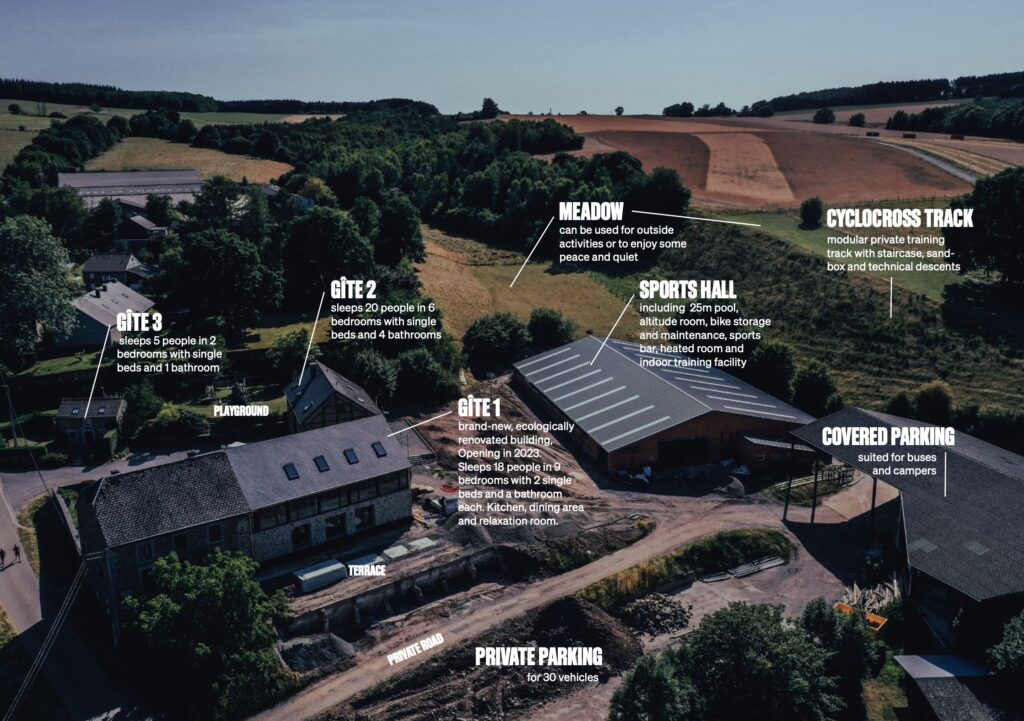
A venue like TÆRU is particularly strong when a team can use the entire environment as a performance campus. Think about cycling routes, trail routes, indoor training, strength training, massage, recovery rooms, team meetings, and a kitchen that can cater to large groups.
This makes TÆRU more like a compact sports campus than a traditional hotel. This is important for coaches. The less time wasted on logistics, the better you can manage the training camp. This creates space for what really matters: training, eating, sleeping, recovering, and making adjustments.
Checklist for teams considering TÆRU
- Determine the main objective of the internship beforehand.
- Don't plan every day as a heavy training day.
- Use the altitude chambers progressively, not to the maximum.
- Meet sleep quality, SpO2 trend, recovery feeling, and complaints.
- Adjust nutrition and iron status to training load.
- Make one coach or supervisor responsible for monitoring.
This is how you monitor this lens
An altitude stimulus only becomes truly useful when you follow it. This applies at home, in an altitude hotel, and during a classic high-altitude training camp. A single SpO2 measurement says little. The trend over multiple nights is much more valuable.
Therefore, do not look at just one number. Combine measurements with sleep quality, how you feel in the morning, resting heart rate, HRV if available, training response and symptoms. This provides a reliable picture. Those who consistently sleep poorly, develop headaches or clearly recover less well, should not automatically increase their training load.
| Measuring point | What are you following? | Practical interpretation |
|---|---|---|
| SpO2 trend | Morning value and nocturnal trend. | Look at changes over multiple days, not at a single measurement. |
| Sleep | Sleep duration, restlessness, waking up, and subjective quality. | Worse sleep could mean the stimulus is too heavy. |
| Recovery | Fatigue, resting heart rate, HRV and training feeling. | The dalend herstel requires rest or a lower height setting. |
| Symptoms | Headache, nausea, dizziness, or unusual shortness of breath. | Complaints are a signal not to increase further. |
What are you following? morning value and nocturnal trend.
Interpretation: Look at changes over several days, not at a single isolated measurement.
What are you following? Sleep duration, restlessness, waking up, and subjective quality.
Interpretation: Poorer sleep can mean the stimulus is too intense.
What are you following? Fatigue, resting heart rate, HRV, and training feel.
Interpretation: The calendar recovery requires rest or a lower height setting.
What are you following? headache, nausea, dizziness, or unusual shortness of breath.
Interpretation: Complaints are a signal not to increase further.
Anyone who wants to approach this professionally can link the internship to a broader approach for measuring altitude training effect. When doing this, you don't just look at how intense the stimulus feels, but primarily at recovery, load capacity, and performance indicators.
Common misunderstandings about TÆRU height hotel Erezée
Misunderstanding 1: Sleeping at simulated altitude is the same as training at altitude
That's not correct. Sleeping at simulated altitude primarily provides a long-lasting, relatively calm hypoxic stimulus. Training at altitude presents a different kind of stress. It demands more from ventilation, heart rate, and power output. Both can be valuable, but they are not the same.
Misconception 2: The higher the room is situated, the better the internship
That too is too simple. The optimal height is personal. Sports history, sleep quality, fatigue, iron status and training phase all play a part. A slightly lower stimulus that can be well sustained may be more useful than a high setting that disrupts sleep and recovery.
Misunderstanding 3: a high-altitude hotel replaces all other preparation
A height hotel is a tool. It does not replace smart training structures, good nutrition, sufficient recovery, and realistic planning. Furthermore, for mountain athletes, simulated altitude does not fully replace real acclimatisation. However, it does make preparation more controlled, measurable, and plannable.
Medical nuance Sleeping in a hypobaric chamber can help the body acclimatise to lower oxygen availability. It can significantly reduce the risk of altitude sickness, but it does not offer a 100 per cent guarantee. If symptoms arise, adjustment remains essential.
When does TÆRU work better than an altitude training camp abroad?
TÆRU is particularly strong when accessibility, team logistics, and training quality are important. For teams from Belgium, the Netherlands, and Northern France, Erezée is much easier to reach than traditional high-altitude training locations. This makes a short training camp more realistic.
A foreign altitude training camp remains interesting if you want to live at a natural altitude for weeks. Think of locations such as Sierra Nevada, Font Romeu, Livigno or Sankt Moritz. But for many teams, that investment is not always feasible. Then a altitude hotel in Belgium can be an attractive intermediate solution.
For those who want to compare different options, you can first look at the broader overview of top locations for high-altitude courses. In this way, you can better see when a classic high-altitude training camp is more logical, and when a compact, closer-to-home training camp is a better fit.
TÆRU is most logical when:
- if travelling as a team or group;
- you want to combine multiple training methods;
- you want to organise altitude training closer to home;
- you want to plan a short, compact internship;
- you want to keep the height stimulus measurable and controlled.
TÆRU fails to make sense if:
- you're only looking for a single, one-night stay;
- you don't have a clear training goal;
- you're already starting the internship completely exhausted;
- you expect height to automatically yield performance;
- you do not wish to use monitoring or guidance.
How do you plan a training block around TÆRU height hotel Erezée?
A strong training block doesn't start on the day of arrival. Preparation begins earlier. Ideally, you shouldn't arrive tired. A training camp works better when your body has room to process the stimulus. Especially when you combine altitude, volume, and intensity.
For teams, it is wise to determine in advance which sessions are truly important. Don’t schedule every day full. Leave room for recovery, team moments, and light training. The Ardennes invite hard training, but the gains are often in pacing yourself.
Sample structure for a 5-day team stage
Day 1: Arrival, light activation, briefing, first night with mild altitude stimulus.
Day 2: Endurance training and technique, recovery moments, monitoring in the morning and evening.
Day 3: main quality training, no unnecessary increase in height stimulus.
Day 4: Steady-state cardio or recovery training, possibly massage or mobility.
Day 5: Short incentive, evaluation, departure with clear follow-up arrangements.
When undertaking longer stages, the altitude stimulus can be gradually increased. With shorter stages, caution is more important. The aim is then often not maximum physiological adaptation, but a smart combination of team training, recovery, and controlled exposure to hypoxia.
Practical tips for athletes and coaches
The quality of a block periodisation plan depends on small choices. Therefore, start with simple agreements. Who measures what? When will the load be adjusted? What do you do with poor sleep? When will a training session be shortened? Such agreements prevent discussion during the training camp.
Practical arrangements for departure
- To capture the main purpose of the internship.
- Determine which training sessions have priority.
- Start the first night conservatively.
- Use SpO2 as a trend, not a hard judgement.
- Make recovery more important than ego.
- Increase the height stimulus only during stable sleep and recovery.
- Plan your food and hydration as if it's part of your training.
For athletes with little experience of hypoxia, a gradual build-up is especially important. The initial reaction to altitude can differ from person to person. Some athletes sleep fine. Others notice restlessness, vivid dreams, a higher heart rate, or a slight headache. That is precisely why monitoring is so important.
Frequently asked questions about the TÆRU height hotel in Erezée
What is TÆRU height hotel Erezée?
TÆRU is a sports-oriented venue in Erezée in the Belgian Ardennes, offering altitude chambers and training facilities for teams and endurance athletes.
Is TÆRU primarily intended for cyclists?
No. Cycling teams are well-suited to the Ardennes, but triathletes, runners, trail runners and other endurance athletes can also benefit from the combination of training and recovery.
What is the difference between a height chamber and actual altitude?
A height chamber works with normobaric hypoxia. The air pressure remains normal, but the oxygen percentage decreases. Real altitude lowers the air pressure.
How quickly do you notice the effects of sleeping at simulated altitude?
This varies per athlete. Sleep, recovery and SpO2 trend can be monitored quickly. Physiological adaptations usually require more time and repetition.
Is a hotel at altitude safe?
For healthy athletes, a controlled build-up is usually manageable. Nevertheless, monitoring remains important. In case of complaints, you should reduce or stop the stimulus.
Would you like to understand which altitude stage suits you first?
A high-altitude hotel like TÆRU can be beneficial for teams and endurance athletes, but the best choice depends on timing, training goals, recovery needs, and altitude experience. Therefore, it's advisable to compare different high-altitude training options first.
Conclusion: TÆRU height hotel Erezée brings altitude training closer
TÆRU High Altitude Hotel Erezée is more than just a hotel with altitude chambers. Its real value lies in the combination of a sports environment, team facilities, recovery room, and simulated altitude. This creates a new type of training base: closer to home, more predictable, and practically beneficial for sports teams looking to utilise altitude training more seriously.
Yet the approach remains crucial. Simulated altitude doesn't work because you're simply setting it higher. It works when the stimulus suits the athlete, the stage, and the recovery. Therefore, gentle progression, objective monitoring, and smart training planning are essential.
For teams who find a classic foreign altitude training camp too complex, TÆRU can be a strong alternative. Not as a replacement for every altitude training camp, but as a practical, modern, and measurable way to incorporate altitude into a professional training block.


