Nepal trekking acclimatisation: the right schedule for Everest Base Camp and Annapurna
Published 5 March 2026 · 5 min read
A good nepal trekking acclimatisation often determines the difference between a successful trek and a premature descent. In the Himalayas, you often climb rapidly from 1,000 metres to above 5,000 metres. Without a well-thought-out acclimatisation schedule, the risk of altitude sickness greatly increases.
So for treks like Everest Base Camp or the Annapurna Circuit, acclimatisation is not a detail, but a crucial part of your preparation. In this article, you will learn how acclimatisation works, which schedule is most commonly used in Nepal and how to objectively monitor whether your body is adjusting properly.
- Most Nepal treks ascend faster than the body can adapt.
- A good acclimatisation schedule includes rest days around 3000m and 4000m.
- The principle is: walk higher, sleep lower.
- Symptoms of altitude sickness often start around 3,000 metres.
- Good preparation can significantly reduce the likelihood of problems.
Why acclimatisation is crucial while trekking in Nepal
The Himalayas are among the highest mountain ranges in the world. During popular treks, you often rise quickly to great heights. For example:
- Everest Base Camp: 5364 metres
- Annapurna Circuit Thorong La: 5416 metres
- Annapurna Base Camp: 4130 metres
Above about 2,500 metres, the amount of available oxygen starts to drop noticeably. This requires the body to adapt. This process is called acclimatisation.
The body's responses include:
- faster breathing
- elevated heart rate
- more red blood cells
- changes in oxygen transport
You can read more background on these physiological processes in how altitude training works.
When you rise too fast, the body is not given enough time to make these adjustments. This can lead to altitude sickness.
Why many trekkers misjudge acclimatisation
Many trekkers think that good fitness provides sufficient protection against altitude sickness. This is a persistent misconception.
In fact, altitude sickness has much less to do with fitness than with adaptation speed of the body.
Even very fit athletes can develop symptoms if the increase is too fast.
The key factors are:
- rate of climb
- sleeping height
- individual sensitivity
- hydration and recovery
This is why most trekking organisations in Nepal adopt a set acclimatisation pattern.
The classic acclimatisation schedule for Everest Base Camp
A standard Everest Base Camp trek usually lasts 12 to 14 days. The schedule is largely based on safe ascent rates.
Typical acclimatisation profile
- Day 1: Lukla (2860 m)
- Day 2: Phakding (2610 m)
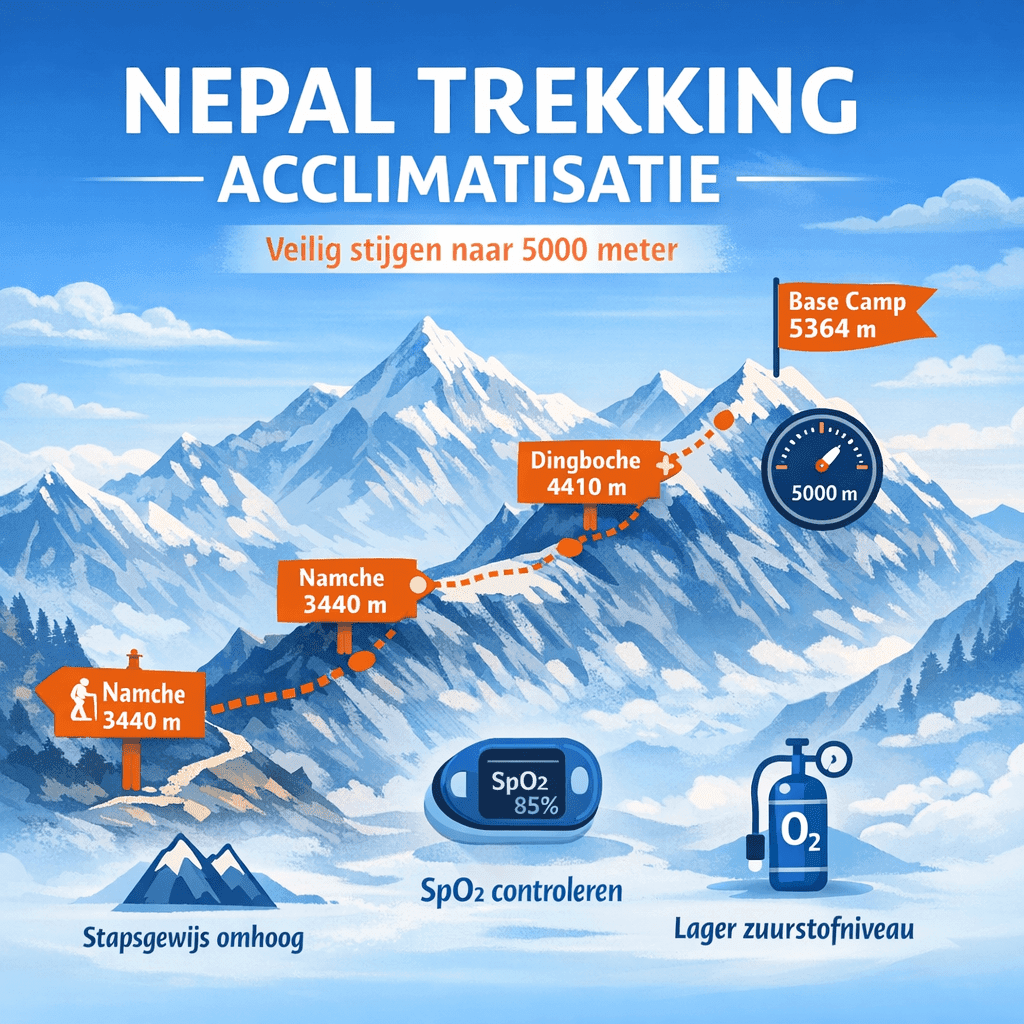
- Day 3: Namche Bazaar (3440 m)
- Day 4: acclimatisation day Namche
- Day 5: Tengboche (3860 m)
- Day 6: Dingboche (4410 m)
- Day 7: acclimatisation day Dingboche
- Day 8: Lobuche (4910 m)
- Day 9: Everest Base Camp (5364 m)
The rest days around 3400 metres and 4400 metres are crucial. They give the body extra time to adjust physiologically.
You can also read more background on safe acclimatisation in acclimatising for 6000 metres.
Acclimatisation schedule Annapurna Circuit
The Annapurna Circuit trek follows a slightly different profile, but the same principles apply.
Key acclimatisation points
- Manang (3540 m) acclimatisation day
- Yak Kharka (4050 m)
- Thorong Phedi (4450 m)
- Thorong La pass (5416 m)
The rest day in Manang is an essential time. Here, many trekkers take an acclimatisation hike to around 4,000 metres and then descend to sleep again.
This principle is also called:
climb high, sleep low
A similar physiological principle is used in sleep high train low protocols.
How fast can you climb in the Himalayas
International guidelines usually advise:
- above 3000 m up to 300 to 500 metres extra sleep altitude per day
- a rest day after every 1,000-metre ascent
Many Nepal treks follow this principle fairly closely. Nevertheless, weather conditions or logistics can sometimes force a faster pace.
This is why self-monitoring is important.
This is how you monitor acclimatisation objectively
Subjective feelings are important, but objective monitoring helps identify problems early.
1. SpO2 trend
If possible, measure your oxygen saturation daily.
Important: look at the trend over several days. A single reading says little.
You can read more about this in oxygen saturation at altitude.
2. Sleep quality
Suddenly worse sleep can be a first sign of adaptation stress.
Many triggers experienced:
- lighter sleep
- more night waking
- faster breathing
3. Symptom development
Pay special attention:
- headache
- nausea
- loss of appetite
- extreme fatigue
These symptoms may indicate incipient altitude sickness.
You can read more about this in altitude sickness symptoms and risks.
Practical decision rule
Do symptoms get noticeably worse after a rise? Then it is wise to take an extra rest day or descend slightly.
Can you prepare acclimatisation already at home
More and more trekkers are preparing their Nepal trekking in advance with a pre acclimatisation programme.
In this approach, you sleep in an altitude tent several weeks beforehand in which the oxygen level is reduced. This is called normobaric hypoxia.
As a result, the body starts the acclimatisation process even before you leave for Nepal.
Key features of this method:
- sleep is the primary stimulus
- height is built up incrementally
- adaptation is tracked via SpO2 trends
An altitude tent does not completely replace acclimatisation in the mountains. However, it can significantly reduce the risk of altitude sickness and make the process more predictable.
You can read more background in acclimatising at home for mountain expeditions.
The biggest mistakes in Nepal trekking acclimatisation
Many problems arise from a number of classic mistakes.
Rising too fast
Saving extra days seems attractive, but significantly increases the risk of complaints.
Skip rest days
Acclimatisation days are not a luxury but an essential part of the schedule.
Ignoring symptoms
Many trekkers try to walk on despite incipient symptoms. This increases the risk of more serious forms of altitude sickness.
No monitoring
Without objective signals, you sometimes notice too late that the body is struggling to adapt.
Conclusion
A good nepal trekking acclimatisation is one of the most important factors for a safe trek to Everest Base Camp or Annapurna.
A sensible rate of ascent, strategic rest days and objective monitoring allow the body to better adapt to altitude.
Those who additionally prepare acclimatisation in advance can further reduce the risk of problems.
Preparing at home for a trek above 5,000 metres?
With a pre-acclimatisation programme, you can start the acclimatisation process before you leave for Nepal.
View acclimatisation programme for treks above 5,000 metres
or read about the high altitude tent experiences of other climbers