Climbing Manaslu: route and schedule
Published 4 May 2026 · 19 min read
Climbing Manaslu: route and schedule requires more than a list of camp numbers, altitudes and a possible summit day. The most important question is how much margin you keep along the way. At 8,163 metres, Manaslu is among the 14 eight-thousanders. As a result, your acclimatisation often determines more than your pure climbing fitness.
Many expeditions present the normal route on Manaslu as a logical first 8000m expedition. Yet that picture remains too simple. This mountain requires strong basic fitness, experience with fixed ropes, discipline in recovery and, above all, planned handling of altitude. Those who work in advance to acclimatising at home for mountain expeditions, start the expedition not risk-free, but with more control.
Short answer: Manaslu is usually climbed via the northeast normal route. Base camp is around 4,800 metres. This is usually followed by four altitude camps towards the summit at 8,163 metres. A realistic schedule often takes 5 to 7 weeks from Kathmandu, including trekking, rest days, rotations, summit window and descent. Sleeping in an altitude tent for 3 to 4 weeks beforehand can significantly reduce the risk of altitude sickness, as your body already gets used to less oxygen in a controlled way.
Conclusion: Climbing Manaslu mainly requires a smart acclimatisation schedule, not just strong legs.
Nuance: An altitude tent does not replace real acclimatisation on the mountain, but it makes your preparation controlled, measurable and planable.
Practical hook: Ideally, start 4 weeks before departure and steer for SpO2 trend, sleep quality, recovery and complaints.
Climbing Manaslu: route and schedule in brief
Most expeditions follow the northeastern normal route. First, you travel to Kathmandu. This is followed by the approach to the Manaslu region. Then you trek through lower-lying villages towards Samagaon and Manaslu Base Camp. That trek is not a formality, but the first real acclimatisation layer.
From base camp to four altitude camps
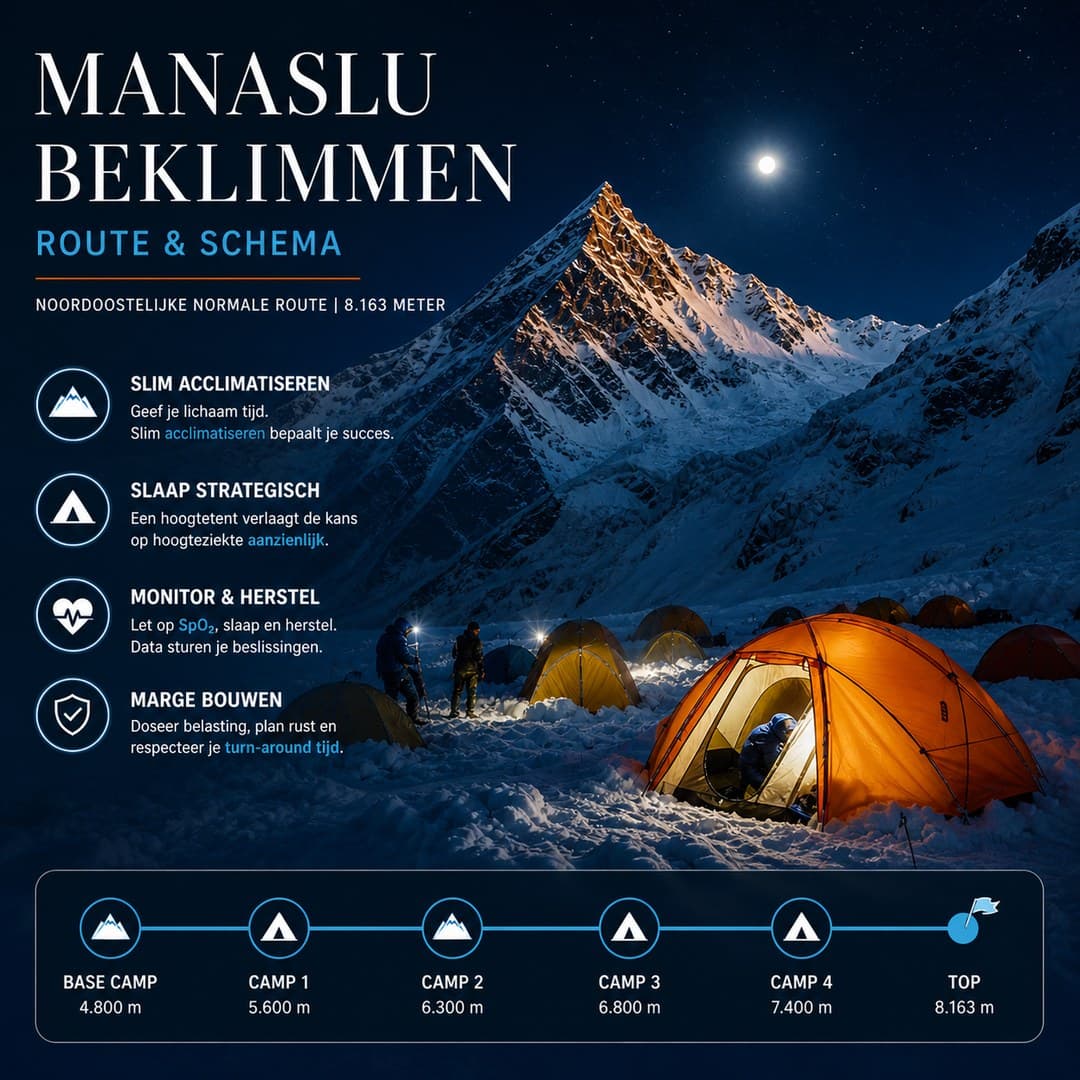
From base camp, the climbing phase begins. The route crosses moraine, glacier, snow slopes and higher camps. The exact camp layout varies by organisation, season and route condition. Usually you see the same pattern: base camp around 4,800 metres, camp 1 around 5,500 to 5,800 metres, camp 2 around 6,300 to 6,400 metres, camp 3 around 6,800 to 6,900 metres and camp 4 around 7,400 to 7,450 metres.
Why the summit day is not the only benchmark
After camp 4 comes the summit attempt. That day is long, cold and mentally demanding. Moreover, the descent is often at least as decisive as reaching the summit. Experienced climbers therefore do not only look at when they can reach the top. They also assess oxygen reserve, weather margin, crowding on fixed ropes and the quality of the descent.
The true summit of Manaslu
At Manaslu, the last ridge is especially important. In recent years, there has been a lot of focus on the difference between the pre-summit and the actual highest peak. Therefore, ask your expedition provider specifically how the route is fixed, to where the ropes run and how summit claims are assessed.
Practice interpretation: Within the category of eight-thousanders, Manaslu is relatively accessible but not easy. The greatest strain often comes from accumulation: lack of sleep, cold, appetite loss, glacier stress, congestion on fixed ropes and too little recovery between rotations.
Why Manaslu is not just a route question
If you search on Manaslu climbing, you will usually see daily schedules and camp overviews. Such a schedule is valuable only when you understand what each stage does to your body. The route is the outside. Acclimatisation is the inside.
Height is the dominant factor
At 8,163 metres, the available oxygen pressure is extremely low. As a result, your body has to work much harder to get enough oxygen to muscles, brain and organs. Your breathing speeds up, your heart rate rises and your sleep becomes lighter. Moreover, your recovery slows down after each day of climbing.
Altitude sickness often starts subtly
Therefore, it is wise to symptoms of altitude sickness not to be taken seriously until the mountain. Headaches, nausea, dizziness, restless sleep and noticeable loss of appetite are not details. Such signs can indicate that your ascent rate, load or recovery is out of balance.
Condition helps, but does not compensate for altitude
Strong endurance skills remain important. Yet fitness does not prevent altitude sickness. Indeed, fit climbers sometimes take too much risk because they easily keep up in the lower stages. As a result, they ascend faster than their acclimatisation allows.
At Manaslu, that risk is real. The lower route often feels manageable to experienced mountaineers. Then the temptation arises to shorten rotations or skip rest days. This is precisely where things go wrong. The body needs not only stimulus, but also time to process that stimulus.
The normal route on Manaslu
The normal route starts from base camp on the north side of the mountain. You then move across glacier terrain to camp 1. This is followed by the climb towards camp 2, often seen as one of the more taxing and technically mindful parts of the route.
Camp 1 and camp 2 require focus
Between camp 1 and camp 2, crevasses, seracs, fixed ropes and changing snow conditions play a bigger role. This makes this section not only physically but also mentally exhausting. Experienced climbers sometimes underestimate this section because it does not look extremely steep. Yet a slow passage here can take a lot of energy.
Timing is part of safety
Moreover, congestion often occurs here when many teams move in the same weather window. Therefore, timing is important. A strong expedition leader plans not only based on weather, but also on crowding, rope fixing, route condition and team recovery status.
Camp 3, camp 4 and the summit push
Above camp 2, the altitude takes over more and more. Camp 3 is usually around 6,800 to 6,900 metres. Camp 4 is often around 7,400 to 7,450 metres. From there, the summit attempt starts, usually early at night.
At that point, it's all about margin. You want to have enough energy to ascend, but also to keep clear thinking. You also need to be able to descend in case of cold, fatigue and possible crowding on the route. Therefore, a turn-around time should always be part of the schedule.
Route stages and expert focus
| Phase | Height | Target | Expertfocus |
|---|---|---|---|
| Home | Gradual hypoxia simulation | Getting used to less oxygen in advance | Don't force high, but keep sleep and recovery stable |
| Trekking | Approximately 700 to 4,800 m | Quiet transition to real height | Limit pace, monitor appetite and avoid infections |
| Base camp | Approximately 4,800 m | Recovery, logistics and initial climate adaptation | Rotate only when sleep, appetite and energy are stable |
| Camp 1 and 2 | 5,500 to 6,400 m | Glacier route and technical acclimatisation | Move efficiently on fixed ropes and reduce energy loss |
| Camp 3 and 4 | 6,800 to 7,450 m | Building summit position | Monitoring recovery, oxygen strategy, weather and turn-around time |
Situation: You gradually build up hypoxia simulation.
Objective: The body gets used to less oxygen beforehand.
Focus: Keep sleep and recovery stable, without forcing too high.
Altitude zone: The run-up runs roughly from 700 to 4,800 metres.
Importance: This phase marks the transition to true height.
Focus: Limit your pace, monitor appetite and avoid infections.
Altitude zone: Base camp is usually around 4,800 metres.
Importance: Here you combine recovery, logistics and initial climbing adaptation.
Focus: Start rotations only when sleep, appetite and energy are stable.
Altitude zone: These camps are usually between 5,500 and 6,400 metres.
Importance: You will have to deal with glacier route and technical acclimatisation.
Focus: Move efficiently on fixed ropes and limit energy loss.
Altitude zone: The highest camps are often between 6,800 and 7,450 metres.
Importance: You build summit position.
Focus: Monitor recovery, oxygen strategy, weather and turn-around time.
Climbing Manaslu: route and schedule with altitude tent
For Manaslu, sleeping in an altitude tent beforehand is particularly relevant. After all, you are not preparing for a short trekking summit, but for an expedition above 8,000 metres. As a result, the physiological margin is smaller. At the same time, the consequences of poor sleep, too rapid ascent or late adjustment are greater.
The value of controlled exposure
An altitude tent does not lower air pressure. The system lowers the oxygen percentage in the air you breathe. This creates normobaric hypoxia: you get an altitude stimulus while sleeping at normal air pressure at home.
This stimulus is valuable because you build up many hours of exposure without greatly disrupting your training or daily load. Moreover, you can quietly increase the stimulus. This makes preparation measurable and planable.
What an altitude tent does and does not do
An altitude tent is no substitute for acclimatisation on the mountain. Nor does it offer a 100 per cent guarantee against altitude sickness. However, it can significantly reduce the risk of altitude sickness, especially if your build-up is calm, consistent and SpO2-controlled.
Why sleep is more important than single sessions
For an 8000m expedition, total exposure is crucial. This is why sleeping is so interesting. You build up several hours of hypoxia stimulus night after night. Then you can train, work and recover normally during the day.
At Manaslu, this is practically strong. You don't arrive at 4,800 metres completely unprepared. Moreover, you have already learned how your body reacts to oxygen deprivation. This allows you to better interpret signals during trekking and at base camp.
A concrete 4-week protocol for Manaslu
For Manaslu, a preparation of three to four weeks makes sense. Four weeks gives more room to start slowly, stabilise and not build up too aggressively just before departure. The highest setting is not the goal. A stable response is the goal.
Protocol for experienced mountaineers
Experienced climbers often want to move quickly to a higher simulation. Yet this is not always wise. When sleep quality drops, you lose some of the advantage. Therefore, the build-up should feel like controlled adaptation, not an extra training camp.
Guideline: preferably sleep in the altitude tent until the last practical night before departure. For an expedition like Manaslu, it makes sense to maintain habituation as close to the trip as possible. However, do not increase aggressively in the final days.
Use your trend as a steering tool
A single SpO2 value says little. Rather, look at several mornings in a row. Combine that trend with your sleep quality, sense of rest and any complaints. That way, you avoid increasing too quickly or remaining unnecessarily cautious.
Four-week build-up in practice
| Timing | Focus | Target | Adjust when |
|---|---|---|---|
| Week 4 | Start slowly | Maintaining sleep quality and getting used to hypoxia | Headaches, restless sleep or marked fatigue increase |
| Week 3 | Increase incentive | Accrue more effective night hours | SpO2 trend drops too sharply or recovery gets worse |
| Week 2 | Stabilise | Consistent night routine and reliable morning measurements | You wake up several mornings markedly less refreshed |
| Week 1 | Holding | Maintaining habituation without disrupting departure fitness | You build up symptoms or sleep loss just before departure |
Starting point: Start calmly and maintain good sleep quality.
Objective: Your body gets used to the initial hypoxia stimulus.
Adjustment: Lower the stimulus in case of headaches, restless sleep or obvious fatigue.
Structure: Increase the incentive only when the first week was stable.
Objective: Build more effective night hours.
Adjustment: Stabilise when the SpO2 trend drops too much or recovery gets worse.
Rhythm: Make your night routine and morning measurements consistent.
Objective: Confirm that you are processing the stimulus well.
Adjustment: Take it easy when you wake up several mornings less than fresh.
Departure phase: Maintain habituation without aggressively increasing.
Objective: Leave fit, rested and adjusted.
Adjustment: Choose rest when complaints or loss of sleep arise just before departure.
A realistic expedition programme for Manaslu
A Manaslu expedition often takes 35 to 45 days from Kathmandu. Some programmes are longer. This is not automatically inefficient. On the contrary, on an 8000m expedition, extra time often gives more margin for recovery, weather and route conditions.
Why a wider schedule is often stronger
A short programme looks attractive. Yet faster usually means less flexibility. If one rotation goes badly, the weather turns, or your team is delayed, the reserve quickly disappears. Therefore, with Manaslu, don't just look at the planned top day. Above all, look at the recovery space before it.
What experienced climbers pay particular attention to
A good schedule includes rest days that are allowed to be real rest. There should also be room to re-enter a camp without having to head straight for the summit. This prevents logistics from driving medical decision-making.
Schedule as a conversation with your expedition provider
Use the programme not as leaflet text, but as a checklist. Ask where the buffer days are, how rotations are adjusted and who makes the final medical decision. Experienced climbers in particular benefit from clear agreements before fatigue and top pressure come into play.
Example of a realistic shipping layout
| Phase | Days | What happens | What you pay attention to |
|---|---|---|---|
| Arrival | Day 1 to 3 | Kathmandu, briefing, equipment check, permits | No fatigue piling up before the draw starts |
| Approach | Day 4 to 12 | Drive and trek towards Samagaon and base camp | Monitor pace, hygiene, sleep and appetite |
| Base camp | Day 13 to 17 | Installation, rest, puja, skills and first exploration | Do not rotate when recovery is still clearly lagging behind |
| Rotations | Day 18 to 30 | Climb to camp 1, camp 2 and possibly camp 3 | Load dosage and do not stay high unnecessarily long |
| Top phase | Day 31 to 40 | Rest, weatherwindow, camp 4 and summit push | Only proceed if there is sufficient physical and mental margin |
| Descent | Day 41 to 45 | Back to base camp and Kathmandu | Keeping concentration until the expedition is really finished |
Timing: Day 1 to 3.
Programme: Kathmandu, briefing, equipment check and permits.
Point of attention: Avoid starting the trek already tired.
Timing: Day 4 to 12.
Programme: Drive and trek towards Samagaon and base camp.
Point of attention: Monitor pace, hygiene, sleep and appetite.
Timing: Day 13 to 17.
Programme: Installation, rest, puja, skills and first exploration.
Point of attention: Rotate only when recovery is sufficiently stable.
Timing: Day 18 to 30.
Programme: Climb to camp 1, camp 2 and possibly camp 3.
Point of attention: Dose load and don't stay high unnecessarily.
Timing: Day 31 to 40.
Programme: Rest, weatherwindow, camp 4 and summit push.
Point of attention: Proceed only with sufficient physical and mental margin.
Timing: Day 41 to 45.
Programme: Back to base camp and Kathmandu.
Point of attention: Hold concentration until the expedition is really done.
Strategic insights for experienced mountaineers
For experienced mountaineers, the profit is not in basic explanations. The gain is in better choices under pressure. Manaslu rewards climbers who move efficiently, manage their ego and adjust early enough.
Insight 1: more rotations are not always better
More rotations sound safe, but they also cost recovery. When you go to high camps too often, you pile up sleep deprivation, fluid loss and appetite problems. Therefore, the best strategy is not always maximum exposure. Often the better answer is sufficient stimulus, then real rest.
Insight 2: oxygen use does not replace acclimatisation
Many Manaslu climbers use supplemental oxygen in the summit phase. This can make the summit push more manageable. Still, oxygen should not be an excuse for weak acclimatisation. Discuss in advance flow rates, bottle changes, spare capacity, mask comfort and what to do in case of equipment problems.
Insight 3: traffic jams are a security risk
On popular peak days, crowds on fixed ropes can disrupt your schedule. As a result, you stand still longer, cool down faster and consume more oxygen and energy. It is wise to discuss in advance how your team will handle start time, catch-up policy and turn-around decisions.
Insight 4: stomach and gut often determine your expedition
Many climbers focus on lungs, legs and equipment. Yet a gastrointestinal infection can quickly undermine your acclimatisation and recovery. Therefore, hygiene, nutrition, fluid intake and caution with unfamiliar food are not details, but performance conditions.
Insight 5: descent requires advance policy
A summit plan without a descent plan is incomplete. Agree in advance on the minimum oxygen reserve, when to turn around and how to act in case of frozen hands, confusion or extreme sluggishness. It is precisely fatigue after the summit that makes objective decision rules valuable.
Common misconceptions about Manaslu
The first misconception is that Manaslu is an easy 8000er. Better is: Manaslu is logistically more accessible than some other eight-thousanders. That is different from safe or easy.
Misconception: a short schedule is more efficient
A short schedule may seem appealing. Yet at Manaslu, it is often fragile. When weather, route conditions or recovery are disappointing, pressure quickly arises to continue anyway. As a result, the focus shifts from sensible climbing to meeting the schedule.
Misunderstanding: acclimatisation only starts in Nepal
For some treks, on-site preparation may be sufficient. For Manaslu, it makes less sense. Your goal is above 8,000 metres. Therefore, sleeping in an altitude tent beforehand is not a luxury extra, but a rational way to take the first physiological step already at home.
Misconception: one good SpO2 value says enough
A single saturation measurement may seem reassuring. Yet one measurement says little. Cold fingers, measurement time, breathing and measuring device affect the value. Therefore, look at the trend in combination with sleep quality, symptoms and recovery.
To do and not to do in preparation
Do: Start pre-acclimatisation early, build up slowly, look at measurements as a trend and critically assess your expedition planning.
Don't: setting the altitude tent too high too soon, ignoring poor sleep, relying only on fitness or thinking that previous 4000m experience is enough.
This is how you monitor this lens
Monitoring makes your preparation sharper. Especially when sleeping in an altitude tent, you don't want to steer by one single value. Therefore, look at trends over several days. Combine SpO2 with sleep, recovery and complaints.
Trends outweigh single measurements
Many users steer for a morning trend around 92 to 94 per cent in the altitude tent, depending on person, phase and habituation. Still, trend remains more important than a single number. If you sleep well, recover stably and do not develop symptoms, the stimulus is often more tolerable.
Always measure under similar conditions
Preferably measure immediately after waking up and before you actively move. Make sure your hands are warm and always use the same meter. This will make your values more comparable. If you want to interpret this properly, find out in advance about normal saturation at altitude.
Monitoring points for the altitude tent
| Signal | What you are following | Interpretation | Action |
|---|---|---|---|
| SpO2 trend | Morning value over several days | Trend is more important than one single measurement | Increase only if trend remains stable |
| Sleep | Falling asleep, sleeping through and waking up rested | Poor sleep often indicates too much stimulus | Taking a step back or stabilising for longer |
| Recovery | Resting pulse, training sensation and fatigue | Recovery must remain bearable | Reduce training load temporarily |
| Symptoms | Headache, nausea, dizziness, tightness in the chest | Complaints are more important than planning | Do not increase and seek medical advice if necessary |
Measurement: Track your morning reading over several days.
Significance: The trend says more than one single measurement.
Action: Increase only when the pattern remains stable.
Measurement: Pay attention to falling asleep, sleeping through and waking up rested.
Significance: Poor sleep often indicates too much stimulus.
Action: Take a step back or stabilise longer.
Measurement: Combine resting pulse, training feel and fatigue.
Significance: Recovery must remain bearable.
Action: Temporarily reduce your training load.
Measurement: Watch for headaches, nausea, dizziness and tightness in the chest.
Significance: Complacency outweighs your schedule.
Action: Do not increase and seek medical advice if necessary.
Decision rules for a stronger Manaslu scheme
A strong schedule doesn't just give days and heights. It also gives decision rules. When do you move on? When do you stay an extra night? When do you turn back? And when do you accept that the summit is not more important than descending safely?
When planning feels right
A schedule is stronger when your sleep quality remains stable, your appetite remains reasonable and you really recover after rest days. Moreover, you want rotations to leave room for adjustment. When each camp is directly linked to an inevitable next step, margin is lacking.
When to slow down
Slow down if there is a marked decline in recovery, persistent headache, nausea, unusual shortness of breath at rest, confusion or poor sleep over several nights. A sudden loss of appetite also deserves attention. Especially above base camp, small signs can quickly grow larger.
This is relevant when: you plan Manaslu as your first 8000er, were previously sensitive to altitude, have little time for slow acclimatisation in Nepal or want maximum control over your preparation.
Be cautious when: you are sick just before departure, sleep badly, get obvious complaints at low simulation or your training load is already too high.
Use a gentle build-up schedule
When preparing in the tent, use a calm structure. A practical next step is to follow a clear assembly diagram for the high altitude tent. This prevents motivation from pushing the incentive up too fast.
Checklist for the last few weeks before Manaslu
The last weeks before departure are not a time to improve everything quickly. Above all, you want to leave fit, rested and adapted. That is why this phase is about consistency, not heroism.
Practical checklist
- Preferably start sleeping in an altitude tent 4 weeks before departure.
- If possible, sleep in the altitude tent until the last practical night before departure.
- Do not increase aggressively in the last few days.
- Measure SpO2 as a trend, not an absolute truth.
- Do not plan heavy training blocks in the last acclimatisation week at home.
- Discuss with your expedition provider how many rotations and rest days are provided.
- Ask how the route to the true summit is fixed and assessed.
- Agree in advance on complaints, reversal and oxygen reserve.
- Train efficient movement with ascender, descender and thick gloves.
- Protect your stomach and intestines from day one of the trip.
CTA: prepare Manaslu in a controlled manner
On an 8000m expedition, you don't want to discover how your body reacts to altitude only in Nepal. This is why pre-acclimatisation for Manaslu is a logical choice. It makes your preparation more relaxed, concrete and measurable.
Prepare Manaslu in a controlled manner with pre-acclimatisation
On an 8000m expedition, you want to leave with as much margin as possible. With an altitude tent, you build controlled exposure at home, steer on your SpO2 trend and significantly reduce the risk of altitude sickness, without pretending that risk disappears completely.
Conclusion: route, schedule and preparation belong together
Climbing Manaslu does not start at camp 1 and does not end with a schedule on paper. The route gives direction, but your acclimatisation determines how much margin you keep along the way. Therefore, it is wise to look at the schedule more broadly: prepare at home, slowly get to base camp, rotate conservatively and go up only when recovery, weather and health add up.
Why pre-acclimatisation makes sense
Sleeping in an altitude tent beforehand is a strong choice in this regard. It significantly reduces the risk of altitude sickness, as your body learns to cope with less oxygen even before departure. At the same time, nuance remains important: an altitude tent is no substitute for real acclimatisation on the mountain and does not offer a full guarantee.
The most important choice
In short, if you prepare Manaslu seriously, you are not just choosing fitness and equipment. Above all, you choose margin. On an 8,163-metre mountain, margin is not a detail, but an essential part of your expedition.
Frequently asked questions about climbing Manaslu
How high is Manaslu?
Manaslu is 8,163 metres high. This makes it the eighth highest mountain in the world and a full 8,000m expedition.
How long does a Manaslu expedition last?
Many programmes last about 35 to 45 days from Kathmandu. A wider schedule gives more margin for acclimatisation, recovery and weather.
Is Manaslu suitable as a first 8000er?
For experienced mountaineers, Manaslu can be a logical first 8000er. Still, the altitude remains extreme and the expedition requires serious preparation.
How long in advance should I sleep in an altitude tent?
For Manaslu, sleeping in an altitude tent 3 to 4 weeks in advance is a logical guideline. Four weeks gives more room to build up slowly.
Does an altitude tent completely prevent altitude sickness?
No. An altitude tent significantly reduces the risk of altitude sickness, but does not offer a complete guarantee. On the mountain, acclimatisation remains necessary.
Resources and deepening
For general mountain data, you can visit the page of the Nepal Tourism Board on Manaslu consult. For route layout and camp context, current expedition notes from Adventure Consultants and Climbing the Seven Summits relevant. For the discussion around the true summit, the analysis of ExplorersWeb on Manaslu useful.