Using an altitude tent: complete guide – depth and frequently asked questions
Published 7 January 2026 · 8 min read
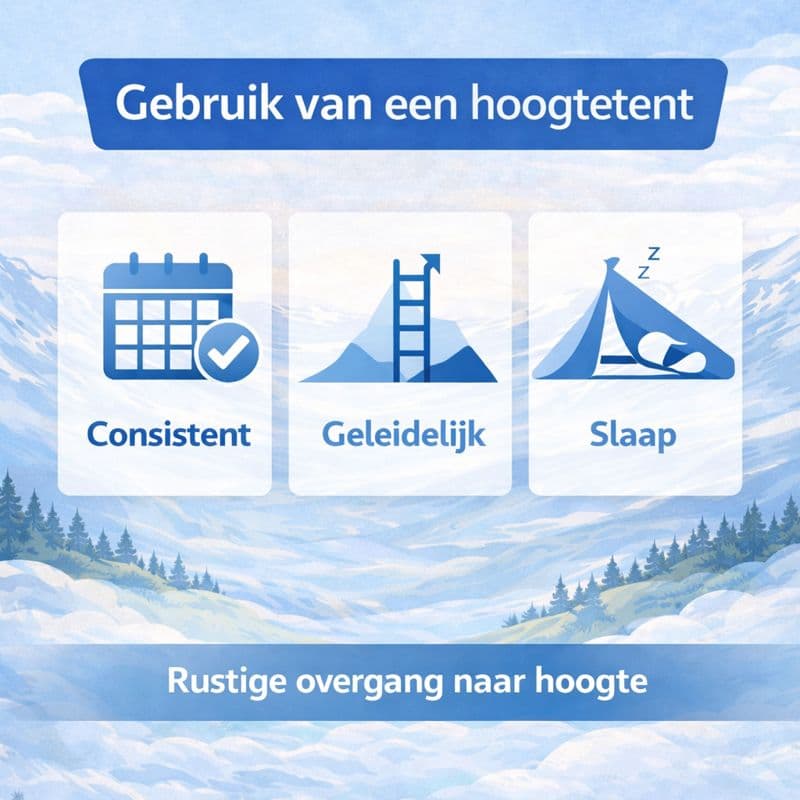
Using an altitude tent is by now familiar territory for many athletes and mountain travellers. Yet in practice, the most relevant questions arise just after the first introduction. Does a high altitude tent work even without a sport goal? What if you sleep worse? How long do you have to start using it to really benefit from it? And how do you cleverly combine it with training, travelling and recovery?
This in-depth is designed for readers who already understand the basics but need nuance, context and informed answers to frequently asked questions. You'll get a practical decision framework, clear red flags and concrete tips to tailor settings and approaches to your goal. In doing so, this article acts as a deepening reference point within the altitude tent and pre-acclimatisation cluster.
What exactly do we mean by pre-acclimatisation?
Pre-acclimatisation means acclimatising your body to low-oxygen conditions beforehand, so that the transition to altitude is less abrupt. This can be done off-road by gradually ascending, or controlled at home by simulating hypoxia. In the latter case, an altitude tent is a sleeping environment in which oxygen levels are reduced while air pressure remains the same as sea level.
The goal is not to “go maximum high”, but to build adaptation with as little disruption to your sleep and recovery as possible. In practice, successful pre-acclimatisation is about three things: consistency, a smart build-up and monitoring load.
When does a high altitude tent really become relevant?
The effectiveness of an altitude tent depends less on the device itself and more on the context in which it is deployed. In practice, we see three situations where its use makes the most sense in terms of content.
1) Rapid exposure to altitude
Trips that involve reaching altitudes above 3,000 metres within a few days increase the likelihood of complaints and performance loss. Think of treks with tight schedules, expeditions, or events that start at altitude. In these situations, pre-acclimatisation can clearly support the starting phase, as your body is already accustomed to lower oxygen availability.
2) Limited time or logistics
Not everyone can plan an altitude training trip in advance. An altitude tent then offers a controlled way to deploy hypoxia without travel time, jet lag, extra training load or staying at altitude. Especially with a busy work schedule, this can make the difference between “arriving unprepared” and “starting with margin”.
3) Previous complaints or sensitivity to altitude
If you have experienced symptoms at altitude before, even at relatively limited metres, you are more likely to be more sensitive to hypoxia. Especially in that group, a gentle build-up and good plan is important. An altitude tent can then help smooth the transition in the first few days, provided you dose the stimulus and monitor your recovery.
What happens physiologically with long-term use?
A frequently asked question is whether the body can “over-adapt” to altitude or actually become less susceptible to hypoxia. The bottom line is: adaptation is functional and largely temporary, and the effect does not accumulate indefinitely.
Adaptation is temporary and reversible
Repeated exposure to hypoxia causes the body to adapt, including through changes in breathing, oxygen transport and more efficient use of limited oxygen. When the hypoxic stimulus subsides, this effect gradually subsides again. This is normal and also exactly why timing and consistency are important.
The effect is not linear
More weeks or a higher setting does not automatically yield more results. In practice, the adaptation curve flattens: the greatest gain is often in the first weeks of consistent, well-tolerated exposure. We therefore recommend a window of use of at least 4 weeks and a maximum of 6 weeks. Within this window, the balance between effect and load capacity is usually most favourable.
Impact on ventilation and recovery
Hypoxia affects your ventilation and can lighten your sleep, especially if the setting is too aggressive. This is not a “flaw” of the method, but a signal that dosage and build-up could be better. Successful pre-acclimatisation is a process, not an on-off switch.
Sleep quality is your most important steering tool
One of the most underrated factors when using an altitude tent is sleep quality. Pre-acclimatisation works best when your recovery remains intact. When sleep structurally deteriorates, the overall load becomes too high and you get less out of the route.
How do you recognise that the stimulus is too strong?
- You wake up more often or sleep restlessly for no apparent reason
- You have a morning headache or don't feel recovered
- You feel flat, irritable or noticeably tired during the day
- Your workout feels heavier while your schedule is not more intense
How do you make adjustments without stopping everything?
Adjusting is often simpler than people think. Instead of “continue or stop”, you can make the stimulus doseable:
- Lower the height equivalent temporarily
- Make the build-up slower and increase only after a few good nights
- Schedule recovery nights in normal oxygen if your recovery is lagging behind
- Set sleep and recovery above maximum metres
The goal is consistent, well-tolerated use. That almost always delivers more than short spikes of poor sleep.
The role of an altitude tent in comfort and tolerance at altitude
Pre-acclimatisation with an altitude tent is increasingly used to improve tolerance for altitude and make the first days more comfortable. Combined with thoughtful planning and a responsible pace of ascent, this constitutes valuable preparation for altitude for many users.
Practically, this means that you often experience less “transition stress”: your breathing adapts faster, exertion feels more manageable earlier and you usually recover more easily in the first phase of a trip or stage. How big that effect is varies per person and per plan, but the gist is that a high altitude tent allows you to better support the starting phase.
If you want to delve further into a safe acclimatisation plan, also read our article preventing altitude sickness with a smart pace of ascent and good signalling.
Combination with training: sleep high, train low in practice
Many athletes combine an altitude tent with training at sea level on the principle of sleep high, train low. The idea: you sleep in hypoxia (adaptation), but train in normal oxygen (quality). This way, your training stimulus remains good while you still build up the acclimatisation effect.
Why training should preferably remain normoxic
Intensive training in hypoxia can disproportionately increase the load. Your heart rate and perceived effort increase faster, while absolute training output is often lower. This can be useful in specific protocols, but for most athletes it is smarter to protect the quality of training and use hypoxia primarily as a sleep stimulus.
Tax monitoring: the overall picture counts
An altitude tent is an additional stressor. If you combine this with heavy training weeks, work stress, little sleep or travelling, the risk of your recovery lagging behind increases. A simple rule of thumb: if your recovery is clearly deteriorating, reduce the hypoxic stimulus before tinkering with your training plan.
Read more about this principle in our in-depth article on sleep high, train low.
Common dilemmas from practice
“I don't feel anything. Does it work then?”
Not everyone feels obvious sensations. Absence of symptoms or a “height feeling” says little. Adaptation can largely take place in the background. More important is whether your sleep remains good and whether you notice a smoother transition on arrival at altitude.
“Can I use a high altitude tent without a sport goal?”
Yes, provided the goal is clear. For mountain travellers who mainly want to start comfortably and ease into their first days at altitude, pre-acclimatisation can be valuable. However, in doing so, it is wise to build up the stimulus slowly and not focus on maximum settings.
“Is longer than six weeks better?”
Usually not. In practice, longer use rarely yields proportionally greater gains, while actually increasing the likelihood of poorer sleep or mental fatigue. Therefore, 4 to 6 weeks is often the most efficient and practical.
“Can I set too high?”
Yes. Setting it too high is one of the most common mistakes, often out of enthusiasm. The paradox is that it can actually work against you by making your sleep worse. The best protocol is almost always the one you maintain consistently with good nights.
“What if I fall ill or make a bad recovery in the middle of the process?”
Take it seriously. Illness, overtiredness or obvious recovery problems are signals to lower or temporarily pause the stimulus. Think of an altitude tent as training stress: you use it when your body can handle it.
Red flags and clear decision moments
The signals below do not automatically mean that you should stop, but rather that you should make immediate adjustments and lower the incentive:
- structurally bad nights for several days
- increasing morning headaches or marked daytime fatigue
- loss of appetite or noticeably higher resting heart rate
- training suddenly deteriorating sharply with no apparent explanation
In many cases, lowering the setting and rebuilding is enough to continue the trajectory successfully.
Practical decision framework: does a high altitude tent make sense to you?
Use this framework to make a quick, rational choice:
You will probably benefit from a high altitude tent if:
- you will soon be staying or performing above 3,000 metres
- your travel planning leaves little room for quiet build-up on site
- you are willing to actively monitor sleep and recovery
- you have a minimum of 4 weeks to do the track consistently
You may get less out of a high altitude tent if:
- your schedule already contains ample acclimatisation days
- your sleep is already fragile and you have no room to adjust
- you expect an altitude tent to make all other components redundant
For those who want to prepare properly, it helps to have your goals and planning briefly reviewed. More and more mountaineers and athletes choose to make pre-acclimatisation part of an overall plan, focusing on sleep, recovery and a responsible pace of ascent.
Resume
Using an altitude tent is especially effective when you think of it as a controlled, doseable stimulus. The biggest gains lie in a smart build-up, good sleep and consistent use. With a minimum of 4 weeks and a maximum of 6 weeks, you usually have the best balance between effect and load capacity.
Using an altitude tent with the right plan can improve tolerance for altitude and make the first few days more comfortable. Combine this with thoughtful planning and a responsible pace of ascent, and you take a strong step towards a better start at altitude.
Infographic proposal
Title: Using altitude tents: depth and nuance
Brief description: Minimalist infographic with three blocks: goal (pre-acclimatisation), preconditions (4 to 6 weeks, gentle build-up, sleep as a guide) and result (smoother start at altitude).
File name: altitude-dream-2-altitude-dream-1080×1080.png
Alt text: Infographic on in-depth use of an altitude tent with focus on sleeping, erection and comfortable start at altitude.