Acclimatisation schedules for Peru and Bolivia
Published 2 January 2026 · 3 min read
Peru and Bolivia are unique high-altitude countries: you often arrive at an altitude of over 3000 metres, stay at altitude for several days and make relatively long journeys without a gradual build-up. That is precisely why a good acclimatisation schedule is not a luxury here, but a prerequisite for preventing altitude sickness and enjoying your trip, trek or expedition to the full.
In this article, you will learn:
- Why acclimatising in Peru and Bolivia is fundamentally different from acclimatising in Nepal or the Alps
- what a safe acclimatisation schedule looks like per region
- what are the biggest pitfalls when arriving directly at altitude
- how to cleverly combine acclimatisation with travel and trekking planning
- when pre-acclimatisation offers a significant advantage
Key message: Anyone who wants to “push through” too quickly in Peru or Bolivia is almost guaranteed to encounter altitude problems. Rest, order and sleeping altitude determine success here.
Read also:
Altitude sickness: symptoms, risks and treatment
What is a normal acclimatisation rate per 1000 metres?
Why acclimatisation in Peru and Bolivia requires extra attention
Unlike classic Himalayan treks:
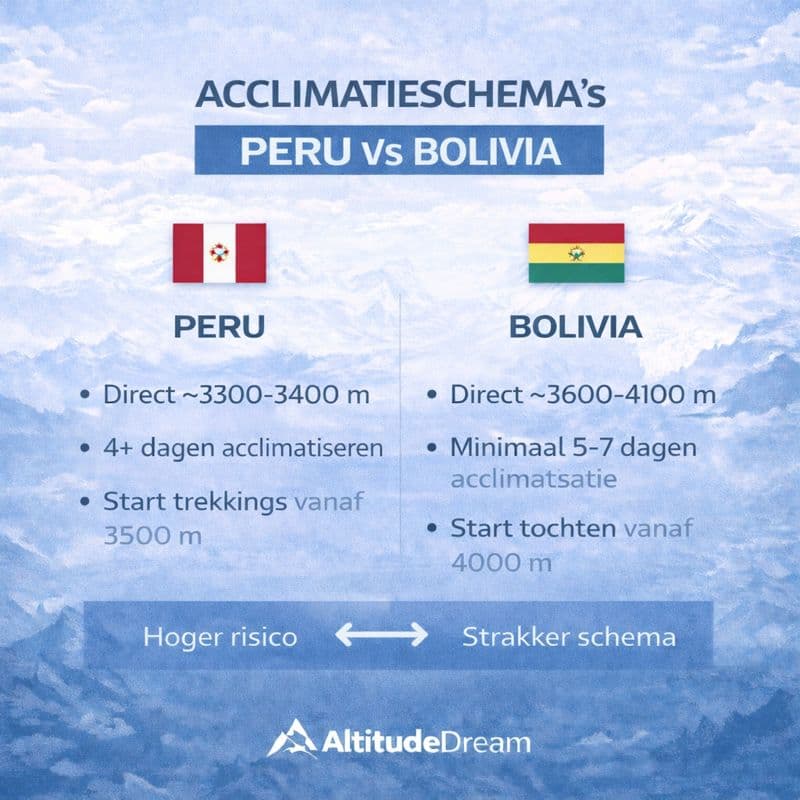
- do you fly often? directly to 3000–4100 metres
- Are you already sleeping at altitude during the first few nights?
- travel by bus or car without a gradual increase
Examples:
- Cusco (Peru): ~3,400 metres
- Puno (Peru): ~3,800 metres
- La Paz (Bolivia): ~3600–4100 metres
So your body doesn't get a “warm-up”. That explains why altitude sickness is so common in these countries among travellers who otherwise feel fit.
The basic principles for acclimatisation schedules in the Andes
1) The first 48 hours are sacred
The first two days determine whether acclimatisation succeeds or fails. Rest, low exertion and good sleep are more important here than sightseeing.
2) Sleeping height is more important than daytime height
You may ascend higher during the day, but your sleeping altitude must be increased gradually. This principle is often underestimated in Peru and Bolivia.
3) Not every “rest day” is passive
Light activity helps acclimatisation, as long as you sleep at a lower or similar altitude afterwards.
Acclimatisation schedule Peru – sample plan
Day 1–2: arrival and initial acclimatisation (Cusco or Arequipa)
- arrival at approximately 2300–3400 metres
- easy walks
- plenty of rest, no strenuous activity
- extra attention to hydration
Day 3–4: active acclimatisation
- day trips up to 3,800–4,200 metres
- return to the same sleeping height
- keep the pace slow
Days 5–7: further development
- overnight stays at around 3600–4000 metres
- shorter walks higher
- ready for multi-day treks such as Salkantay or Ausangate
Common mistake: travel directly to Puno or Lake Titicaca without any stopovers.
Acclimatisation schedule Bolivia – sample plan
Day 1–2: arrival in La Paz or El Alto
- sleeping altitude 3,600–4,100 metres
- very quiet first few days
- no stairs, no strenuous walks
Day 3–4: controlled exposure
- light day trips
- no extra sleeping height
- monitoring sleep quality
Days 5–7: preparation for higher hikes
- overnight stays at 4,200–4,500 metres
- day trips higher possible
- suitable time for Condoriri, Huayna Potosí base camp
Note: Bolivia is less forgiving than Peru due to its higher starting altitude.
Acclimatisation schedules for popular treks
Salkantay & Ausangate (Peru)
- acclimatise for at least 4–5 days beforehand
- First stabilise sleeping altitude at around 3,500–3,800 metres.
- extra rest day for passes above 4500 metres
Huayna Potosí (Bolivia, 6,088 metres)
- minimum 5–7 days of acclimatisation
- overnight stay at base camp around 4700 metres
- no quick “2-day” attempt without preparation
Common mistakes in Peru and Bolivia
- “I feel good, so I can keep going.”
- wanting to see too much in the first few days
- increase sleeping height by means of transport
- reasoning away altitude sickness
In the Andes, complaints are common delayed. That makes them particularly treacherous.
When is pre-acclimatisation useful?
Pre-acclimatisation with an altitude tent is particularly beneficial if:
- your schedule is tight
- you quickly reach altitudes above 4500–5000 metres
- you previously experienced altitude sickness
By sleeping in hypoxia beforehand:
- arrival is calmer
- do you sleep better during the first few nights?
- do you have more leeway when travelling onward?
View the Andes acclimatisation options:
Altitude tent hire and personal advice
How do you know if your acclimatisation is going well?
- sleep stabilises after 2–3 nights
- headache disappears with rest
- appetite returns
- resting heart rate gradually decreases
If complaints continue to increase, then the schedule is too aggressive.
Conclusion: acclimatisation schedules for Peru and Bolivia
Peru and Bolivia request discipline in the early days. Who:
- rest upon arrival
- sleep height monitored
- applies active acclimatisation
- parks his ego
will find these countries not only safer, but also more energetic and enjoyable.
Would you like to have your itinerary checked for acclimatisation risks?
Request personal advice