10 tips when sleeping in a height tent
Published 9 September 2012 · 12 min read
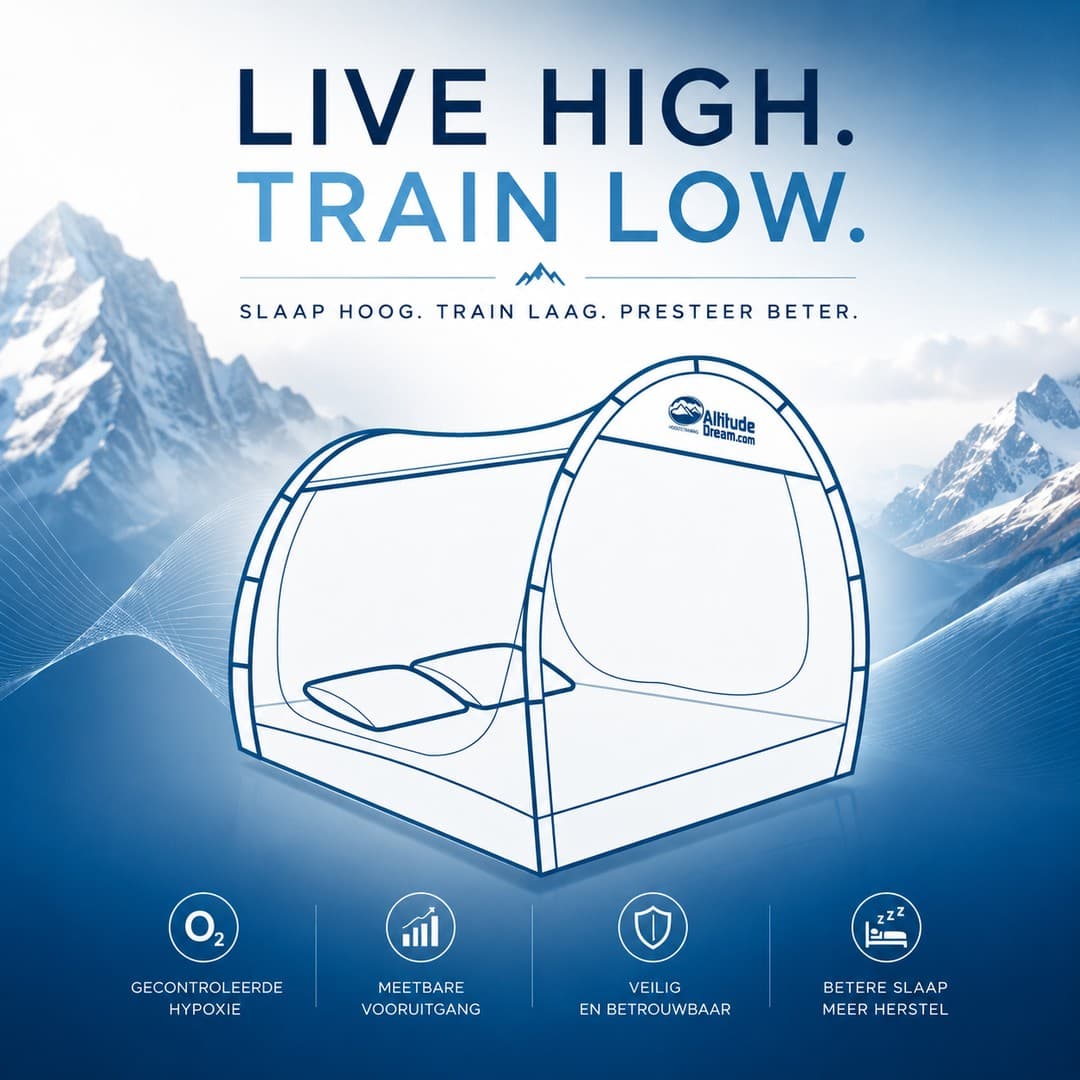
Live high train low This means you sleep in an environment with less oxygen, while continuing to train normally at low altitude during the day. For customers who are about to start using a rented altitude tent, this is the most important basis: the tent is not an extra training session that you need to force, but a controlled sleep stimulus that allows your body to gradually get used to less oxygen.
The goal is simple: you want to get enough hypoxic stimulus to stimulate adaptation, without unnecessarily compromising your sleep, recovery, or training quality. That's why a good LHTL protocol isn't about getting to a high setting as quickly as possible, but about building up slowly, measuring well, and adjusting smartly. Those who first master the basics of sleep high train low understands, usually gets more out of the altitude tent.
Short answer: use live high train low by preferably sleeping about 1 hour more than usual, gradually increasing, training normally during the day, and monitoring your SpO2 trend, sleep quality, recovery, and complaints daily. Only increase the setting when you are sleeping stably for several nights, recovering well, and your morning saturation indicates it.
Conclusion: live high train low works best if you view the altitude tent as a sleep stimulus, not as a performance test.
Nuance: Setting it higher isn't automatically better, especially in the first few days.
Practical hook: Sleep approximately 1 hour more than usual, measure daily and let recovery weigh heavier than ambition.
What "high train low" means practically
With live high train low, you spend several hours a day in a lower oxygen environment. In an altitude tent, this happens through normobaric hypoxia: the oxygen percentage is reduced, while the air pressure remains the same. Your body therefore experiences a similar oxygen stimulus as at altitude, but at home and more controllable.
The second part of LHTL is at least as important: you continue training at low altitude. This means you do not perform your normal running training, cycling training, strength training or recovery training in the altitude tent. This way, you can better maintain the quality of your training sessions while primarily receiving the adaptation stimulus during sleep.
This is interesting for athletes because training at real altitude often comes at the expense of intensity. For mountaineers and climbers, it's particularly interesting because you can acclimatise to low-oxygen conditions in a controlled way at home. The same principle applies in both cases: sleep soundly, build up gradually and don't overreact to a single measurement.
If you want to understand what is happening physiologically in more depth, then how altitude training works a logical explanation. This article focuses primarily on what to do concretely once the altitude tent has been delivered.
The first few days in the altitude tent
The first few nights often determine how pleasant the rest of your protocol goes. Therefore, do not start too aggressively. Your body needs to get used to the new sleeping environment, the sound of the equipment, the airflow, and the lower oxygen availability.
A calm start has three advantages. You sleep better, you notice more quickly what is normal for you, and you prevent mild complaints from being confused with too strong a stimulus. Especially during a first rental period, comfort is not a luxury, but a prerequisite for consistent use.
In addition, extra sleep is important. A practical rule of thumb is to plan for about 1 hour more sleep than usual during your altitude tent period. This doesn't mean you have to force yourself to stay in bed, but rather that you give your body extra recovery time. The hypoxic stimulus requires energy. Therefore, extra sleep helps to better maintain sleep quality, recovery, and training response.
Practical start-up protocol
- Night 1 and 2: Choose a conservative setting and focus on acclimatisation.
- Nights 3 to 5: Increase only if sleep and recovery remain stable.
- Afterwards: Build gradually, preferably on the basis of trend measurements.
- When in doubt: Stay a few nights at the same setting.
The biggest mistake is thinking you have to get the most out of it right away. With LHTL, total exposure over several weeks is often more important than one impressive night. Consistency, therefore, almost always wins over haste.
Live High Train Low: first week build-up schedule
The diagram below is intended as a practical guide. It does not replace personal advice, but helps you to start the first week calmly and measurably. The exact setting depends on your goal, experience, sleep quality, and individual response.
| Phase | Target | What you pay attention to | Practical decision |
|---|---|---|---|
| Night 1-2 | Getting used to sleeping in hypoxia | Sleep, comfort, headache, feeling of rest | Don't aim for maximum stimulus yet |
| Night 3-5 | Build stable exposure | SpO2 trend, recovery, morning feeling | Only increase if everything remains calm |
| Night 6-7 | Refine protocol | Multi-night trend | Hold on, increase or step back |
Objective: Getting used to sleeping in hypoxia.
Note: Sleep, comfort, headache, and feeling of rest.
Decision Don't send for maximum stimulation yet.
Objective: build stable exposure.
Note: SpO2 trend, recovery and morning feeling.
Decision only increase if everything remains calm.
Objective: Refine protocol.
Note: Trend over multiple nights.
Decision Hold, increase or step back.
A more in-depth exploration can be found in the article about the altitude tent construction diagram. Use that particularly when you are renting for several weeks or have a specific sporting or expedition goal.
The 10 most important usage rules
Use this checklist during your tenancy
- Sleep for approximately 1 hour more than usual. Extra sleeping space helps to maintain sleep quality and recovery.
- Get enough sleep. Less than 6 hours per night often gives too little consistent exposure.
- Build up gradually. Increase only when sleep, recovery, and saturation trend remain stable.
- Keep training normally. Keep heavy training outside the tent and monitor your training quality.
- Measure at fixed intervals. Preferably measure in the morning and compare trends.
- Use SpO2 as a trend. A single isolated value says less than the pattern over multiple nights.
- Pay attention to sleep quality. Poor sleep is often a signal that the stimulus is too intense.
- Drink and eat normally. Ensure adequate fluid intake, energy, and iron status where relevant.
- Prevent extra stress. Don't combine the start with extremely heavy training weeks.
- Send accompanying document with complaints. Headaches, restless sleep, or clear fatigue are reasons to slow down.
These rules sound simple, but they often determine the difference between a pleasant protocol and an unnecessarily arduous experience. Sleep quality is particularly important. A hypobaric tent doesn't work better if it leads to worse sleep. The stimulus needs to be strong enough to induce adaptation, but mild enough to be consistently maintained.
This is how you monitor this lens
Objective monitoring prevents you from building up too quickly based on gut feeling. Use measurements not as an exam, but as navigation. Especially the combination of SpO2 trend, sleep quality, recovery and complaints provides a good picture.
The most practical guideline is your morning oxygen saturation level. Ideally, measure this shortly after waking up, always at a similar time of day. The ideal morning saturation level is usually between 90% and 93%. Within this range, your body receives sufficient stimulation without the strain becoming unnecessarily heavy.
Saturation guidelines for live high train low
The table below shows the target values and associated actions. Use these values as practical guidance. Always look at the trend over multiple mornings and combine the measurement with sleep quality, recovery, and any complaints.
| Morning SpO2 | Action | Explanation |
|---|---|---|
| ≥ 94% | Increase height | Likely insufficient stimulus, provided sleep and recovery remain good |
| 90% – 93% | Maintain altitude | Optimal adaptation zone for most users |
| ≤ 89% | Lower height | Overexertion. Recovery and sleep quality are priorities |
Action: Increase height.
Explanation Likely insufficient stimulus, provided sleep and recovery remain good.
Action: Maintain height.
Explanation optimal adaptation zone for most users.
Action: lower height.
Explanation Over-training. Recovery and sleep quality are prioritised.
These guidelines are intended for practical guidance, not as a firm medical diagnosis. Therefore, a low value after one restless night does not automatically mean something is wrong. However, if low saturation is accompanied by poor sleep, headaches, or clear fatigue, that is a reason to switch back.
Which signals do you monitor besides saturation?
Saturation is useful, but not entirely. Therefore, you always look at multiple signals at the same time. This way you avoid overreacting to one figure and underreacting to the total workload.
| Measuring point | What you are following | How to interpret |
|---|---|---|
| SpO2 | Morning value and trend | Look at multiple days, not a single measurement. |
| Sleep | Falling asleep, waking up, feeling of rest | Poorer sleep can indicate an overly rapid build-up |
| Recovery | Fatigue, muscle sensation, training response | When load-bearing capacity decreases, it is preferable to stabilise. |
| Symptoms | Headache, nausea, shortness of breath, restlessness | In case of clear complaints, reduce or pause the dose. |
What you're following: morning value and trend.
Interpretation: look at several days, not one single measurement.
What you're following: Falling asleep, waking up and feeling rested.
Interpretation: Poorer sleep can indicate over-training.
What you're following: Fatigue, muscle sensation and training response.
Interpretation: When load capacity is decreasing, it is preferable to stabilise.
What you're following: headache, nausea, shortness of breath, and restlessness.
Interpretation: In the case of clear complaints, reduce or pause the institution.
For more context on normal values and interpretation, you can refer to the article on saturation in the altitude tent to use. The important thing remains: SpO2 is a trend instrument. Always measure under the same conditions and combine the value with how you feel.
When do you increase, when do you stay stable?
Decision rule for adjustment
Increase the height if your morning oxygen saturation remains ≥ 94% for several mornings, you are sleeping well and you feel you are recovering normally. This usually indicates an insufficient hypoxic stimulus.
Maintain the height if your morning oxygen saturation is usually between 90% and 93%, you sleep soundly and your training or daily energy levels remain good. This is generally the optimal adaptation zone.
Reduce or pause if your morning oxygen saturation is ≤ 89%, particularly if this is accompanied by a headache, poor sleep, nausea, shortness of breath or marked fatigue.
It is especially important for athletes to monitor the intensity of key training sessions. When intervals, tempo sessions, or long endurance rides suddenly and consistently go worse, it is usually not a sign that the altitude tent should be used more. It is often a signal that the overall load is too high.
Something similar applies to mountain travellers. The tent helps to make the acclimatisation process more controlled, measurable and plannable. However, it does not replace a sensible schedule on the mountain. A slow ascent rate, good hydration, sufficient rest and alertness to symptoms remain essential. Those preparing for altitude can also benefit from a broader explanation about acclimatising at home view.
Common misunderstandings about live high, train low
What is correct and what is not
Misunderstanding 1: The higher the setting, the better the effect. In reality, an appropriate stimulus often works better than a maximum stimulus.
Misunderstanding 2: You also have to train in the tent. At LHTL you train low to maintain quality.
Misunderstanding 3: A low SpO2 is always a good thing. A morning saturation level between 90% and 93% is usually the desired range. A consistently low level of ≤ 89% is often too severe.
Misunderstanding 4: A height tent guarantees that you won't experience symptoms. It can significantly reduce the risk, but never completely rule it out.
The best approach is therefore a sober one. Use the tent consistently, but keep listening to your body. You don't need to increase the stimulus every night to make progress. Often, a stable, well-tolerated exposure is exactly what you need.
Practical tips for the day of delivery
On the day of installation, you don't need to do anything complicated. Ensure the installer can easily access the bed, clear space around the system, and ask your questions immediately during the explanation. After that, it's mainly important to start the first night calmly.
For your first night
- Ensure normal ventilation of the room.
- Get your saturation meter ready in a fixed place.
- Do not use alcohol when you are just starting the tent.
- Don't plan the first night after an extremely hard training session.
- Allow approximately 1 hour of extra sleeping space.
- Briefly note how you slept and how you are waking up.
A simple note is often enough. Consider: hours slept, morning feeling, any complaints, SpO2 trend, and training for the day. This quickly gives a practical overview of your response.
Live High Train Low FAQ
How many hours per night should I sleep in the altitude tent?
Preferably plan for about 1 hour more sleep than usual. That extra sleep allowance will help maintain sleep quality and recovery during the hypoxic stimulus.
What is a good morning saturation in the altitude tent?
For most users, the desired morning saturation level is between 90% and 93%. At ≥ 94%, the stimulation is often too low. At ≤ 89%, the workload is usually too heavy.
Is it okay to train intensively during my altitude tent period?
Yes, but keep a close eye on the quality. In 'live high train low' high-intensity training typically remains outside the tent.
When will I notice the effects of Live High Train Low?
This varies by person and goal. Many protocols aim for several weeks of consistent exposure. The first few days are mainly for gradually getting used to it.
Can a high-altitude tent prevent altitude sickness?
An altitude tent can provide controlled support for the acclimatisation process and significantly reduce the risk of symptoms. It does not offer a 100% guarantee and is no substitute for a sensible altitude training programme.
Start slowly and build up measurably
Use your altitude tent primarily to acclimatise for the first few days. After that, you can fine-tune the stimulus step by step based on sleep, recovery, SpO2 trend, and your goal towards competition, travel, or expedition.
View the practical construction schedule for the altitude tent
Conclusion: Live high train low works best with rest
Live high train low is not a competition against the altimeter. It is a controlled way of getting your body used to less oxygen for multiple nights in a row, while still functioning and training normally during the day.
The best results are usually achieved through rest, regularity, and measurable adjustments. Start conservatively, build up gradually, and use SpO2 as a trend alongside sleep quality, recovery, and symptoms. Additionally, plan for approximately 1 hour more sleep than usual, so your recovery is not unnecessarily pressured.
So, use the first week primarily to get to know your personal response. After that, you can refine. That is the core of good live high train low: not harder, but smarter.
Scientific background: The live high train low (LHTL) approach is described in the literature as a method where athletes reside or sleep in moderate hypoxia, while training intensity at low altitude is maintained. Recent reviews emphasise that individual response, sufficient exposure, training load, and monitoring are determinant for the outcome.