
The ideal height for a height tent: why higher isn’t always better
Published 24 January 2015 · 11 min read
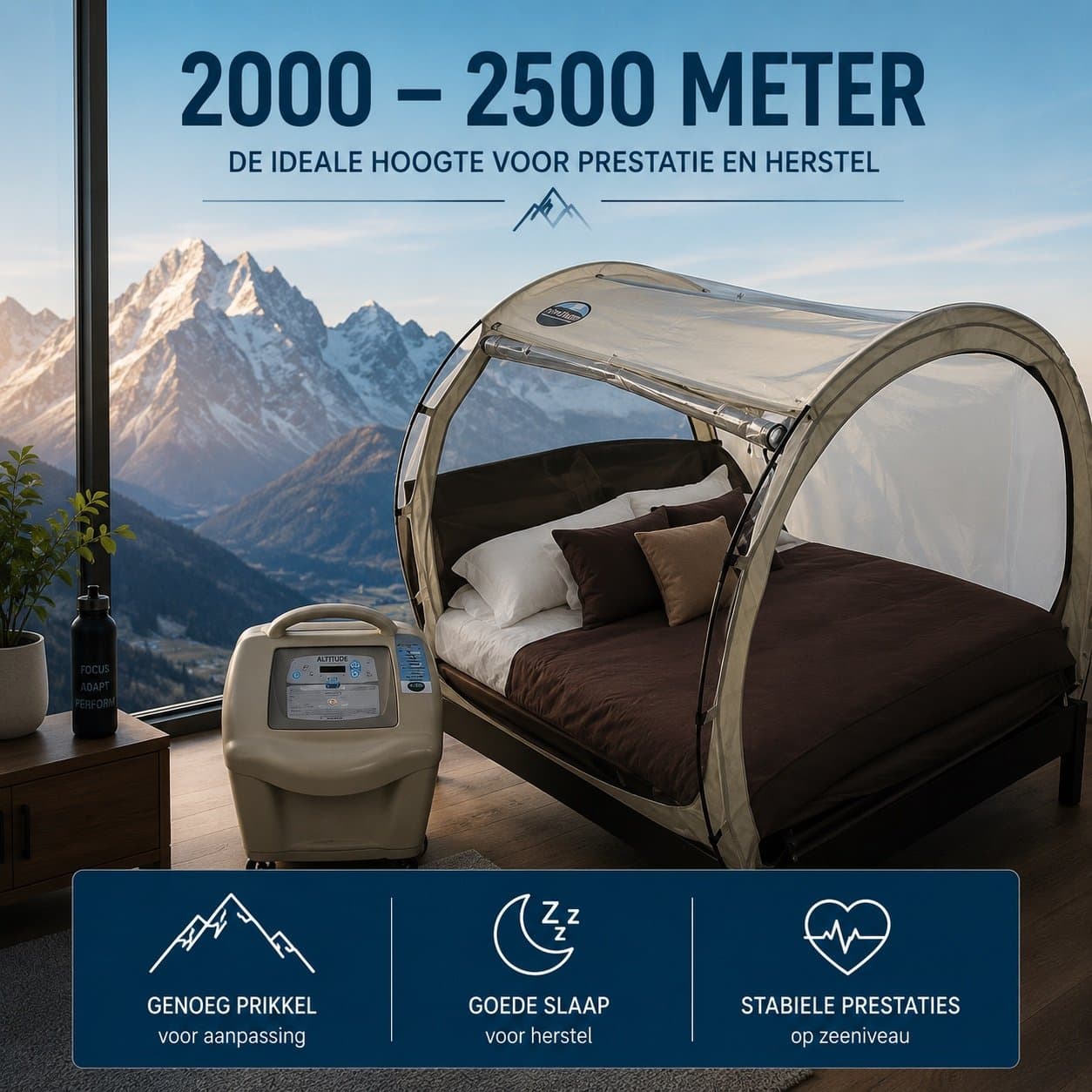
The ideal height for a height tent For most athletes, this isn't as high as possible, but usually around 2000 to 2500 metres. That sounds contradictory. However, this is precisely what altitude training is all about: enough of a stimulus to induce adaptation, but not so much stress that sleep, recovery and training quality deteriorate.
Many athletes still think that sleeping higher automatically works better. In practice, that is rarely the case. Especially with sleep high train low It's not about maximum suffering, but about smart pacing. The right altitude should challenge your body without undermining your recovery.
Short answer: The ideal altitude for a high-altitude tent is usually between 2000 and 2500 metres. Below 1800 metres, the stimulus is often limited. Above 2500 metres does not automatically provide further performance benefits and can negatively affect sleep quality, recovery, and training load.
Conclusion: Sleeping higher isn't automatically better for altitude training.
Nuance: The optimal height depends on purpose, experience, sleep quality, SpO2 trend, and training phase.
Practical hook: Build gradually and aim for recovery, not ego.
Why the ideal height for a high-altitude tent isn't at maximum height
Altitude training works through controlled exposure to less oxygen. This creates a physiological stimulus. Your body responds through, among other things, respiration, heart rate, oxygen transport, recovery processes, and with sufficient duration, also through blood-related adaptations.
However, this stimulus has an upper limit. If the altitude is too low, not enough happens. If the altitude is too high, the load becomes too great. This can make your sleep more disturbed, reduce your recovery, and diminish your training quality. For sports performance at sea level, this is usually not the intention.
This is why the ideal altitude isn't a competition for who can sleep highest. It's a balance between stimulation and recovery. It's precisely this balance that determines whether altitude training becomes useful preparation or primarily extra stress.
💡 Did you know? The best altitude training doesn't always feel the hardest. A good stimulus is often subtle, measurable, and sustainable. If you're sleeping poorly every night, the altitude is usually set too aggressively.
Research on the ideal height for a high-altitude tent
A frequently cited study in the Journal of Applied Physiology researched which altitude was most effective for performance improvement at sea level. In this study, 48 runners lived at different altitudes for four weeks, while training at comparable altitudes.
The groups lived at approximately 1780 metres, 2085 metres, 2454 metres, and 2800 metres. Afterwards, blood values and performance on a 3000-metre test were examined. The groups at around 2085 and 2454 metres, in particular, improved their performance. Thus, the group at 2800 metres did not automatically achieve the best result.
This is important. It shows that the optimal altitude is not simply the highest altitude. For athletes aiming to perform at sea level, a moderate altitude often seems better than an aggressive altitude. This also aligns with practical experience with choosing the right height in a high-altitude tent.
| Height zone | Stimulus | Practical significance |
|---|---|---|
| 1500 to 1800 m | Light | Often well tolerated, but sometimes too limited for experienced athletes. |
| 2000 to 2500 m | Effective and controllable | Usually the best balance between altitude stimulus, sleep and recovery. |
| 2500 to 2800 m | Stronger | Can be useful for specific goals, but requires more monitoring. |
| 2800 m and higher | Heavy | Not automatically better. More chance of worse sleep and loss of recovery. |
Stimulus Light.
Practical significance: Often well tolerated, but sometimes too limited for experienced athletes.
Stimulus Effective and controllable.
Practical significance: Usually the best balance between altitude stimulus, sleep and recovery.
Stimulus Stronger.
Practical significance: Can be useful for specific goals, but requires more monitoring.
Stimulus Heavy.
Practical significance: Not automatically better. More chance of worse sleep and loss of recovery.
The ideal height for a high-altitude tent for sports performance
For athletes who want to perform better at sea level, the most logical zone is usually between 2000 and 2500 metres. That is high enough to provide a relevant hypoxic stimulus, but often still low enough to maintain good quality sleep.
This last point is essential. Altitude training isn't a standalone trick. It must fit within your overall training load. If you recover less well due to sleeping too high up, the net effect can become negative. You'll get more of a stimulus, but less adaptation.
Therefore, in practice, we don't just look at the set altitude. We also look at sleep duration, morning feeling, training quality, heart rate, recovery, and SpO2 trend. That combination provides much more information than a single number on the display.
Why 2000 to 2500 metres often works well
This zone is interesting because it provides a strong but controllable stimulus for many athletes. Your body clearly notices the lower oxygen pressure. At the same time, sleep quality remains good enough for many athletes to allow for training adaptations.
This is important for runners, cyclists and triathletes. They don't just want to react to altitude, but more importantly, train, recover and perform better. Therefore, the ideal altitude for an altitude tent is usually not an extreme setting.
When sleeping higher can still make sense
There are situations where sleeping at altitude can be beneficial. This is particularly true when the goal is not only to perform at sea level, but also to prepare for actual altitude. Consider mountain expeditions, competitions at altitude, or travel where you quickly reach over 3000 metres.
In that case, the question shifts. Then it's not just about athletic performance, but also about acclimatisation and tolerance for lower oxygen pressure. Still, the build-up remains important even then. Increasing it without monitoring is seldom wise.
Anyone preparing for the mountains should look at a comprehensive plan for acclimatising at home for mountain expeditions. In doing so, altitude, duration, sleep, rest days and symptoms all play a role.
Sports performance versus altitude preparation
For sporting performance at sea level, you primarily want an optimal stimulus without a loss of recovery. For expeditions, you also want to acclimatise to greater heights. This sometimes requires a different structure, but not automatically a more aggressive start.
| Target | Usually logical height | Main point of attention |
|---|---|---|
| Sea level performance | 2000 to 2500 metres | Maintaining sleep quality and training quality. |
| High-altitude match | Gradually building towards the match peak | Don't increase too quickly and follow symptoms. |
| Mountain expedition | Construction depending on target height | Acclimatisation, rest and SpO2 trend combine. |
Usual logical height 2000 to 2500 metres.
Point of attention: Maintaining sleep quality and training quality.
Usual logical height Gradually building towards match intensity.
Point of attention: Don't increase too quickly and follow symptoms.
Usual logical height Structure dependent on target height.
Point of attention: Acclimatisation, rest and SpO2 trend combine.
Common misconceptions about sleeping higher
The biggest misconception is that a higher setting automatically yields more returns. That's not true. Altitude training only works when the stimulus remains well-dosed. Otherwise, it becomes mainly stress.
A second misunderstanding is that discomfort proves it's working. A mild adjustment reaction can be normal, certainly in the first few nights. But structurally poor sleep, morning headaches, clear fatigue or declining training quality are not badges of honour. They are signals that adjustments are needed.
A third misconception is that everyone needs the same height. Two athletes can react completely differently to the same setting. Therefore, personal monitoring is more important than a fixed schedule without feedback.
⚠️ Reality check Sleeping at altitude can sound impressive, but the body mainly rewards smart dosing. If your recovery deteriorates, the altitude stimulus is often too heavy for that moment.
This is how you build height wisely
A good build-up starts slowly. This is especially true when sleeping in a height tent for the first time. The goal isn't to get to 2500 metres as quickly as possible. The goal is to build up a stable, well-tolerated stimulus.
In the first few nights, you primarily want to see how your body reacts. After that, you can increase gradually. For many athletes, a progression of about 300 metres per step works well. However, this is still dependent on sleep, SpO2 trend, and your feeling of recovery.
Practical setup for athletes
- Start at a comfortable height where you can sleep well.
- Every morning, measure your SpO2 and especially note the trend.
- Increase only when sleep, recovery, and morning feeling remain stable.
- For sporting performance, generally stay around 2000 to 2500 metres.
- Temporarily reduce if symptoms are clear or recovery is poor.
| Phase | Target | Practical approach |
|---|---|---|
| Starting phase | Getting used to the stimuli | Gentle start and monitor sleep quality. |
| Build-up phase | Increase incentive | Only increase with stable SpO2 trend and good recovery. |
| Stabilisation phase | Effect vasthouden | They usually stay between 2000 and 2500 metres. |
| Correction phase | Preventing overload | Reduce when sleep is poor, complaints arise, or training quality declines. |
Objective: Getting used to the stimulus.
Approach Gentle start and monitor sleep quality.
Objective: Increase stimulus.
Approach Only increase with stable SpO2 trend and good recovery.
Objective: Sustain the effect.
Approach They usually stay between 2000 and 2500 metres.
Objective: Prevent overloading.
Approach Reduce when sleep is poor, complaints arise, or training quality declines.
This is how you monitor this lens
The ideal height for a high-altitude tent is not determined solely in advance. You confirm that height during use. This is done by combining objective signals with practical feedback from training and recovery.
SpO2 is useful for this, but only as a trend. A single measurement doesn't tell you much. It's better to look at multiple mornings in a row. If the SpO2 remains stable, you sleep well, and training feels normal, then the altitude is likely well-dosed.
If your SpO2 trend is clearly declining, you're sleeping restlessly, or you're waking up more tired, then it's sensible not to increase further. Sometimes temporarily reducing is better than stubbornly pushing on. It is precisely because of this that the overall training adaptation remains stronger.
A practical in-depth look can be found in the article about saturation in an altitude tent. In it, we explain how to interpret measurements soberly without becoming fixated on a single number.
Check these signals daily
- Morning SpO2 as a trend over multiple days.
- Sleep duration and number of awakenings.
- Morning feeling and headache.
- Resting heart rate and general feeling of recovery.
- Training quality at normal intensity.
- Unusual shortness of breath, nausea, or dizziness.
Decision rules: when to raise, hold, or lower?
A good altitude tent setup requires simple decision rules. This way, you avoid increasing too quickly based on instinct. Most mistakes are not made by starting too low, but by wanting to sleep too high, too quickly.
Practical decision rules
Increase only when you have several nights of good sleep, the SpO2 trend remains stable, and your training feels normal.
Hold on when you are in the 2000 to 2500 metre zone and recovering well.
Lower when sleep quality declines, complaints increase or your training quality clearly deteriorates.
| Signal | Interpretation | Action |
|---|---|---|
| Sleep well | Stimulus appears well tolerated. | Maintain altitude or increase cautiously. |
| SpO2 trend stable | The body is calmly adapting. | Don't force it, keep the rhythm. |
| Poor sleep | Stimulus can be too heavy. | Do not increase. Possibly lower temporarily. |
| Complaints | Taxation may be too aggressive. | Prioritise reduction and recovery. |
Interpretation: Stimulus appears well tolerated.
Action: Maintain altitude or increase cautiously.
Interpretation: The body is calmly adapting.
Action: Don't force it, keep the rhythm.
Interpretation: Stimulus can be too heavy.
Action: Do not increase. Possibly lower temporarily.
Interpretation: Taxation may be too aggressive.
Action: Prioritise reduction and recovery.
Practical tips for correct height adjustment
Use the altitude tent as part of your training plan, not as an extra competition. The value lies in consistency. A well-sustained period at an appropriate altitude generally yields more than a few nights at too high a setting.
Furthermore, plan intense training sessions wisely. Especially in the first week, it's advisable not to aggressively increase the training load all at once. Your body is already receiving a new stimulus during the night. Give it time to process that stimulus.
To objectively monitor the effect of altitude training, don't just rely on how you feel. Combine training data, recovery data, and performance indicators. In the article about measuring altitude training effect Check which signals are practically useful.
The most important tips
- Start larger than your end goal and build up slowly.
- Do not increase when your sleep is already under pressure.
- Always use SpO2 as a trend, not as an isolated truth.
- For sporting performance, generally stay around 2000 to 2500 metres.
- Only select higher settings with a clear purpose.
- Let recovery weigh heavier than ambition.
FAQ on the ideal height for a height tent
Is sleeping higher always better for altitude training?
No. Sleeping higher up leads to more hypoxic stress, but not automatically more performance benefit. Above a certain threshold, sleep and recovery can deteriorate.
What is the ideal height for a sleep altitude tent?
For most athletes, the ideal height for a altitude tent is between 2000 and 2500 metres. This often provides the best balance between stimulus and recovery.
When can I sleep higher than 2500 metres?
This can be logical when preparing for competitions or high-altitude expeditions. Always do this gradually and based on monitoring.
How do I know if the height is set too high?
Be aware of poorer sleep, morning headaches, fatigue, declining training quality, and an unfavourable SpO2 trend over multiple days.
Do I have to sleep at the same height every night?
Not necessarily. In the build-up phase, the height can increase gradually. In the stable phase, consistency is usually more important than continually increasing it.
Do you want to use altitude training without going too high?
For athletes, altitude training is all about finding the right balance between stimulus, sleep, and recovery. Altitude Dream helps you choose a suitable progression based on your goal, sport, and reaction to altitude.
Conclusion: choose the height that makes you better, not the height that impresses.
The ideal altitude for a height tent isn't the highest setting you can tolerate. For most athletes, the best zone is around 2000 to 2500 metres. The stimulus there is strong enough to encourage adaptation, but often mild enough to maintain sleep and recovery.
Sleeping at a higher altitude can be beneficial for specific high-altitude goals. However, for sea-level performance, higher altitude is not automatically better. The best setting is the altitude at which your body responds well, while still allowing you to sleep, recover, and train effectively.
That's why the main rule stays simple: build up gradually, monitor objectively, and let your recovery determine if the altitude is correct. This way, altitude training becomes not a gamble, but a controlled part of your preparation.


