Sleeping at altitude: why you sleep lighter and dream differently
Published 10 December 2012 · 10 min read

Sleeping at altitude feels different for many people than sleeping at sea level. You sometimes wake up more often, your dreams seem more vivid, and you might need a bit more sleep to wake up feeling rested. This is usually no reason to panic. It's mainly a logical consequence of how your body reacts to less available oxygen.
Short answer: At altitude, you often sleep lighter because your breathing becomes more active and less stable. This means you enter a lighter sleep phase more frequently for short periods. It's precisely then that you remember dreams more easily. This can also happen in an altitude tent, especially in the first few nights or if the acclimatisation is too rapid.
Conclusion: Dreaming at altitude is usually a normal phenomenon.
Nuance: Restless sleep can also mean that the altitude stimulus is too strong.
Practical hook: Therefore, don't look at a single night, but at your sleep, recovery, and SpO2 trend together.
What happens when sleeping at altitude?
At altitude, your body takes in less oxygen per breath. This does not mean there is less oxygen in the air. The percentage of oxygen remains about the same. However, the air pressure drops, making it more difficult for oxygen to be absorbed.
Your body reacts to this with a higher respiratory drive. You start breathing deeper or faster. This helps to get more oxygen in, but it also makes the night slightly more active. As a result, your sleep often becomes less deep and somewhat more sensitive to short interruptions.
Anyone wishing to understand more about the general physiology behind altitude can start with our explanation of how altitude training works. For this article, it is particularly important that sleep at altitude is not a passive state. Your body continues to adapt throughout the night.
Why do you dream differently at high altitude?
Many people say that they remember dreams more often when in the mountains or in a high-altitude tent. This does not automatically mean that you dream more. It mainly means that you wake up more often around a phase in which dreams are better remembered.
Dreams often return more clearly when you wake up briefly from light sleep or REM sleep. At altitude, this happens faster. Your breathing fluctuates more. This can cause your sleep to shift from deeper to lighter more often.
💡 Did you know? A vivid dream doesn't necessarily have to be a sign that something is wrong. It often simply means that you woke up at a very memorable moment. The context is more important than the dream itself: how did you feel upon waking?
This is why some users of a high-altitude tent experience more intense dreams. This can be particularly noticeable in the first week. Afterwards, it often becomes calmer, especially when the altitude is gradually increased.
Sleeping at altitude is lighter, but not automatically worse
Light sleep sounds negative. Yet that is too simplistic. Lighter sleep at altitude can be part of a normal adjustment. The body remains more alert, as breathing, oxygen uptake and recovery need to find a new balance.
There is a difference between normal adjustment and an excessive stimulus. One restless night is usually not important. Several nights of poor sleep, headaches, clear fatigue, or a declining SpO2 trend do require adjustment.
| Signal | Probably normal | Adjust when |
|---|---|---|
| Dreams | You remember dreams better, but wake up feeling reasonably rested. | Dreams go hand in hand with restlessness, stress, or repeatedly waking up with a start. |
| Sleep | You sleep a bit lighter during the first few nights. | You've been sleeping noticeably worse than usual for several nights. |
| Recovery | You feel mildly fatigued, but are functioning normally. | You wake up feeling very tired or recover poorly. |
| SpO2 | The trend remains stable within your personal bandwidth. | The trend is falling for several nights or remains remarkably low. |
Probably normal you remember dreams better, but wake up reasonably rested.
Adjust when: Dreams coinciding with restlessness, stress, or waking up with a start.
Probably normal You sleep a bit lighter during the first few nights.
Adjust when: you have been sleeping significantly worse than usual for several nights.
Probably normal You feel slightly tired, but are functioning normally.
Adjust when: you wake up severely fatigued or recover poorly.
Probably normal The trend remains stable within your personal bandwidth.
Adjust when: the trend falls for multiple nights or remains conspicuously low.
What does breathing have to do with this?
The main explanation lies in your breathing. At altitude, your body tries to compensate for the lower oxygen supply. Your breathing becomes more sensitive to changes in oxygen and carbon dioxide.
This can make the night more restless. Sometimes you breathe a bit deeper for a period, and then more calmly again. These fluctuations can cause small micro-awakenings. You don't always wake up fully then, but your sleep structure does change.
This also explains why some people in the mountains feel like they’re “not really sleeping deeply”. That feeling is recognisable. However, with a gentle build-up, the body can often adapt well.
If you use a height tent at home, its setup is extra important. You'll find a practical basis in our guide to to use a height tent. The core remains the same: don't start too high, build up steadily, and respond to signals.
How does sleeping in a height tent feel in the first few nights?
The first few nights in a height tent can feel different. Some people notice almost nothing. Others sleep more lightly, wake up a few times, or remember their dreams strikingly well.
This does not automatically mean the tent is too high. It does mean your body registers the stimulus. This is why we always advise to assess the first few nights calmly. Not based on a single feeling, but based on a pattern.
Calm interpretation of the first week
- Night 1 to 2: expect possibly lighter sleep or more dream recall.
- Nights 3 to 4: See if your sleep quality stabilises.
- Night 5 to 7: assess recovery, morning feeling and SpO2 trend together.
- After week 1: Increase only if the trend remains calm and stable.
For more context about this phase, you can also read our explanation of Sleeping in a high-altitude tent during the first few weeks.
Video: do you dream differently in a height tent?
The subject remains a bit fun, of course. Because yes, if you sleep lighter and remember dreams better, the question naturally arises: do you really dream differently in a high-altitude tent?
We previously asked 800-metre runner Jan Van Den Broeck, who finished fifth at the 2012 World Indoor Championships. His answer fits precisely with what many users recognise: sleeping at altitude can feel different, but it doesn't have to be difficult or problematic.
🧭 In practice The video below is not medical evidence, but it is a recognisable practical experience. That is precisely why it fits well with this topic. Altitude training is measurable and serious, but the experience remains human. Sometimes that simply starts with a strange dream.

When is restless sleep a signal?
Restless sleep is not immediately worrying in itself. However, you should not ignore it. Especially when sleep problems are combined with other signals.
Think of headaches, nausea, noticeable fatigue, dizziness, or a significantly poorer recovery. In the mountains, these could be early signs of insufficient acclimatisation. At home in a height tent, they could mean the set altitude is too ambitious.
Decision rule
Remain calm if you are only sleeping lighter or remembering more dreams. Adjust your approach if you have several nights of poor sleep, develop complaints, or your SpO2 trend is moving unfavourably. Only increase the altitude once sleep, recovery, and morning feeling are stable.
Those using a height tent would be wise to consider sleep and saturation together. Our in-depth guide to saturation in an altitude tent helps to interpret those values more calmly.
This is how you monitor this lens
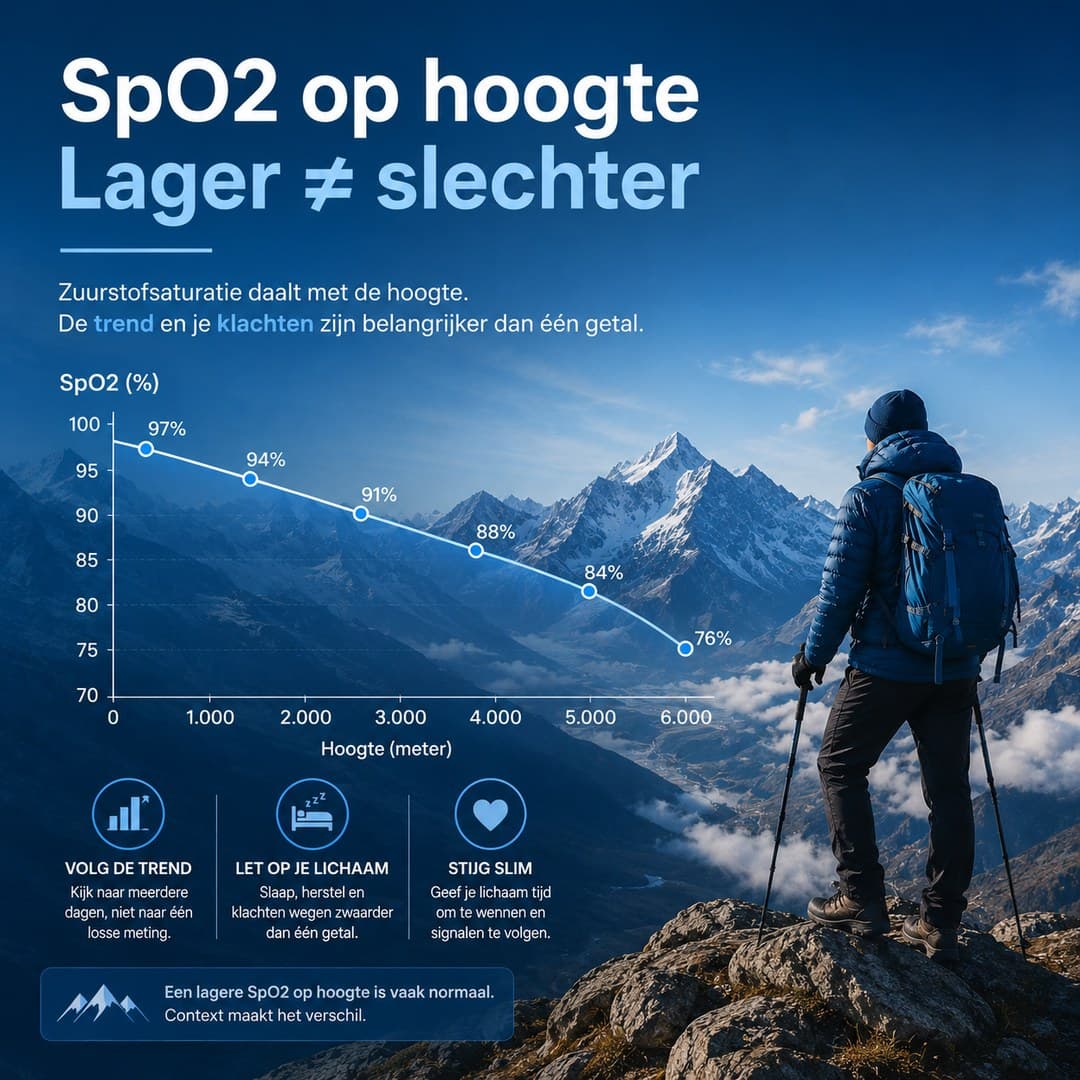
The mistake many people make is weighting one night too heavily. Sleep fluctuates. Therefore, it's better to look at trends over multiple nights.
Use these four checkpoints
- SpO2 trend: look at several mornings, not one single measurement.
- Sleep quality: Note whether you sleep lighter, wake up more often, or experience restlessness.
- Recovery: Rate energy, resting heart rate, HRV if available, and training readiness.
- Symptoms: Please note headache, nausea, dizziness or unusual tiredness.
| Trend | Interpretation | Action |
|---|---|---|
| Stable | Sleep and recovery remain similar, SpO2 moves steadily. | Maintain current altitude. |
| Slightly unsettled | You sleep more lightly, but without any clear complaints. | Do not increase yet. Stabilise first. |
| The end | SpO2 trend is decreasing and sleep or recovery is worsening. | Lower the height or take extra rest. |
| Complaints | Headache, nausea or noticeable fatigue. | Do not increase. Adjust conservatively in case of complaints. |
Interpretation: Sleep and recovery remain similar, SpO2 is moving steadily.
Action: Maintain current height.
Interpretation: You sleep lighter, but without obvious complaints.
Action: Do not increase yet. Stabilise first.
Interpretation: SpO2 trend is decreasing and sleep or recovery is worsening.
Action: Lowering the height or taking extra rest.
Interpretation: headache, nausea or pronounced fatigue.
Action: Do not increase. Adjust conservatively for complaints.
Practical tips for sleeping better at altitude
You don't need to perfect sleep at altitude. That's also not realistic. The goal is for the stimulus to be strong enough to provoke adaptation, but mild enough to allow for recovery.
- Gradually build up the height.
- Do not increase after a bad night.
- Don't plan the first few nights too aggressively.
- Drink sufficient amounts, but don't overdo it just before bed.
- Avoid alcohol if you notice sleep or recovery deteriorating.
- Use your morning feeling as an extra checkpoint.
- Always assess SpO2 as a trend over multiple days.
Common misconceptions about altitude dreams
Not every strange dream means the same thing
Misunderstanding 1: “I dream more, so I sleep worse.” That doesn't have to be the case. You remember dreams better primarily when you wake up briefly.
Misunderstanding 2: “Light sleep means altitude training doesn't work.” That's also incorrect. A limited change in sleep can be part of the adaptation process.
Misunderstanding 3: “A low SpO2 is always good, because then the stimulus is stronger.” No. The stimulus must remain functional. Training too hard or sleeping at altitude often has the opposite effect.
Who is this primarily relevant for?
This topic is especially relevant for people who sleep at home in a hyperbaric chamber, athletes who work with sleep high, train low, and mountain travellers who notice their nights changing at altitude.
For an expedition, sleep quality is extra important. Poor sleep can affect recovery, decision-making, and acclimatization. The same applies to athletes. A high-altitude stimulus must not structurally undermine recovery.
Therefore, sleeping well at altitude isn't about toughing it out at the highest possible point. It's about controlled acclimatisation, careful monitoring, and timely adjustments.
Do you want to start sleeping more calmly at altitude?
An altitude tent works best when the setup suits your goals, your recovery, and your personal response. Therefore, start with a gentle baseline and adjust based on sleep, complaints, and SpO2 trend.
Conclusion: dreams at a higher altitude are usually just a sign of lighter sleep
Dreaming more while sleeping at altitude is usually no mystery. Your body is reacting to lower oxygen availability. This changes your breathing, sometimes makes you sleep lighter, and makes dreams easier to remember.
That's usually normal, especially in the first few nights. However, context remains important. A few vivid dreams are not a problem. Structurally poor sleep, fatigue, headaches or an unfavourable SpO2 trend do require adjustment.
The best approach is therefore simple: build up gradually, follow trends and keep listening to your body. This way, sleeping at altitude becomes not a gamble, but a controlled stimulus.
FAQ about sleeping and dreaming at altitude
Why do I dream more at altitude?
You're probably no longer necessarily dreaming. You primarily remember dreams better because you enter a lighter sleep phase more frequently at altitude.
Is lighter sleep in a height tent normal?
Yes, especially in the first few nights. The body needs to get used to the height stimulus. If your sleep remains poor, it is wise to adjust.
Should I lower the height if I sleep badly?
Not always after one night. Look at multiple nights, your recovery, symptoms and SpO2 trend. If there is a clear deterioration, reducing it is advisable.
How do I know if the height stimulus is too strong?
Note a combination of poor sleep, declining SpO2 trend, headache, nausea, dizziness, or clearly worse recovery.
Does extra sleep during altitude training help?
Often, yes. Some people temporarily need more sleep because the body uses extra energy for adaptation and recovery.