Acclimatising at home for mountain expeditions: rent, buy or apply?
Published 9 January 2026 · 3 min read
Acclimatising at home for mountain expeditions is increasingly being considered by mountain hikers and expeditioners who want to prepare properly for altitudes above 4,000 metres. The key question is logical: does home acclimatisation make sense, when does it really work, and do you choose to rent, buy or use a guided application? In this article, you will read what home acclimatisation does physiologically, when it contributes to a safer expedition and how to apply it responsibly without false expectations.
What does acclimatising at home mean for a mountaineering expedition?
Acclimatising at home involves controlled exposure to lower oxygen %, similar to that at altitude, prior to a mountain trip. This is usually done via normobaric hypoxia, in which the oxygen percentage in inhaled air is reduced while air pressure remains the same.
The aim is not to simulate full acclimatisation, but to get the body used to oxygen scarcity in advance. As a result, your expedition starts with a physiological edge, especially above 4,000 metres.
How does acclimatisation work physiologically?
The role of oxygen and respiration
At altitude, available oxygen decreases. The body responds by deepening and speeding up breathing. This increases oxygen uptake, but also costs energy and can disrupt sleep in the first few days.
Haematological adaptation
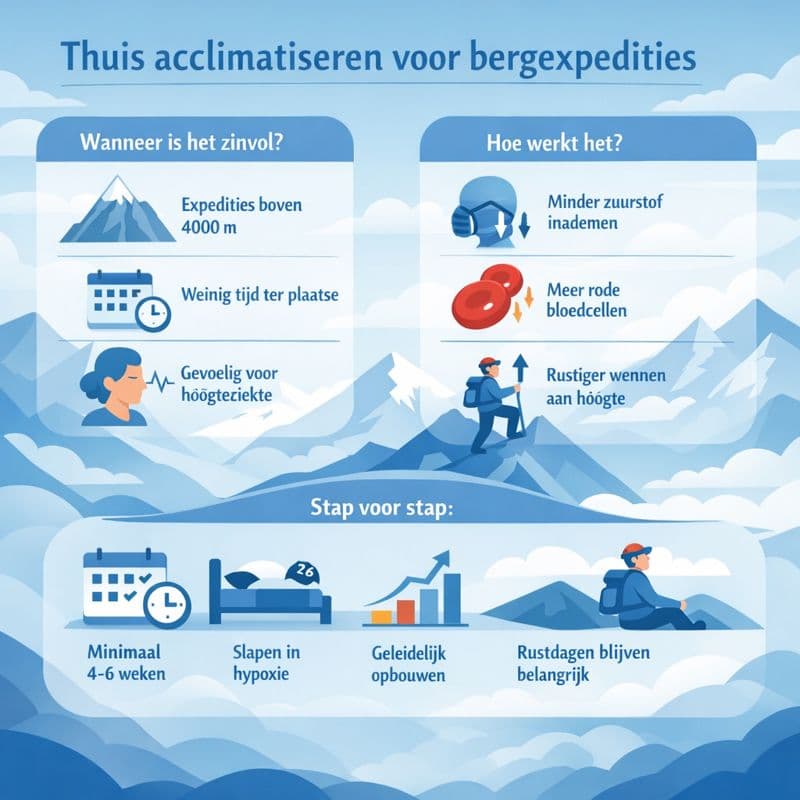
Repeated exposure to hypoxia increases the production of erythropoietin (EPO). This hormone stimulates red blood cell production, allowing oxygen to be transported more efficiently. This adaptation is gradual and requires time and consistency.
Why getting used in advance helps
Those who have had hypoxic stimuli beforehand often react more calmly on arrival at altitude. This does not mean that symptoms are impossible, but it does mean that the transition is less abrupt.
When does acclimatising at home make sense for mountain travel?
Acclimatising at home is especially relevant with:
- Expeditions above 4,000 metres
- Limited acclimatisation time on site
- Susceptibility to altitude complaints in the past
- Tight travel schedules with rapid altitude gain
For treks up to around 3,000 metres, the effect is limited. From 4000 metres, pre-acclimatisation can be a valuable addition to a good ascent schedule on site.
Rent, buy or guide: which is wise?
Renting: flexible and guided
Renting is the most logical choice for most expeditioners. You use the equipment temporarily, receive guidance and tailor duration and altitude to your goals. This prevents overuse and misuse.
For expedition goals, you can refer directly to:
- Acclimatising for 4,000 metres
- Acclimatising for 5,000 metres
- Acclimatising to 6,000 metres
- Acclimatising for 7,000 metres
- Acclimatising for 8,000 metres
Buy: only for very frequent use
Buying only makes sense if you carry out long-term pre-acclimation runs several times a year and have sufficient knowledge to monitor this independently. Without monitoring and expertise, buying actually increases the risk of misuse.
Applying without guidance: biggest pitfall
Experimenting on your own without a schedule, monitoring or advice often leads to too rapid altitude build-up, poor sleep or a false sense of security. Acclimatisation is not a trick, but a process.
Practical guidelines for acclimatising at home
- Start at least 4 weeks before departure
- Use the system mainly during sleep
- Build height gradually, no jumps
- Always combine with a realistic on-site take-off schedule
- Stop or reduce if symptoms persist
The recommended duration is between minimum 4 and maximum 6 weeks, depending on target height and individual response.
Common mistakes and misunderstandings
“I am fully acclimatised for departure”
This is not realistic. Acclimatisation at home is support, not a substitute for acclimatisation on location.
Up too fast
An overly aggressive schedule actually increases strain and reduces sleep quality.
No link with dispatch planning
Pre-acclimatisation only works if it fits with route, altitude gain and rest days locally.
Experiences of other mountain travellers
Many expeditioners share their experiences by target altitude. These reviews provide insight into how home acclimatisation is applied in practice:
In summary: what is the best choice?
For most mountain travellers supervised hire the safest and most effective way to acclimatise at home before an expedition. It provides structure, flexibility and avoids false assumptions. Acclimatising at home increases the chances of a calmer start at altitude, but always requires realistic expectations and a well-tuned plan.
For those who want to prepare properly for an expedition above 4,000 metres, more and more mountain travellers are opting for a personally tailored pre-acclimatisation programme.