Intermittent Hypoxia Training (IHT) for recovery from COVID-19 and Long COVID: what does the research say?
Published 13 March 2020 · 10 min read
You have recovered from Covid, but your body hasn't yet. Fatigue, shortness of breath, and a lack of stamina persist. Somewhere, you read that intermittent hypoxic training (IHT) might help with recovery after Covid and long Covid. A valid question, and one that deserves an honest answer. In this article, you'll read what the research does and doesn't show, why caution is particularly important here, and how to make an informed decision rather than hoping for a miracle cure.
Short answer: There are initial, cautiously positive indications that a controlled form of hypoxia training may support recovery from long Covid. The strongest evidence comes from a single, non-randomised pilot study of hypoxic-hyperoxic training (IHHT) within a clinical rehabilitation pathway. While promising, this is not yet proof. It should not be considered self-treatment or a replacement for standard rehabilitation. Extra caution is also needed for long Covid patients experiencing exercise intolerance.
Conclusion: Hypoxia training for coronavirus recovery is a promising but still unproven supplementary avenue.
Nuance: the evidence relies on a single pilot study; the effects and safety need to be confirmed in larger, randomised research.
Practical hook: Anyone considering this does so under medical supervision and with their own tolerance as a guide, never on their own accord.
What intermittent hypoxia training is precisely (and what it isn't)
During intermittent hypoxia training, you breathe in air with a reduced oxygen content and normal air alternately, in short, repeated blocks. Your body then experiences a mild, controlled oxygen stimulus without having to go up a mountain. That stimulus activates an oxygen sensor in your cells (the HIF pathway), which in turn controls processes such as the production of red blood cells and adaptations in your blood vessels and energy metabolism. It is the same fundamental principle that underlies how altitude training works sit, only in short intervals instead of a long stay at altitude.
It is important to distinguish between two variants, as they are often confused. Classic IHT alternates hypoxia (low oxygen) with normal air. The clinical variant used in the long Covid research alternates hypoxia with hyperoxia (too much oxygen) and is therefore called IHHT. That difference is not cosmetic: it determines which research is applicable to what.
| Form | What it entails | Context in the research |
|---|---|---|
| IHT | Alternation of low-oxygen and normal air in short bursts | To be investigated especially in sport, fitness and healthy adaptation |
| IHHT | Alternation of oxygen-poor and oxygen-rich air | The shape from the Long Covid pilot study, in a clinical setting |
| Altitude tent | Sleeping in normobaric hypoxia as a longer stimulus | Focused on pre-acclimation and training stimulus, not disease treatment |
What alternation of low-oxygen and normal air in short blocks.
Research especially with sports, fitness and healthy adaptation.
What alternation of oxygen-poor and oxygen-rich air.
Research The form from the Long Covid pilot study, clinically guided.
What Sleeping in normobaric hypoxia as a longer stimulus.
Research focused on pre-acclimatisation, not disease treatment.
This nuance is at the heart of the entire subject. Existing research on long Covid concerns a supervised, clinical IHHT protocol with a medical device, not sleeping in a hypobaric chamber or breathing hypoxised air at home. Those who conflate the two are drawing conclusions that the evidence does not support.
What the research says about IHT for long COVID
The most concrete indication comes from a pilot study from 2024, published in the Journal of Cachexia, Sarcopenia and Muscle. In a German rehabilitation clinic, 145 long COVID patients received either standard rehabilitation, or the same rehabilitation supplemented with guided IHHT sessions. The group that received IHHT walked significantly further on average in the six-minute walk test afterwards and showed more progress in strength and daily function. No serious side effects were reported in the study.
📊 Research shows
In the pilot study, the walking distance in the six-minute walk test improved by approximately 92 metres in the IHHT group, compared to approximately 33 metres with rehabilitation alone. That difference is striking. At the same time, it was a single study at one location, without randomisation between the groups, which limits the strength of the evidence.
The latter is essential. Participants were not randomly assigned to groups, the study took place at a single location, and the research is partly linked to the manufacturer of the device used. In a published response, other researchers also pointed out that the results do not simply apply to everyone with long Covid, and that the group with pronounced exercise intolerance in particular needs to be considered separately and with caution. The researchers themselves explicitly refer to their work as a stepping stone to larger, randomised follow-up research.
The honest summary is therefore twofold. The initial results are positive enough to be taken seriously, and too thin to be presented as proven. For a condition for which there are few targeted treatments available, that is a cause for cautious interest, not for grand promises.
The biggest misunderstandings about hypoxia training and coronavirus
There are a few persistent misconceptions surrounding this topic that create a false impression. The first, and most important to correct: pre-emptive hypoxia training would boost your immune system, thereby preventing a severe course of corona. That claim is not supported by research. The relationship between oxygen sensors and viruses is complex and works both ways; some viruses even use that same pathway to multiply. There is no good evidence that hypoxia training prevents infections or alleviates the course of illness.
The second misunderstanding: sleeping in a hypobaric tent treats long COVID. The protocol studied is a guided, clinical IHHT application within rehabilitation, not a hypobaric tent at home. These two are not interchangeable. The third: deeper or longer oxygen deprivation leads to faster recovery. The opposite is true. More stimulation is not better for long COVID and can even be harmful, especially in people who relapse after exertion.
⚠️ Reality check
The positive results come from a supervised clinical setting with dosage and monitoring. They are not a green light to tackle your long COVID at home yourself with low-oxygen air or a hypobaric tent. What happens in a rehabilitation clinic under supervision is different from experimenting with your recovery yourself.
Why extra caution counts with Long Covid
A portion of people with long COVID experience post-exertional malaise: a relapse in symptoms that arises hours to days after exertion and sometimes persists for a long time. For this group, a progressive exertion approach can actually be harmful. Therefore, the starting point for long COVID is often not to train until one gets better, but to pace oneself and monitor energy levels. Major health organisations conclude that there is still no firm evidence that rehabilitation helps for the subgroup with this exertional intolerance.
Where IHHT is administered at rest, breathing without physical exertion, it differs from classical strength training. This does not automatically make it safe for everyone. The sensible approach is that every stimulus in long COVID fits within your capacity and is supervised by someone who knows your situation. your body's reactions to oxygen deprivation varies significantly from person to person, and with a fragile recovery, that variation weighs particularly heavily.
🧭 In practice
If you notice that an effort or stimulus knocks you out a day later, that's not a sign to push through. It's a signal to scale back. Track how you feel 24 to 48 hours after a session, and let that pattern carry more weight than how you felt at the moment.
This is how you monitor this lens
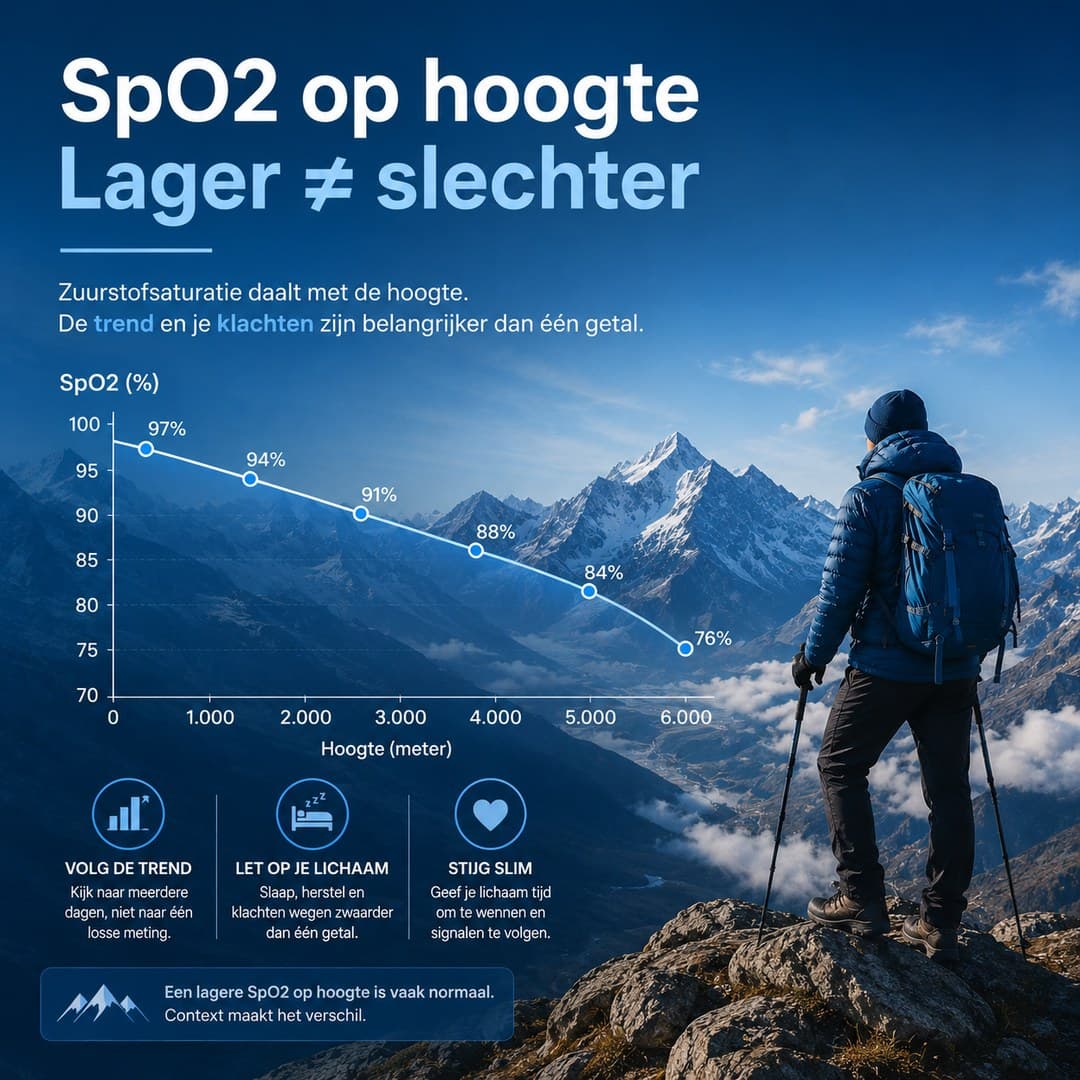
Recovery after Covid-19 feels erratic, and how you feel is an unreliable compass. A few simple, objective signs help you assess whether an approach is working well for you or not. Measure calmly and follow the trend over days; a single measurement says little.
| Signal | What you are following | What you do with it |
|---|---|---|
| Energy for 24-48 hours | Relapse of symptoms after exertion or a session | In case of clear relapse: taper off and consult, don't push through |
| SpO2 trend | Morning saturation over multiple days, not individual measurements | Persistent low or falling: contact your doctor |
| Sleep and recovery | Sleep quality and how rested you wake up | Deterioration: reduce stimulus, incorporate more rest |
| Symptom burden | Shortness of breath, palpitations, headache, concentration | Increase or new complaints: stop and have them assessed |
Tracking: Relapse in symptoms after exertion or a session.
Action: Upon clear relapse, reduce and consult, do not persevere.
Tracking: Morning saturation over several days, not individual measurements.
Action: persistently low or falling, contact your doctor.
Tracking: sleep quality and how rested you wake up.
Action: If symptoms worsen, reduce the stimulus and build in more rest.
Tracking: Shortness of breath, palpitations, headache, concentration.
Action: In case of an increase or new symptoms, stop and have it assessed.
To understand this saturation side well, read how you measures and interprets your oxygen saturation. The most important rule remains: one figure is noise, the trend over days is information.
When hypoxia training is and isn't suitable for COVID-19 recovery
Whether this track is right for you depends on your situation and your support, not on a general promise. The following decision rules will help you draw the line.
When it is possibly meaningful within a structured rehabilitation programme, under medical supervision, with dosage and monitoring, and with scope for adjustment.
When you don't do it: experimenting on one's own initiative without guidance, during an active infection or fever, or with pronounced exercise intolerance without a professional plan.
When you make adjustments: If symptoms worsen in the 24 to 48 hours after a session, or if your recovery and sleep deteriorate. Then reduce the stimulus or pause.
When you stop and consult a doctor: in the event of a clear relapse after exertion, a persistently declining saturation trend, or new complaints such as chest pain, palpitations, or severe shortness of breath.
Practical tips if you're considering this
Start with your doctor or therapist, not with a device. Discuss whether a guided form of hypoxia training fits within your recovery, and have your baseline recorded: how much strain can you handle now, and what is a safe dose. Set realistic expectations. The research results are about averages in a clinic, not about a guaranteed outcome for you.
Furthermore, choose measurement over guesswork. Record a brief baseline of your saturation trend, energy levels, and sleep before making any changes, so you can later see if an approach is actually making a difference. And monitor your energy levels closely: with long Covid, patient pacing is almost always wiser than pushing yourself.
Main source Doehner W. et al. (2024). Intermittent Hypoxic-Hyperoxic Training During Inpatient Rehabilitation Improves Exercise Capacity and Functional Outcome in Patients With Long Covid: Results of a Controlled Clinical Pilot Trial. Journal of Cachexia, Sarcopenia and Muscle. Supplemented with the published commentary by Kulka and Tryba (2025) on the limitations of the non-randomised design and the exercise intolerance group.
Frequently asked questions
Does hypoxic training beforehand prevent a severe course of coronavirus?
No, there is no good evidence for that. The old idea that hypoxia training strengthens immunity and thus prevents severe COVID-19 is not supported by research. The interaction between oxygen signalling and viruses is complex and works both ways.
Is hypoxia training proven effective for long Covid?
Not yet. There's an initial, cautiously positive pilot study with the hypoxic-hyperoxic variant, but it wasn't randomised and was conducted at a single site. Larger randomised studies still need to confirm the effects and safety.
Can I do this at home with a hypobaric tent to recover?
The research concerns a supervised clinical protocol, not a home altitude tent. Therefore, do not use this as self-treatment for long COVID. First, discuss with your doctor whether a supervised form of hypoxia training is suitable for your situation.
Is it safe if I always relapse after exertion?
Dan, extra caution is required. With pronounced exercise intolerance, exertion can cause harm and dosage is paramount. Do not start anything without a professional plan, and let your capacity dictate the pace.
Understand where hypoxic training originates
Would you like the full picture of hypoxia as a stimulus, separate from the recovery issue? Read about the different forms of altitude training and how they relate to each other, so that you can put this topic into better perspective.
Intermittent hypoxia training for recovery after coronavirus and long COVID is a topic where hope and evidence do not yet align. The initial results deserve attention, but not exaggeration. Anyone considering this should do so with guidance, in measured doses, and guided by their own capacity. This way, you can make a calm, informed decision instead of relying on a promise that research cannot yet fulfil.
This information is for general guidance only and does not replace personal medical advice. Always consult your doctor or healthcare provider regarding recovery from coronavirus or long COVID before making any changes.