
How long do I have to stay in an altitude tent?
Published 27 July 2012 · 10 min read
How long to stay in an altitude tent? This is the practical guideline
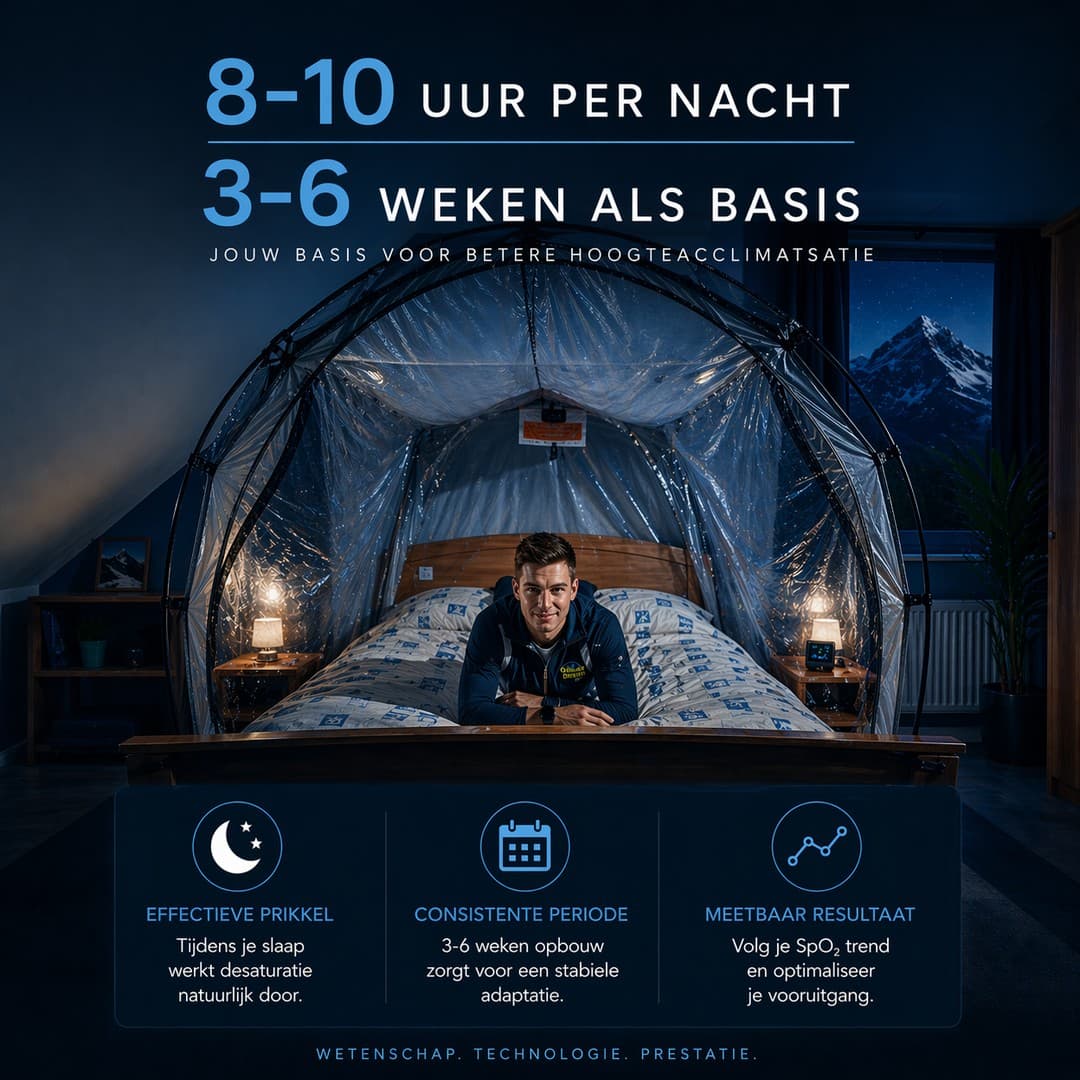
How long to stay in an altitude tent is not a question with one set answer for most people. Nevertheless, there is a useful practice line. For many athletes and mountain travellers, the effective zone is around 8 to 10 hours per night, for 3 to 6 weeks. Shorter can already do something, but the real effect depends on your goal, your sleep quality, the set altitude and how consistently you maintain the schedule.
That makes this issue more important than it often seems. Not only staying too short gives less incentive. Building up too quickly or continuing at too high a setting for too long can also work against you. This article therefore not only tells you how many hours and how many weeks usually make sense, but also when to adjust and how to track this objectively.
Direct response
- For many users, 8 to 10 hours a night is the most useful zone.
- A period of 3 to 4 weeks is often a good minimum. For pre-acclimatisation, 4 to 6 weeks often makes more sense.
- More time is not automatically better. Good sleep, recovery and a stable SpO2 trend are more important than extreme hours.
Conclusion: the best results usually come from enough nights, not maximum aggression.
Nuance: your ideal duration depends on goal, tolerance and timing towards race or mountain trip.
Practical hook: Think in a combination of hours per night, total weeks and objective monitoring.
How long to stay in an altitude tent for effect
The question of how long staying in an altitude tent makes sense should be cut into two parts. First, you look at the number of hours per night. Then you look at the total period in weeks. Only that combination determines whether the incentive is big enough to trigger something.
In doing so, it helps to remember what an altitude tent actually does. You don't sleep at true altitude, but in an environment with reduced oxygen levels at normal air pressure. This is called normobaric hypoxia. So the aim is not to make it heavy, but to expose your body repeatedly and in a controlled way to a stimulus that remains recoverable.
Anyone working with a tent for the first time would do well to first understand how a altitude tent use works in practice. Indeed, the biggest mistake is not too little ambition, but too little structure. Without a plan, you will quickly oscillate between being too cautious and too aggressive.
For an initial useful guideline, this is usually true: below about 6 hours a night, stimulus often remains limited. Between 6 and 8 hours, a basic stimulus often develops. Between 8 and 10 am is the most workable zone for many people. Up to about 12 hours, additional exposure may still be useful in some situations, but only if sleep and recovery remain good. Above that, the practical added value usually diminishes.
🧭 In practice
The best schedules rarely feel spectacular. They feel stable. You sleep reasonably, you train normally and your trend gradually moves in the right direction. That is often a better sign than an extreme schedule that gives you headaches, restless nights and loss of training quality after only five days.
How long to stay in an altitude tent per purpose
Not everyone uses an altitude tent for the same reason. A marathon runner looking for an extra physiological boost often has a different time path than someone who wants to prepare for a trek or mountain expedition at home. This is why a targeted guideline helps better than one general number.
| Target | Total period | Hours per night | Practical focus |
|---|---|---|---|
| Getting used to the tent first acquaintance |
1 to 2 weeks | 6 to 8 hours | find rhythm, monitor sleep quality, don't start too high |
| Basic stimulus general sporting commitment |
3 to 4 weeks | 8 to 10 hours | consistency, recovery and morning feeling more important than extra aggression |
| Pre-acclimatization mountain trip or expedition |
4 to 6 weeks | 8 to 10 hours | gradually build up towards a stable, tolerable stimulus |
| Ambitious schedule more experience and good tolerance |
5 to 8 weeks | 9 to 10 am | only useful if sleep, recovery and performance remain good |
Total period1 to 2 weeks
Hours per night6 to 8 hours
Practical focusFinding rhythm, monitoring sleep quality and not starting too high.
Total period3 to 4 weeks
Hours per night8 to 10 hours
Practical focusConsistency and recovery are more important than extra aggression.
Total period4 to 6 weeks
Hours per night8 to 10 hours
Practical focusGradually build up to a stable, tolerable stimulus.
Total period5 to 8 weeks
Hours per night9 to 10 am
Practical focusOnly continue if sleep, recovery and training remain good.
So for many users, 3 to 4 weeks is the point where the schedule really becomes meaningful. On a mountain trip, 4 weeks is often more pleasant, simply because you have more time to build up slowly. This lowers the risk of unnecessary complaints and makes preparation more plannable.
The set altitude also plays a role. Those who start too high immediately often chase the schedule early. Therefore, it is usually smarter to work from a ideal tent height which is firm enough to give effect but remains mild enough to sleep well.
More hours is not always better
What usually does work
Start slowly, then increase to 8 to 10 hours a night. Increase the altitude only when your sleep remains stable and your morning feeling is good.
What often works against
Immediately aim for 10 to 12 hours at an overly high setting. That sounds ambitious, but often leads to restlessness, headaches and reduced training quality more quickly.
A practical set-up protocol
The most useful question is often not just how many weeks you need, but how you fill in those weeks. That is exactly where many schedules gain or lose. With a good build-up, you make the stimulus planable. Without a build-up, it remains a gamble.
Practical structure in four stages
- Week 1: start conservatively. Think 6 to 7 hours a night on a mild setting. The goal is getting used to the system, not scoring.
- Week 2: Go towards 7 to 8 hours a night if your sleep remains good. Only after that carefully increase the stimulus.
- Week 3 and 4: For many goals, work towards 8 to 10 hours a night. This is often the most productive phase.
- Week 5 onwards: extend only if you have a clear reason to do so, such as a later departure or extra preparation time.
So a good schedule doesn't just build hours. It also builds confidence. You notice more quickly what your body tolerates, what sleep duration is feasible and when a higher stimulus becomes logical. As a result, preparation becomes not only more effective, but also more restful.
This is also why many users benefit from an article on myths about sleeping in an altitude tent. Indeed, a lot of insecurity comes from wrong expectations. Not every night has to be perfect. However, the overall line should remain good.
Common thinking mistakes about length of stay
The first fallacy is that more is always better. That is not true. A schedule only works if you tolerate it well. A heavier stimulus without recovery is not a smart schedule, but a troubled test.
The second fallacy is that short stakes would be worthless. That too is not entirely correct. A short schedule can already be useful to build rhythm or provide the initial physiological stimulus. Only with a short schedule, you have to keep your expectations more realistic.
The third fallacy is that one bad night immediately means the whole protocol is wrong. That too is too black and white. Rather, look at patterns. One bad night says little. Three or four bad nights in a row do say something.
⚠️ Reality check
An altitude tent is no substitute for real acclimatisation on the mountain. It is a controlled, measurable and plannable support that can significantly reduce the risk of problems. However, it is still important to ascend sensibly and take signals seriously even on location.
This is how you monitor this lens
If you want to know if your length of stay is right, you need to measure what matters. Not obsessively, but consistently. The gist is always the same: track your SpO2 as a trend, look at sleep quality, assess your recovery and pay attention to complaints. One single value says little. The combination of signals says much more.
Those wondering what a normal value in a tent is usually have more context than a single number. That is why it is smart to familiarize yourself beforehand with normal saturation in an altitude tent. Then you will better understand when a lower value is a normal training stimulus and when it is a sign that you are going too hard.
| Signal | Interpretation | What do you do practically |
|---|---|---|
| SpO2 trend stable your values are fairly predictable |
the stimulus seems tolerable | keep the schedule and only increase cautiously if sleep remains good |
| Sleep worse multiple nights of restlessness |
the load may have been increased too quickly | Reduce the incentive or temporarily reduce the number of hours |
| Recovery sinks in training feels unusually heavy |
your total tax increases | look not only at the tent, but also at training, work stress and sleep duration |
| Complaints keep coming back headache, nausea, pronounced restlessness |
the stimulus is probably not well dosed | step back and re-evaluate altitude, hours and timing |
InterpretationThe stimulus seems tolerable.
Practical actionStick to schedule and only increase cautiously if sleep remains good.
InterpretationThe load may have been increased too quickly.
Practical actionReduce incentive or temporarily reduce hours.
InterpretationYour total load increases.
Practical actionAlso look at training, work stress and total sleep duration.
InterpretationThe stimulus was probably not properly dosed.
Practical actionStep back and re-evaluate altitude, hours and timing.
When to proceed and when to adjust
Continue
You sleep reasonably, your morning mood is stable, your workout remains normal and your symptoms remain limited or absent.
Adjust
Your nights become restless, your recovery sags for several days or you develop recurring symptoms that do not go away.
Practical tips to get the right length of stay
The art of a good elevation scheme is usually in simplicity. Not in maximising. Those who get the basics right are more likely to achieve their planned weeks and nights than someone who over-achieves. As a result, the end result is often actually better.
Checklist for a workable schedule
Start milder than your ego wants
The first week is meant to build tolerance. Starting too aggressively often actually takes time.
Choose fixed nights
Consistency usually wins over loose peak nights. A calm rhythm gives the best practical yield.
Save room for recovery
An altitude tent is an extra incentive. So take into account your overall training load and sleep deprivation.
Evaluate by week
Always look at the trend. Not one morning, one workout or one bad night.
Frequently asked questions
Is 2 weeks in an altitude tent enough?
For getting used to and an initial stimulus, 2 weeks can be useful. For a firmer effect or pre-acclimatisation, 3 to 6 weeks usually makes more sense.
Do I have to sleep in the altitude tent every night?
For a stable effect, regularity usually works best. Skipping a lot makes the stimulus less predictable and often lowers the practical yield.
Is 12 hours a night always more effective than 8 hours?
No. More hours only help if you also tolerate that exposure well. Poor sleep can actually undermine gains.
When should I lower my schedule?
If you are sleeping poorly for several nights, your recovery is slipping or symptoms are returning, switching back is usually wiser than pushing on.
What is a good foundation for most people?
For many users, 8 to 10 hours per night for 3 to 4 weeks is a strong base. For mountain goals, 4 to 6 weeks often makes more sense.
Want to get your build-up right first?
A good schedule doesn't start with going maximum, but with smart dosing. Look at a calm and logical build-up plan first, so that you better match hours, altitude and timing.
Conclusion
Those who want to know how long staying in an altitude tent makes sense usually come to a simple but important conclusion. For many people, a combination of 8 to 10 hours a night and 3 to 6 weeks works best. Within that, determine the exact duration based on purpose, timing and tolerance.
The best approach is rarely the most extreme. A schedule that you maintain well usually delivers more than one that looks heavy on paper but in practice undermines your sleep and recovery. So think of the altitude tent as a controlled support. Not as a panacea, but as a plannable way to make preparation smarter.


