Climbing Toubkal: acclimatisation and preparation for the Atlas
Published 4 April 2026 · 9 min read
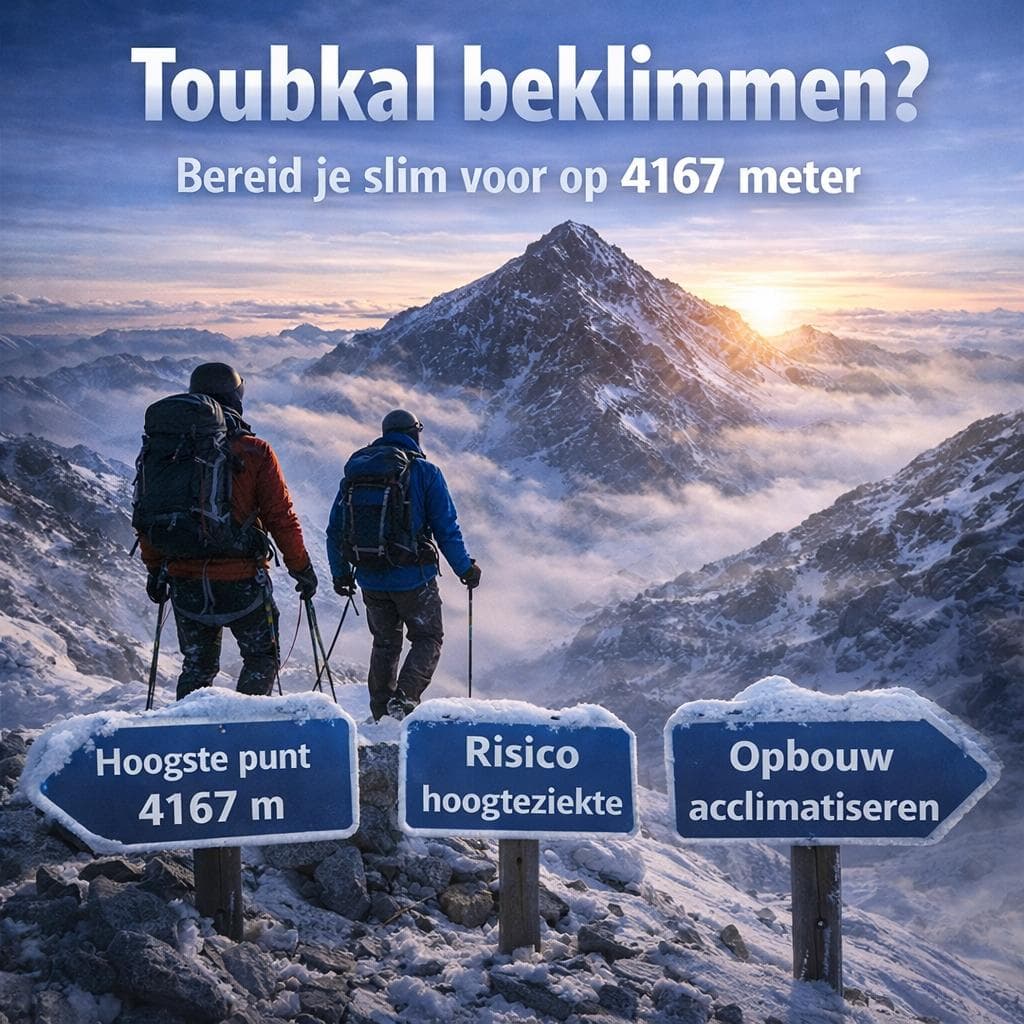
Climbing the Toubkal seems like an achievable goal for many mountaineers. Yet the altitude is not something to underestimate. At 4167 metres, the Toubkal is high enough to put obvious strain on your body, especially if you are travelling directly to Morocco from lowlands. Therefore, good preparation is not just about fitness, but also acclimatisation, pacing, recovery and smart management of altitude.
Those who want to better prepare for altitude in advance can benefit greatly from acclimatising at home for mountain expeditions. Especially on a relatively compact climb like Toubkal, this can give extra margin.
Conclusion: Climbing Toubkal is quite doable for fit hikers, but the altitude demands respect.
Nuance: The route is often not extremely technical, but it is physically demanding and prone to altitude sickness.
Practical hook: With a smart build-up, leisurely pace and good monitoring, you increase your chances of a strong summit day.
Climbing Toubkal requires more than just good fitness
Jebel Toubkal is the highest mountain in North Africa and is located in the Moroccan Atlas Mountains. The classic route usually starts in Imlil and ascends to the summit via the refuge. This makes the climb logistically manageable, but physiologically not obvious. In particular, the relatively rapid rise in sleeping height makes this trek tougher than many people think beforehand.
Many hikers look mainly at distance and difficulty. Yet the real challenge on Toubkal often lies in the combination of altitude, dry air, restless sleep, early morning cold and too fast a pace on day one. It is precisely this that makes people feel worse than expected even at the refuge.
⚠️ Reality Check - The Toubkal is not an extremely technical expedition mountain, but it is a serious four-thousander. Those who climb too fast or do not pay enough attention to acclimatisation can suffer from headaches, poor sleep or reduced appetite well before the summit.
Why the classical route is physiologically quite tough
Those who climb Toubkal often make a marked jump in altitude in a short time. From Imlil, you usually sleep the first mountain night already around 3207 metres in the refuge. This is an altitude at which the body often begins to react noticeably differently. Not only due to lower oxygen availability, but also due to the combination of exertion, travel fatigue and a drier mountain environment.
If you want to better understand why a rapid rise has so much impact, it helps to look at a normal acclimatisation rate per 1,000 metres. Right there you can see why compact Toubkal planning is efficient but gives less margin.
What the classical route means physiologically
| Moment | Height | What you often notice | Practical advice |
|---|---|---|---|
| Imlil | approx. 1,740 m | Usually little altitude effect, but travel fatigue | Start slowly, eat well, don't force it |
| Refuge | approx. 3,207 m | Headache, mild nausea, worse sleep, high respiratory rate | Keep pace slow, drink a lot, monitor complaints |
| Summit day | 4.167 m | More shortness of breath, slower recovery, symptoms may magnify | No race pace, fair evaluation for top bump |
Imlil
Height: approx. 1,740 m
What you often notice: Usually little altitude effect, but travel fatigue
Practical advice: Start slowly, eat well, don't force it
Refuge
Height: approx. 3,207 m
What you often notice: Headache, mild nausea, worse sleep, high respiratory rate
Practical advice: Keep pace slow, drink a lot, monitor complaints
Summit day
Height: 4.167 m
What you often notice: More shortness of breath, slower recovery, symptoms may magnify
Practical advice: No race pace, fair evaluation for top bump
The biggest mistake at Toubkal is wanting to go too fast
Many people arrive in Morocco fit and think that fitness provides sufficient buffer. In reality, this is only partly true. Strong fitness helps you tolerate the exertion better, but does not make you immune to altitude sickness. Even athletic people can react surprisingly badly at 3,200 to 4,200 metres if they take too little margin.
So the biggest mistake on Toubkal is not necessarily a bad equipment plan, but a bad pace plan. Those who hike uphill too sportily on day one often arrive at the refuge with too much residual fatigue. As a result, you eat worse, recover less well and sleep more restlessly. You almost always feel this back on summit day.
This is exactly why what happens in the first 72 hours at altitude so relevant. That's where it is often decided whether your body is picking up the load well or just lagging behind.
Here's how to prepare smartly for Toubkal
Good preparation for Toubkal consists of three layers. First, you build general mountain fitness. Then you limit unnecessary fatigue just before departure. Finally, you consciously think about acclimatisation. The latter is still too often forgotten, while altitude is precisely the factor that distinguishes this trek from an ordinary solid mountain hike.
1. Work on sustainable taxability
Don't focus only on speed or short intensive workouts. For Toubkal, you will mainly benefit from longer walks, pedal training, gentle endurance efforts and sufficient strength training in thighs and calves. Certainly the descent demands more from your muscles than many people expect.
2. Keep the last week fresh
The last week before departure is not the time to want to gain fitness. The focus should then shift to recovery, sleep, equipment check and rhythm. Fresh legs and a stable body are more valuable than one last heroic workout.
3. Consider pre-acclimatisation
For those who have limited time on location, are prone to altitude complaints or want to leave with extra margin, pre-acclimatisation can make sense. In doing so, it is important to understand that an altitude tent works with normobaric hypoxia. The oxygen percentage drops, not the air pressure. This makes the process at home controlled, measurable and plannable. It does not replace the mountain, but it can help you leave with more physiological margin.
🧭 In practice - For a goal like Toubkal, preparation at home does not have to be perfect to be useful. The main goal is to get you through the first mountain nights more relaxed and your body less abruptly confronted with altitude.
Equipment, clothing and pace in the Atlas
Many Toubkal climbs fail not because of a lack of motivation, but because of small practical mistakes that quickly become bigger at altitude. Think too warm clothing during the climb up, too little protection from wind on summit day, or taking food you normally like but can't get rid of at altitude. This is precisely why it pays to keep your equipment plan simple, functional and well thought-out.
Work with layers. The temperature in Imlil can be pleasant, while around the refuge and on summit day it feels considerably colder, especially before sunrise or in windy conditions. Therefore, opt for several thin layers rather than one heavy solution. This will make it easier to stay dry and comfortable.
Walking poles are often a smart choice on Toubkal. Not only do they help your rhythm up, they also ease the strain on your knees and upper legs during the descent. Certainly the latter is often underestimated. The way back feels heavier than expected for many people, mainly because fatigue and loss of concentration have already set in by then.
What you definitely want to bring
- well-worn mountain boots or sturdy trail shoes with sufficient grip
- hiking poles for pace and relief on descents
- windproof outer layer and warm layer for early mornings
- sunglasses, sun cream and lip balm against dry mountain air
- headlamp for an early start towards the summit
- simple food that you can still easily take even when your appetite is reduced
On Toubkal, a calm, steady pace is more important than making an athletic impression. Those who run too much on power in the first few hours almost always pay for it later. Altitude punishes impatience faster than lack of ambition.
This is how you monitor this lens
With Toubkal, it is smart to combine feeling and objective signals. Always use SpO2 as a trend, never as an absolute truth. One single value says little. But several similar readings combined with sleep, appetite and symptoms do give direction. That in particular helps you make better decisions.
Pay particular attention to four things: your SpO2 trend, your sleep quality, your sense of recovery and your symptoms. A lower saturation need not be immediately alarming if you feel otherwise well. Conversely, be alert if your saturation drops AND your headaches, nausea or dizziness increase.
Those who want to better understand how to assess complaints beforehand can benefit greatly from recognising altitude sickness and how to act. This makes you calmer and more decisive on the mountain.
Practical decision rules
- If you have a mild headache without worsening, then calmer pace is often the first step.
- If you have a headache plus nausea or noticeably less appetite, you need to reassess your top plan.
- If you feel you are getting worse at rest, then not rising further is the safest choice.
- If there is tightness at rest, unsteady walking, confusion or persistent deterioration, descend.
Common misunderstandings around Toubkal
“It's just a trekking mountain”
That reasoning is only half right. In dry conditions, the normal route is often technically clear, but 4167 metres remains 4167 metres. Altitude makes the climb more serious than many hikers think beforehand.
“I am fit, so acclimatisation is less important”
Fitness helps, but offers no guarantee. Altitude sickness depends not only on fitness, but mainly on ascent rate, sleep altitude and individual susceptibility.
“If I make it to the refuge, I'll make it to the top too”
Just there is often the miscalculation. The refuge is not the end of the challenge, but the point at which your honest evaluation begins. How you sleep, eat and recover there determines a lot for the next morning.
“Drinking more solves altitude problems”
Drinking well helps, but it is not a panacea. Hydration supports your recovery, but does not compensate for too rapid an ascent, poor pacing or lack of acclimatisation.
Practical tips for summit day
Set off in a controlled way, not in a hurry. From the first hour, make sure you deliberately stay below your maximum. Use walking sticks as a rhythm giver and to spare your legs. Eat small, simple calories and drink regularly. Also choose clothing in layers so that you can react quickly to cold winds, warming up from exertion or an early sunrise.
On summit day, discipline is often more important than motivation. In fact, most people have motivation enough. What is sometimes lacking is the willingness to slow down honestly. Exactly that, at altitude, often makes the difference between fighting and controlled climbing.
Want to start Toubkal with more margin?
For a climb around 4,000 metres, pre-acclimatisation at home can be a valuable step. This way, you leave better prepared and increase your chances of a more peaceful first night at altitude.
Conclusion
Climbing Toubkal is feasible for many people, but not something to be taken lightly. It is precisely the combination of altitude, relatively rapid build-up and limited recovery margin that makes this trek serious. Those who prepare for this well in advance will not only be physically stronger, but also make better decisions along the way.
So don't think of Toubkal as a quick four-thousander you just do on the side, but as a compact expedition with real altitude load. Then you will get more out of the climb, more safely, more peacefully and with more fun.
FAQ about climbing Toubkal
Is Toubkal technically difficult?
In dry conditions, the normal route is often mainly physically demanding. In snow or winter conditions, the character can become much more alpine.
How high is Toubkal?
Toubkal is 4167 metres high, making it the highest mountain in North Africa.
Do you need acclimatisation for Toubkal?
Yes. Especially if you have limited time on location, acclimatisation is an important factor for comfort and safety.
Can you get altitude sickness on Toubkal?
Yes. Altitude complaints can also occur at 4167 metres, especially with a rapid ascent or limited recovery margin.
Is pre-acclimatisation before Toubkal useful?
For many people, yes. Especially with a compact itinerary, it can help to start the climb with more margin.