
High-stay costs: what do you pay for 2-4 weeks?
Published 22 April 2026 · 8 min read
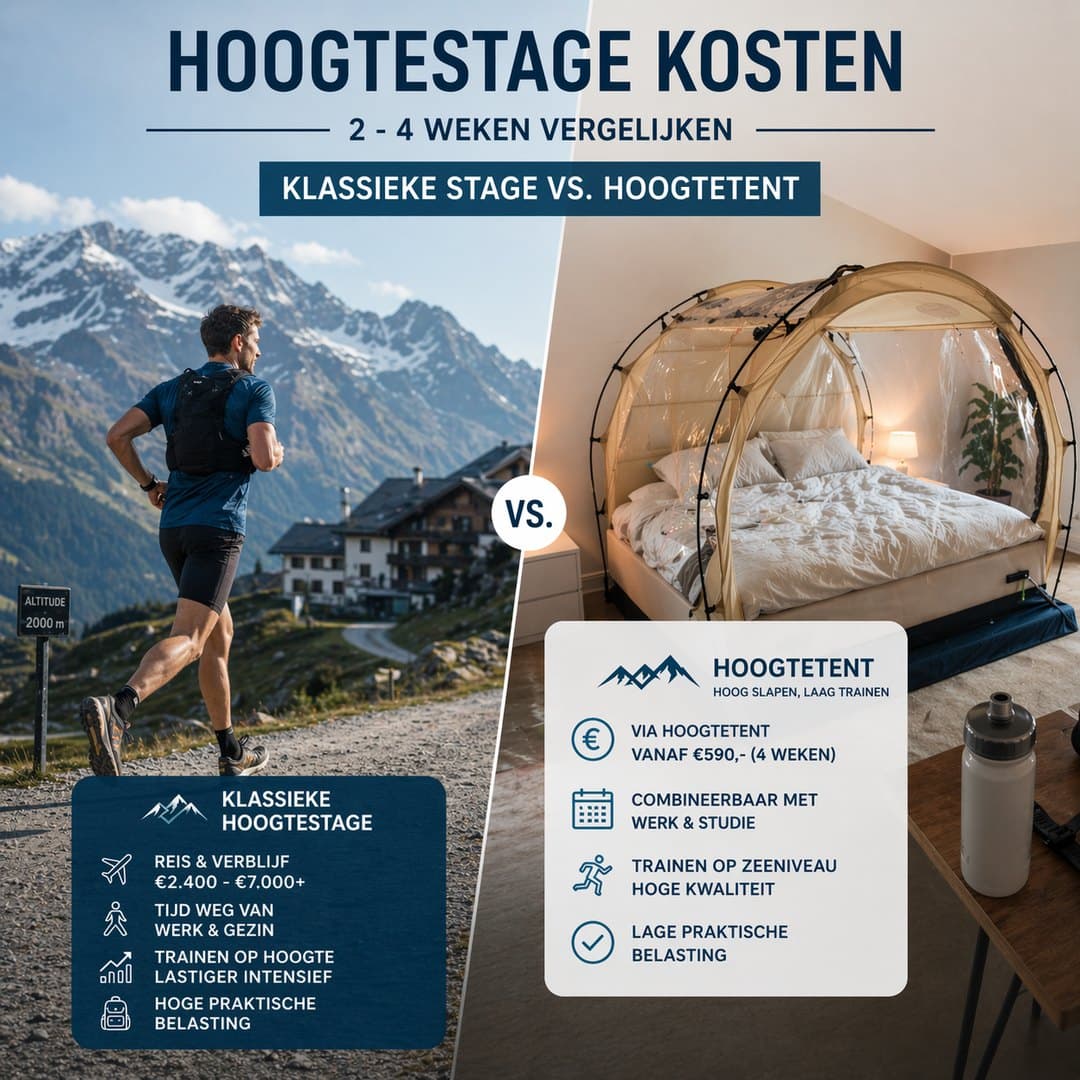
The question of how much a altitude training costs is rarely just about budget. Usually, you want to know which option gives the most impact per euro, per week of preparation and per intervention in your daily life. That is exactly why a good comparison should go beyond flight, hotel or rent alone.
Who the real altitude training costs Indeed, if you take a good look at the situation, you will soon see that a classic internship in the mountains is much more expensive than previously thought. Not only due to travel and accommodation, but also food, local transport, training logistics and the impact on work, study and family life.
Therefore, it is smart to look not only at the price of a location, but at the total investment as well as the expected training return. It is precisely then that a Live High, Train Low approach via altitude tent rental at home is the rationally strongest choice for many athletes. Scientifically, LHTL is a very interesting approach, while via Altitude Dream you can already 4-week altitude tent rental from €590 can achieve. This is considerably cheaper and more practical for many athletes than travelling to altitude for 2 to 4 weeks.
The essentials in 30 seconds
A classic two- to four-week altitude training trip often costs much more than most athletes estimate beforehand. Once you include travel, accommodation, food, transport and time investment, the total quickly adds up.
For many athletes, the altitude training costs much more favourable at home. With a high altitude tent, you can sleep high, train low, keep exercising in your own environment and combine work or study better. At Altitude Dream, you can rent a high altitude tent for 4 weeks from €590,-.
High-stakes costs: why comparing often goes wrong
Many sportsmen compare just one line: what does a stay in the mountains cost versus what does a high altitude tent cost at home. But such a comparison is too limited. To altitude training costs properly, you need to look at three layers at once:
- Direct costs such as travel, accommodation, food and rent
- Indirect costs such as days off, lost sales, travel time and logistical friction
- Training value of the approach taken
That third point is crucial. A classic internship at altitude can be valuable, but often also brings a limitation: qualitative training is more difficult to perform well at altitude. This is precisely why the combination of staying high and training low is often seen as strong. You can also read more about this in this explanation on sleep high, train low.
High tuition fees for a classic traineeship of 2 to 4 weeks
A classic altitude training course usually means temporarily travelling to a mountain area, sleeping, eating, recovering and training there. That can be a nice experience, but the altitude training costs almost always run up further than just the booking price of accommodation or flight.
| Section | 2 weeks of classic altitude training | 4 weeks of classic altitude training | Comment |
|---|---|---|---|
| Round trip | €250 - €700 | €250 - €700 | Depending on destination, season and luggage |
| Stay | €700 - €2.100 | €1.400 - €4.200 | Flat, hotel or sports accommodation |
| Nutrition | €250 - €600 | €500 - €1.200 | Cooking yourself is cheaper than eating out |
| Local transport | €100 - €350 | €150 - €500 | Rental car, transfers or public transport |
| Additional training logistics | €50 - €250 | €100 - €400 | Facilities, equipment and practical expenses |
| Total indicative | €1.350 - €4.000 | €2.400 - €7.000+ | Excluding impact on work, study and family life |
2 weeks of classic altitude training
4 weeks of classic altitude training
Who the real altitude training costs add up, you will see that staying on location will almost always be more expensive than previously thought. This need not be a problem if you consciously choose the experience, but it is important when looking for the smartest ratio between impact and investment.
When do higher altitude costs make sense?
Higher altitude training costs can make sense if you are not only looking for a physiological effect, but also opt for the full training camp experience. Think team sports, complete focus without work commitments or the desire to temporarily live and train entirely in a mountain environment.
For some elite athletes or teams, this is a conscious choice. But for many individual athletes, the more relevant question is whether the same or even more feasible effect can be achieved in a smarter way.
Why training quality outweighs location alone
An internship in the mountains sounds professional and ambitious. Yet location is not automatically the best choice. For many endurance athletes, the payoff lies in combining hypoxic sleep with training at normal altitude, so that training intensity and quality are better maintained.
This is exactly why LHTL is so interesting from a scientific point of view. Also read more about how altitude training works and possibly also check external scientific background via scientific studies on Live High, Train Low.
High altitude tent costs at home: what does a high altitude tent cost for 4 weeks?
For many athletes, the altitude training costs home much more attractive than a traditional stage in the mountains. At Altitude Dream, you rent an altitude tent for 4 weeks from €590. With this, a content-rich LHTL solution suddenly becomes accessible without major travel or accommodation costs.
That price is especially interesting because not only do you save money, but you also take friction out of your preparation. You stay overnight in your own environment, keep your usual training structure and can continue to combine work or study with your protocol.
- you sleep high in your own familiar surroundings
- you continue to train low in your normal training context
- you avoid travel and accommodation costs
- no need to completely rearrange your schedule for weeks on end
- you make a 4-week preparation much more realistically feasible
| Option | Cost 4 weeks | Training quality | Combination with work or study | Practical load |
|---|---|---|---|---|
| Classic on-site altitude training | Often €2,400 - €7,000+ | Can be good, but quality training at altitude is often trickier | Restricted | High |
| LHTL via altitude tent at home | From €590 | Sleep high, train low and maintain training quality better | Good | Low to medium |
Classic on-site altitude training
LHTL via altitude tent at home
Why low altitude training costs at home are often more interesting
Lower altitude training costs at home do not automatically mean lower quality. On the contrary: for many athletes, the home situation is actually more functional. You can execute a protocol more consistently, maintain your normal training sessions better and build up your preparation logistically much more calmly.
This is exactly why the altitude training costs of a home solution better out of the equation for many ambitious athletes. Not only because it is cheaper, but also because it is more feasible.
High-stage costs and returns: which option is smartest?
The best choice depends not only on price, but on efficiency. What does an option deliver in relation to time, money and practicality? For many athletes, a classic mountain training scores high on experience, but lower on efficiency. By contrast, an LHTL approach at home scores highly on control, affordability and practicality.
If you want to better understand why this approach is physiologically interesting, read also the physiological benefits of altitude training and the complete guide to using a high altitude tent.
Decision block: which option best suits your situation?
- More likely to opt for a classic altitude tour if experience, team context and full sports focus are more important to you than budget and practical burden.
- Rather choose LHTL via altitude tent at home if you seek maximum efficiency and maintain training quality.
- Be sure to opt for a home protocol If you want to combine work, study or family with serious altitude preparation.
Is 2 weeks enough, or is 4 weeks smarter?
When comparing altitude training costs the length of preparation is a decisive factor. Two weeks can make sense if your schedule is limited, but 4 weeks is often more attractive in practice because you have more room for gradual build-up and consistency.
This is precisely where the difference becomes sharp: where 4 weeks on location quickly becomes financially demanding, the altitude training costs at home much more manageable. This makes 4 weeks of preparation feasible for a much larger group of athletes.
Important nuance: the cheapest option is not automatically the right one
Although the altitude training costs home are often markedly more favourable, individual tuning remains important. Not every athlete responds the same to hypoxia, and goal, timing, sleep tolerance and training load also play a role.
An altitude tent is no substitute for acclimatisation, but it does make that process more controlled, measurable and plannable. It can significantly reduce the risk of problems at altitude and strengthen your preparation, but does not offer an absolute guarantee. This is why an appropriate protocol is always more important than equipment alone.
Conclusion: what do you pay for 2 to 4 weeks of altitude training?
Who altitude training costs honest comparisons will see a clear difference. A classic 2-week altitude internship often costs between €1,350 and €4,000. If you extend that to 4 weeks, you often end up between €2,400 and €7,000+, quite apart from indirect costs.
In contrast, a 4-week LHTL approach via altitude tent hire from €590,-. For many athletes, this is not only the most economical choice, but also the smartest. You stay in your own training environment, maintain training quality and make combining it with work or study much more realistic.
That is ultimately why this is the best route for many athletes: not because it is the most spectacular plan, but because on paper and in practice it often offers the strongest combination of effect, control and affordable altitude training costs.
Want to know if a 4-week altitude tour is smarter than a classic altitude tour?
Check out the options for altitude tent hire or request advice directly. Then you can quickly determine which approach best suits your race, mountain goal or training schedule.
For many aspiring athletes, this is the most efficient way to build height effects without an expensive overseas internship.


