What is altitude training?
Published 8 October 2012 · 12 min read

What is altitude training? Altitude training is training or sleeping in an environment with less available oxygen. This provides your body with a controlled stimulus to use oxygen more efficiently. For athletes, this can help improve performance. For mountaineers, it can help them depart for altitude better prepared.
Short answer: Altitude training means that your body is temporarily exposed to thinner air. This can be done in the mountains, in a hypobaric chamber, or at home with an altitude tent. The goal is not to train harder, but to allow your body to quietly adapt to less oxygen.
Conclusion: Altitude training is particularly valuable when the stimulus is built up properly.
Nuance: More altitude is not automatically better, as recovery and sleep remain paramount.
Practical hook: Start with a clear objective: performance, acclimatisation or altitude preparation.
A lot of the explanation surrounding altitude training gets stuck on one idea: more red blood cells. While important, that's not the whole story. In practice, good altitude training is all about dosage, timing, recovery, monitoring, and the right protocol. That's why this article will help you not only understand what altitude training is but, more importantly, when it makes sense for you.
Would you like to understand more deeply what happens physiologically? Then this article logically follows our deeper dive into how altitude training works. Here, we consciously keep the focus more practical: what does this mean for your preparation?
Hoogtetraining is een trainingsmethode waarbij je traint op grotere hoogte, waar de luchtdruk lager is en er dus minder zuurstof beschikbaar is. Dit kan de prestaties van atleten verbeteren doordat hun lichaam efficiënter wordt in het gebruik van zuurstof.
Altitude training is a method by which your body is exposed to lower oxygen availability. This can be achieved by genuinely going to altitude, but also by simulating altitude. With simulated altitude, the air pressure usually remains the same, while the oxygen percentage decreases. This is called normobaric hypoxia.
Your body immediately notices this lower oxygen availability. Your breathing may increase slightly. Your heart rate may be higher. Your sleep may be lighter for the first few nights. Your oxygen saturation also usually drops. This is precisely the stimulus your body responds to.
The reaction doesn't happen the same for everyone. Some people adapt quickly. Others need more time. That's why altitude training isn't a standard trick, but a process that you need to manage.
Reality check: Altitude training doesn't work because you put yourself under maximum pressure. It works when the stimulus is strong enough to provoke adaptation, but remains calm enough not to disturb recovery, sleep and training.
Atlete trainen op hoogte om hun lichaam aan te passen aan de lagere zuurstofconcentratie, wat kan leiden tot een verhoogde productie van rode bloedcellen, een betere zuurstoftransportcapaciteit en uiteindelijk een verbeterde sportprestatie.
Athletes primarily use altitude training to make their bodies more efficient at processing oxygen. This is of interest to runners, cyclists, triathletes, speed skaters, and other endurance athletes. However, its application is broader. Team sports players can also benefit from improved repeated sprint ability.
The most well-known adaptation is a potential increase in haemoglobin and red blood cells. This allows the body to transport oxygen more effectively. However, that is not the only factor. Ventilation, muscle metabolism, buffering capacity, and movement economy can also change.
Therefore, it's too simplistic to judge altitude training solely on blood values. The real question is: does the protocol suit your sport, your level, your timing, and your recovery capacity?
| Target | What you're looking for | Practical significance |
|---|---|---|
| Performance | Better oxygen utilisation and endurance | Especially interesting towards peak match or training block |
| Repeated effort | Better handling of fatigue | Relevant for interval sessions, race situations and team sports |
| Acclimatization | React more calmly to real heights | Relevant for mountain trips, expeditions and multi-day treks |
| Preparation | More control before departure | Helps to monitor altitude stimulus, sleep and recovery in advance |
What you are looking for: better oxygen utilisation and endurance.
Practical significance: especially interesting towards peak match or training block.
What you are looking for: Better managing fatigue.
Practical significance: relevant for interval blocks, course situations and team sports.
What you are looking for: react more calmly in real altitude.
Practical significance: Relevant for mountain trips, expeditions, and multi-day treks.
What you are looking for: More control before departure.
Practical significance: helps to monitor height stimulation, sleep and recovery in advance.
Height training for mountaineers is a method of acclimatisation to high altitudes before undertaking a demanding climb.
For mountaineers, altitude training serves a different purpose than for athletes. It's less about running or cycling faster. It's primarily about arriving at altitude better prepared. Think of Kilimanjaro, Everest Base Camp, Aconcagua, Mont Blanc, or a trek in the Andes.
At altitude, the available oxygen decreases. This means the body must acclimatise. Those who ascend too quickly are at greater risk of experiencing symptoms such as headaches, nausea, poor sleep and a reduced appetite. In more severe cases, altitude sickness can become dangerous.
Acclimatising at home can help to start that initial adjustment before you leave. It does not replace a sensible ascent rate in the mountains. However, it does make preparation more measurable. You can read more about this in our guide on acclimatising at home for mountain expeditions.
Altitude training makes sense when
Altitude training is most logical when your goal is clear, you have enough time, and you are prepared to gradually build up the stimulus. For a mountain trip, this usually means a few weeks of preparation. For athletic performance, the timing depends on your competition calendar, training load, and recovery.
Er zijn twee hoofdvormen van hoogtetraining: 1. **"Live High, Train High" (LHTH):** Hierbij verblijft de atleet op natuurlijke hoogte (bijvoorbeeld de bergen) en traint hij ook op die hoogte. 2. **"Live High, Train Low" (LHTL):** Bij deze methode verblijft de atleet op hoogte, maar daalt hij af om op een lagere hoogte te trainen. Dit wordt
Not every form of altitude training has the same goal. This is why confusion often arises. Some people think of training in the mountains. Others think of sleeping in a hypoxy tent. Yet others think of short hypoxic sessions with a mask.
The main forms are:
| Form | Principle | When logical? |
|---|---|---|
| Live high, train high | You live and train at altitude | With classic altitude training, but training intensity can drop |
| Live high, train low | You sleep at altitude and train lower | Interesting when you want to combine a height stimulus with qualitative training. |
| Altitude tent | You sleep at home in simulated altitude | Practical for athletes and mountain travellers who want control |
| IHT | Short sessions with alternating low and normal oxygen | Suitable as a supplementary stimulus, not as a complete replacement for sleeping at altitude |
Principle You live and train at altitude.
When logical: during classic altitude training, but training intensity can drop.
Principle You sleep at altitude and train lower down.
When logical: interesting when you want to combine altitude training with quality training.
Principle You sleep at home in simulated altitude.
When logical: practical for athletes and mountaineers who want control.
Principle Short sessions with alternating low and normal oxygen.
When logical: suitable as a supplementary stimulus, not as a complete replacement for sleeping at altitude.
If you're unsure which method suits your goal, then learn more about what kind of altitude training the logical next step.
Video: Altitude training explained clearly
Take a look at the explanation This video visually and clearly explains the principle behind altitude training. Use the video as your starting point. Subsequently, this article will help you make the right choices for your situation.

What is happening in your body?
During altitude training, your body is supplied with less oxygen than normal. This creates a mild form of hypoxia. That sounds severe, but with a good protocol, it is controlled and measurable.
Your body responds in various ways. Breathing can increase. Heart rate can rise. The kidneys can produce more of your body's own EPO. This can stimulate the production of red blood cells. At the same time, muscle cells, energy metabolism and oxygen efficiency can also adapt.
The main lesson: altitude training isn't an on-off switch. It's an adaptation process. That process requires time, repetition, and recovery.
In practice: A good height stimulant is often felt subtly. You might notice that sleeping feels slightly different or that you need to consciously seek out calmer breathing. But you shouldn't wake up feeling structurally exhausted.
What are the biggest misconceptions about altitude training?
Misconception 1: higher is always better
That's not correct. Too high a stimulus can disrupt sleep, recovery, and training quality. For many athletes, the optimal sleep altitude is lower than they expect. For mountaineers, the progression needs to be suitable for the final altitude and their departure schedule.
Misconception 2: You need to train hard in low-oxygen air
Not always. For many protocols, sleeping or resting in hypoxia is more important than training hard in hypoxia. Especially with live high, train low, the focus is actually on the combination of altitude stimulus and qualitative training at normal intensity.
Misconception 3: Everyone reacts the same
That's not right either. Age, fitness, iron status, sleep, stress, training load, and personal sensitivity all play a role. That's why objective monitoring is essential.
This is how you build altitude training wisely
A strong protocol doesn't start with the highest setting. It starts with observation. How are you sleeping? How is your recovery feeling? What is your morning reading showing? How does your body respond after a few nights?
Practical setup in four steps
- Determine your goal. Are you training for sports performance, a mountain journey, or general preparation?
- Start slowly. Choose a conservative height stimulus and give your body time.
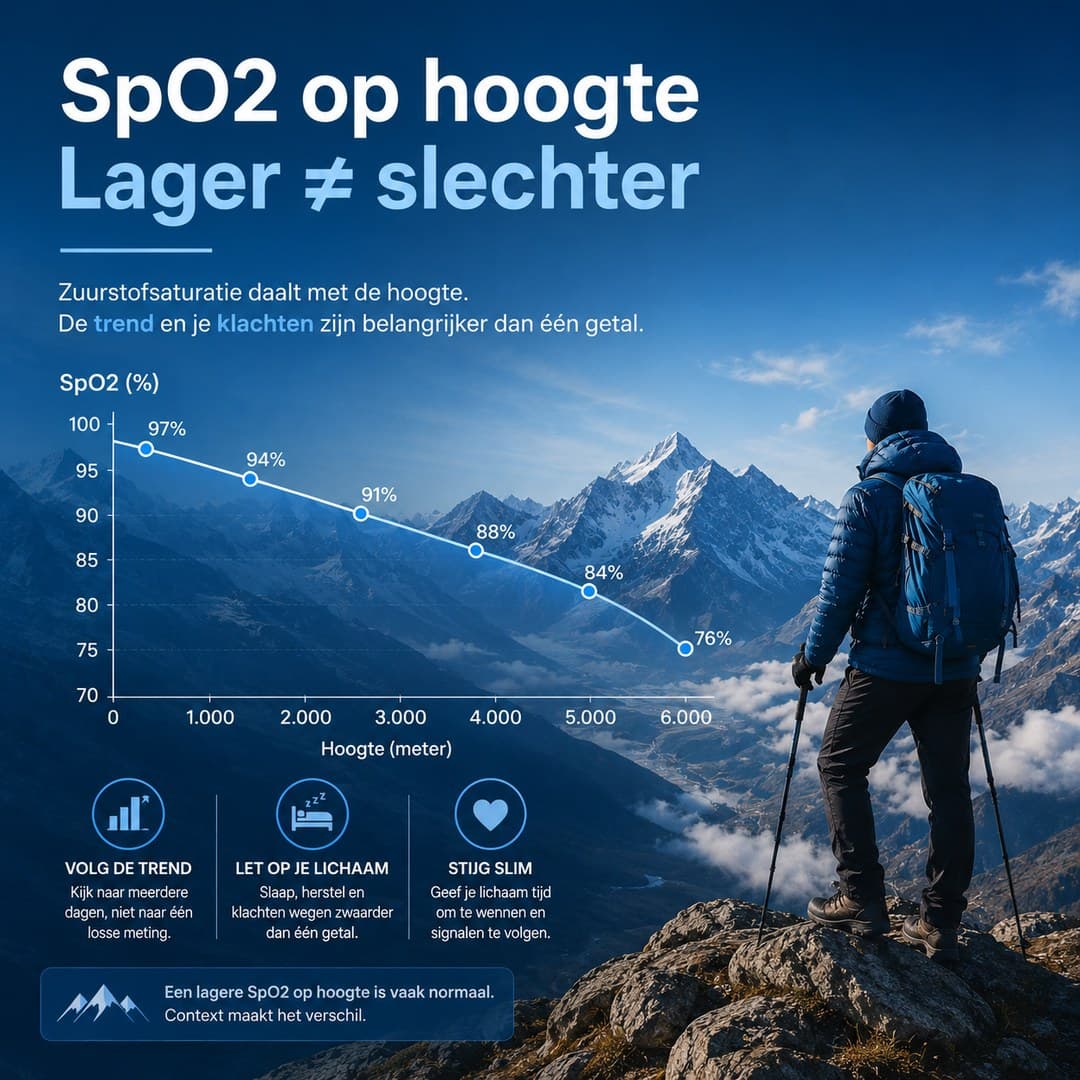
- Monitor trends. Look at SpO2, sleep, recovery and complaints, not at a single measurement.
- Send it along. Increase only when your body reacts stably.
For anyone working with a height tent at home, a structured schedule is important. It's better to use a gradual progression plan for this than to make individual altitude choices. Our practical guide on the altitude tent construction diagram expands on that.
This is how you monitor this lens
Objective monitoring prevents altitude training from becoming a guessing game. However, you must interpret figures correctly. SpO2 in particular is useful as a trend, not as absolute truth. A single measurement says little. A pattern over several mornings says much more.
| Signal | What you are following | How you decide |
|---|---|---|
| SpO2 trend | Morning values over several days | Stable and symptom-free can allow for progression |
| Sleep quality | Sleep duration, rest, waking | Poor sleep is often a reason not to increase. |
| Recovery | Feeling of stiffness, HRV, fatigue | Healing typically requires a gentler stimulus. |
| Symptoms | Headache, nausea, feeling of pressure | On clear complaints, reduce or pause |
What you're following: morning values over several days.
How you decide: stable and trouble-free may allow for assembly.
What you're following: Sleep duration, rest, waking up.
How you decide: Poor sleep is often a reason not to increase.
What you're following: Numbness, HRV, fatigue.
How you decide: Healing usually requires a gentler stimulus.
What you're following: Headache, nausea, feeling of pressure.
How you decide: When symptoms are severe, reduce or pause treatment.
Do you want to better objectify the effect of your preparation? Then our explanation about measuring altitude training effect a useful deepening.
Height training is suitable for whom?
Altitude training can be suitable for three groups. Firstly, for endurance athletes working towards a peak performance. Secondly, for mountaineers who want to be better prepared for altitude. Thirdly, for people who want to acclimatise to low-oxygen conditions under supervision.
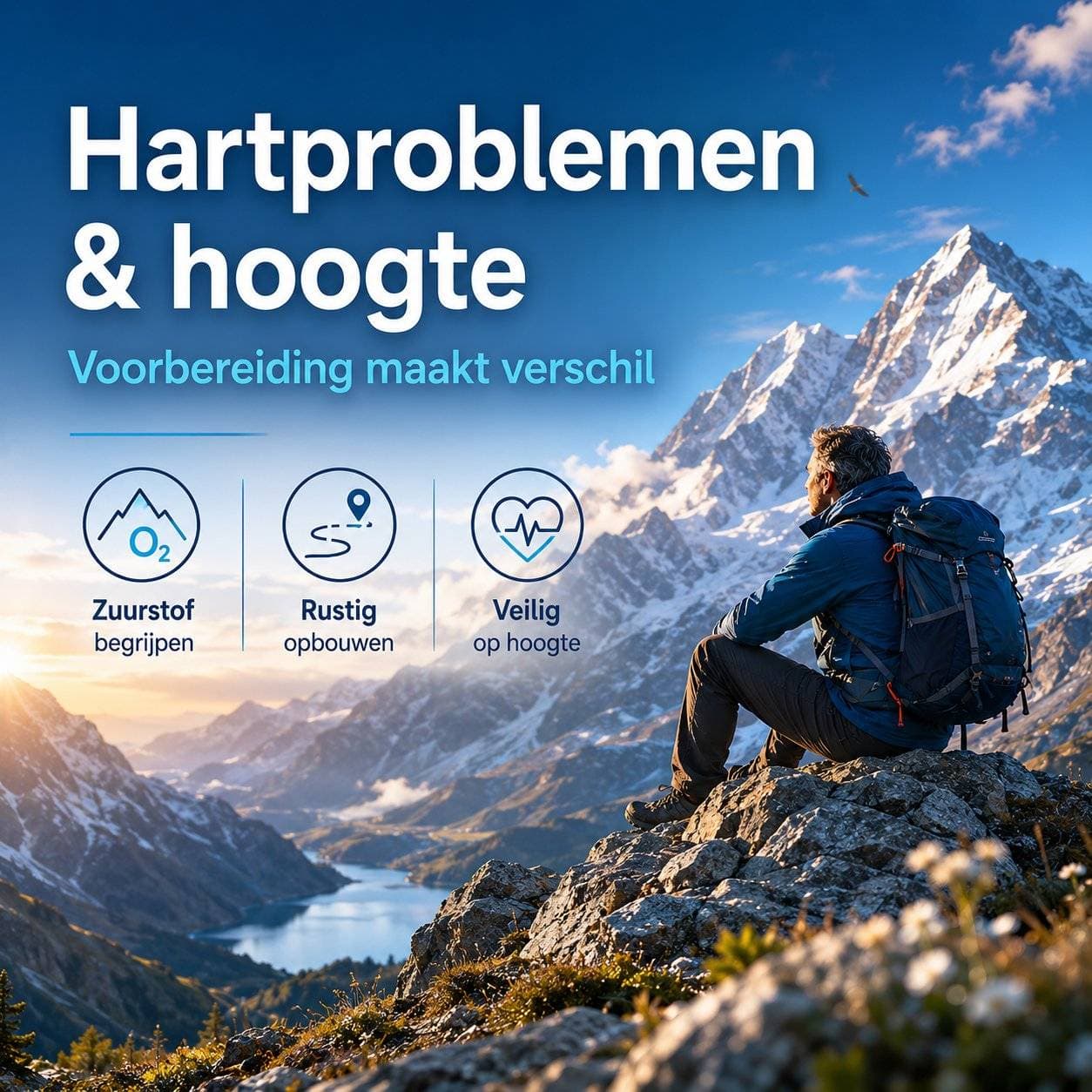
That doesn't mean everyone should start. Those who sleep poorly, are ill, recovering or have medical complaints, should be more careful. For heart, lung or blood-related conditions, personal medical advice is important.
Altitude training is most suitable if you:
- a concrete sporting or mountain goal;
- at least a few weeks of preparation time;
- prepared to build up gradually;
- takes sleep and recovery seriously;
- to monitor objectively instead of guessing based on gut feeling.
When should you be careful?
Caution is needed when stimulation comes at the expense of recovery. You’ll often notice this sooner than you think. Poor sleep, persistent headaches, clear fatigue, or a sharply declining recovery trend are all signs that you shouldn't push on.
Problems also arise with overly aggressive timing. Those who drastically increase their training intensity just before an important match may start feeling fatigued. Those who ramp up too quickly just before heading to the mountains might experience unnecessary sleep disturbances.
Decision rules
- Are you feeling well and are trends remaining stable? Then you can carefully build.
- Are you sleeping noticeably worse? Maintain the same stimulus or decrease it.
- Are you getting complaints? Lower, pause or ask for advice.
- Do you have doubts about medical safety? Let yourself be assessed personally.
Altitude training at home versus in the mountains
Actual altitude and simulated altitude are not the same. In the mountains, air pressure, cold, exertion, sleep, nutrition, hydration, and logistics all change simultaneously. At home, you can administer the oxygen stimulus in a much more controlled manner.
That's precisely the value of training at home or sleeping in simulated altitude. You bring part of the altitude stimulus into a safe, measurable environment. This allows you to build up more calmly and respond better to signals.
This can be practical for athletes as normal training can be maintained. For mountaineers, it can help to discover how your body reacts to altitude before reaching the mountain itself.
Frequently asked questions about altitude training
What exactly is altitude training?
Altitude training is training, sleeping or living in an environment with less available oxygen. The goal is to allow your body to adapt in a controlled manner to low-oxygen conditions.
How quickly do you notice the effects of altitude training?
This varies from person to person and depending on the protocol. You'll notice some effects within days, such as breathing and sleep. Performance-oriented or acclimatisation-oriented effects usually take several weeks.
Is altitude training safe?
With a gentle build-up and good monitoring, altitude training can be well-managed for many healthy individuals. For medical conditions or clear complaints, personal advice is important.
Is a height tent the same as altitude training?
No. A height tent simulates altitude at home. A high-altitude training camp combines accommodation, training, environment, and often also cold, travel stress, and other stressors. Both can be valuable, but they require a different approach.
Should you train or sleep at altitude?
That depends on your goal. For many athletes and mountain climbers, sleeping at altitude is a logical basic stimulus. Training in hypoxia can be supplementary, but is not always necessary.
Do you want to know which form suits your goal?
Altitude training works best when the goal, timing, and progression are right. Therefore, do not start at the highest setting, but with the correct method.
Conclusion: what is altitude training mainly and not?
Altitude training is not a shortcut, nor is it a guarantee of improved performance. It is a controlled oxygen stimulus that can help your body adapt. Its value lies primarily in the combination of correct dosage, sufficient time, good sleep, and objective monitoring.
For athletes, altitude training can help them work towards a peak performance moment in a more prepared way. For mountaineers, it can help to make the transition to altitude calmer and more measurable. In both cases, the same basic rule applies: build up gradually, follow trends, and let recovery remain paramount.
Those who approach altitude training in this way, don't use it as a gimmick. Then it becomes a well-thought-out part of preparation, performance, and safety.