Altitude sickness test: how the Lake Louise score works
Published 26 May 2026 · 7 min read
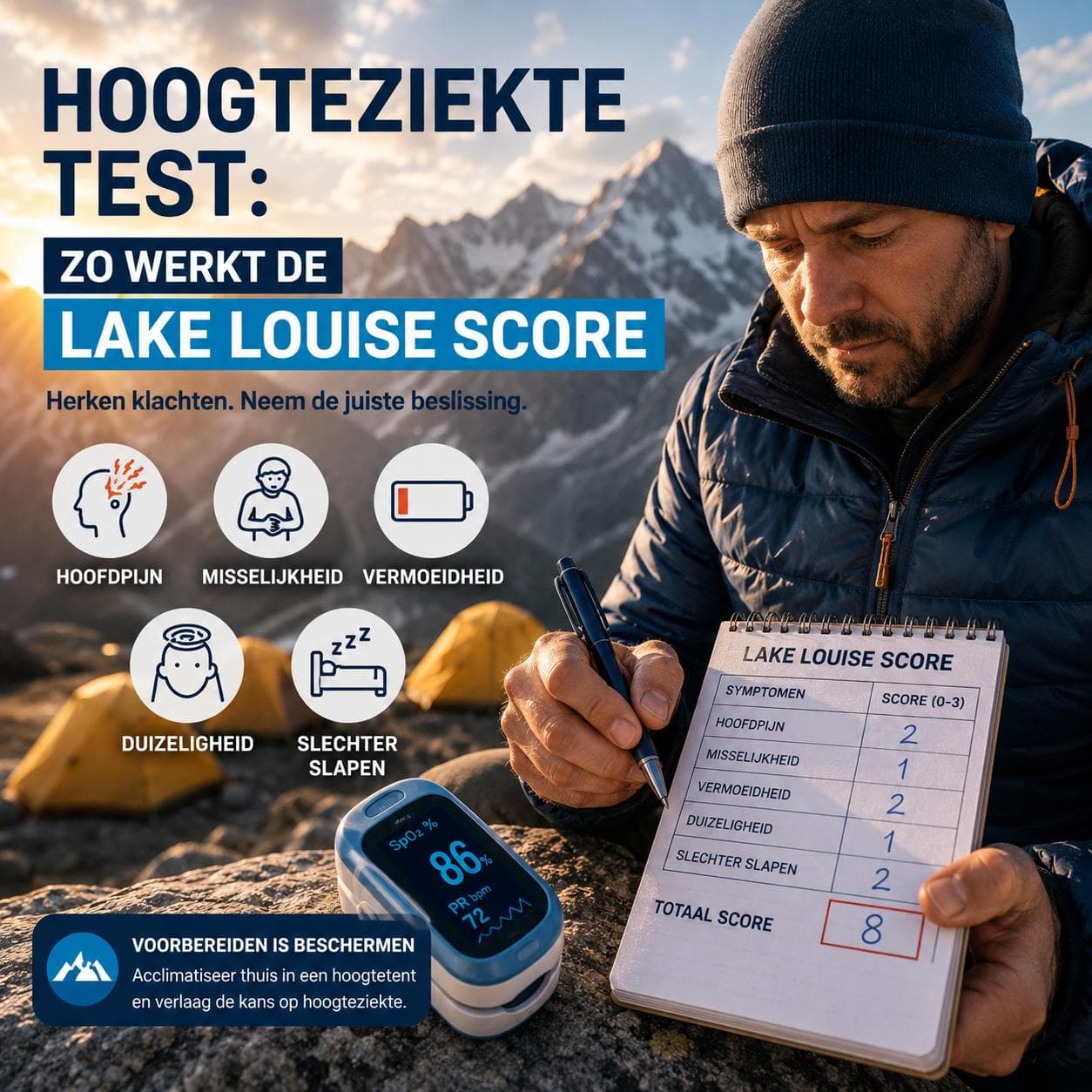
For mountain travellers, hikers and expedition climbers, such a mountain sickness test is valuable. Many people hesitate: is this headache still part of the first few days at altitude, or is it the beginning of AMS? In this article, you will learn how the Lake Louise Score works, when you should stop ascending, and why sleeping in a hyperbaric chamber beforehand can significantly reduce the risk of altitude sickness.
Short answer: The Lake Louise score is a practical altitude sickness test. A score of 3 or higher, combined with a headache, likely indicates acute altitude sickness. The higher the score, the more important it becomes to stop ascending, rest more, or descend.
Conclusion: The Lake Louise score makes altitude sickness more measurable.
Nuance: The score remains a tool and does not replace medical assessment.
Practical hook: Pre-acclimatising with a height tent significantly reduces the chance of complaints.
The Lake Louise score is a test for altitude sickness.
The Lake Louise Score is an international questionnaire for assessing acute mountain sickness. Doctors, mountain guides, researchers, and expedition leaders use this altitude sickness test to interpret symptoms at altitude in a structured way.
The test is particularly relevant when you have recently been above approximately 2500 metres. At that altitude, your body has less oxygen available. If the ascent is faster than your acclimatisation, symptoms can develop.
At altitude sickness it is almost never about a single isolated symptom. The combination of headache, nausea, fatigue, dizziness, and poor sleep, in particular, strengthens the assessment.
Which symptoms does the altitude sickness test count?
The Lake Louise score considers five main complaints. Each component is scored from 0 to 3. The more severe the complaint, the higher the total score.
- Headache
- Nausea or decreased appetite
- Fatigue or weakness
- Dizziness or lightheadedness
- Sleeping worse than usual
Headache plays a central role. Without headache, classic acute mountain sickness is usually not discussed according to the Lake Louise criteria.
⚠️ Reality check
Many mountain hikers dismiss mild complaints too easily. In particular, slight headaches, poorer sleep, and reduced appetite can together be an early warning sign. This is precisely why an altitude sickness test is useful.
At what Lake Louise score do you get altitude sickness?
| Lake Louise score | Interpretation | Practical action |
|---|---|---|
| 0 – 2 | Normally normal acclimatisation | Keep monitoring calmly |
| 3 – 5 | Mild altitude sickness possible | Do not rise further until improved |
| 6 – 9 | Clear AMS | Take a rest day or consider descending |
| 10+ | Severe complaints | Consider medical assistance and descending seriously |
Interpretation: usually normal acclimatisation
Action: Maintain a calm monitoring
Interpretation: mild altitude sickness possible
Action: do not rise further until improvement
Interpretation: clear AMS
Action: Take a rest day or consider descending
Interpretation: serious complaints
Action: Consider seeking medical attention and descending seriously
A higher score does not automatically mean you are in immediate mortal danger. However, it does mean your body is struggling with the altitude. Further ascent is then ill-advised.
Read also how to how to recognise and deal with altitude sickness when complaints increase.
A high-altitude sickness test is particularly important when:
An altitude sickness test is particularly useful when symptoms are vague. This often happens during the first few days of a trek or climb. You feel tired, sleep poorly, and may have a slight headache. This can be normal, but it can also be the beginning of AMS.
Use the Lake Louise score primarily when:
- You get above 2500 metres
- You've risen quickly recently
- Headache accompanied by nausea or poor sleep
- You are not recovering as well as usual
- You're in doubt whether continuing to rise is wise
When is it not altitude sickness?
Not every complaint at altitude is acute mountain sickness. This can make interpretation difficult at times. Headaches can also be caused by dehydration, sun, stress, cold, or lack of sleep.
| Complaint | Resembles altitude sickness | Other possible cause |
|---|---|---|
| Headache | Yes | Dehydration, sun, stress |
| Poor sleep | Yes | Jet lag, stress, cold |
| Nausea | Yes | Stomach problems or diet |
| Fatigue | Yes | Strenuous effort or lack of sleep |
Looks like altitude sickness: yes
Another cause: Dehydration, sun or stress
Looks like altitude sickness: yes
Another cause: Jet lag, stress of the journey
Looks like altitude sickness: yes
Another cause: Nutrition or stomach problems
Looks like altitude sickness: yes
Another cause: Heavy exertion or sleep deprivation
This is why a single complaint is insufficient as a diagnosis. The strength of the Lake Louise score lies in the overall picture.
Why measuring saturation alone is insufficient
Many people use a pulse oximeter as a test for altitude sickness. That's understandable, but not entirely correct. A low SpO2 can be normal at altitude, especially during the first few days.
Conversely, people with a reasonable saturation can still develop clear AMS symptoms. Therefore, it remains oxygen saturation at altitude Especially interesting as a trend, not as an isolated absolute value.
📊 Research shows
Symptoms, sleep quality, recovery, and SpO2 trend together provide a stronger picture than a single saturation measurement. The Lake Louise score complements that measurement practically.
This is how you monitor this lens
A good assessment combines the altitude sickness test with other signals. So don't just look at the score, but also at the progression over several hours or days.
| Monitoring | What are you paying attention to? | When to pay attention? |
|---|---|---|
| Score | Rising Lake Louise score | Score remains above 3 or increases |
| SpO2 trend | Thresholding across multiple measurements | Decline combined with symptoms |
| Sleep | Ever-worsening recovery | Waking up with a headache or nausea |
| Functioning | Normal pace feels extremely difficult | Clear regression compared to the group |
What are you paying attention to? rising Lake Louise score
When to pay attention? score remains above 3 or is rising
What are you paying attention to? darling over multiple measurements
When to pay attention? dizziness in combination with complaints
What are you paying attention to? Ever worse recovery
When to pay attention? Waking up with a headache or nausea.
What are you paying attention to? A normal pace feels extremely heavy
When to pay attention? clear relapse compared to the group
How a height tent reduces the risk of altitude sickness
A height sickness test is most useful during the journey. However, the best strategy begins even before departure. Sleeping in a high-altitude tent beforehand can significantly reduce the chances of altitude sickness.
With a height tent, you sleep in normobaric hypoxia for several weeks. The air pressure remains the same, but the oxygen percentage decreases. This gives your body a controlled oxygen stimulus at home.
This makes acclimatisation more manageable. You can build up step by step, track your SpO2 trend, and let your body get used to it before you arrive in the mountains.
- Less chance of headaches during the first few days at altitude
- Better sleep and more restful recovery at altitude
- Less chance of nausea and loss of appetite
- Greater stability in SpO2 trends
- More control over your preparation
A height tent is not a complete guarantee against altitude sickness. However, it makes acclimatisation controlled, measurable and plannable. As a result, the chance of suffering symptoms often decreases significantly.
Read more about acclimatising at home for mountain expeditions And how to build up a preparation calmly.
When should you stop rising?
Stop rising when:
- Je Lake Louise scoort boven de 3 blijft
- Headache clearly worsening
- Nausea or dizziness increases
- Rust no improvement gives
- Your performance is noticeably deteriorating
Serious symptoms such as confusion, coordination problems, breathlessness at rest, or extreme weakness should always be taken seriously.
Read also how to act during acute altitude sickness.
Do you want to reduce the chance of altitude sickness in advance?
With an altitude tent, you can acclimatise in a controlled manner at home in preparation for your trek, expedition or climb. This is especially helpful for trips above 3000 metres to ensure you arrive better prepared.
FAQ about Altitude Sickness Testing
What is the best altitude sickness test?
The Lake Louise score is the best-known practical symptom test for acute mountain sickness. The test combines multiple symptoms into a single score.
At what Lake Louise score do you get altitude sickness?
Usually from a score of 3 or higher, combined with headaches.
It is possible to experience altitude sickness even with a normal saturation.
Yes. Symptoms and functioning remain more important than a single isolated SpO2 measurement.
Is headache at altitude always altitude sickness?
No. Dehydration, sun, stress, and lack of sleep can cause similar symptoms.
Does an altitude tent help against altitude sickness?
A height tent significantly reduces the chance of altitude sickness, but offers no complete guarantee.
Sources and deepening:
Conclusion: use the altitude sickness test as a decision-making aid
The Lake Louise score is a valuable altitude sickness test as it makes symptoms more objective. It is not a single measurement that determines if you can continue safely, but the overall picture.
Therefore, combine the score with your SpO2 trend, sleep quality, recovery, and performance. If symptoms worsen, not increasing further is often the wisest choice.
Sleeping in a height tent beforehand creates a controlled oxygen stimulus before departure. This significantly reduces the chance of altitude sickness and makes your preparation more measurable, calmer, and better planned.