Preventing altitude sickness: complete guide - rent, buy or apply?
Published 18 January 2026 · 4 min read
Prevent altitude sickness is a source of doubt for many athletes and mountain travellers. You know the risk exists, but not whether acclimatising is enough, whether you should rent an altitude tent, or whether building up quietly on the way is enough. In this guide, you won't get a quick checklist, but a grip. You will learn what exactly causes altitude sickness, why a lot of advice falls short, and how to choose an approach that suits your goal, pace and load capacity.
Why altitude sickness is so often underestimated
Many people think of extreme expeditions when they think of altitude sickness. In practice, however, symptoms often arise as early as between 2,500 and 4,000 metres. Headaches, nausea and poor sleep are then seen as “belonging”. This is a misconception.
Altitude sickness has little to do with perseverance. It is a physiological response to lack of oxygen. The faster you ascend and the less time your body has to adapt, the greater the risk of symptoms.
What does this mean concretely?
- Planning is more important than fitness.
- Faster is almost always riskier.
- Complaints are signals, not weaknesses.
What happens in your body during altitude sickness?
At altitude, the amount of available oxygen decreases. Your body reacts to this by breathing faster and increasing your heart rate. This is a normal and necessary adaptation. Problems arise when this compensation is insufficient or demanded too quickly.
If you want to understand those physiological processes even further, read about what causes altitude sickness and how the body adapts to low oxygen levels.
What does this mean concretely?
- Acclimatisation takes days to weeks.
- Sleep and recovery are crucial indicators.
- Effective prevention starts before you travel.
Did you know...
... most cases of altitude sickness do not occur during ascent, but rather at night during the first nights at altitude? During sleep, your breathing slows down, reducing oxygen intake. Poor sleep is therefore often an earlier warning sign than headaches or nausea.
Avoiding three persistent misconceptions about altitude sickness
1. “I'm fit, so I won't get altitude sickness”
Good fitness does not protect against oxygen deprivation. Fitness can even mask symptoms, making you continue longer than is wise.
2. “Taking a break helps with acclimatisation”
Continuing while symptoms persist actually increases the risk of worsening. Acclimatisation occurs through recovery, not through forcing.
3. “An altitude tent always prevents altitude sickness”
An altitude tent can help with pre-acclimatisation, but never completely rule out altitude sickness. Without proper set-up and guidance, risk always remains.
What does this mean concretely?
- Listen to signals, not assumptions.
- Use tools supportively, not as a solution in itself.
Two recognisable scenarios
Scenario 1: the fanatical puller
You sleep badly above 4,200 metres, but during the day you feel reasonable. You wonder if this is normal.
Insight: Poor sleep is often an early warning sign. Extra rest or a rest day can prevent mild symptoms from developing into altitude sickness.
Scenario 2: the athlete with a tight schedule
You want to quickly advance to 5,000 metres because your schedule is fixed.
Insight: Schedules are secondary to physiological adaptation. The body does not adapt to calendar pressure.
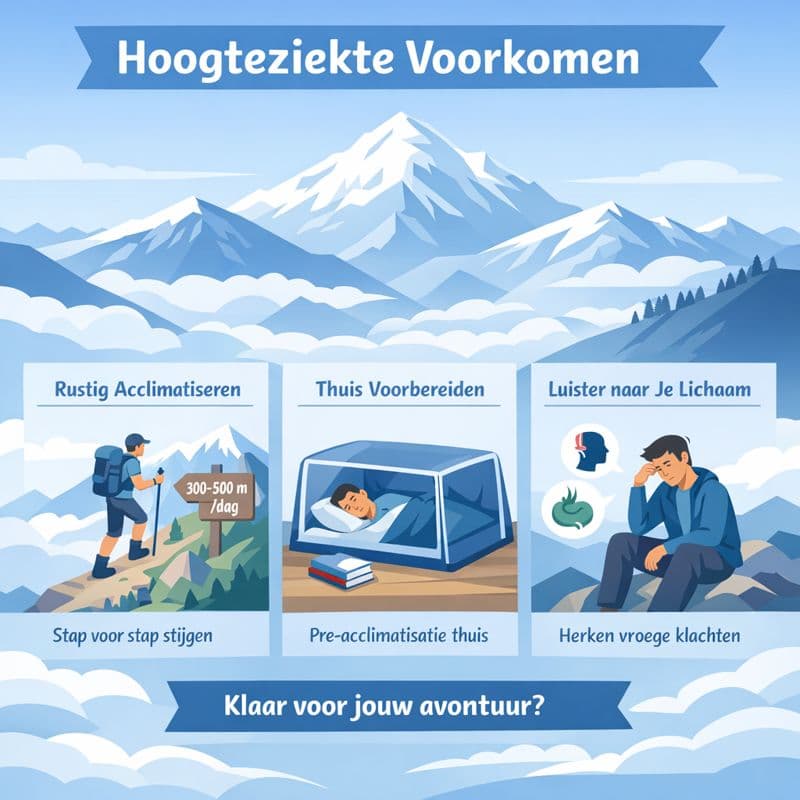
Three ways to prevent altitude sickness
1. Classic on-site acclimatisation
Quiet ascents of up to 300 to 500 metres a day, regular rest days and attention to sleep and recovery are core.
2. Pre-acclimatisation at home
With an altitude tent, you lower the oxygen percentage before departure (normobaric hypoxia). The practical steps for this can be found in Acclimatising at home for mountain expeditions, in which you will learn exactly how to use it effectively.
3. Combination approach
For higher targets or limited travel time, a combination of pre-acclimatisation and quiet build-up on site is often most effective.
What does this mean concretely?
- More preparation gives more margin at altitude.
- Less stress and uncertainty during your trip.
High altitude tent: rent, buy or don't use?
An altitude tent is especially useful when you have little time or a high goal where you climb more than 500 metres per day. The recommended duration is between a minimum of 4 and a maximum of 6 weeks. The set altitude is determined individually and incrementally based on measured SpO₂.
Unsure if a high altitude tent makes sense for your plan? Use the checklist: when are you ready for a high altitude tent? as a quick reality check to properly assess expectations and timing.
When exactly is a high altitude tent not necessary?
An altitude tent is not necessary in all situations. If you have enough time to ascend gently, your target altitude is below 3,500 to 4,000 metres and you have no previous experience of altitude sickness, classical acclimatisation on site may suffice.
What does this mean concretely?
- More time on site lowers the need for tools.
- A slower pace and good sleeping spots are often more effective than accelerating beforehand.
- Not using is sometimes as wise as using.
Decision moments and red flags
- Continuing: Stable sleep, recovery feels normal, SpO₂ recovers well.
- Adjust: deteriorating sleep, mild headache, increasing fatigue.
- Stop: persistent headache, nausea, loss of coordination.
When is counselling wise?
With goals above 4,500 metres, previous experience of altitude complaints or limited acclimatisation time, guidance is not a luxury but a form of risk mitigation.
If you want an even deeper understanding of how to recognise and prevent complaints by altitude zone, it is valuable to see which signals belong to which altitude in the context of altitude sickness symptoms by altitude zone.
Summary and next step
Preventing altitude sickness does not require heroism, but insight. By taking your body seriously and aligning your preparation with your goal, you increase both your safety and comfort.
If you are unsure which approach suits your plans, personal advice is often the wisest first step.