When to use acetazolamide for altitude sickness?
Published 13 July 2016 · 4 min read
Acetazolamide, better known by its brand name Diamox®, is a medicine that can help prevent and treat altitude sickness. It is mainly used when the body is not given enough time to adapt naturally to the lower oxygen pressure at altitude.
The drug speeds up the acclimatisation process by stimulating breathing and improving oxygen transport in the body. Nevertheless, acetazolamide is no substitute for proper acclimatisation. It always remains better to acclimatise the body to altitude beforehand, for example by a gradual ascent or by pre-acclimatisation with an altitude tent.
In this article, you will read when acetazolamide can be useful, when it is better not to use it and what situations increase the risk of altitude sickness.
What is acetazolamide?
Acetazolamide is a drug originally developed as a diuretic, but now best known as a remedy for altitude sickness.
It works by slightly changing the acidity of the blood. This automatically makes the body breathe faster and deeper. This leads to better oxygen uptake and speeds up the natural acclimatisation process.
It is important to note that acetazolamide does not replace acclimatisation. It only partially supports the process.
When can acetazolamide be used?
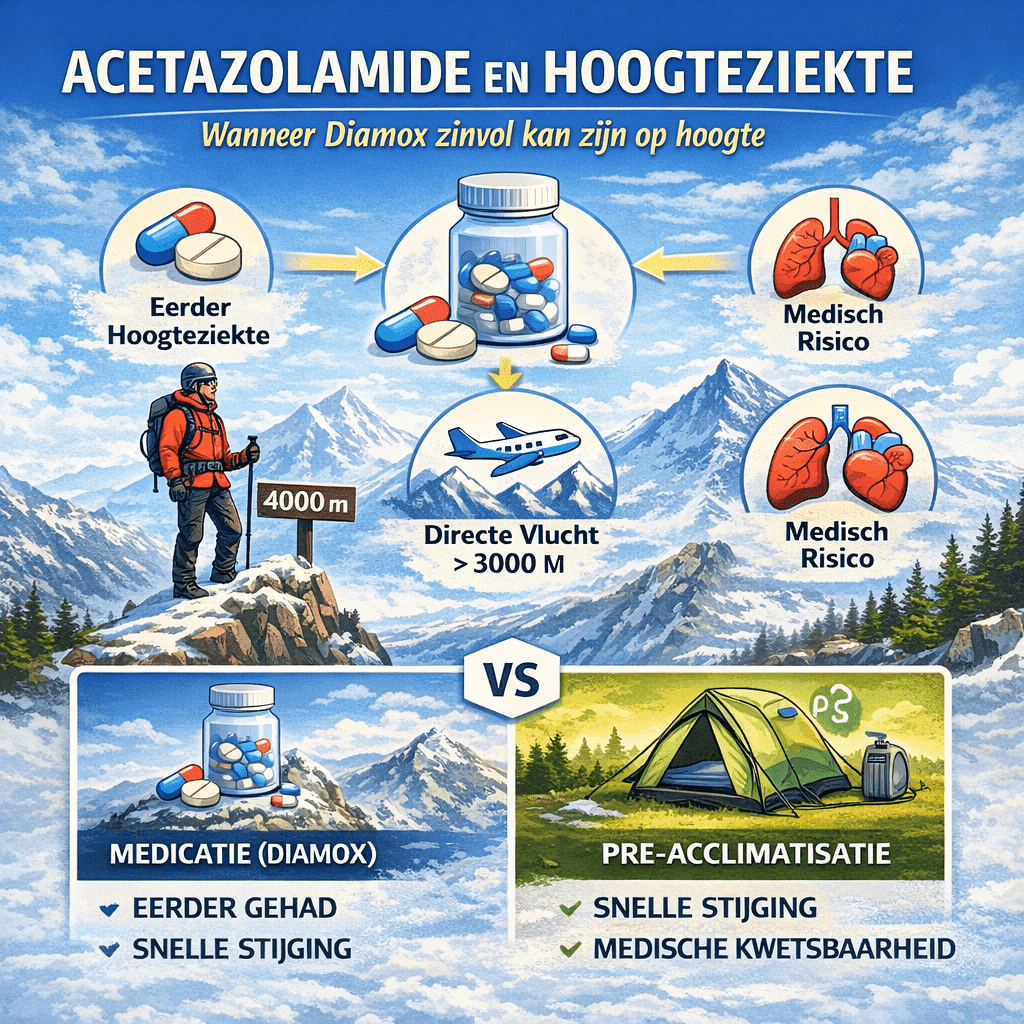
Acetazolamide is usually used in situations where gradual acclimatisation is difficult or impossible. For example, during rapid altitude travel or when a person has been found to be prone to altitude sickness in the past.
1. When you have had altitude sickness before
Those who have experienced altitude sickness in the past are more likely to experience it again on a subsequent expedition. In that situation, a doctor may recommend taking acetazolamide preventively.
2. When flying directly to high altitude
A direct flight to high altitude hardly gives the body time to adjust. This occurs, for example, in cities with airports above 3,000 metres.
Well-known examples are:
- Tibet - Lhasa (3749 metres)
- Bolivia - La Paz (3640 metres)
- Peru - Cusco (3399 metres)
- Ecuador - Quito (2850 metres)
Upon direct arrival at these altitudes, about 40 to 50 per cent of travellers may develop symptoms of altitude sickness.
3. When a rapid rise is inevitable
A general rule in mountain expeditions is to sleep no more than about 300 to 500 metres higher per day after 2,500 metres. In some expeditions, however, this is not feasible.
When a rise of more than 500 metres per day is unavoidable, acetazolamide can provide temporary support.
4. In case of medical vulnerability (only in consultation with doctor)
In people with certain lung or heart problems, altitude can put extra strain on the body. In these situations, a doctor may prescribe acetazolamide as a preventive measure.
This should always be done in consultation with a medical specialist.
Where is altitude sickness most common?
Altitude sickness can occur from about 2,500 metres altitude. The risk increases as altitude and rate of ascent increase.
Popular destinations where travellers regularly experience altitude sickness include:
- Mount Kenya (5199 metres)
- Kilimanjaro (5895 metres)
- Machu Picchu region (around 2,500 metres)
- Andean treks in Peru and Bolivia
- Himalayan expeditions in Nepal and Tibet
Trekkings involving rapid ascents, such as Kilimanjaro, in particular have a relatively high rate of altitude sickness.
What should you do in case of symptoms of altitude sickness?
The main rule for altitude sickness is simple: never ascend further when you have symptoms.
Common early symptoms are:
- headache
- nausea
- loss of appetite
- fatigue
- sleep worse
When these symptoms occur, always take rest and do not ascend further until the symptoms disappear.
If you are travelling with a group or guide, always report complaints immediately. Research shows that climbers in groups sometimes continue longer despite symptoms, often due to social pressure. This can cause dangerous situations.
When should you descend?
When symptoms do not improve after rest, or when they get worse, descent is the most important and effective treatment.
Even a drop of 500 to 1,000 metres can make a big difference.
Why pre-acclimatisation often works better
Although acetazolamide can be a useful aid, proper acclimatisation remains the best protection against altitude sickness.
An increasingly popular method is pre-acclimatisation at home, for instance by sleeping in an altitude tent a few weeks beforehand. This involves reducing oxygen levels so that the body can already adapt to conditions at altitude.
This makes the acclimatisation process controlled, measurable and plannable. Many expedition athletes use this method to significantly reduce the risk of altitude sickness.
Conclusion
Acetazolamide can be a useful aid when rapid altitude travel is unavoidable or when a person has had previous altitude sickness. It supports the acclimatisation process, but does not replace proper preparation.
The safest strategy always remains a combination of:
- gradual increase
- sufficient rest days
- recognition of symptoms
- timely descent in case of complaints
Those who prepare properly and take their bodies seriously can avoid most altitude problems.
More information on altitude sickness and prevention can be found on the website of
Vaccinations on Travel.