Preventing altitude sickness: headaches at altitude - causes and management
Published 16 January 2026 · 5 min read
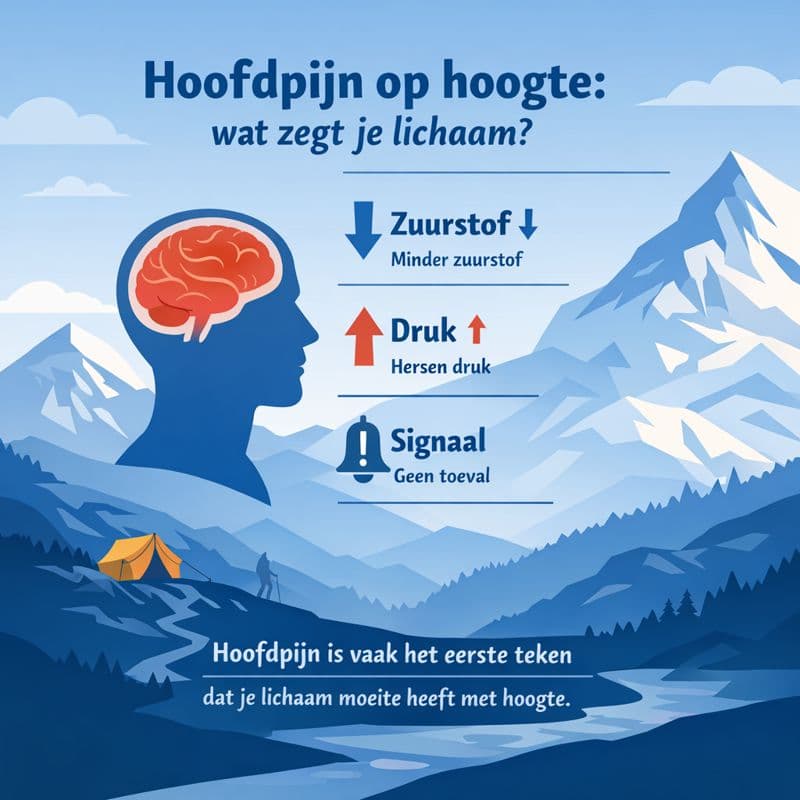
Most people who suffer from altitude sickness first notice it from headaches at altitude. This often feels harmless: some pressure behind the eyes, a nagging head on exertion, poor sleep. Yet this is usually the first warning signal That your body is struggling to cope with low oxygen conditions. If you want to prevent altitude sickness, you need to understand where those headaches come from and what you can practically do about them.
In this article, we clearly explain why headaches occur at altitude, why it is often misinterpreted and how you can reduce the risk of exacerbation with the right choices. Not as a checklist, but as guidance for decisions along the way or in your preparation.
Why headaches are often the first signal
Headaches at altitude are rarely accidental. It is usually a physiological response to reduced oxygen availability. As soon as you ascend, the oxygen pressure in the air drops. Your body has to adjust to keep transporting enough oxygen to the brain and muscles.
That adjustment is not the same for everyone.
What is happening in your body?
When exposed to altitude, the following happens:
- Oxygen saturation (SpO2) falls
- Breathing speeds up, even at rest
- Blood vessels in the brain dilate
- Moisture balance shifts
This combination can lead to increased pressure in the head, which manifests as a headache. This is a core component of acute mountain sickness (AMS).
What does this mean concretely?
- For planning: rapid rise increases risk
- Before load: intense exertion worsens symptoms
- For recovery: poor sleep slows adaptation
Common misconceptions about headaches at altitude
Headaches are often misinterpreted. This leads to choices that actually exacerbate the problem.
Misconception 1: “It's just dehydration”
Dehydration may contribute, but rarely explains everything. If a headache persists despite adequate drinking, height adaptation is likely to be the limiting factor.
Misconception 2: “Just hang on, it will pass”
Mild symptoms can disappear with adequate rest. But persistent or increasing headache is not a sign of habituation, but of overuse.
Misconception 3: “Paracetamol solves the problem”
Pain relief masks symptoms, but does not improve oxygenation. This makes it more difficult to interpret signals correctly.
What does this mean concretely?
- For planning: symptom monitoring is more important than schedules
- For load: pain relief should never be leading
- For risk: ignoring increases risk of more severe altitude sickness
Scenario 1: the tractor above 4,000 metres
A mountain hiker sleeps at 4,200 metres. He is fine during the day but wakes up at night with pounding headaches and restless sleep. During the day, the complaint subsides.
This pattern often indicates insufficient overnight acclimatisation. During sleep, the breathing stimulus decreases, causing oxygen deprivation to be experienced more strongly.
What does this mean concretely?
- Extra rest days are more effective than continuing to rise
- Sleeping lower may help more than leaving later
- Sleep quality is a crucial decision parameter
When headaches indicate incipient altitude sickness
Not every headache is immediately dangerous. But certain combinations are.
Red flags
Pay extra attention if headaches are associated with:
- Nausea or vomiting
- Dizziness or loss of coordination
- Poor appetite
- Obvious deterioration on exertion
This suits AMS and requires adjustment of pace or altitude.
What does this mean concretely?
- For planning: no further increase in case of exacerbation
- For load: resting is more active than continuing
- For risk: timely adjustment prevents escalation
Scenario 2: the athlete who is “fit enough”
A well-trained athlete feels strong and decides to ascend faster. On day three, a headache develops that does not disappear with rest.
Physical fitness protects not against altitude sickness. Indeed, fit people often overestimate their adaptation rate.
What does this mean concretely?
- Condition does not replace acclimatisation
- SpO2 trends are more reliable than feeling
- Extra rest days are not a sign of weakness
Preventing altitude sickness: what does work?
Effective prevention consists of coherent choices, not single tricks.
1. Limit daily rise
Above 3,000 metres applies:
- Maximum 300 to 500 metres of sleep altitude per day
- Regular rest day
2. Sleep lower than you rise during the day
This supports natural adaptation processes.
3. Monitor trends, not snapshots
A one-off low SpO2 is less relevant than a decreasing trend over several days.
4. Take headaches seriously
Especially like this one:
- ’Getting worse at night
- Unresponsive to rest
- Combines with other symptoms
5. Consider pre-acclimatisation
When travelling with limited time acclimatising at home help reduce the initial shock.
High altitude tent and pre-acclimatisation: when does it make sense?
Pre-acclimatisation with an altitude tent can be supportive, if applied properly.
- Minimum duration: 4 weeks
- Optimal duration: 4 to 5 weeks
- Maximum duration: 6 weeks
The set height is incrementally adjusted based on measured SpO2, not on fixed schedules. This is guidance, not a guarantee against complaints.
What does this mean concretely?
- For planning: earlier start reduces peak load
- For risk: less chance of sudden headache
- For recovery: better sleep adaptation beforehand
Decision moments: continue, adapt or stop?
Use these signals as a guide:
Continuing makes sense if:
- Headaches are mild and diminishing
- SpO2 remains stable
- Sleep quality improves
Adapting makes sense if:
- Headache persists
- Nighttime symptoms increase
- Exercise clearly feels heavier
Slowing down or descending is necessary if:
- Headache worsens
- Nausea or neurological symptoms occur
- Recovery stalled despite rest
This decision framework helps to prevent altitude sickness by reacting in time.
In conclusion: trust through understanding
Headache at altitude is not a weakness, but information Those who understand why it arises, can make better choices and significantly reduce the risk of altitude sickness.
If you want to know how this relates to your target altitude or trip planning, check out the height-to-oxygen table Or delve further into the acclimatisation basics. For personal advice or guidance on pre-acclimatisation, Altitude Dream can follow along to see what makes sense in your situation.