5 factors that can negatively influence your altitude training
Published 23 October 2017 · 8 min read
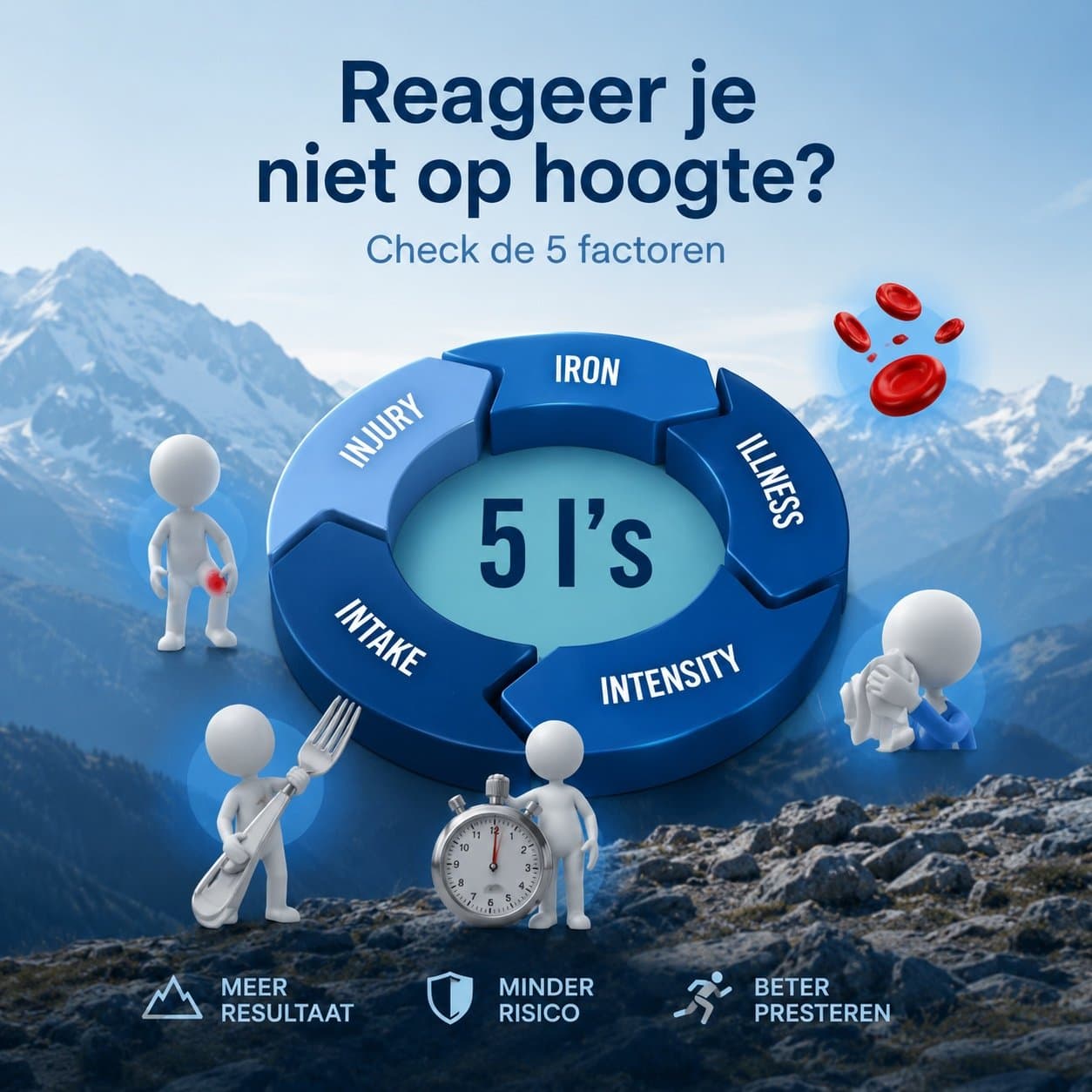
Some athletes show little improvement after a period at altitude. They are called non-responders: people for whom altitude training supposedly has no effect. But do non-responders actually exist? More and more scientists are doubting this. The Australian Institute of Sport has identified five factors, the five “I”s, that can disrupt the blood effect of altitude training so much that it appears an athlete is not responding. This article explains what these five factors are and how to overcome them.
Short answer: A true non-responder is rare. Far more often, something is wrong with one of the five “I”s: Injury (inflammation), Iron (deficiency), Illness, Intensity (training too hard), and Intake (too few carbohydrates and protein). If one of these factors is not right, your altitude block will miss its effect, however good your schedule may be otherwise.
Conclusion: “Not reacting to altitude” is usually not a disposition, but a disturbed precondition.
Nuance: The five “I”s work together; one weak link is enough to block the stimulus.
Practical hook: He who puts these five things in order beforehand and monitors them during the internship will get the most out of the same height.
Why the “non-responder” is largely a myth
Until recently, the rule of thumb was that approximately 10 percent of athletes would be non-responders. Nowadays, many researchers think differently. According to them, a non-responder is often nothing more than someone for whom one or more of the five “I”s were not in order during the altitude period.
That difference is important. If you believe that your predisposition is holding you back, you'll give up. If you see it as a list of controllable factors, you can do something about it. The real mechanism behind altitude training is the same for everyone: less oxygen stimulates the production of red blood cells. How Altitude training works physiologically, does not change from person to person; rather, the circumstances allow for that effect.
The five “I”s at a glance
Each of these five factors can slow down your blood adaptation. They are listed below with their core message; we will then discuss them one by one.
| Factor | What's going wrong | What you do about it |
|---|---|---|
| Injury | Inflammation disrupts adaptation | Allow injuries and inflammations to heal first |
| Iron | Iron deficiency inhibits red blood cell production | Check and supplement ferritin in advance |
| Illness | Illness and fever break down the effect | Delay altitude training until you're fit |
| Intensity | Training too hard undermines recovery | To slow down deliberately, to close with a buffer |
| Intake | Too little fuel and construction dust | Eating sufficient carbohydrates and proteins |
Mismanages Inflammation disrupts adaptation.
Solution: Allow injuries and inflammation to heal first.
Mismanages Iron deficiency inhibits the production of red blood cells.
Solution: Check and supplement ferritin beforehand.
Mismanages Illness and fever break down the effect.
Solution: Postpone altitude training until you are fit.
Mismanages Training too hard undermines your recovery.
Solution: Brake deliberately and close with a margin.
Mismanages too little fuel and construction dust.
Solution: Eat enough carbohydrates and protein.
1. Injury: prolonged inflammation disrupts everything
A persistent inflammation can completely disrupt the effect of altitude on your body. It doesn't have to be a serious injury. From a stubborn knee complaint to a minor gum inflammation: every latent focus of infection draws on the same system that needs to create your new red blood cells.
If you go to altitude with an inflammation like that, you're investing in a stimulus your body can't use. So, get your symptoms checked out first. Unsure if something's wrong? A quick check-up with your doctor or dentist beforehand is worthwhile, precisely because minor inflammations are so easily overlooked.
2. Iron: Without iron, there are no new red blood cells
Iron is the main building block for haemoglobin, the protein that transports oxygen. If your iron supply is too low, your altitude training will almost certainly be ineffective. Therefore, a few weeks before departure, have your Blood test to check your iron status, so you can make adjustments in time.
During your internship, your body also uses more iron than usual, as the production of red blood cells is in full swing. Extra iron supplements are then usually necessary. How you Iron and nutrition around your altitude training approaches, determines whether the stimulus lands or fades away.
🧭 In practice
Take iron supplements in the morning on an empty stomach, preferably with a fresh orange. The vitamin C in it significantly increases absorption. Avoid coffee, tea, and dairy at the same time, as they inhibit absorption. Do this under guidance, as too much iron is also not desirable.
3. Illness: illness breaks the stimulus
Illness is a classic disruptor on the road to better performance. Just like with regular training, an infection can negate the effect of your altitude period. Your body can only deploy its energy once: if it goes towards recovery from an infection, there's little left for blood adaptation.
With a fever, the advice is always the same: postpone altitude training until you are one hundred percent fit again. Pushing through will not only cost you the stimulus, but also increase the risk of staying out of action for longer. Postponement may feel frustrating, but it will pay off in the long run.
4. Intensity: training too hard undermines the effect
The best results are seen in athletes who manage to hold themselves back somewhat during the altitude period. At altitude, your recovery capacity is reduced, meaning the same training weighs heavier than at home. Those who continue to go all out will exhaust themselves and undermine precisely the adaptation they are seeking.
The right intensity means that at the end of a workout, you feel like there was more in the tank. This feels counterintuitive to driven athletes, but that margin isn't weakness. It's the space where your body can convert the stimulus of the hard work into gains. It's also one of the most common altitude training errors.
5. Intake: sufficient fuel and building materials
Sufficient carbohydrates and proteins are indispensable during a period at high altitude. Carbohydrates provide the fuel to prevent inflammation and sustain your training. Proteins provide the building blocks that support the increased production of red blood cells.
If you eat too little, your body goes into 'economy mode' and your blood can't get the raw materials it needs. Don't underestimate this: appetite often drops at altitude, while your energy needs actually increase. Eating consciously and sufficiently is therefore not a detail, but a prerequisite.
⚠️ Reality check
The five “I”s work like a chain. Your iron levels might be perfect, but a dormant inflammation or insufficient nutrition can still hinder adaptation. One weak link is enough. Therefore, assess the factors together, not in isolation, before drawing conclusions about your response.
This is how you keep the five “I”s under control
Whether altitude training works for you depends less on natural talent and more on preparation. The five “Is” are all controllable. These decision rules will help you determine when to proceed and when to correct something first.
Do start if you are symptom-free, your ferritin levels are optimal, and you can eat sufficiently during the placement.
First course correction If your iron levels are low or you have a dormant infection, address it before going to altitude.
Postpone In case of fever or illness; only resume when you are fully recovered.
Dismount Once your recovery is lagging or your workouts feel harder than usual; reduce the intensity before you build further.
Measurement helps keep this objective. How you measure the effect of your altitude training With your saturation, heart rate variability, and recovery, it quickly shows if one of the five “I”s is causing problems. This way, you adjust based on data rather than intuition.
📊 Research shows
The idea that 10 per cent of athletes simply do not respond to altitude is increasingly unsustainable. Researchers point out that most so-called non-responders were actually suffering from a disrupted factor, often iron or inflammation. If you correct those, the vast majority still respond to the altitude stimulus.
Make the most of your altitude training
Would you like to systematically approach the five “I”s and build up your excitement for heights at home in a measurable way? Explore your options and read how other athletes approached it.
Frequently asked questions
Do non-responders to altitude training really exist?
Genuine non-responders are rare. What was previously considered predisposition often turns out to be a disturbed prerequisite: one of the five “I”s that was not in order. If you correct these factors, the vast majority of athletes will still respond to the altitude stimulus.
De vijf “I's” van hoogtetraining zijn: 1. **Isolatie:** Het isoleren van de effecten van hoogte boven die van training. 2. **Intensiteit:** Het aanpassen van de trainingsintensiteit, omdat deze lager moet zijn bij hoogte. 3. **Interval:** Het effectief gebruiken van intervallen in de training om herstel te bevorderen. 4. **Individualisering:** Het aanpassen van de trainingsaanpak aan de specifieke behoeften en reacties van de atleet. 5. **Informatie:** Het verzamelen en analyseren van data over de prestaties en fysiologische reacties van de atleet tijdens de hoogtetraining.
The five “Is” are Injury, Iron, Illness, Intensity (training intensity), and Intake (nutrition). The Australian Institute of Sport named them as the factors that can disrupt the blood effect of altitude training and make an athlete appear to be a non-responder unfairly.
Why is iron so important in altitude training?
Iron is the building block for haemoglobin. Without sufficient iron, your body cannot produce new red blood cells, which is precisely the effect you aim for with altitude training. With a deficiency, the training will almost certainly miss its purpose, so get your ferritin checked beforehand.
Is it possible to overtrain during altitude training?
Yes, and that's a common mistake. At altitude, your recovery capacity is reduced, making the same training more strenuous. If you don't slow down enough, you undermine the adaptation process. The rule of thumb: finish a training session feeling like you could have done more.
Does an athlete not react to altitude? Almost always, this is not indicative of a lack of predisposition, but rather of one of the five “I”s that require attention. Injury, Iron, Illness, Intensity, and Intake collectively determine whether your altitude period is successful. Get these in order beforehand and monitor them along the way, and you will achieve a real, measurable result from the same altitude.