Using altitude tents: complete guide to settings, safety and monitoring
Published 4 February 2026 · 5 min read
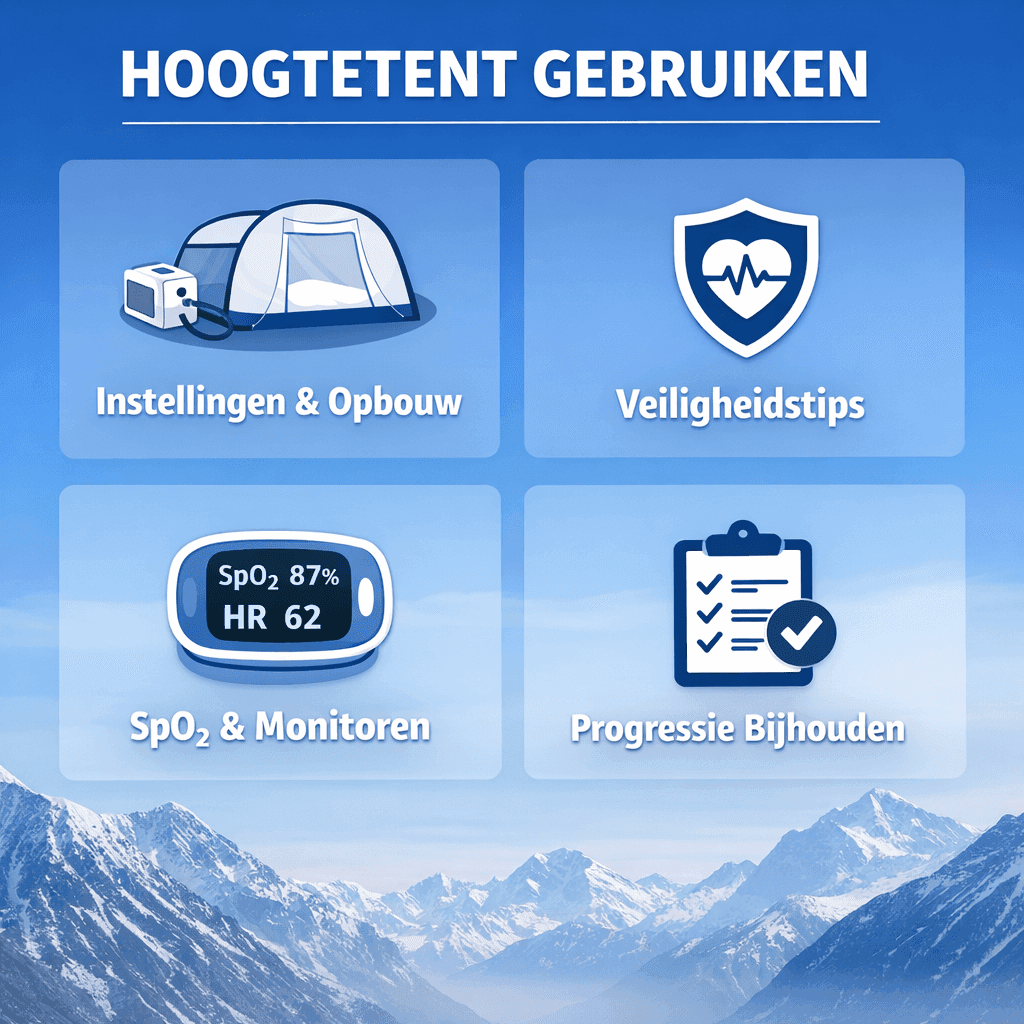
A altitude tent using can be a powerful way to prepare your body for altitude, but only if you know what you are doing. In practice, problems arise from too high start settings, restless sleep or lack of monitoring. This article is for athletes, mountaineers and expeditioners who want to use their altitude tents safely, thoughtfully and effectively.
The essentials in 30 seconds
Conclusion: An altitude tent works best when settings, sleep and monitoring are carefully matched.
Nuance: Increasing too quickly or blindly relying on institutions can actually undermine adaptation.
Practical lead: Start lower than you think, monitor SpO₂ and adjust for sleep quality.
Why high altitude tents are often misunderstood
The appeal of an altitude tent is obvious. You sleep at home in a simulated altitude environment and expect your body to adjust automatically. Many users assume that it is simply a matter of ‘set high and hold on’.
This is precisely where things often go wrong. Altitude tenting is too quickly approached as an achievement in itself, rather than as a controlled stimulus. The result is restless sleep, reduced recovery signals and doubt as to whether it works at all.
A high altitude tent does not require perseverance, but precision. Those who understand that difference will experience the tool fundamentally differently.
💡 Did you know? Many negative experiences with altitude tents do not arise from hypoxia itself, but from too rapid a build-up without attention to sleep and recovery. Quiet habituation significantly increases the chances of effective adaptation.
What a high altitude tent does physiologically
An altitude tent works through normobaric hypoxia. This means that the air pressure remains the same, but the oxygen percentage in the inhaled air is reduced. As a result, the body temporarily receives less oxygen, which activates adaptation mechanisms.
The first reaction takes place in breathing. The body subtly increases breathing frequency and depth. This is followed by changes in oxygen transport, recovery processes and ultimately aerobic capacity.
These processes are not linear. The body needs time to interpret signals and make adjustments. This is precisely why repeatability is more important than intensity.
Why sleep is the primary stimulus
Although hypoxia can also be applied during training, with altitude training, the core lies at night. During sleep, the stimulus is stable and prolonged, without disruption by training, nutrition or mental stress.
This makes sleep the ideal time for controlled exposure. At the same time, it is also the time when disturbance becomes most readily apparent. Sleeping badly is often the first signal that the stimulus is too heavy.
Therefore, when using high altitude tents: sleep quality is not an afterthought, but a leading parameter.
Settings: why starting lower works better
A common mistake is starting at too high a simulated altitude. It feels logical to want to be ‘effective’, but the body responds better to a mild stimulus that it can process.
The first phase is all about tolerance. Can your body sleep peacefully in a slightly hypoxic environment? Does your breathing remain stable? Do you wake up rested?
Only when this base is in place does raising make sense. Generator settings are tools, not an end in themselves.
⚠️ Reality check More altitude does not automatically mean more adaptation. In too aggressive settings, the body switches to stress response, which actually hinders recovery and adaptation.
Monitoring: measuring to understand, not to control
Without monitoring, altitude tenting remains a matter of feel. SpO₂ measurements offer objective feedback on how your body reacts to hypoxia.
What is important here is not the exact value at one moment, but the progression over several nights. Do you see recovery? Is saturation stabilising? Or does it continue to fall?
Always combine numbers with subjective cues: how deeply do you sleep, how often do you wake up and how does your recovery feel during the day?
📊 Research shows That controlled hypoxic exposure is more effective when trends in SpO₂ and sleep quality are leading, rather than fixed elevation schedules without feedback.
A recognisable scenario from practice
Suppose you start with a relatively low setting. The first nights you sleep slightly restless, but after three nights you notice that you fall asleep faster and wake up more rested.
This is often the time when people want to increase too quickly. It feels like ‘it's working’, so why not scale up?
This is precisely where patience pays off. An extra few stable nights strengthens adaptation. Increase only when recovery, sleep and SpO₂ together give the green light.
🧭 In practice Many experienced users only build up after several stable nights, even if the temptation is to go faster.
Safety and preconditions
An altitude tent is a technical tool and requires a safe environment. Good ventilation, stable temperature and dry air are essential for reliable use.
It is also important to dose the duration of use. More hours is not always better.
Technical guidelines such as maximum usage time, ambient conditions and ventilation are not a formality, but preconditions for safe use.
Decision moments and signals
When to continue
- Stable sleep quality
- Gradual normalisation of SpO₂ trends
- Fresh feeling of recovery during the day
When to adapt
- Persistently low SpO₂ without recovery
- Restless or fragmented sleep
- Increasing fatigue
When to slow down or stop
- Headache or nausea that does not go away
- Multiple nights of poor sleep
- Feeling of systemic overload
🧭 In practice Downshifting often feels like failure, but is actually a sign of good adjustment. Adaptation rarely happens in a straight line.
Height tent as part of guidance
An altitude tent is not a replacement for acclimatisation, but a way to make the process controlled, measurable and planable.
This is precisely why the tool works best when data, experience and guidance come together. No fixed schedules, but interpretation of signals.
Anyone using guidance will find that small adjustments can make big differences in comfort and effectiveness. So be sure to take contact with us.
Summary reflection
Using a high altitude tent requires attention and calm. Not working harder, but smarter determines the result.
By listening to signals, measuring where necessary and leaving room for recovery, acclimatisation becomes a manageable process.
Those who understand that adaptation takes time structurally get more out of hypoxic training.
❓ Mini-FAQ Should you always keep raising? No. Stable exposure can be just as effective as further scaling up.