
Taking iron supplements during altitude training promotes hemoglobin production
Published 17 October 2015 · 11 min read
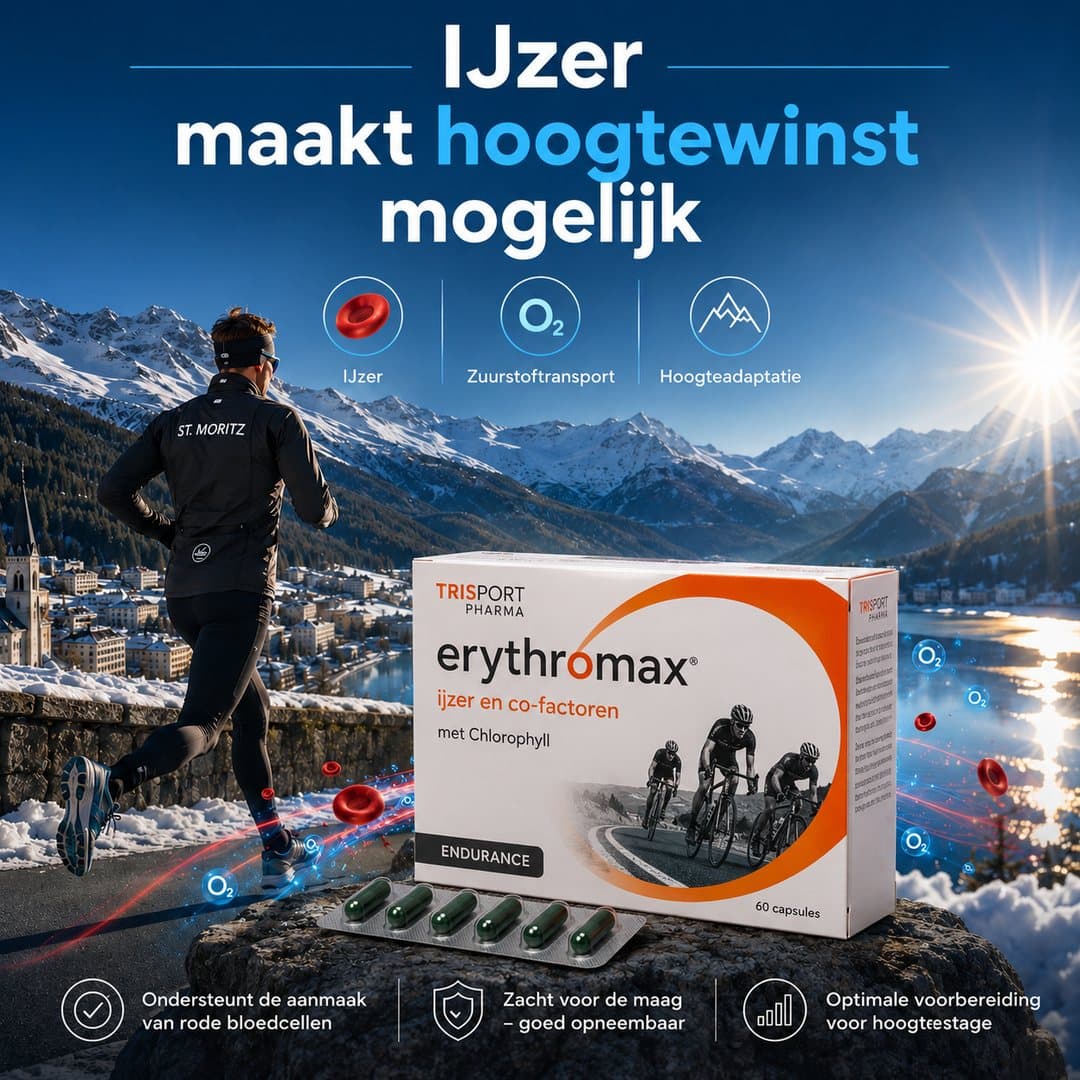
Iron supplements during altitude training: when does it help for haemoglobin?
Iron supplements during altitude training can support the production of haemoglobin, but only when your iron status, timing, and load are correct. Iron is not a shortcut to better performance. It is a building block your body needs to convert the hypoxic stimulus of a altitude training camp into more oxygen transport. Therefore, the real question is not: should every athlete take iron? The better question is: do you have enough available iron reserves to properly process an altitude training camp?
This article helps you decide when iron supplementation makes sense, when blood tests are needed first, and how to avoid supplementing blindly. It complements our in-depth articles on iron and ferritin in altitude training and iron and nutrition during altitude training Here the focus is primarily on supplementation around a high-altitude training camp and the relationship with haemoglobin.
Short answer: Iron supplements during altitude training can be beneficial if your iron reserves are low or vulnerable, as hypoxia increases iron demand. Therefore, have your ferritin, haemoglobin, and preferably transferrin saturation levels checked beforehand. Do not supplement blindly; coordinate dosage and timing with a doctor, sports doctor, or sports dietitian.
Conclusion: Iron can support haemoglobin production during altitude acclimatisation when your buffer is insufficient.
Nuance: With normal or high iron levels, extra iron is not an automatic performance booster.
Practical hook: Test 6 to 8 weeks beforehand, provide targeted support and monitor recovery during the internship.
Why iron supplements are relevant during altitude training
Altitude training works because your body temporarily has less oxygen available. This stimulus activates processes that can make your oxygen transport more efficient. An important part of this is the production of red blood cells and haemoglobin. Haemoglobin is the protein in red blood cells that binds and transports oxygen.
Iron is required for this formation. Not a small amount, but structurally enough. During a serious altitude training camp, the demand for iron can therefore increase. This applies especially to endurance athletes, athletes with high training loads, female athletes, vegetarians, vegans, and athletes who have previously had low ferritin levels.
Research on 178 elite Australian athletes revealed that those who took iron daily during altitude training showed a greater increase in haemoglobin mass compared to athletes who did not supplement. In that study, Hb mass increased by an average of approximately 1.1 per cent without iron, compared to 3.3 per cent and 4.0 per cent in groups taking 105 mg or 210 mg of elemental iron per day. Importantly, this does not mean that every athlete should automatically take the same dose. It mainly shows that iron availability can be a limiting factor during altitude exposure.
Research in perspective: Iron appears to be particularly valuable when the altitude training period is long enough, the hypoxic stimulus is significant and iron stores are not at optimal levels. A supplement therefore does not work in isolation from training, nutrition, sleep and recovery. Above all, it removes a potential limiting factor.
Iron, ferritin and haemoglobin: don't confuse these values
Many sportspeople talk about “iron” as if it were a single value. In practice, there are multiple markers. This is precisely what can make decisions tricky at times.
Haemoglobin shows how much oxygen-carrying protein is present in your blood. A normal haemoglobin value does not rule out a low iron reserve. So you can have a normal Hb value and still have insufficient reserves to respond well to high-altitude training.
Ferritin is the form in which iron is stored. For athletes, this is often the most important indicator ahead of a high-altitude training camp. A low ferritin level means that your iron stores are limited. As a result, your body may struggle to produce extra red blood cells and haemoglobin when the hypoxic stimulus increases.
Transferrin saturation provides greater insight into the availability of iron during transport. This value helps in understanding whether iron is not only stored but also becomes usefully available.
CRP or whether another inflammatory marker can help with interpretation. This is because ferritin can rise with inflammation. As a result, a value may appear more favourable than it is functionally.
When iron supplements can be logical during altitude training
Iron supplements are particularly logical when there is a demonstrable reason. Consider low ferritin, previous iron issues, a long period at altitude, or clear signs of fatigue consistent with an iron deficiency. The need for iron can also increase during a heavy training block.
For elite athletes and ambitious endurance athletes, it is therefore advisable to check iron levels well in advance. The Australian Institute of Sport recommends an iron screening well before the start of specific altitude training, so that there is still time to correct any deficiency.
Checklist: When to get your iron levels tested
- You will start a high-altitude training camp or high-altitude tent block within 6 to 8 weeks.
- You have previously had low ferritin or anaemia.
- You are an endurance athlete with many training hours per week.
- You eat vegetarian, vegan, or little red meat.
- You are often tired for no clear reason.
- Your recovery, sleep, or training quality fluctuates greatly.
- You are a female athlete with heavy periods.
A practical starting point: the greater the hypoxic stimulus, the more important it becomes not to gamble. This applies to a classic altitude training camp in the mountains, as well as to a well-structured sleep high train low-block with a raised tent.
When iron supplements are not advisable during altitude training
More iron isn't automatically better. Iron is an essential mineral, but excessive intake can cause complaints. Think nausea, constipation, abdominal pain, and reduced absorption of other minerals. In certain conditions, such as iron overload, unnecessary supplementation can even be risky.
Therefore, taking iron “just in case” is not a strong strategy. Especially not for athletes who already have high ferritin levels or who have never had their levels checked. In that case, you are adding uncertainty to a process that should actually be measurable.
To supplement or not to supplement?
| Situation | Interpretation | Practical choice |
|---|---|---|
| Low ferritin | Limited iron reserve for increased haemoglobin production. | Discuss targeted supplementation with your doctor or sports dietitian. |
| Grey area | Value depends heavily on complaints, burden and timing. | Review the overall picture and repeat blood tests if necessary. |
| Generous buffer | Extra iron is usually not a performance enhancer. | Focus on nutrition, sleep, recovery, and training load. |
| Unknown values | You don't know whether iron helps or is redundant. | Test it first, especially if you’re undertaking a serious altitude training camp. |
Interpretation: Limited iron buffer for increased haemoglobin production.
Practical choice Discuss targeted supplementation with a doctor or sports dietitian.
Interpretation: value depends heavily on complaints, load and timing.
Practical choice Take a look at the overall picture and repeat blood tests if necessary.
Interpretation: Extra iron is usually not a performance booster.
Practical choice focus on nutrition, sleep, recovery, and training load.
Interpretation: You don't know if iron helps or is redundant.
Practical choice Test first, especially for a serious altitude training camp.
Practical protocol for iron supplements during altitude training
A robust iron protocol doesn't start on day one of altitude training. It begins well beforehand. The biggest mistake is waiting until you're already at altitude and feeling fatigued. Then you're playing catch-up.
Protocol: From blood test to altitude training camp
| Moment | What are you doing? | Why? |
|---|---|---|
| 8 weeks in advance | Have ferritin, Hb, transferrin saturation and CRP checked. | You still have time to make some targeted adjustments. |
| 6 weeks in advance | Discuss supplementation when levels are low or vulnerable. | Iron levels don’t improve overnight. |
| During internship | Keep track of recovery, sleep, gastrointestinal problems and training. | Supplementation should support the process, not disrupt it. |
| After the work placement | Evaluate performance, recovery and if necessary, blood values. | This is how you know if the protocol worked for your body. |
What are you doing? Have ferritin, Hb, transferrin saturation and CRP checked.
Why? You still have time to make some targeted adjustments.
What are you doing? Discuss supplementation when levels are low or vulnerable.
Why? Iron levels don’t improve overnight.
What are you doing? Keep track of recovery, sleep, gastrointestinal problems and training.
Why? Supplementation should support the process, not disrupt it.
What are you doing? Evaluate performance, recovery and if necessary, blood values.
Why? This is how you know if the protocol worked for your body.
The exact dosage should not come from a blog. It depends on your blood values, tolerance, medical history, and the type of supplement. However, it is advisable not to combine iron with coffee, tea, or a lot of calcium at the same time. These can reduce absorption. Vitamin C with an iron-rich meal can help, especially with plant-based iron sources.
The relationship between iron, EPO and red blood cells
At altitude, the body responds partly through EPO, or erythropoietin. This hormone stimulates the production of red blood cells. However, EPO is not an on/off switch that you flick for more performance. The process requires building materials, recovery, and sufficient energy.
This is why iron is so important. Without sufficient available iron reserves, the EPO stimulus is less effectively converted into extra haemoglobin. If you want to understand this physiology further, this article logically follows our explanation of Red blood cells during altitude training and the wider role of Increase EPO naturally.
nuance remains important. An increase in haemoglobin mass is valuable, but not the only outcome. Altitude training can also influence efficiency, ventilation, muscle adaptation, recovery behaviour, and mental load. Anyone who only looks at one blood marker misses part of the story.
This is how you monitor this lens
Good monitoring prevents iron supplementation from becoming a gamble. Don't just look at your supplement pot, but at the whole system: blood values, recovery, sleep, training quality, and symptoms.
| Marker | What does it say? | How do you use it? |
|---|---|---|
| Ferritin | Displays your iron buffer. | Use as a starting point for supplement decisions. |
| Haemoglobin | Represents oxygen-carrying protein in the blood. | Assess together with ferritin, not separately. |
| SpO2 trend | Show how you respond to hypoxia. | Look at the trend, not at a single measurement. |
| Sleep | Indicates recovery tax. | Send us a message if sleep deteriorates over several nights. |
| Symptoms | Fatigue, dizziness, headaches or stomach problems. | Use as a signal to review taxation or supplementation. |
What does it say? Displays your iron buffer.
How do you use it? Use as a starting point for supplement decisions.
What does it say? Represents oxygen-carrying protein in the blood.
How do you use it? Assess together with ferritin, not separately.
What does it say? Show how you respond to hypoxia.
How do you use it? Look at the trend, not at a single measurement.
What does it say? Indicates recovery tax.
How do you use it? Send us a message if sleep deteriorates over several nights.
What does it say? Fatigue, dizziness, headaches or stomach problems.
How do you use it? Use as a signal to review taxation or supplementation.
When it comes to SpO2, the rule is always: assess the trend. A single night’s low reading doesn’t mean much. A downward trend accompanied by poorer sleep, a more difficult recovery and more symptoms is far more telling. This principle applies both at altitude and when sleeping in a high-altitude tent.
Decision rules for athletes
When should you, and when shouldn’t you?
- Test weld: during a planned high-altitude training camp, previous low ferritin or unexplained fatigue.
- Supplements if blood values and the context give cause for it.
- Do not supplement blindly. if you don't know your values or already have ample iron reserves.
- When to adjust course if sleep, recovery, or gastrointestinal complaints worsen.
- Medical consultation in case of anaemia, iron overload, intestinal complaints or medication use.
For ambitious athletes, this is not a minor detail. Altitude training is an investment in time, energy, and planning. Therefore, you want the conditions to be right. Iron is not a standalone trick in this regard, but part of a larger adaptation plan.
What does this mean with a height tent?
When using an altitude tent, you sleep in normobaric hypoxia. The oxygen percentage is lowered while the air pressure remains the same. This provides your body with a controlled hypoxia stimulus during sleep. This makes the stimulus measurable and predictable, especially when you build up your training based on SpO2 trends, sleep quality, and recovery.
With a hypobaric chamber, the same applies: if your body wants to produce extra red blood cells and haemoglobin, it needs sufficient building blocks available. This is why iron status is relevant. At the same time, a hypobaric chamber is no substitute for real acclimatisation. It makes the process more controlled, measurable and plannable. It can significantly reduce the chance of altitude sickness, but offers no 100 per cent guarantee.
For athletes, the added value is mainly about control. You can start in advance, build up calmly, and objectively monitor how your body reacts. This is precisely why blood testing fits well with a professional altitude training program.
Would you like to prepare your altitude acclimatisation in a controlled manner?
A good altitude training camp is not just about altitude, but also about recovery, sleep, SpO2 trend, and preconditions such as iron status. With a sports-oriented altitude tent course, you can build up the hypoxic stimulus quietly and measurably at home.
Conclusion: iron is mostly helpful when it is the limiting factor
Iron supplements during altitude training can support haemoglobin production. Athletes with low or vulnerable iron reserves, in particular, can benefit from this. But it's not a universal performance pill. Its value lies in targeted use: measure first, then decide, then monitor.
When iron is used smartly, the chance increases that the hypoxia stimulus is actually converted into adaptation. Those who blindly supplement miss the core of professional altitude training: controlled work with data, recovery, and timing.
Frequently asked questions about iron supplements during altitude training
Should every athlete take iron supplements during a high-altitude training camp?
No. Iron is particularly beneficial if your iron stores are low or vulnerable. You should therefore have your blood levels checked beforehand.
Which blood test results are important for altitude training?
Ferritin, haemoglobin, transferrin saturation and CRP together provide a more accurate picture than a single iron level.
Can iron increase my haemoglobin levels?
Iron can support haemoglobin production if your body wants to make extra red blood cells due to hypoxia and your supply is insufficient.
When should I take a test for a high-altitude training camp?
Ideally, 6 to 8 weeks in advance. That way, you’ll still have time to adjust your diet, supplements or training load.
Is too much iron harmful?
Yes, unnecessary or excessive supplementation can cause complaints and is risky in some medical situations. Consult a doctor if in doubt.


