The history of Mount Everest
Published 4 April 2015 · 14 min read
The History of Mount Everest: From Sacred Mountain to Ultimate Expedition
The history of Mount Everest is much more than a story about the highest mountain in the world. It is a story about ambition, science, endurance, acclimatisation, and the thin line between preparation and risk. Whoever looks at Everest today sees not just a mountain of 8,849 metres. You also see over a hundred years of lessons about altitude, oxygen deprivation, and human limits.
Short answer: Mount Everest gained international fame following British expeditions from 1921. In 1953, Edmund Hillary and Tenzing Norgay were the first to officially reach the summit. Since then, Everest has grown to become a symbol of extreme altitude, but also a harsh lesson in acclimatisation. Without careful progression, monitoring and preparation, the mountain quickly becomes dangerous.
Conclusion: Everest is historically impressive, but physiologically extreme.
Nuance: Modern logistics makes the mountain more accessible, not easier.
Practical hook: Anyone going to such altitudes must plan for acclimatisation well in advance of departure.
Why the history of Mount Everest is still relevant today
Everest captures the imagination because the mountain forms the highest point on Earth. However, that's not the most important lesson for modern climbers. The real lesson lies in what each generation discovered: altitude commands respect.
In the beginning, Everest was mainly about exploration. Then it became a national ambition. Later, it became a commercial expedition destination. Today, Everest is primarily a test of preparation. Equipment, guides, and oxygen systems have greatly improved. But the fundamental principle remains the same: the body must acclimatise to less oxygen.
Therefore, the history of Everest is closely linked to acclimatising at altitude. Every successful expedition builds on the same principle: ascend slowly, recover sufficiently, measure signals, and adjust in good time.
The first explorations of Everest
Long before Everest became an international expedition destination, the mountain was already part of the world of local communities in Tibet and Nepal. The Tibetan name Chomolungma often translates as “Goddess Mother of the World”. In Nepal, the mountain is called Sagarmatha.
Western history largely began with land surveys in the nineteenth century. The mountain was named Mount Everest after Sir George Everest, former Surveyor General of India. It was only later that it became clear this peak was higher than all other known mountains.
The first British reconnaissance expeditions arrived in the 1920s. Nepal was closed to foreign expeditions at that time. Therefore, climbers approached the mountain via Tibet, from the northern side. That route was difficult, remote, and uncertain.
🧭 In practice
The first Everest expeditions had little knowledge of modern altitude physiology. Climbers learned through experience, often at a high price. It was precisely because of this that more attention later arose regarding acclimatisation, rest days, oxygen use, and objective signs.
Mallory and Irvine's Expeditions
No chapter in the history of Everest is as mysterious as that of George Mallory and Andrew Irvine. In 1924, they disappeared high on the mountain during a summit attempt via the north side. The big question remained: did they reach the summit before they died?
Mallory's body was only found in 1999. It provided new information, but no conclusive evidence that he had reached the summit. As a result, 1924 remains one of the most discussed moments in mountaineering history.
What is clear is that Mallory and Irvine climbed in a time when equipment, clothing, communications and weather information were limited. Their achievement was therefore exceptional. At the same time, their story shows how dangerous extreme altitude is when the margin becomes small.
1953: Hillary and Tenzing reach the summit
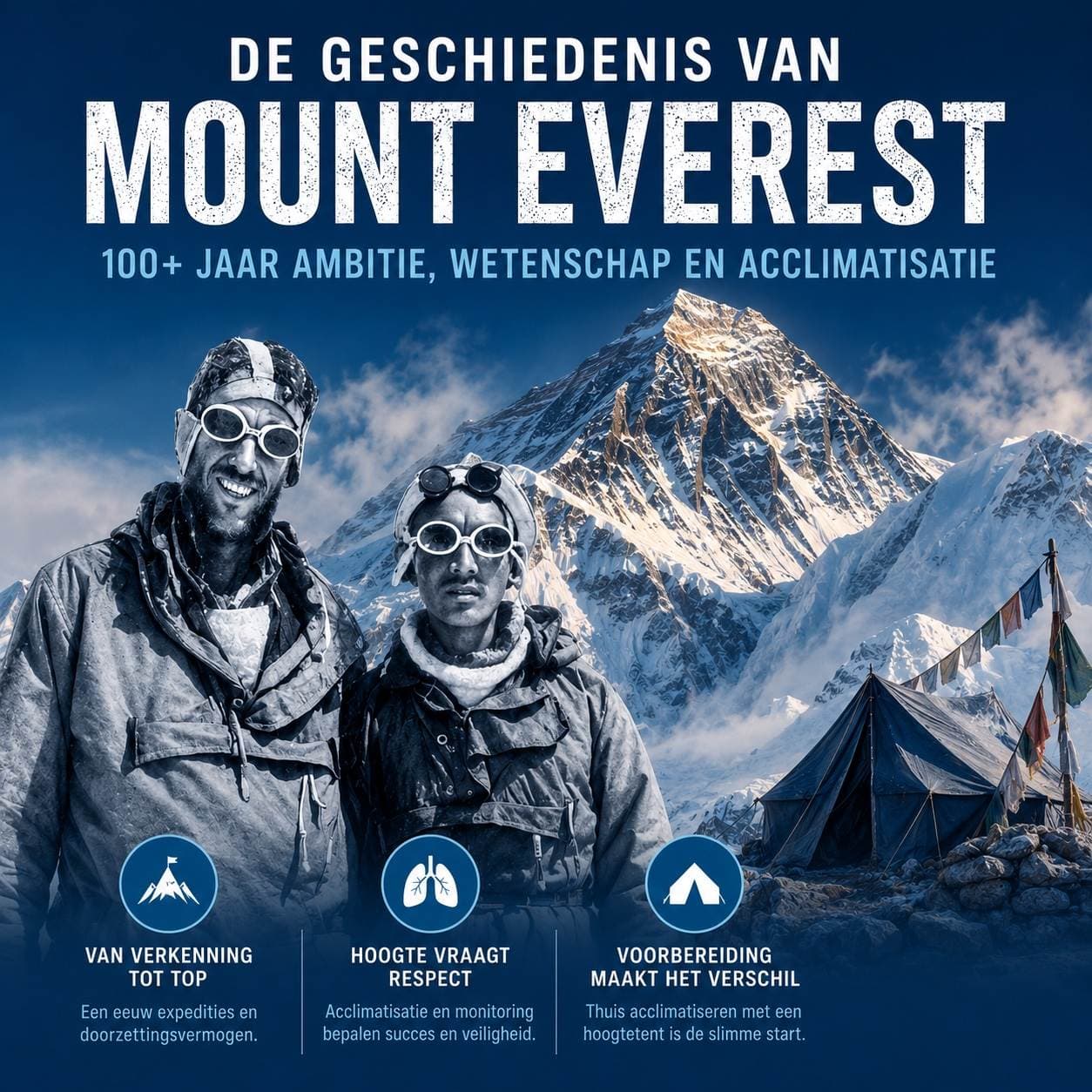
On 29 May 1953, Edmund Hillary from New Zealand and Tenzing Norgay, a Sherpa climber from Nepal, officially became the first people to reach the summit of Mount Everest. Their ascent via the south side marked a historic turning point.
The expedition was highly organised. It involved setting up camps, using porters and oxygen systems, and phased acclimatisation. This still made the climb extremely tough, but less reliant on improvisation.
Hillary and Tenzing's top day was celebrated worldwide. Yet their success was not just a personal hero's tale. It was also proof that Everest became plannable when logistics, teamwork, and acclimatisation came together.
| Milestone | Period | Meaning |
|---|---|---|
| 19th century | Land surveying | Everest is identified as the highest known mountain. |
| 1921 to 1924 | British explorations | The north face is being investigated and the first summit attempts will follow. |
| 1953 | Hillary and Tenzing | First officially confirmed successful ascent. |
| 90s | Commercial expeditions | Everest is becoming accessible to more well-guided climbers. |
| Today | Modern Expeditions | Preparation, monitoring and acclimatisation are increasingly determining the risk. |
Period: Land surveying
Significance: Everest is identified as the highest known mountain.
Period: British explorations
Significance: The north face is being investigated and the first summit attempts will follow.
Period: Hillary and Tenzing
Significance: First officially confirmed successful ascent.
Period: Commercial expeditions
Significance: Everest is becoming accessible to more well-guided climbers.
Period: Modern Expeditions
Significance: Preparation, monitoring and acclimatisation are increasingly determining the risk.
The role of Sherpas in the history of Everest
Anyone who wants to understand the history of Everest fairly cannot ignore the Sherpa community. Sherpas have played a central role in virtually every phase of Everest's history. Not only as porters, but also as guides, route-makers, rescuers, and summit climbers.
Tenzing Norgay became world-famous in 1953, but he symbolised a much larger group of mountain people. Their knowledge of terrain, weather, rhythm, and altitude made many expeditions possible.
Today, there is more focus on safety, working conditions, and recognition. Yet, this remains a sensitive part of the Everest reality. The mountain is not just a dream for foreign climbers. It is also a workplace for people who often bear the highest risk.
Why Everest is physiologically so extreme
Everest is not only technically or logistically challenging. The altitude itself is the biggest adversary. Above approximately 8,000 metres, climbers often speak of the death zone. There, the amount of available oxygen is so low that the body can no longer fully recover.
At sea level, oxygen is readily available. As you ascend, air pressure decreases. This means less oxygen is available per breath. The percentage of oxygen in the air remains roughly the same, but the effective oxygen pressure drops significantly.
Those who want to understand why this is so difficult will find more depth in the article on oxygen at 8,000 metres. For Everest, that context is essential. The summit is not a place where your body functions normally. It is a place where every decision comes at a cost.
What Everest teaches us about acclimatisation
The most important lesson from the history of Mount Everest is that acclimatisation is not a detail. It is the foundation of survival and performance at extreme altitude.
Traditional Everest expeditions work with rotations. Climbers ascend to higher camps, return to recover, and thus gradually build tolerance. That process takes weeks. It requires discipline, rest, and acceptance that faster is not always better.
For many modern expeditions, that preparation begins at home. An altitude tent can provide a controlled stimulus through normobaric hypoxia. You sleep in an environment with less available oxygen while remaining at home to recover and train.
That's not a miracle cure. It doesn't completely replace proper acclimatisation on the mountain. But it can help to plan the initial phase of getting used to it better. Especially for expeditions to Nepal, Everest Base Camp or higher, it can acclimatising at home for mountain expeditions a rational preparation.
History of Mount Everest and the development of expedition preparation
In the early Everest years, preparation primarily revolved around physical toughness and logistics. Today, preparation is much broader. A modern expedition considers fitness, sleep, nutrition, iron status, recovery, previous altitude experience, route planning, and medical risks.
That is an important shift. Everest isn't just a mountain for strong people. It's a mountain for people who can pace themselves carefully.
This is why the difference between ambition and preparation is so important. A sportsman or climber can be physically strong yet react poorly to altitude. Conversely, someone with a calm approach can ascend much more safely. Altitude response is personal.
Old expedition logic versus modern preparation
Previously, the emphasis was mainly on perseverance. Now, the emphasis is increasingly on measurable preparation. This does not mean that mental strength is less important. It does mean that mental strength without physiological control is insufficient.
| Approach | Previously | Today |
|---|---|---|
| Planning | Much uncertainty and limited information. | Rosters, rotations and rest days are strictly planned in advance. |
| Monitoring | Primarily feeling and observation. | SpO2 trend, symptoms, sleep and recovery are being tracked. |
| Acclimatization | Especially on the mountain itself. | Increasingly partially prepared with a height tent or pre-acclimatisation. |
| Risk management | Reactief handelen bij problemen. | Early adjustment based on signals and trends. |
Previously Much uncertainty and limited information.
Today Rosters, rotations and rest days are strictly planned in advance.
Previously Primarily feeling and observation.
Today SpO2 trend, symptoms, sleep and recovery are being tracked.
Previously Especially on the mountain itself.
Today Increasingly partially prepared with a height tent or pre-acclimatisation.
Previously Reactief handelen bij problemen.
Today Early adjustment based on signals and trends.
Common misconceptions about Everest
Everest is often misunderstood. The media shows traffic jams on the mountain, commercial expeditions and spectacular imagery. This sometimes makes it seem as though Everest is primarily a logistical project. That perception is incorrect.
Misunderstanding 1: Everest is safe with good guidance
Good guidance reduces risks. However, extreme altitude remains unpredictable. Weather, fatigue, infections, lack of sleep and individual altitude response can quickly combine.
Misunderstanding 2: Being fit is enough
Physical fitness helps, but does not automatically protect against altitude sickness. Even strong athletes can acclimatise poorly. That's why monitoring is important.
Misunderstanding 3: Extra oxygen solves everything.
Extra oxygen can help, but it doesn't make Everest normal. Equipment can fail, bottles can run out and decisions remain difficult in fatigue.
Misunderstanding 4: acclimatising faster is better
Faster is rarely better at altitude. The body needs time. A good build-up respects recovery, sleep, and symptoms.
Hoe bereid je je vandaag beter voor op een Everest-expeditie?
An Everest expedition doesn't start at the foot of the mountain. It starts months earlier. Physical preparation requires endurance, strength, resilience, and recovery capacity. But acclimatisation deserves at least as much attention.
An altitude tent can be particularly valuable in the weeks leading up to your departure. This involves sleeping at a simulated altitude at home. The goal is not to sleep at extreme heights immediately. The aim is to acclimatise in a controlled manner, follow trends and avoid unnecessarily overloading your body.
Practical approach to pre-acclimatisation
- Start well before departure, preferably several weeks in advance.
- Build the height gradually rather than starting aggressively.
- Measure your SpO2 as a trend, not as a single day value.
- Combine with sleep quality, recovery, and symptom tracking.
- Send at a time when sleep, recovery or symptoms worsen.
For expeditions to Everest, Manaslu, Cho Oyu or other 8,000-metre peaks, tailored guidance is advisable. The physiological strain is considerable. The margin for error is small. Pre-acclimatisation should therefore not be undertaken haphazardly, but according to a clear schedule.
This is how you monitor this lens
Objective monitoring makes altitude acclimatisation more reliable. Nevertheless, interpretation remains important. A single measurement says little. A trend over several days says much more.
When sleeping in a high-altitude tent, you therefore don't just look at oxygen saturation. You also look at sleep quality, how you feel in the morning, resting heart rate, recovery, and any symptoms. It is primarily the combination that determines if you are responding well.
| Signal | What are you following? | Practical interpretation |
|---|---|---|
| SpO2 trend | Morning values over multiple days. | A stable trend often indicates better adjustment. |
| Sleep | Falling asleep, quietness and waking up. | Sleeping worse could mean the stimulus is too much. |
| Recovery | Fatigue, resting heart rate and training feel. | Recovery requires rest or a reduced altitude stimulus. |
| Symptoms | Headache, nausea, dizziness or restlessness. | Complaints are more important than ambition. Adjusting is better than persevering. |
What are you following? Morning values over multiple days.
Interpretation: A stable trend often indicates better adjustment.
What are you following? Falling asleep, quietness and waking up.
Interpretation: Sleeping worse could mean the stimulus is too much.
What are you following? Fatigue, resting heart rate and training feel.
Interpretation: Recovery requires rest or a reduced altitude stimulus.
What are you following? Headache, nausea, dizziness or restlessness.
Interpretation: Complaints are more important than ambition. Adjusting is better than persevering.
Decision-making rules for those wanting to go to extreme altitudes
The history of Mount Everest shows that success rarely comes from haste. Success comes from a plan that allows for reality. Therefore, those who wish to reach extreme heights need decision rules.
Use these decision rules as a basis
- Don't go to bed any later when you've been sleeping badly for several nights.
- Increase stimulation only when your SpO2 trend and recovery remain stable.
- Always take headaches, nausea, and dizziness seriously.
- Plan rest days as part of your strategy, not as a last resort.
- Never let ambition become more important than symptoms.
The requirements for Everest Base Camp are different from those for the summit of Everest. Nevertheless, the principle is the same. Your body must be given time to adapt. Those who underestimate this process increase the risk. Those who take it seriously increase the chances of a strong and safer experience.
For trekkers in the Khumbu region, the article about Preventing altitude sickness at Everest Base Camp A logical progression. For 8000-metre expeditions, individual guidance is essential.
Practical tips from a hundred years of Everest experience
- Start your preparations early and don't wait until the final weeks.
- Train not only harder, but especially smarter and with a greater focus on recovery.
- Use height incentives gradually and measurably.
- Create a plan for rest days, nutrition, sleep, and monitoring.
- Discuss medical risks beforehand with a doctor when relevant.
- Use a height tent as a tool, not a guarantee.
- Stay on the mountain, ready to turn around.
These tips sound simple. Yet, they often only become important when things go wrong. Everest teaches the opposite: good decisions are made beforehand.
Prepare your expedition to extreme altitudes in a controlled manner
Are you heading towards Everest, another 8000-metre peak, or an expedition involving extreme altitude exposure? Then pre-acclimatisation isn't just a detail, but a strategic part of your preparation. A high-altitude tent allows you to get accustomed to lower oxygen availability in a controlled manner at home, while objectively monitoring your SpO2 trend, sleep, and recovery.
FAQ about the history of Mount Everest
Mount Everest werd voor het eerst beklommen op 29 mei 1953.
Mount Everest was first officially climbed on 29 May 1953 by Edmund Hillary and Tenzing Norgay.
Mount Everest is dangerous for several reasons. The sheer altitude is one of the biggest factors. At over 8,000 metres, the air pressure is a third of that at sea level, meaning there's very little oxygen. This leads to altitude sickness, which can cause headaches, nausea, vomiting, and in severe cases, cerebral or pulmonary edema, which can be fatal. The weather on Everest is also extremely unpredictable and harsh. Sudden storms, high winds, and extreme cold can appear with little warning, leading to frostbite and hypothermia. Temperatures can plummet to -60°C. Avalanches and falling ice are constant threats. The Khumbu Icefall, a notoriously dangerous part of the route, is a constantly shifting glacier with deep crevasses and towering ice seracs that can collapse without warning. The 'Death Zone' is the term used for the altitude above 8,000 metres. Here, the human body begins to deteriorate, and survival for long periods is impossible. Climbers must descend quickly from this zone. There's also the issue of rockfalls and loose scree, especially on the steeper sections of the mountain. Logistical challenges also contribute to the danger. Climbers often have to queue at bottleneck points, particularly near the summit, like the Hillary Step. This waiting can lead to exhaustion, exposure to the elements, and running out of oxygen. Finally, the sheer physical exertion required for such a climb is immense, pushing the human body to its absolute limits. This, combined with the other factors, makes Everest an incredibly perilous undertaking.
Everest is dangerous due to extreme altitude, low oxygen pressure, volatile weather, fatigue, and the risk of altitude sickness.
The most important lesson from the history of Everest is the importance of humility and respect for the mountain, and that no one should ever underestimate its power.
The most important lesson is that acclimatisation, rest and timely adjustments are more important than speed or pure willpower.
Does a height tent help with preparation for Everest?
An altitude tent can help you get used to hypoxia in a controlled manner beforehand. It does not reduce risks to zero, but makes preparation more plannable and measurable.
Is Everest Base Camp comparable to the summit of Everest?
No. Everest Base Camp is much lower than the summit. Nevertheless, good acclimatisation is also important there, as many trekkers reach over 5,000 metres.
Conclusion: the history of Mount Everest is primarily a lesson in preparation
The history of Mount Everest began as a story of discovery and national ambition. Today, it is primarily a story of preparation, choices and respect for altitude.
Hillary, Tenzing, Mallory, Irvine, and the generations of Sherpas and climbers after them all show the same truth: Everest forgives little. The mountain demands fitness, experience, and mental fortitude. But above all, it demands time to acclimatise.
For modern expeditions, this means: don't just start on the mountain. Build up your preparation well in advance. Use objective monitoring. Respect signals. And see a high-altitude tent as a controlled tool to help the body acclimatise to an environment where oxygen becomes scarce.
Everest is historically huge. But the most important decision remains small and personal: prepare your body before the altitude forces you to react.