Pulmonary oedema symptoms: how to recognise it in time
Published 21 March 2026 · 3 min read
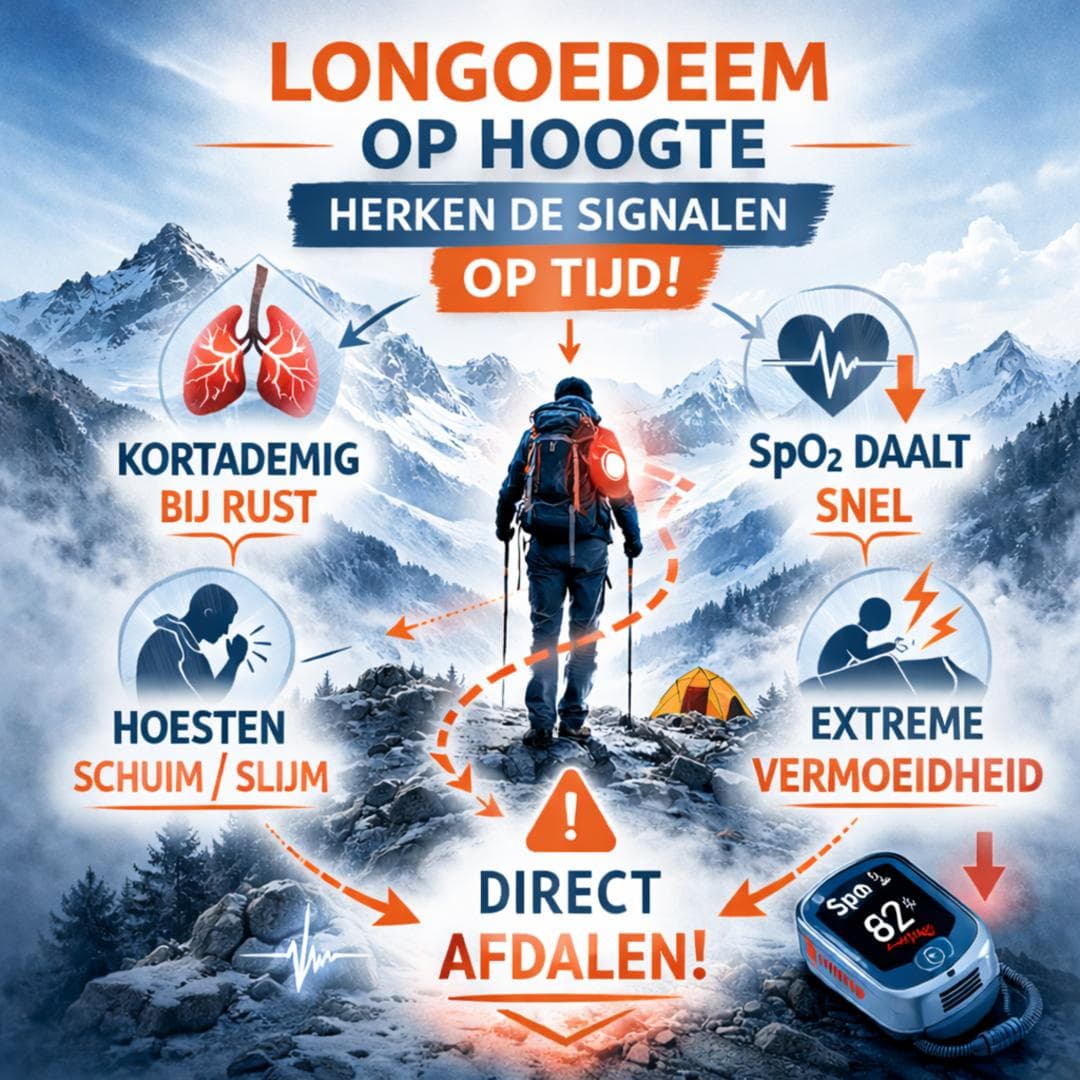
Pulmonary oedema symptoms at altitude are one of the most important signs to take seriously while trekking, expeditioning or staying above 2,500 metres. Pulmonary oedema, also known as HAPE (High Altitude Pulmonary Edema), is a severe form of altitude sickness in which fluid builds up in the lungs. Those who recognise the symptoms in time can avoid serious complications.
In this article, you will learn exactly what symptoms come with pulmonary oedema, how quickly it can develop, how to distinguish it from normal altitude symptoms and what to do if you develop symptoms.
For background on altitude sickness also read altitude sickness explanation. :contentReference[oaicite:0]{index=0}
⚠️ The essentials in 30 seconds
- Pulmonary oedema is a severe form of altitude sickness
- Emerges mostly above 3,000 metres
- Main symptoms: shortness of breath, coughing, extreme fatigue
- SpO2 often drops faster than normal
- Direct descent is the main treatment
🫁 What is pulmonary oedema at altitude
Pulmonary oedema at altitude occurs when the pressure in the pulmonary vessels increases due to lack of oxygen. This allows fluid to leak from the blood vessels into the alveoli of the lungs. This interferes with oxygen uptake and causes increasingly severe shortness of breath.
This type of pulmonary oedema is called HAPE and is different from pulmonary oedema due to heart problems.
You can read more about cause here:
how altitude sickness is caused. :contentReference[oaicite:1]{index=1}
📊 When does pulmonary oedema usually occur
| Height | Risk HAPE | Comment |
|---|---|---|
| 2500 m | low | possible with rapid rise |
| 3000 m | moderate | first cases |
| 3500 m | high | regular when rising rapidly |
| 4000 m+ | very high | extra care |
| 5000 m+ | high | only with acclimatisation |
See also first days at altitude. :contentReference[oaicite:2]{index=2}
🚨 Pulmonary oedema symptoms you should never ignore
The symptoms often start mild and gradually get worse.
- Short of breath on exertion
- Short of breath at rest
- Dry cough
- Cough with foam or phlegm
- Fast heart rate
- Extreme fatigue
- Poor sleep
- Blue lips or nails
- Squeaky breathing
- Pressing sensation on chest
When in doubt: assume the worst.
More symptoms:
altitude sickness symptoms. :contentReference[oaicite:3]{index=3}
⚠️ Difference between normal altitude complaints and pulmonary oedema
| Complaint | Normal altitude sickness | Pulmonary oedema |
|---|---|---|
| Headache | often | sometimes |
| Nausea | often | sometimes |
| Short of breath | light | serious |
| Coughing | no | yes |
| SpO2 trend | gradually | rapidly falling |
| Effort | goes | increasingly difficult |
📉 This is how you monitor this lens
Always use trends, never one measurement.
- SpO2 trend over several days
- Resting heart rate
- Sleep quality
- Cough yes/no
- Effort possible?
Warning signs:
- SpO2 continues to fall
- Recovery fails to materialise
- Shortness of breath increases
- Cough gets worse
- Unable to sleep due to breathing
Read also
oxygen saturation at altitude. :contentReference[oaicite:4]{index=4}
🧭 What to do if pulmonary oedema is suspected
- Stop rising
- Taking rest
- Measure SpO2
- Don't stay alone
- Go downhill
- Seek medical help
The main rule:
When in doubt, descend.
See also
what to do in case of altitude sickness. :contentReference[oaicite:5]{index=5}
🏔 Why pre-acclimatisation greatly reduces risk
Those who acclimatise beforehand are less likely to experience HAPE because the body is already adapted to oxygen deprivation.
This can be done with:
- gradual increase
- altitude internship
- acclimatising at home
- altitude tent
More on this:
acclimatising at home. :contentReference[oaicite:6]{index=6}
❓ FAQ
Is pulmonary oedema life-threatening?
Yes, without descent, it could be fatal.
How quickly does HAPE arise?
Usually within 2 to 5 days of rapid rise.
Can it be done in fit people too?
Yes, fitness does not protect.
Is a saturation gauge sufficient?
No, symptoms remain important.
Does it disappear on its own?
Not without descending.
📌 Conclusion
Pulmonary oedema symptoms are often subtle at first but can quickly become serious. Those who recognise signs and act in time avoid life-threatening situations.
Want to greatly reduce the risk of altitude sickness?
With pre-acclimatisation, you can let your body get used to altitude in advance.