Preventing altitude sickness with sleep problems at altitude: what really works for beginners
Published 31 January 2026 · 5 min read
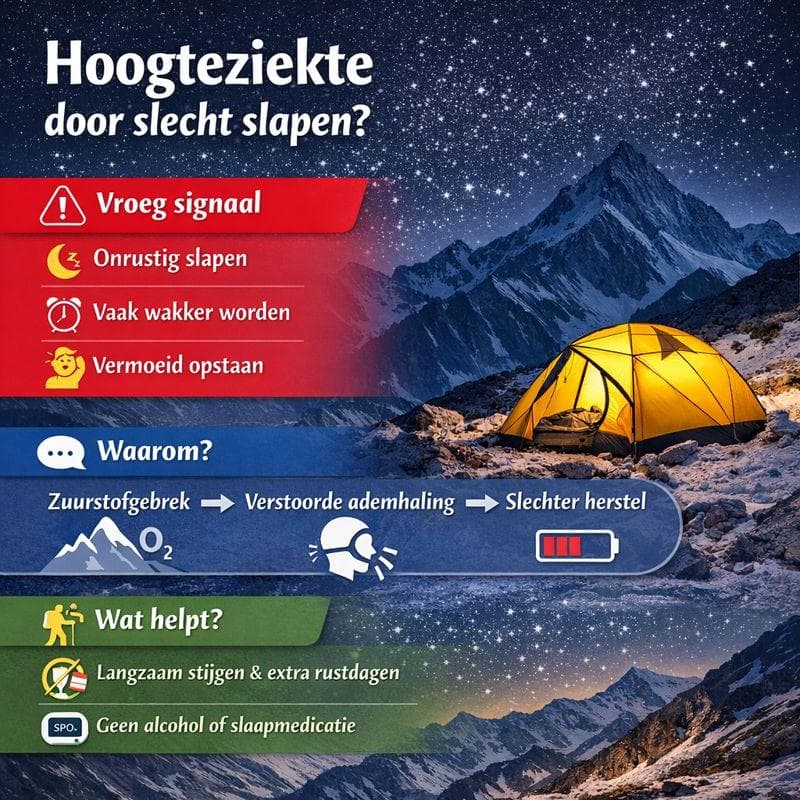
Sleeping badly at altitude is one of the most underestimated signs of incipient altitude sickness. Many beginners find that they sleep restlessly, wake up more often or feel exhausted in the morning, even when they are not physically demanding. In this article, you will find out how sleep problems are related to altitude sickness, who is particularly at risk of this and what actually helps to prevent symptoms.
The essentials in 30 seconds
Conclusion: Poor sleep at altitude is often an early sign of inadequate acclimatisation.
Nuance: Sleep problems do not automatically mean altitude sickness, but they have been shown to increase the risk.
Practical lead: Always assess sleep together with SpO2 trends, recovery feeling and rate of rise.
Why sleeping at altitude often goes worse than expected
Many people prepare for shortness of breath or fatigue but underestimate what altitude does to their sleep. Yet sleep is one of the first physiological systems to respond to oxygen deprivation. In fact, what many people experience as restful when travelling - silence, cold and physical fatigue - often makes sleeping at altitude worse rather than better. As early as around 2,500 metres, nocturnal breathing regulation changes noticeably.
The main cause is hypoxia. The lower oxygen supply causes the breathing centre in the brain to become less stable. Breathing becomes more shallow or erratic, with short pauses alternating with faster breathing. This leads to micro-awakenings, often without being aware of it.
What does this mean concretely?
You sleep lighter, your heart rate stays higher and the restorative deep sleep becomes shorter. As a result, you build up fewer reserves for the next day, which actually slows acclimatisation.
💡 Did you know?
Many people experience their first night at altitude as restless, but only after two or three nights does it become clear how structural the sleep disruption is. It is precisely this delay that makes the risk insidious.
Why sleep problems are often misinterpreted
Poor sleep at altitude is often attributed to cold, a strange bed or stress. Although those factors come into play, research shows that nocturnal oxygen saturation and breathing stability play a much bigger role.
The problem is that many beginners only associate altitude sickness with headaches or nausea. By the time those symptoms appear, the underlying disturbance has often been present for days.
What does this mean concretely?
Those who ignore sleep problems miss an early warning signal and increase the likelihood that symptoms will accumulate and be harder to correct.
⚠️ Reality check
Poor sleep is often waved away as “part of it”. In reality, it is actually one of the first signs that the body is struggling to adapt to altitude.
The physiological link between sleep and altitude sickness
Altitude sickness occurs when the body is given insufficient time to adjust to hypoxia. During sleep, this balance is especially vulnerable. Automatic breathing regulation becomes more unstable and blood oxygen pressure fluctuates more strongly.
What does this mean concretely?
Deep sleep supports recovery and adaptation. When that sleep is structurally disrupted, the acclimatisation process slows down and the risk of Acute Mountain Sickness increases.
📊 Research shows
Studies show that nocturnal drops in oxygen saturation are more strongly associated with altitude sickness than values measured during the day.
Sleep stages at altitude: what exactly changes?
At sea level, light sleep, deep sleep and REM sleep alternate cyclically. At altitude, deep sleep and REM sleep in particular become shorter and more unstable.
What does this mean concretely?
Being in bed for a long time does not automatically mean a good recovery. Sleep quality is more decisive than sleep duration.
⚠️ Reality check
Many beginners think they sleep enough because they get enough hours. In reality, sleep duration says little without an understanding of sleep quality.
Scenario 1: the recreational mountain hiker
A beginner climbs from 1,200 to 3,000 metres in three days. The pace feels good during the day, but at night he wakes up several times feeling rushed.
What does this mean concretely?
This often indicates nocturnal hypoxia. Without additional rest or adjustment, the risk of further symptoms increases.
Scenario 2: the athlete on training camp
A runner stays at 2,400 metres for endurance training. The first few nights are restless, but he keeps to his schedule.
What does this mean concretely?
Sleep disruption here is a signal that load and height are not balanced.
🧭 In practice
When sleep quality deteriorates, it is often more effective to reduce load temporarily than to continue training in the hope that the body will recover on its own.
What really helps with sleep problems at altitude?
- Slow rise with extra rest days
- Daytime load adjustment on bad nights
- Avoiding alcohol and sleep medication
- Fixed sleep times and a quiet sleep environment
💡 Did you know?
Sleep medication can suppress breathing patterns and actually worsen sleep problems at altitude.
High altitude tent and pre-acclimatisation: where does this fit?
Pre-acclimatisation via a altitude tent can help get through the first nights at altitude better. The primary stimulus is sleeping in normobaric hypoxia, built up incrementally based on SpO2 response.
🧭 In practice
An altitude tent is not a replacement for acclimatisation, but it makes the process controlled, measurable and planable. It significantly reduces risk, but does not yet offer a 100% guarantee.
What to take from this
Sleep problems at altitude are not a detail, but a meaningful signal within acclimatisation. Those who understand these signals and act accordingly significantly reduce the risk of altitude sickness.
What this looks like in practice often becomes clearest when you look at people who have already been through the same journey.
Experiences of Kilimanjaro climbers
For many Kilimanjaro climbers, the biggest challenge is not in the walking itself, but in how the body responds to sleeping above 3,500 to 4,500 metres. Experiences of other climbers show that paying attention to sleep, oxygen saturation and calm build-up helps to be less surprised by altitude complaints.
Want to see how other Kilimanjaro climbers prepared with the aim of preventing altitude sickness and sleeping better at altitude? Then check out their experiences and find out which choices made the difference for them.
View experiences of Kilimanjaro climbers and other mountain travellers
❓ Mini-FAQ
Should you descend when sleeping badly? Not always. Persistent deterioration calls for slowing down, adjusting or sometimes losing altitude.
International guidelines of the UIAA emphasise that persistent sleep disturbance at altitude can be an early warning signal and should be taken seriously within acclimatisation planning.