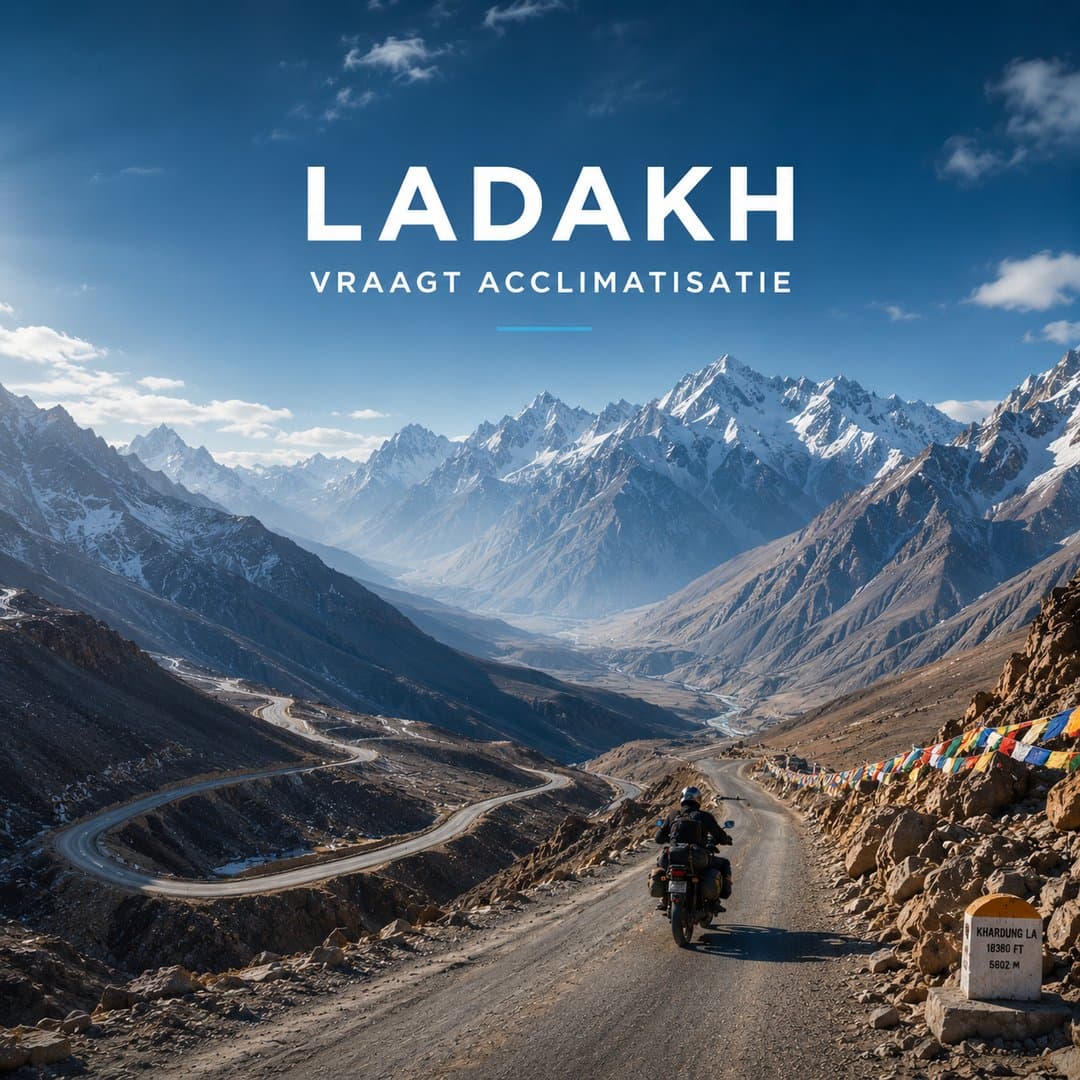
Acclimatising at altitude: how a mountain guide looks at it
Published 1 May 2026 · 9 min read
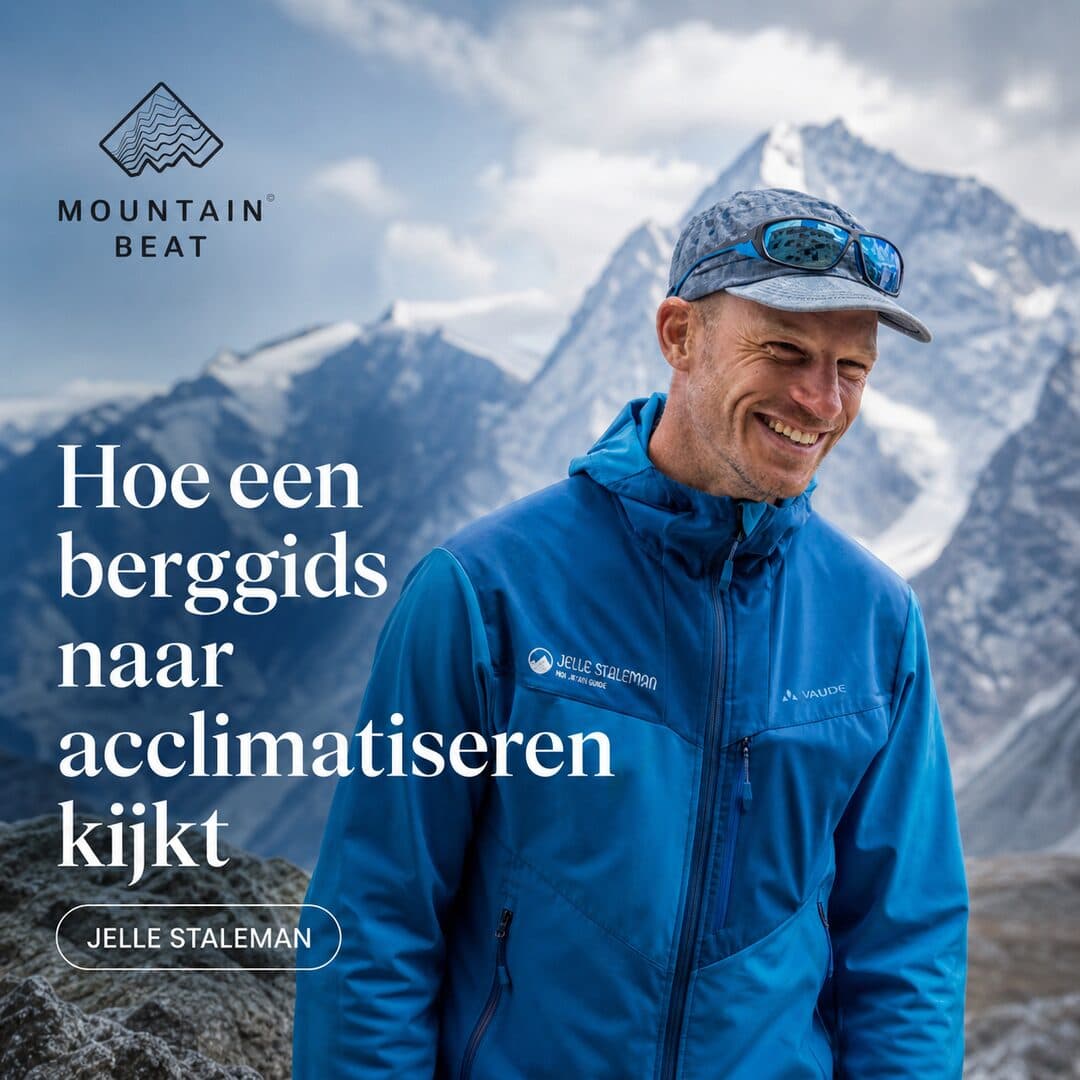
Why I'd rather acclimatise for a week than train even harder
Mountain guide Jelle Staleman sees it time and again: people train for months before a trek at altitude, but forget how much profit there is in calm and smart acclimatisation. In this blog, he shares how he looks at this in practice, from sleeping altitude and rest days to Diamox and real summit opportunities.
On sleeping altitude, rest days and why time at altitude often pays off more than extra training hours
Good fitness will help you up the mountain. But acclimatisation often determines whether your body can actually handle the altitude.
As a mountain guide, I often get the same question: what helps most when preparing for a trek at altitude? People then usually expect an answer about training schedules, intervals or extra strength work. Don't get me wrong: good fitness is important. You want to be fit at the start, be able to handle long days and keep thinking clearly at altitude. But when it really comes to acclimatisation, I see the same thing over and over again in practice: time at altitude often makes more difference than training even harder.
In my work as a ski and mountain guide, I accompany people on very different mountains, from alpine treks in the Alps to larger expeditions at altitude. With my company, Mountain Beat, I build programmes in which acclimatisation is not an afterthought, but an essential part of the trip. As a result, I see up close what works, where people get themselves into unnecessary trouble, and how much profit there is in a calmer and smarter build-up.
Train well, but give acclimatisation at least as much attention.
The main gain is not always in yet another training block. Instead, it often lies in arriving earlier, building up more slowly and choosing sleep levels carefully.
Acclimatising doesn't start with your legs, but with your sleeping height
Your body slowly adapts to less oxygen. You can't force that process, only guide it properly. This is why, when acclimatising, I always look at where someone sleeps first, not just how high someone gets during the day.
A useful guideline is to raise your sleeping altitude by about 300 to 500 metres per day. If you have slept higher for three days in a row, it is a good idea to have a rest day on which you do not sleep higher. On such a day, it's okay to walk a bit, but you don't move your sleeping height.
That may sound conservative, but in my experience it is exactly the opposite. Those who take their time feel more comfortable and increase their summit chances. Those who go too fast often find that the mountain automatically slams on the brakes.
Slowly increase your sleep level and build in a rest day after several nights.
The mountain usually rewards not the fastest build-up, but the most sensible build-up. Rest days are therefore not lost days, but part of a better summit attempt.
Training hard doesn't help against altitude sickness
This is a misconception I often see: people think that better fitness automatically means they are less likely to have altitude sickness.
Unfortunately, that's not how it works.
Good fitness is absolutely necessary. But being fit does not automatically lower your risk of altitude sickness, nor does it make you acclimatise faster. These are two different things. If you look purely at the acclimatisation process, training hard in the Netherlands does not directly help against it.
So I often say: train well, but don't overestimate training. You can make your body stronger at home, but you can't fully teach it to cope with altitude at home. For that, you have to go into the altitude, or otherwise cleverly mimic that process.
What I prefer to see in practice
When someone asks me where the most to gain is, my answer is usually not: another training block. My answer is: come earlier. Give yourself time. Build up slowly.
I see that on Mont Blanc, but also on larger targets such as Kilimanjaro, Aconcagua or expeditions where altitude plays an even bigger role. And in the programmes we work with Mountain Beat Building up you see that rhythm everywhere. At Mont Blanc you don't suddenly sleep from low to very high. First a hut around 2800 metres, then 3100 metres, then a valley day to recover, then again around 3100 to 3200 metres, and only then higher. A step of 600 metres can then sometimes be justified, precisely because there was enough buildup before that. A summit attempt from 3800 to 4800 metres is different again, because after that you descend directly and thus do not sleep at that altitude.
For programmes in the Monte Rosa-massive works like this: first lower in the Mont Blanc massif getting used to it, and only then on to a hut at 3600 metres. The mountain still dictates a lot, but a smart build-up at least gives your body a chance to come along.
A good route is not only a climbing route, but also an acclimatisation route.
The order of huts, sleeping heights, rest days and summit attempts helps determine how comfortable and promising a trek becomes.
You don't have to demolish your body to wake it up
Acclimatising also does not mean going as high as possible every day.
You want to excite your body, not overload it.
On average, many people are fine making a first night at around 2,500 to 2,800 metres. That's high enough to shake your body awake, but usually not yet so high that the night becomes immediately miserable. At the Mont Blanc is the Albert 1er hut at around 2,800 metres, where people notice the altitude well without immediately getting into serious trouble.
That's exactly the point. Your body needs to feel: there is less oxygen here, I need to do something. Make more red blood cells, work more efficiently, react more calmly. But if you immediately go too high, you sleep badly, recover badly and arrive tired at the very moment you want margin.
Climb high, sleep lower still works surprisingly well
What often also works well is to climb a little higher after arriving at your sleeping altitude. Not another huge effort right away, but for example 200 to 400 altitude metres extra, have lunch there or sit quietly for an hour, and then descend again to where you sleep.
This is a simple way to give your body another boost, without immediately making your sleep worse. It is not a panacea, but it fits well into a calm acclimatisation rhythm.
I often use that principle in practice, not as rigid protocol, but as a clever building block in a programme.
The goal is not to go maximum high, but to excite just enough.
A short climb above sleep level can be valuable, as long as sleep and subsequent recovery remain good.
So what about Diamox?
Diamox is a topic that gets a lot of questions.
My position on this is pretty simple: I don't recommend it by default, but I don't categorically advise against it either. I am not a doctor, and everyone reacts differently. If anyone is considering taking Diamox preventively, it should always be done in consultation with a GP. And above all: don't try it on the mountain for the first time. Rather, use it at home for a few days first, so you know how your body reacts to it.
Some people hardly experience any side effects. Others barely sleep anymore because they have to pee constantly, or get tingling fingers and legs. Then the drug ends up backfiring, because you start your trip more tired than without it.
For the Alps, I myself would almost always prefer to opt for more extensive acclimatisation rather than preventive Diamox. At higher altitudes, above about 5000 metres, it becomes a more relevant consideration, but even then it is still something to approach carefully and personally.
Trouble with altitude is not always altitude sickness
Another thing that often causes unease: people feel something at height and immediately think it will go wrong.
But suffering from altitude does not automatically mean altitude sickness.
Mild complaints may come with altitude, but severe ones require immediate attention.
A little headache, less appetite, mild nausea, languidness or some dizziness may be part of it. This is annoying, but not necessarily dangerous. Many people will notice such symptoms in mild form somewhere. Only when symptoms become really severe should you be much more alert.
Think violent vomiting, severe headaches, problems with balance or coordination, difficulty talking, or sounds on the lungs. Then the story changes.
And then the same main rule still applies.
The best medicine remains descent
This may not be the answer people are hoping for, but it is the most important one: descent is the only really good medicine. Medication such as dexamethasone, nifedipine or Diamox plays at most a supporting role in emergency situations. Its purpose is not to still continue to the summit, but to keep someone fit enough to descend safely. You have to be very clear about that.
That black-and-white line is important. Especially at a time when there is a lot of information going around and people sometimes feel that every problem can be solved with a pill.
The mountain works differently. The mountain usually requires simpler choices.
Medication is not a route to the top. Descending remains the most important choice.
In emergency situations, medication can be supportive, but the goal is to be able to descend safely. Do not continue as if the problem has been solved.
What I prefer to give people
If I have to boil everything down to one piece of advice, it is this: take your time. Not because slow sounds nicer, but because in practice it feels more comfortable, increases your top chances, and gives you more space to really be present where you are.
Whatever the mountain, the preparation does not start only on the first day of climbing. It starts much earlier, with the choices you make in pace, build-up and rest. With Mountain Beat I try to build those routes so that acclimatisation is taken as seriously as the mountain itself. Whatever mountain you have in mind, from a first trip in the Alps to Mont Blanc or Monte Rosa or a larger expedition such as Kilimanjaro or Aconcagua, you can look at the programmes available and see what that build-up looks like in practice.
Want to know more about acclimatising in the mountains?
Mountain Beat also previously wrote a practical article on acclimatisation and altitude sickness in the mountains. That ties in well with this story, as it goes into more detail about what happens to your body at altitude, what symptoms you should take seriously and why a gentle build-up makes so much difference.
Read the Mountain Beat article on acclimatising in the mountains