Island Peak Nepal: preparation and acclimatisation
Published 23 April 2026 · 9 min read
This starts weeks before departure. With a strong aerobic base, good leg strength and a well thought-out altitude-building plan, you noticeably increase your safety margin. Especially if you have limited time in Nepal, you can acclimatising at home for mountain expeditions be a valuable addition. Not as a replacement for the real mountain, but as controlled preparation.
- Plan enough days between arrival in Lukla and your summit push.
- Treat Chhukung and Base Camp as acclimatisation stages, not just transit.
- Use SpO2, sleep quality and complaints as trends, not as single figures.
- Think of pre-acclimatising at home as support, not as a license for a too-fast schedule.
Conclusion: Island Peak succeeds more often with patience than aggression.
Nuance: Strong fitness helps, but does not correct too rapid altitude gain.
Practical hook: Build your preparation as if you were training for a 6,000-metre expedition, not an ordinary trek.
Why Island Peak is often underestimated
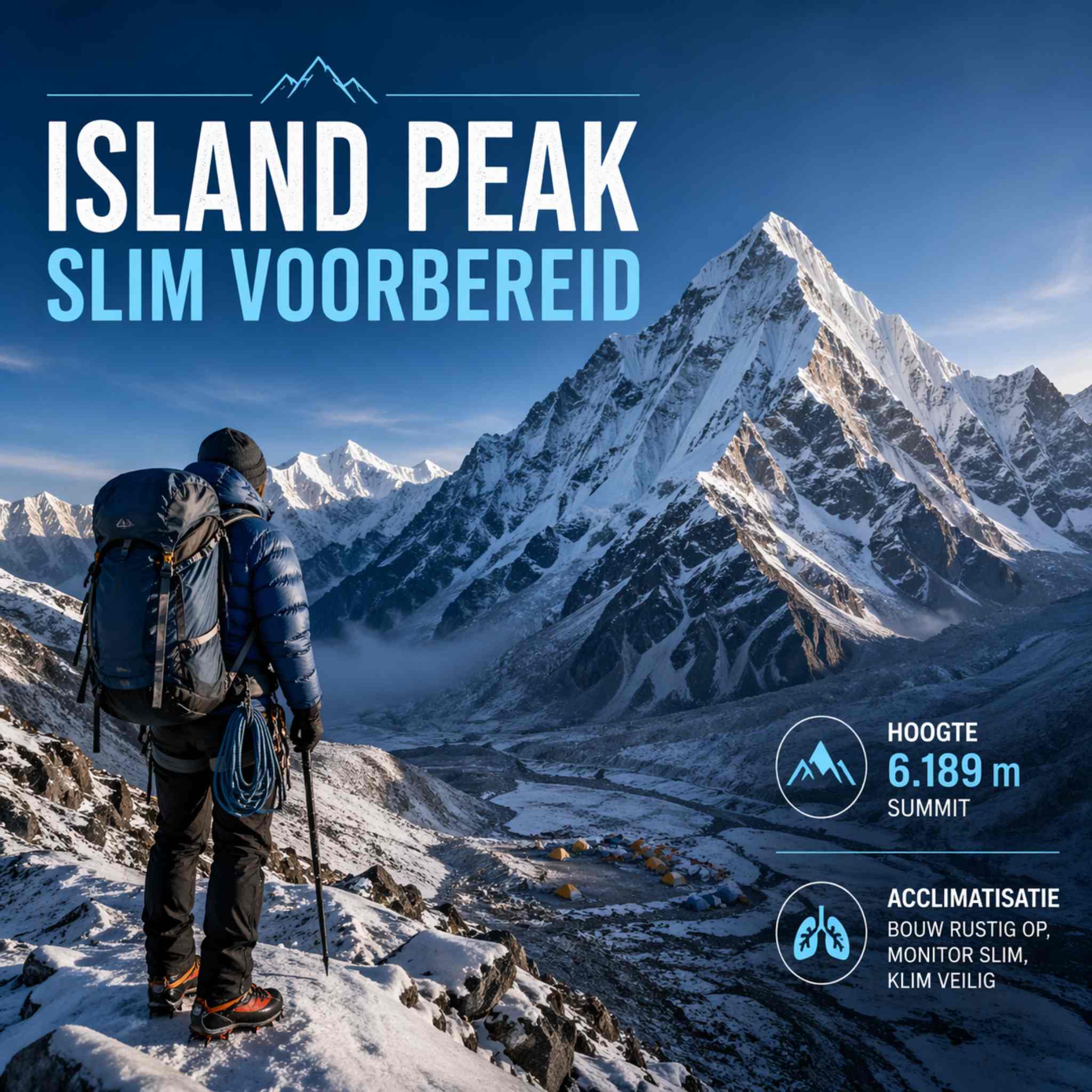
Island Peak, also known as Imja Tse, is often sold as a popular trekking peak. True, but the word “trekking” gives many people too mild an image. In reality, you face serious altitude, cold mornings, limited recovery time and, on summit day, often a glacial section, fixed ropes and a steeper final climb. So it is not a pure hiking challenge.
This is precisely why you see that the outcome is often decided before Chhukung. Those who arrive there tired, bloated, sleeping badly or slightly symptomatic start the decisive phase with too little room to play. On paper, you can then continue. In practice, every extra metre becomes more expensive.
The right approach is down-to-earth. Don't think of Island Peak as “just catching a summit” after the Everest region, but as a compact alpine project with clear preparation, clear resting moments and clear stopping rules.
⚠️ Reality check
Most problems on Island Peak do not arise because people are completely technically unfit. They occur because the addition is wrong: climbed a little too fast, ate a little too little, slept a little too little and still on. At 5,000 metres plus, that addition suddenly adds up hard.
How to prepare for Island Peak Nepal without gambling
1. Build a great aerobic engine first
You don't have to be a top alpinist to make it to Island Peak. You do need to be able to move efficiently for hours on limited oxygen. Therefore, think in long gentle endurance blocks, incline work, stair climbing, backpacking hikes and repeatability over several days. The question is not whether you can handle one tough day. The question is whether on day eight, nine or 10 you are still decidedly fresh enough.
2. Train specifically for mountain loads
Leg strength, calf loading, trunk stability and backpacking are more important than single peak wattages. Those who can only run hard at sea level often lack the local load capacity for ascending, descending and moving on irregular terrain. So add step-ups, lunges, hikes with elevation change and controlled descents to your plan.
3. Make the technical threshold low
Island Peak is not an extremely technical expedition, but summit day becomes much calmer when basic operations already feel familiar. Crampons, crampon passes, walking on a fixed rope, handling gloves, layer management and eating under cold stress are not things you want to discover for the first time at 5600 metres.
Fit only
You can climb hard, but lose margin as soon as sleep, altitude and cold come together. Often it still feels fine up to 4400 metres, after which the blow comes later.
Fit and acclimatised
You move more calmly, recover better and retain decision capacity. This is often more important on Island Peak than a slightly higher pure fitness level.
- At least 8 to 12 weeks of targeted endurance and mountain-specific training.
- Weekly backpacking or stair work with increasing load.
- Test your clothes and gloves in cold conditions beforehand.
- Practice eating and drinking during prolonged exercise.
- Work on sleep, recovery and energy availability before departure.
- Learn to recognise the early signs of AMS, HAPE and HACE.
- Take a conservative mindset, not a top drive.
- Decide in advance at which signals you will accept a rest day or descent.
A realistic acclimatisation plan for Island Peak Nepal
For Island Peak Nepal, a plan only really works well if it connects to a 6000-metre target. Too tight a schedule makes you dependent on luck. On the contrary, a good schedule builds in redundancy. Therefore, think in stages: arrive, build up, stabilise, prepare technically and only then summit. Those who want to delve further into the content can also look at acclimatising for 6000 metres.
Above about 3,000 metres, the simple rule is still strong: don't raise your sleeping altitude too aggressively, plan conscious rest and use hikes above your sleeping altitude as an incentive. The exact route varies from operator to operator, but the logic behind it does not.
| Phase | Sleeping height | Target | Practical focus |
|---|---|---|---|
| Kathmandu | 1400 m | Recover trip, equipment check, briefing | Don't start your trek tired |
| Lukla and Namche | 2860-3440 m | First height incentive and quiet run-in | Acclimatisation hike above Namche, sleep low |
| Dingboche | 4410 m | Stabilisation and extra acclimatisation day | Don't push through when sleep and appetite drop |
| Chhukung | 4730 m | Fine-tuning for the final phase | Short higher hike, lots of drinking, reviewing technique |
| Island Peak Base Camp | 5100-5200 m | Training, rest and preparation summit day | Preparing equipment and saving energy |
| Summit push | 6180+ m | Top attempt and safe descent | Only go with stable complaint-free trend |
Kathmandu
1400 m
Objective: recover trip, equipment check and briefing.
Focus: don't start your trek tired.
Lukla and Namche
2860-3440 m
Objective: first height incentive and quiet walk-in.
Focus: Acclimatisation hike above Namche, sleep low.
Dingboche
4410 m
Objective: stabilise and extra acclimatisation day.
Focus: don't push through when sleep and appetite drop.
Chhukung
4730 m
Objective: Fine measures for the closing stages.
Focus: short higher hike, drink a lot, review technique.
Island Peak Base Camp
5100-5200 m
Objective: training, rest and preparation summit day.
Focus: prepare materials and save energy.
Summit push
6180+ m
Objective: top attempt and safe descent.
Focus: only go with stable complaint-free trend.
Don't think of this as a rigid schedule, but as the minimum logic of a good plan. Those who shoot from Namche to the higher stages too quickly often lose exactly the margin needed later. This is why understanding normal acclimatisation speed is so valuable: you learn to recognise earlier when speed suddenly works against you.
This is how you monitor this lens
Acclimatisation sometimes feels erratic. That is why objective monitoring is important. Not to declare every figure sacred, but to see a trend. Four signals are most useful in this respect.
SpO2 trend
Preferably measure under similar conditions, e.g. in the morning. Look at the line over several days, not one single measurement.
Sleep quality
Frequent waking, restless breathing and poor recovery are often more relevant than just a saturation number.
Recovery on effort
If a normal hike suddenly feels heavy, or you recover unusually slowly, that is often a more useful signal than bravado.
Symptoms
Headache, nausea, loss of appetite, dizziness and confusion should always outweigh motivation.
Continue
Only with stable trend, reasonable sleep, normal appetite and no escalating symptoms.
Brakes
Take extra rest or maintain the same sleep level if fatigue, headaches or sleep quality deteriorate markedly.
Descend
In case of worsening symptoms, loss of coordination, tightness at rest or marked deterioration, safety counts over summit plans.
Those who want more detail on this would do well to read in advance how to recognising altitude sickness and how to act. Especially on a compact expedition, that knowledge makes your decisions calmer and faster.
🧭 In practice
A good trend usually feels boring. You sleep reasonably, eat normally, rise in a controlled way and don't feel the need to force anything. That's exactly what you want. Acclimatisation that goes well often looks less heroic from the outside than acclimatisation that goes wrong.
How pre-acclimatising at home can help
For Island Peak, pre-acclimatising at home can be interesting if you have limited time in Nepal, were previously found to be sensitive to altitude or simply want to start your trek with more margin. This involves normobare hypoxia at home: the oxygen percentage drops, not the air pressure. That makes the stimulus controlled, measurable and plannable.
What does remain important is proper framing. An altitude tent or other home protocol does not replace true acclimatisation in the mountains. It can, however, support the process, making you arrive in Namche, Dingboche and Chhukung better prepared. For a goal like Island Peak, that is often exactly the benefit: less friction in the first days and more space in the final stages.
Does make sense
Short Nepal itinerary, 6000-metre target, previous altitude sensitivity, or need for more control in preparation.
Less useful
If you do take ample time on the mountain, can't follow a consistent protocol or think homework makes real stop rules unnecessary.
Common mistakes for Island Peak
- Treat Island Peak as an extension of a trek rather than its own expedition objective.
- Starting too late with specific training for ascents, descents and backpacking.
- Waving away a mediocre night in Dingboche or Chhukung because “everyone feels bad”.
- Putting all hope in medication or willpower instead of planning.
- Not enough food and drink in the days before Base Camp.
- Getting to really know material only at altitude.
- Overestimating a low loose SpO2 measurement or, on the contrary, misusing a reasonable reading as a green light.
FAQ on Island Peak Nepal
How many days should you count for Island Peak?
For most people, a schedule with enough trekking and acclimatisation days works better than a compact plan. Not the shortest route, but the most stable route increases your chances of success.
Is Island Peak technically difficult?
Technically, it can be learnt by many mountaineers, but the combination with altitude makes it more serious than an ordinary trekking summit. This is precisely why you should not underestimate summit day.
Does a high altitude tent make sense for Island Peak?
Yes, as support it can make sense. Not as a replacement for the mountain, but as controlled preparation that makes your acclimatisation process more plannable.
When should you take an extra day of rest?
When complaints mount, sleep gets noticeably worse, recovery falls away or the trend is not right. An extra rest day at altitude is often cheaper than adjusting too late.
Are you working towards Island Peak with more control?
For a 6,000-metre goal, preparation that does not rely on luck pays off. With a calmly constructed pre-acclimatisation plan, you increase your margin before you start in Nepal.
Conclusion
Island Peak Nepal is a wonderful first serious expedition peak, but only if you treat it as what it is: a 6,000-metre target with altitude, cold, technical elements and little room for sloppiness. Those who base their preparation on margin rather than bravado increase not only their chances of reaching the summit, but more importantly, their chances of a calm and safe expedition.
The bottom line is simple. Train purposefully. Acclimatise patiently. Monitor objectively. And use pre-acclimatisation at home only as it is intended: as smart support for a good plan.