How can altitude sickness be prevented?
Published 27 August 2021 · 4 min read
Prevent altitude sickness seems simple on paper: ascend calmly, sleep well and listen to your body. In practice, it turns out to be one of the most difficult decisions during a trek or expedition. How fast is too fast? When is a rest day wise? And when does everything seem to be going well, while your body is lagging behind?
In this article, you won't get a checklist of rules, but a grip. You will learn why altitude sickness is so often underestimated, how acclimatisation really works and what choices you can make when the pace of ascent is not ideal. Not dogmatic, but guiding.
Why altitude sickness is so often misjudged
Many mountain travellers associate altitude sickness with extreme expeditions above 6,000 metres. This creates a dangerous assumption: “Up to 4,000 metres, it doesn't happen to me.” The reality is different. It is precisely between 2,500 and 4,000 metres that most complaints arise.
This is not because of height alone, but because of the combination of:
- rapid rise
- insufficient recovery time
- nocturnal stress on breathing and sleep
What does this mean concretely?
It is not the highest pass but the sleeping height that determines your risk. How you stack days and nights is decisive.
Acclimatisation is a process, not a trick
Acclimatisation is the set of adaptations by which your body learns to function at lower oxygen availability. This happens not in hours, but over days.
From about 2,500 metres, oxygen pressure decreases sufficiently to cause measurable physiological stress. Your breathing speeds up, your heart rate increases and your sleep becomes lighter. This is not a problem, as long as the body is given time to adapt.
What does this mean concretely?
Every rise requires recovery. Without recovery, the load accumulates, even if you still feel fine during the day.
A safe ascent rate between 2,500 and 4,000 metres
Experience and research show that between 2,500 and 4,000 metres, a rise of about 300 metres sleep height per day is safe for most people. By ascent rate, we always mean the difference in sleeping height between two stages.
During the day, you can safely climb 800 to 1,000 metres, as long as you sleep lower again in the evening. This principle is deliberately applied by experienced climbers.
Climb high, sleep low is not a saying, but a strategy.
What does this mean concretely?
Passing a high pass does not automatically increase your risk. The night after that is decisive.
Why complaints often arise later
Altitude sickness usually develops 4 to 12 hours after a rise. This explains why people still feel fine in the evening but wake up at night or the next morning with headaches, nausea or restless sleep.
On average, around 65 per cent of people around 4,000 metres experience short-term symptoms consistent with mild altitude sickness. This is not a failure, but a signal.
What does this mean concretely?
Judge a day not by how it starts, but by how you sleep and recover.
Misconceptions that increase your risk
Misconception 1: “I'm fit, so I acclimatise faster”
Good fitness does not protect against altitude sickness. Fitness helps with exertion, not oxygen deprivation.
Misconception 2: “If I don't have a headache, there's nothing wrong”
Headache is just one of the signs. Sleep quality, nausea and feelings of recovery are often earlier indicators.
Misconception 3: “Medication prevents altitude sickness”
Medication can suppress symptoms, but does not replace acclimatisation.
Above 4,000 metres: why the pace gets tighter
Above 4,000 metres, the physiological load increases disproportionately. Some experts recommend a maximum ascent of 150 metres per day here, while others consider 300 metres still feasible provided rest days are included.
Both research and practical experience show that ascents above 300 metres per day at this altitude are often not without consequences.
What does this mean concretely?
Your margin gets smaller. Fixing mistakes takes more time than preventing them.
Scenario 1: schedule too fast, signal too late
A tractor ascends 400 to 500 metres of sleeping altitude four days in a row. During the day, it goes well. On the third night, sleep becomes restless. On day four, headaches and nausea develop.
The body has not failed. It has caught up.
Pre-acclimatisation with an altitude tent
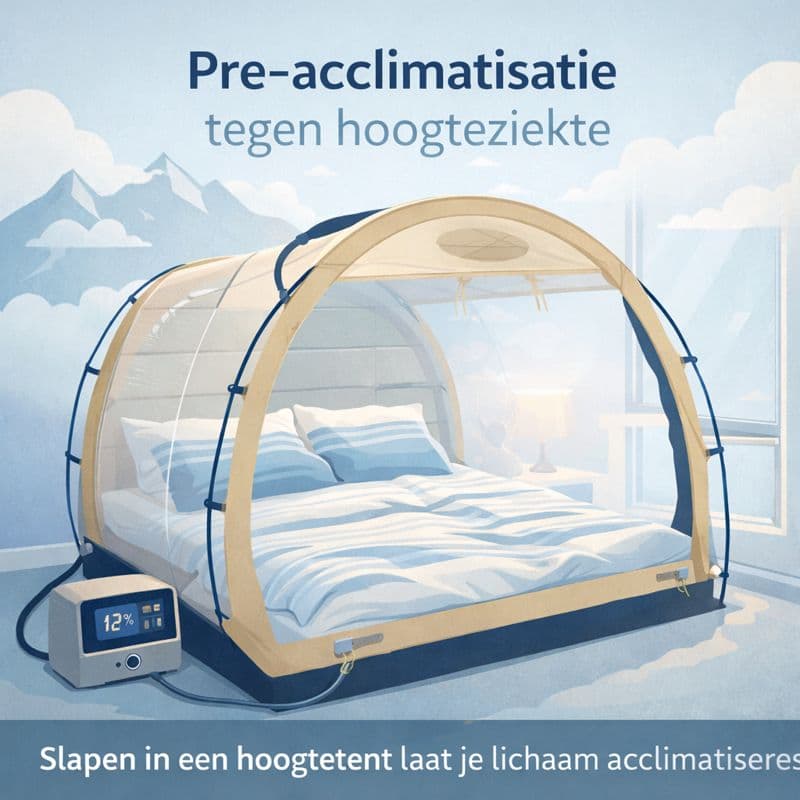
If the itinerary leaves little room for a leisurely pace of ascent, pre-acclimatisation at home can be a valuable addition. By sleeping in an altitude tent for several weeks, the body can already get used to lower oxygen levels.
- Minimum: 4 weeks
- Optimal: 4 to 5 weeks
- Maximum: 6 weeks
The set altitude is always adjusted incrementally based on measured SpO₂ and recovery response. This is guidance, not a guarantee.
What does this mean concretely?
You reduce the risk of acute altitude sickness, but retain the need to ascend sensibly on the spot.
Medication: when to, when not to
Medication may be considered when acclimatisation prescriptions cannot be followed or in case of proven sensitivity.
Acetazolamide (Diamox)
- 125 mg every 12 hours for adults
- Start 24 hours before rise
Dexamethasone
- 4 mg every 12 hours
- Maximum 10 days
Ibuprofen and paracetamol
Symptomatic for headaches, not preventive for acclimatisation.
What does this mean concretely?
Medication supports, but does not replace pacing, rest and observation.
Decision moments and red flags
- Persistently poor sleep
- Falling SpO₂ trend
- No recovery after rest day
- Persistent nausea or headache
In these cases, slowing down or descending is not a weakness, but a rational choice.
In conclusion: trust through understanding
Preventing altitude sickness does not require a perfect schedule, but insight. Those who understand why the body reacts the way it does can make better decisions. This does not guarantee a trouble-free trek, but it does guarantee more control and safety.