Hiking with children at high altitudes: from what age is which destination suitable?
Published 16 May 2026 · 12 min read
Mountain holidays with children
Trekking with children at altitude is not asking for one simple age limit, but for a sensible combination of age, sleeping altitude, ascent rate, route choice and preparation. Parents especially want to know: is Annapurna, the Inca Trail or a mountain trip in the Alps sensible for my child?
That answer doesn't just depend on age. A twelve-year-old can sometimes react better on a quiet route than an adult who is ascending too quickly. A younger child, on the other hand, may be more vulnerable on an ambitious schedule, as symptoms are harder to recognise.
That's why it turns Going hiking with children at altitude especially for margins. The younger the child, the more conservative your route needs to be. Furthermore, acclimatising to less oxygen in advance becomes more important the higher, faster or less flexible the journey is. Sleeping in a high-altitude tent before departure can significantly reduce the chance of altitude sickness, as it makes your acclimatisation more controlled, measurable and plannable. It remains no guarantee, but it does give families with a serious high-altitude trip a stronger starting position.
Hiking with children at altitude: the essentials in 30 seconds
- At around 2,500 metres, the risk of classic altitude sickness is usually limited, but not zero.
- From about 2,500 metres, sleeping altitude becomes more important than daytime altitude.
- With young children, observation is more important than what they say themselves, because symptoms are harder to name.
- For destinations such as the Inca Trail and Annapurna Base Camp, the choice is less about the name of the trek and more about sleeping altitudes, rest days, and escape routes.
- Sleeping in a hypobaric tent beforehand can significantly reduce the chance of altitude sickness, especially when the route offers little scope for gradual acclimatisation.
Why age is a bad decision-making rule
Many parents are looking for a clear-cut answer: from what age can my child swim 3,000, 4,000, or 5,000 metres? That question is understandable, but too simplistic. Altitude exposure is not solely determined by age.
Equally important are the ascent speed, highest sleeping place, number of rest days, duration of the trek, cold, physical exertion, and how well your child can indicate signals. This means the same destination can be logical for one family and too ambitious for another.
Furthermore, complaints in children are not always easy to interpret. A child who becomes tired, quiet or clingy might be hungry, have slept poorly or be suffering from altitude sickness. This is precisely why travelling with children requires a different approach than travelling with adults. Not pushing them to walk faster, not relying on their fitness, but choosing a route beforehand that allows for a slower pace.
Do you mainly want to know what altitude sickness looks like in children? Then read the separate in-depth article on Altitude sickness in children, risks and guidelines. This article deliberately takes a different angle: which destinations are logical, questionable, or inadvisable for each age group?
Quick decision rule for parents
The younger the child and the higher the sleeping areas, the greater the safety margin should be. With children, it is better to choose a route that seems too cautious than a route that is only feasible on paper.
Children at Altitude: Practical Guidelines by Age
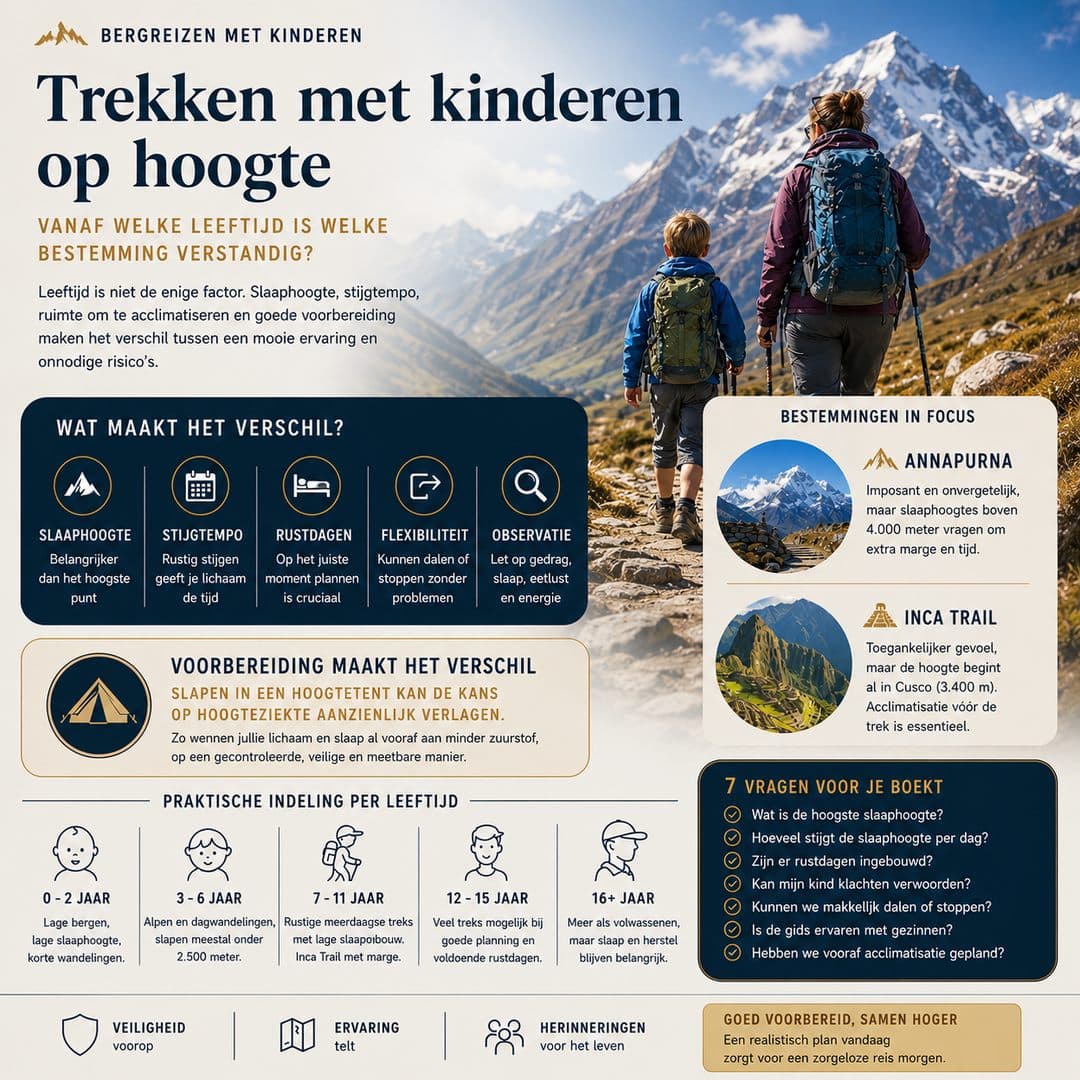
The following classification is not a medical prescription, but a practical decision-making aid for healthy children without relevant lung, heart, or sleep-related conditions. If in doubt, or if there have been previous altitude-related complaints, prematurity, asthma, heart problems, or neurological conditions, it is advisable to consult a doctor before planning a trip to altitude.
| Age | Usually sensible | Only with a large margin | Best avoided |
|---|---|---|---|
| 0 to 2 years | High mountain areas, quiet walks, sleeping altitude preferably low | Short stays around mid-altitude mountain villages if accessibility is good | Multi-day treks with overnight stays above approximately 2,500 metres |
| 3 to 6 years | Alpine holiday, day hikes, usually sleeping below 2,500 metres | Short periods around 2,500 to 3,000 metres with flexibility | Remote treks, fast ascents, sleeping above 3,500 metres |
| 7 to 11 years | Peaceful multi-day mountain trip with low sleeping altitude gain | Inca Trail or light Himalayan routes if the schedule, guidance, and descent are well organised | Ambitious routes above 4,500 metres without pre-acclimatisation or extra rest days |
| 12 to 15 years | Many classic treks are possible with good planning | Annapurna Base Camp, Inca Trail, higher Alpine huts or similar destinations | Rising too quickly, peer pressure, no rest days, no clear exit strategy |
| 16 years and over | Approach seems more adult-like, but growth, sleep and recovery remain important | Higher pulls with pre-acclimatisation and monitoring | Routes where complaints should be ignored to meet the programme |
0 to 2 years
Usually sensible: high mountain areas and quiet walks.
Only with plenty of margin: Short stays in mid-mountain villages.
Prefer to avoid: multi-day treks with sleeping altitudes above approximately 2,500 metres.
3 to 6 years
Usually sensible: Alpine holiday, day hikes and sleeping below 2,500 metres.
Only with plenty of margin: short periods around 2,500 to 3,000 metres.
Prefer to avoid: Remote treks and sleeping above 3,500 metres.
7 to 11 years
Usually sensible: peaceful multi-day mountain trips with low sleep build-up.
Only with plenty of margin: Inca Trail or light Himalayan treks with good guidance.
Prefer to avoid: goals above 4,500 metres without extra acclimatisation.
12 to 15 years
Usually sensible: Classic pulls with good planning.
Only with plenty of margin: Annapurna Base Camp, Inca Trail en hogere huttenroutes.
Prefer to avoid: Peer pressure, progressing too quickly, and no rest days.
16 years and over
Usually sensible: adult approach with extra attention to sleep and recovery.
Only with plenty of margin: improved pulls with pre-acclimatisation and monitoring.
Prefer to avoid: routes where complaints should be ignored.
Why sleeping height is more important than the highest point
Many travel itineraries primarily communicate the maximum altitude. This sounds logical, but for acclimatisation, sleeping altitude is often more decisive. A short passage over a high pass is different from sleeping at high altitude, where your body has to function all night with less oxygen.
For children, that difference is crucial. A day hike to 3,200 metres with a return to a lower valley is not the same as sleeping at 3,200 metres. A trek with a high pass but low overnight stays can therefore be more advisable than a route that involves sleeping above 3,800 metres for days.
Therefore, ask three questions at each destination:
- At what height does my child sleep each night?
- How many metres does the sleep height increase per day?
- Can we easily rest, descend, or stop if things go wrong?
Also, guidelines from, among others, the CDC Yellow Book and the UIAA Medical Commission emphasise the same principle: ascend slowly, observe carefully, and do not force if you experience discomfort.
Annapurna with children: impressive, but not automatically child-friendly
Annapurna sounds appealing to many families: teahouses, mountain culture, beautiful views, and relatively well-known routes. However, “Annapurna” is not a single, unambiguous destination. Annapurna Base Camp is something different to the Annapurna Circuit. Furthermore, a short, lower trek in the Annapurna region is again different from sleeping at or above 4,000 metres.
Annapurna Base Camp with children
Annapurna Base Camp is situated above 4,000 metres. This makes the route physiologically serious, especially for children. The hike itself is usually not the biggest technical problem. The combination of duration, fatigue, cold, sleeping altitude and limited flexibility is.
For young children, this is usually not a logical first high-altitude trek. For older children and teenagers, it can be discussed, but only with a generous schedule, good supervision, extra rest opportunities, and a clear agreement that turning back is not a failure.
Annapurna Circuit with children
The Annapurna Circuit is even more ambitious, as the route traditionally heads towards a very high pass. For families, this is only advisable if your child is old enough to articulate their complaints well, if the schedule is conservative, and if the guides have experience with families at altitude.
Therefore, do not automatically consider the full circuit. For example, opt for a lower route in the Annapurna region. This way, the Himalayan experience remains strong, while the pressure on acclimatisation and safety is reduced.
Decision for Annapurna
With young children: Please choose a lower Nepal route with flexible overnight stays.
With older children: Go only with a spacious schedule, experienced guidance, and willingness to turn back.
With teenagers: Treat Annapurna as a serious high-altitude trek, not a casual walking holiday.
Inca Trail with children: more accessible feel, but still altitude challenge
The Inca Trail to Machu Picchu feels more accessible to many families than Nepal. The duration of the journey is shorter, the infrastructure around Cusco is more familiar, and the destination is culturally significant. Nevertheless, the altitude sickness often begins before the trek even starts, as Cusco is situated at around 3,400 metres.
This means that symptoms can arise even before the first trekking day has begun. For many families, this is an underestimated point. A calm arrival in Cusco or the Sacred Valley is therefore not a luxury, but part of the preparation.
Hoe oud moet je zijn voor het Inca Trail?
For young children, the classic Inca Trail is usually not the most logical first high-altitude trip. From around 10 to 12 years old, the route can become more feasible, provided children have hiking experience, sleep well, can explain any complaints, and the itinerary includes sufficient days in Cusco or the Sacred Valley for acclimatisation.
A sensible Inca preparation, therefore, doesn't just revolve around the trek itself. The days before departure are often crucial. Arriving calmly, not planning strenuous excursions immediately, eating well, hydrating, and using the first few nights to acclimatise can make more of a difference than a strict training schedule.
Inca Trail or an alternative with children?
For families, an alternative programme can sometimes be better: sleeping lower down in the Sacred Valley, doing shorter day hikes, and visiting Machu Picchu without the full classic trail. That is not an inferior choice. On the contrary, for children, a successful mountain trip is one where the experience remains positive and the route is not dependent on sheer perseverance.
Decision for Inca
With children under 10 years old: Consider a lower, more flexible alternative.
With children aged 10 to 12: Only choose the Inca Trail if you have good hiking experience and extra acclimatisation days.
With teenagers: The route is often more realistic, but Cusco remains a serious high-altitude start.
Preparing children for trekking at altitude with a height tent
For families undertaking a serious high-altitude journey, pre-acclimatisation at home is one of the most logical ways to better manage the risk. A high-altitude tent does not lower air pressure, but rather the oxygen percentage in the air. This allows you to simulate altitude in a controlled manner while sleeping at home.
The advantage is primarily practical. You don't have to discover on your trip how your body reacts to less oxygen. You can gradually build up beforehand at your own pace, monitor sleep quality and use a saturation meter to see how your SpO2 trend develops. This way, acclimatisation becomes controlled, measurable and plannable.
This does require extra care with children. For younger children, it is not always necessary or desirable to simulate greatly. For older children and teenagers, supervised pre-acclimatisation can be valuable, especially for destinations with limited acclimatisation time.
Additionally, in many families, it is sensible for the parents to acclimatise beforehand at the very least. Parents who sleep better, stay clearer-headed and are less affected by the altitude themselves can make better decisions for their children en route.
Those who want to tackle this practically can delve into Preventing altitude sickness with acclimatisation and altitude tent preparation and in the base of rent a hypoxie tent for controlled preparation at home.
Which destination is sensible, questionable, or too ambitious?
| Destination type | Logical for children, usually | Terms and Conditions | Examples |
|---|---|---|---|
| Mountain areas | Many families | Low sleeping height, flexible day hikes | Alpine valleys, Dolomites, lower-altitude Pyrenees |
| Medium height | Children with hiking experience | Gentle climb, sleep around 2,000 to 3,000 metres | Hut-to-hut routes with low accommodation |
| Cultural highlight | Older children and teenagers | Extra acclimatisation days, no rush, good observation | Cusco, Sacred Valley, Inca Trail variants |
| Himalayan trek | Especially teenagers | Spacious itinerary, experienced guide, exit options, pre-acclimatisation | Annapurna Base Camp, Lower Nepal Routes |
| High-stakes or expeditionary goal | Rarely suitable for young children | Only with very conservative planning and medical check-ups | High passes above 5,000 metres, remote routes |
Mountain areas
Usually logical: many families.
Terms and Conditions Low sleeping height and flexible day hikes.
Examples: Alpine valleys, Dolomites and lower Pyrenees.
Medium height
Usually logical: children with hiking experience.
Terms and Conditions Ascend gently and sleep around 2,000 to 3,000 metres.
Examples: Hut tours with low overnight stays.
Cultural highlight
Usually logical: older children and teenagers.
Terms and Conditions Acclimatisation days, no rush and good observation.
Examples: Cusco, Sacred Valley and Inca Trail variants.
Himalayan trek
Usually logical: especially teenagers.
Terms and Conditions Poor schedule, experienced guide, exit options, and pre-acclimatisation.
Examples: Annapurna Base Camp and lower Nepal routes.
High step
Usually logical: rarely for young children.
Terms and Conditions Very conservative planning and medical check.
Examples: high passes above 5,000 metres and remote routes.
The parent check: 7 questions before you book
A destination is only sensible if you have a calm answer to the questions below. Not afterwards, but before you book.
- What is the highest sleeping altitude of the journey?
- How many metres does the sleep height increase per day?
- Are rest days built in at the right moments?
- Can my child express their complaints well?
- Is there a realistic possibility of coming down or stopping?
- Is the guide accustomed to working with families and children?
- Have we planned for acclimatisation beforehand, for example using a hypobaric chamber?
Signals where you should not negotiate
This article deliberately does not go into detail on all symptoms of altitude sickness in children, to avoid overlap with the separate medical article. Nevertheless, some red flags are important enough to repeat here.
Is your child becoming noticeably more lethargic, confused, short of breath at rest, unsteady, unusually emotional, persistently nauseous, or progressively more unwell despite resting? Then continuing is not a brave decision. The plan must be adjusted at that moment.
In cases of clear deterioration, descending is the correct choice. Behaviour is often the first indicator, especially in children. A child who no longer plays, doesn't want to eat, becomes quiet, or reacts noticeably differently than normal deserves attention. Measurements can help, but they never replace parental observation and common sense.
Conclusion: Holidaying with children at altitude requires leeway
Trekking with children at altitude kan een prachtige ervaring zijn, maar alleen als de route zich aanpast aan het kind. Niet elke bestemming is op elke leeftijd verstandig. Lage berggebieden zijn voor veel gezinnen logisch. De Inca Trail kan voor oudere kinderen en tieners interessant zijn, mits de acclimatisatie serieus wordt genomen.
Annapurna is impressive, but demands even more margin, especially on routes with sleeping altitudes above 4,000 metres. The best preparation is therefore not just training. It is primarily planning, slowing down, observing and removing as much uncertainty as possible beforehand.
A height tent can play an important role here, as you can start your acclimatisation in a controlled manner at home. This significantly reduces the chance of altitude sickness, without pretending the risk disappears completely.
Prepare your family trip for altitude controlled
Are you going to the Inca Trail, Annapurna, or another high-altitude destination with your family? Then it’s wise to decide in advance whether pre-acclimatisation at home makes sense. Altitude Dream will help you with a realistic plan, tailored to your destination, timing, and experience.