
Traditional altitude training: effects, risks and better choices
Published 21 March 2013 · 12 min read
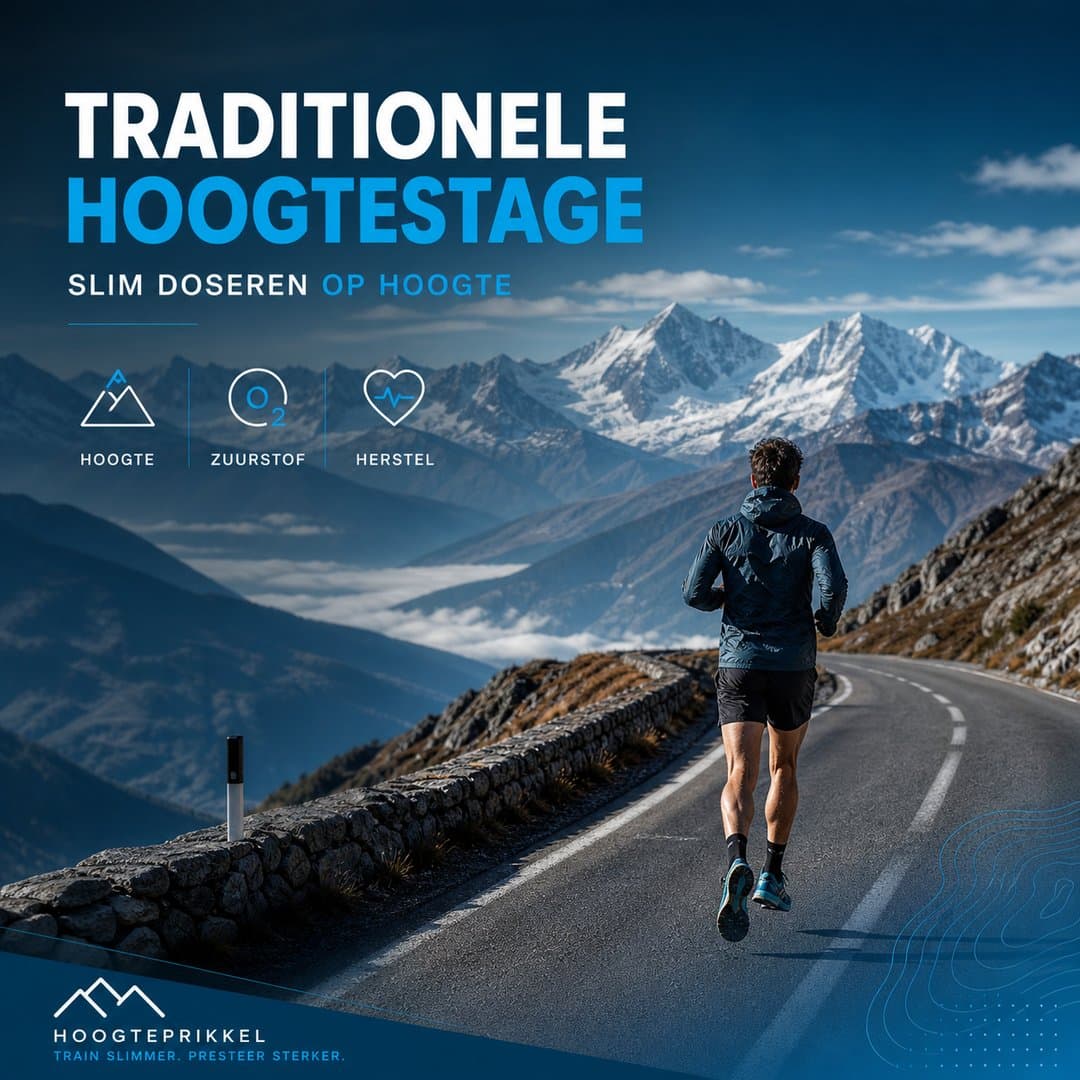
A traditional altitude training means living at altitude as well as training at altitude. That can provide strong physiological stimuli, such as a higher EPO response, more red blood cells and better oxygen efficiency. Yet the effect is never automatic. The biggest pitfall is that training quality drops just when your body is already experiencing extra stress.
Therefore, you should not think of a traditional altitude training session as a magic shortcut, but as a tough training intervention. It works especially well when altitude, duration, training load, recovery, iron status and timing are right. For many athletes, the biggest benefit is not the location itself, but the controlled combination of hypoxic stimulus and maintaining quality training.
Direct response: traditional altitude training can support endurance, especially via improved oxygen transport and adaptation to hypoxia. The risk is that you train too hard at altitude, causing fatigue, muscle breakdown and loss of form. The best results usually come from a planned approach in which the altitude stimulus is dosed and training quality remains protected.
Conclusion: traditional altitude training only works if the load starts lower than at sea level.
Nuance: higher is not automatically better, as too much hypoxic stress can interfere with recovery and training quality.
Practical hook: steer by data, sleep, recovery and SpO2 trend rather than by feel alone.
What is a traditional altitude internship?
In traditional altitude training, an athlete uses the principle Live High, Train High. You stay at altitude for several weeks and also carry out your training there. Well-known locations include St Moritz, Font Romeu, Flagstaff, Sierra Nevada, Iten and Potchefstroom. Most places are between about 1,500 and 2,500 metres.
At that altitude, oxygen pressure is lower. As a result, the body gets less oxygen available per breath. This causes hypoxic stress. It is precisely this stress that triggers adaptations. Think more ventilation, increased EPO production, changes in haemoglobin and more efficient use of available oxygen.
First, if you want to understand what happens in the body, this topic logically connects to the physiological benefits of altitude training. Therein lies the basis for why altitude training potentially works, but also why dosage is so important.
The problem is not in the altitude stimulus itself. The problem arises when athletes simply take their normal training plan to altitude. Tempos feel heavier, recovery takes longer and sleep can become more restless. Those who then force the same intensity don't build form. Who breaks down form.
What effects does traditional altitude training have?
The best-known adaptation is the increase in EPO. EPO is the hormone that stimulates the production of red blood cells. More red blood cells and haemoglobin can improve oxygen transport. This is of interest to endurance athletes because oxygen availability plays a central role in aerobic performance.
Yet this is only one part of the story. Altitude also affects breathing, fluid balance, sleep, energy consumption, muscle strain and recovery. This makes a traditional altitude training session simultaneously a stimulus and a stressor. The trick is to make the stimulus high enough for adaptation, but low enough to avoid falling into chronic fatigue.
📊 Research shows
Altitude training can support aerobic capacity, haemoglobin and performance parameters, but the response varies greatly among athletes. A recent open-access review study on altitude training and aerobic capacity especially emphasises the importance of dosage, duration and individual response.
Changes may also occur at the muscle level. The body learns to cope with less oxygen. This can lead to more efficient use of oxygen during submaximal exercise. Moreover, the respiratory response becomes stronger. This allows an athlete to move more economically after returning to sea level, provided the training load is properly monitored.
In sprint and explosive disciplines, the situation is different. There, lower air resistance at altitude can be temporarily beneficial. For endurance athletes, the combination of oxygen stress and maintaining quality training is especially decisive. This is exactly where the classic Live High, Train High method falters.
Why traditional altitude training can also fail
Many altitude placements fail not because altitude doesn't work. They fail because the first few days are tackled too hard. The first 7-10 days require adaptation. The body has to get used to less oxygen, changed sleep, higher ventilation and often a different environment.
If you force intensive blocks at that stage, a double problem arises. On the one hand, the training produces less quality. On the other hand, the internal load grows. This increases the risk of muscle breakdown, poor sleep, fatigue and overtraining.
Traditional error versus smart approach
Traditional mistake: run normal intervals on day 2 already, because the schedule dictates it.
Smart approach: consciously plan conservatively the first week, with lower intensity, controlled volume and daily monitoring.
Why this matters: the first week often determines whether altitude training provides adaptation or only accumulates fatigue.
A second pitfall is wanting to stay too high. Higher feels impressive, but it is not automatically more effective. Above a certain threshold, hypoxic stress becomes so great that sleep and training output drop. Then you lose exactly the stimuli you need to get better.
A third mistake is not paying enough attention to iron and energy intake. Sufficient iron is essential for the production of new red blood cells. At altitude, energy requirements can rise, while appetite sometimes falls. Failure to take this into account limits adaptation.
Traditional altitude training versus Sleep High Train Low
The traditional method has one fundamental drawback. You train in the same low-oxygen environment in which you are trying to recover. As a result, pace, power and technique are often lower than at sea level. Especially in intensive blocks, this is relevant.
The alternative is Sleep High, Train Low. In doing so, you sleep in hypoxia but train lower or at sea level. The goal is simple: you preserve the hypoxic stimulus for adaptation, while better protecting the quality of your workouts.
| Method | What is happening? | Strong point | Major risk |
|---|---|---|---|
| Live High, Train High | You live and train at altitude. | Strong natural height incentive. | Training quality may drop. |
| Sleep High, Train Low | You sleep in hypoxia and train lower. | Better combination of incentive and quality. | Requires precise dosing. |
| At home with high altitude tent | You sleep in normobaric hypoxia. | Controllable, measurable and planable. | Build-up should be gradual. |
Live High, Train High
What is happening? You live and train at altitude.
Strong point: strong natural height incentive.
Risk: training quality can drop.
Sleep High, Train Low
What is happening? You sleep in hypoxia and train lower.
Strong point: better combination of incentive and quality.
Risk: Requires precise dosing.
At home with high altitude tent
What is happening? You sleep in normobaric hypoxia.
Strong point: verifiable, measurable and planable.
Risk: build-up should be gradual.
This explains why modern altitude training is increasingly about control. Not just where you are, but especially how you dose the stimulus. Those who have good altitude training locations therefore does not only look at altitude. Training routes, recovery options, climate, sleep quality and the ability to train lower also count.
How long should a traditional altitude training course last?
A traditional altitude internship usually lasts 3 to 4 weeks. Shorter may be useful for experience, acclimatisation or specific preparation. Yet the physiological effect on red blood cells is often more limited then. Sufficient duration is needed for a clear haematological response.
The first few days are mainly about getting used to it. After that, the load can gradually increase. Many athletes feel temporarily less good after a few days. This is sometimes called the first dip. Later, a phase often follows in which the body copes better with the altitude.
Practical protocol for the first 14 days
Day 1 to 3: gain weight, drink a lot, move slowly, no intense intervals.
Day 4 to 7: Build volume carefully, keep intensity low, sleep and fatigue track.
Day 8 to 10: first controlled quality incentives, only if recovery and sleep are stable.
Day 11 to 14: Training load further individualise based on response, not ego.
After returning to sea level, timing is again important. Some athletes feel flat at first. Others notice benefits faster. Therefore, it is wise not to predict exactly one fixed peak moment. Rather, plan a window in which form can appear, and make sure recovery is not underestimated.
More practical background on this section can be found in the article on recovery after an altitude training. Especially the first days after returning often determine whether you make good use of the accumulated adaptation.
This is how you monitor this lens
Traditional altitude training requires objective monitoring. Feeling remains important, but feeling alone is too fragile. At altitude, motivation, fatigue and peer pressure can cloud your assessment.
Therefore, use a small set of signals that you monitor daily or weekly. Never look at one single measurement. Above all, the trend is relevant. A lower SpO2 one morning says less than a falling trend with poorer sleep and increasing fatigue.
| Indicator | How to measure? | Healthy interpretation | Adjust when |
|---|---|---|---|
| SpO2 trend | Every morning at rest, under equal conditions. | A decline that stabilises suits adaptation. | Trend continues to decline with complaints or poor sleep. |
| Sleep quality | Note duration, pauses and rested feeling. | Restful sleep or marked improvement after a few days. | Multiple nights of restlessness, headaches or heavy recovery. |
| Recovery | Resting heart rate, HRV, RPE and muscle sensation combined. | Load feels controllable and recovery normalises. | RPE increases during normal workouts or resting heart rate remains high. |
| Symptoms | Headache, nausea, dizziness and appetite follow. | Mild symptoms disappear quickly after rest and adjustment. | Complaints pile up or get stronger. |
SpO2 trend
Measuring: every morning at rest, under equal conditions.
Interpretation: A decline that stabilises suits adaptation.
Adjustment: trend continues to decline with complaints or poor sleep.
Sleep quality
Measuring: note duration, interruptions and rested feeling.
Interpretation: Peaceful sleep or improvement after a few days.
Adjustment: several nights of restlessness, headaches or heavy recovery.
Recovery
Measuring: Resting heart rate, HRV, RPE and muscle sensation combined.
Interpretation: tax feels controllable.
Adjustment: RPE increases during normal workouts or resting heart rate remains high.
Symptoms
Measuring: headache, nausea, dizziness and appetite follow.
Interpretation: mild symptoms disappear quickly after rest.
Adjustment: complaints pile up or get stronger.
If you want to better assess the effect of altitude training, also use a fixed test stimulus. Consider a submaximal running or cycling test comparing pace, power, heart rate and feel. The article on measuring the effect of altitude training helps to make that interpretation more concrete.
Decision rules for a traditional altitude traineeship
A traditional altitude training is particularly interesting for athletes with a solid foundation. Think runners, cyclists, triathletes, cross-country skiers, rowers and other endurance athletes who already train consistently. For beginners, the extra complexity often outweighs the potential gains.
When does traditional altitude training make sense?
Do consider: you have a good training base, sufficient time, guidance, recovery space and a clear goal moment.
Caution: you have little recovery time, a busy work week, low iron status, sleep issues or an injury prone period.
Don't force it: if your normal training load already feels heavy, altitude does not usually make the system stronger but more vulnerable.
The key decision rule is simple: altitude training should enhance your training process. Not disrupt it. As soon as altitude causes your core training to become structurally worse, you need to make adjustments. This can be done by staying lower, running less volume, limiting intensity or opting for a different model.
Common misconceptions about traditional altitude training
The first misconception is that altitude training always leads to more red blood cells. In reality, this requires sufficient duration, correct altitude, proper nutrition and individual response. Some athletes respond strongly. Others respond more narrowly.
The second misconception is that at altitude you have to suffer harder. That sounds tough, but it is often physiologically illogical. Instead, the first stage requires control. Training hard at the wrong time can undermine adaptation.
The third misconception is that an altitude tent is the same as a mountain. This is not true. An altitude tent works via normobaric hypoxia. The air pressure remains the same, but the oxygen percentage is reduced. This allows you to deploy the stimulus in a controlled, measurable and plannable way. It is no substitute for true acclimatisation, but it is a powerful support when you build up carefully.
⚠️ Reality check
A high altitude tent significantly lowers the risk of complaints when set up is done properly, but it does not offer a 100 per cent guarantee. Think of it as controlled preparation. Not as a licence to plan faster, higher or heavier than your body can handle.
Practical pre-departure checklist
Check this before your altitude training
1. Training basis: you should be able to handle the normal training load at sea level stably.
2. Iron status: Have ferritin and relevant blood levels checked in good time.
3. First week: deliberately plan lighter than your normal schedule.
4. Monitoring: Record SpO2 trend, sleep, RPE, resting heart rate and symptoms.
5. Return: Plan recovery time after internship, especially before an important match.
So a strong altitude trip does not start with the flight or the location. It starts with the planning. The fitter and more stable you leave, the more likely it is that altitude will become a useful stimulus. The messier you leave, the more likely it is that altitude mainly adds extra noise.
FAQ on traditional altitude training
How long does a traditional altitude training course last?
Usually 3 to 4 weeks. Shorter placements can be useful but often give less obvious haematological adaptation.
From what altitude does altitude training have an effect?
Many athletes train between 1,500 and 2,500 metres. The optimal altitude depends on experience, sport, recovery and individual response.
Why shouldn't you train too intensely the first few days?
Your body needs to get used to hypoxia. Training too hard at this stage increases the risk of fatigue, poor sleep and loss of form.
Is Sleep High Train Low better than traditional altitude training?
It is often more practical because you combine the altitude stimulus with better training quality. The best choice depends on purpose, planning and monitoring.
Can you recreate an altitude training session at home?
You can simulate the hypoxic sleep stimulus at home via normobaric hypoxia. This makes the approach controlled, measurable and planable.
Want to take advantage of the altitude incentive without losing training quality?
For many athletes, Sleep High Train Low is a logical next step. You sleep in hypoxia but maintain the quality of your workouts during the day. Thus, high training becomes more controllable and more aligned with your goals.
Conclusion: traditional altitude training requires control
Traditional altitude training can be valuable, but only if you build them wisely. The physiological stimulus is real. Yet the execution determines whether that stimulus leads to adaptation or fatigue.
The gist is simple. Start slowly, monitor training quality, monitor SpO2 trends, sleep and recovery, and dare to make adjustments. Don't see altitude as evidence of toughness, but as a stimulus that you need to dose accurately.
For athletes who want to combine the benefits of hypoxia while maintaining intensive training, Sleep High Train Low is often a more modern and controllable approach. Not because traditional altitude training has no value, but because quality, recovery and measurability are increasingly important.


