How to choose the right height setting in your altitude tent? A practical guide
Published 10 July 2025 · 2 min read
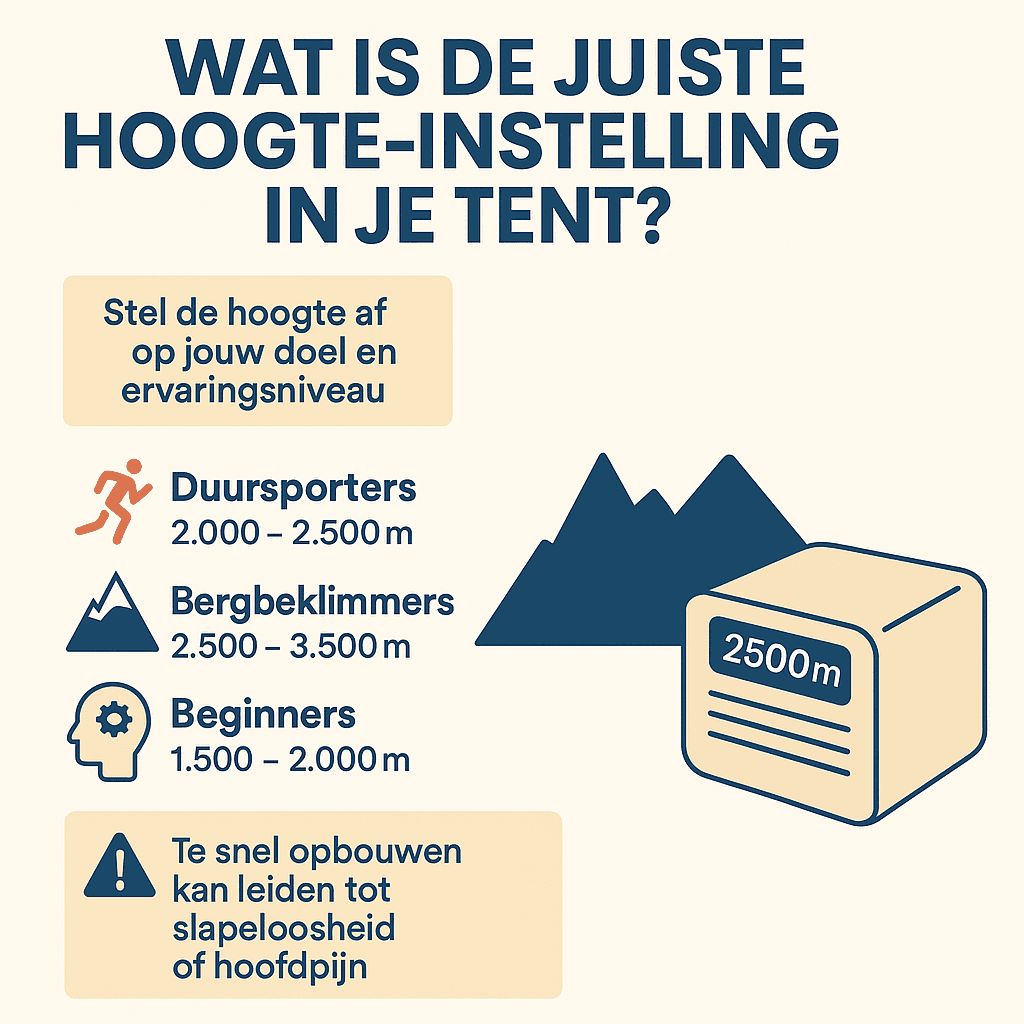
The height you set in your altitude tent determines how much oxygen your body receives. Too low? Then the effect is minimal. Too high? Then you risk sleep deprivation or even overexertion. So it is essential to strike a balance between effectiveness and comfort.
At Altitude Dream, we always advise: train smart, not extreme. That starts with a well-thought-out choice of height.
What does "height" in a height tent actually mean?
The "altitude" in an altitude tent is a virtual altitude. You do not literally sleep at 2,500 metres, but the oxygen concentration in the air is reduced to the level corresponding to that altitude.
For example:
- Sea level: 20.9% oxygen
- 2.000 m: ~16.4% oxygen
- 3.000 m: ~14.5% oxygen
- 4.000 m: ~12.7% oxygen
The height generator of the height tent precisely controls this. But... which height is right for you?
Which height is suitable for whom?
????♂️ Endurance athletes (runners, triathletes, cyclists)
- Start with 2,000 to 2,500 metres
- Build up gradually to 3,000 - 3,200 metres
- Goal: improve endurance, VO2 max, EPO production
⛰️ Mountaineers / travellers to high areas
- Simulate the altitude of your destination - 500 metres
- For an ascent at 4,500 m: start around 3,000 m, build up to 4,000 m
- Goal: prevent altitude sickness and acclimatise faster
???? Biohackers & general recovery
- Low settings (1,800 - 2,200 m)
- Focus on long-term use without sleep disruption
- Purpose: cell repair, mitochondrial stimulation, well-being
How do you build height safely?
???? Step-by-step protocol (example):
- Week 1: 2,000 m
- Week 2: 2,500 m
- Week 3: 3,000 m
- Week 4: 3,200 - 3,500 m (optional)
Pay attention to your sleep quality and recovery: in case of fatigue, restless sleep or headaches, it is better to take a step back.
???? Preferably use a saturation meter To check your saturation in the morning.
What are the signs that you are too high?
- Falling asleep badly or waking often
- Morning headache
- Reduced appetite or nausea
- Muscle recovery takes longer than normal
???? These are signs to lower your virtual altitude by 300-500 metres.
Smartly combine with your training schedule
During intensive training weeks, it is wise to keep your altitude setting a little lower (e.g. max 2,800 m). During resting weeks, you can sleep a little higher.
This is how you fit the famous Live High - Train Low-principle: you benefit from increased Epo production without compromising your workouts.
Our recommendation: the Altitude Dream approach
We always recommend a personally tailored protocol, depending on:
- Your objective
- Your training load
- Your experience with altitude
- Your sleep pattern
- Your saturation
Via our online booking tool we customise everything. You get guidance on setting the right height and construction.
Conclusion
The right height setting is the key to success with your high altitude tent. Too high, and your body protests. Too low, and you miss the effect. Find your ideal zone - and get the most out of every night at altitude.
✅ Do you want to start with a personal coaching programme?
Book your altitude tent now or take contact us for advice.