Acclimatising at home for mountain expeditions: acclimatising for 6000m - schedule and preparation
Published 22 January 2026 · 4 min read
Acclimatising at home for mountain expeditions sounds appealing to many mountain travellers, but it also raises doubts. Can you really prepare your body for 6,000 metres altitude without being in the mountains? And if so: how do you go about it safely, effectively and realistically? In this article, you won't get a simplistic roadmap, but insight. You will learn what home acclimatisation does and does not do physiologically, where it is often misunderstood and how to use it wisely in preparation for an expedition up to 6000m.
Why home acclimatisation for mountain expeditions is often misunderstood
A lot of advice on acclimatisation is binary: “it works” or “it doesn't”. That contradiction is too short. Acclimatising at home is not a substitute for acclimatising in the mountains, but a preparation for it. Those who don't understand that difference risk having too high expectations or, on the contrary, missing opportunities.
In expeditions towards 6000 metres, acclimatisation is not a detail but a determining factor for safety, recovery and success. This is precisely why it is important to understand what you can already influence at home and what only happens at altitude itself.
What exactly does ‘acclimatising at home’ mean?
Acclimatising at home means pre-exposing your body to lower oxygen availability via normobaric hypoxia. This is usually done with a altitude tent and accompanying altitude generator in which the oxygen percentage is reduced, not the air pressure.
The physiological mechanism in outline
Repeated stays in oxygen-depleted air trigger a number of adaptation processes in your body:
- Increased breathing stimulus and more efficient oxygen uptake
- Stimulation of erythropoietin (EPO)
- Improved cellular oxygen utilisation
- Adjustment of ventilation during sleep
These are the same processes that also take place at altitude, but they are more controlled at home and without external stressors such as cold, fatigue or terrain strain.
What does this mean concretely?
For your planning: you can start part of the adaptation even before you leave.
For your load: the incentive is lighter than in the mountains.
For your risk: you lower the chances of an abrupt first shock at altitude.
What acclimatising at home doesn't do
A common misconception is that acclimatising at home “fully acclimatises” you for 6000m. This is not so. Certain adaptations are location-specific and only occur through actual altitude exposure.
Think about:
- Pressure-related effects on fluid balance
- Thermal and energetic stress
What does this mean concretely?
For your expectations: acclimatising at home is a very good preparation, but not yet an end.
For your approach: you still need a careful altitude-building schedule in the mountains.
Three persistent misconceptions about acclimatising at home
Misconception 1: The higher the set height, the better
Many people think that faster and higher settings lead to faster adaptation. In reality, this mainly increases the risk of poor sleep, overexertion and decreasing adaptation.
What does this mean concretely?
Steering by SpO2 trends and sleep quality is more effective than steering by meters.
Misconception 2: Two weeks is enough for a 6000m expedition
For expeditions above 5,000 metres, a minimum preparation time of four weeks is more realistic. Shorter is possible, but produces less stable adaptation.
Misconception 3: If you feel good, you go well
Subjective feeling and physiological adaptation do not always coincide. SpO2 measurements and sleep data often give signals earlier than how you feel during the day.
Scenario 1: The experienced trigger with sleep problems
An experienced mountain hiker prepares for a 6000m peak and starts acclimatisation at home. After a week, he notices restless sleep and night waking.
What does this mean concretely?
This is often a sign that the altitude stimulus is too great. Downshifting and staying at the same altitude for longer is more effective than pushing on.
Scenario 2: The sporty expeditionary who wants to go too fast
A fit athlete increases the set altitude every two nights because morning readings are “okay”.
What does this mean concretely?
Adaptation takes time. Progressing too quickly undermines the effect and increases the risk of complaints upon arrival at true altitude.
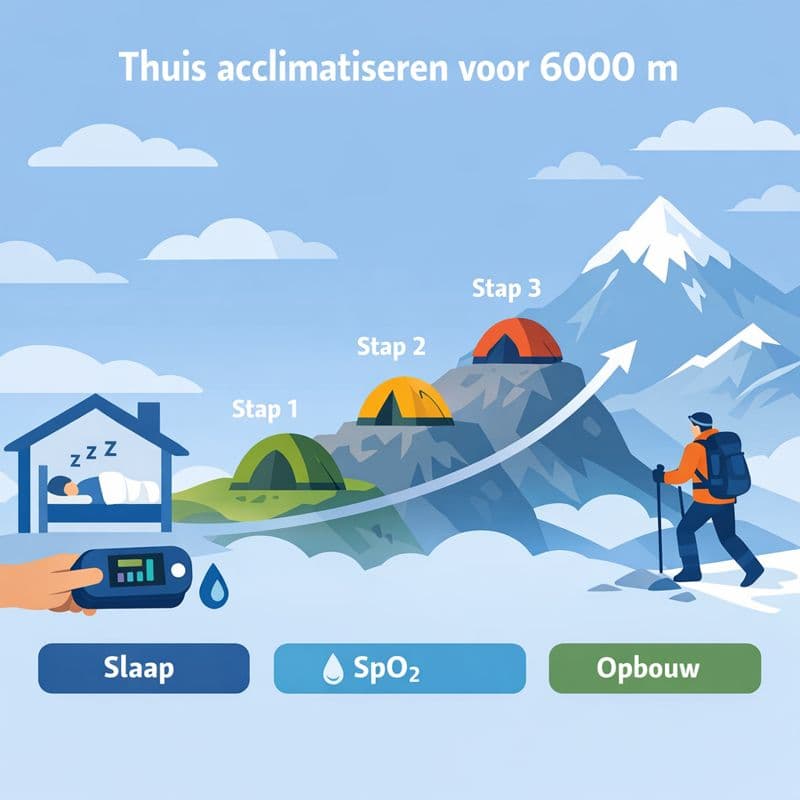
What does a realistic home acclimatisation schedule towards 6000m look like?
Minimum schedule (4 weeks)
- Week 1: low to moderate hypoxia, focus on sleep
- Week 2: stabilisation and slight increase
- Week 3: controlled progression based on SpO2
- Week 4: consolidate, not maximise
Optimal schedule (5 weeks)
More time for stabilisation and recovery, with fewer fluctuations in sleep quality.
Maximum schedule (6 weeks)
For those reacting sensitively or heading towards technically and logistically demanding expeditions.
Important: the set altitude is always determined individually and incrementally based on measured SpO2 trends, never on fixed gauges.
Decision moments and red flags
- Persistently poor sleep several nights
- Declining SpO2 trend without recovery
- Unexplained daytime fatigue
For these signals, slowing down or temporarily lowering is wiser than continuing.
The role of guidance and preparation
Acclimatising at home works best as part of wider preparation. That means: understanding your target altitude, planned ascent rate and personal sensitivity.
At Altitude Dream, we guide this process substantively, with realistic expectations and individual tuning. No guarantees, but direction and overview.
Conclusion: what acclimatising at home will get you
Beforehand a altitude tent hire makes your first days at altitude calmer, more controlled and predictable. It significantly lowers the risk of altitude sickness, but never replaces 100% acclimatisation in the mountains themselves.
Those who use it as preparation and not as a shortcut increase their margin of safety and start an expedition towards 6,000 metres stronger.
If you want to know which schedule suits your target height and schedule, then personal advice the logical next step.