
Altitude training for athletes: how to measure effect with HRV, saturation and power output
Published 26 January 2026 · 5 min read
Altitude training often feels good, but does it really work? That's the question many athletes are left with. They sleep for weeks in oxygen-depleted air, adjust their workouts and invest time and recovery, without knowing exactly whether their bodies are actually adapting. In this article, you will get to grips with that doubt. You will learn how to objectively measure the effect of altitude training with HRV, oxygen saturation and power, and most importantly, how to interpret these signals together to make better decisions.
Why effect measurement in altitude training so often goes wrong
Many athletes judge altitude training by feel. Bad nights are seen as evidence that it works. Fatigue is interpreted as adaptation. And an occasional low saturation reading quickly leads to panic or overestimation.
This is understandable, but physiologically incorrect. High altitude training causes several, partly opposite processes at the same time: hypoxic stress, recovery adaptation and training load intermingle. Without a measurement framework, you only see fragments.
What this means concretely: if you only follow one metric, you miss the bigger picture and risk building up too early or slowing down unnecessarily.
What do we mean by ‘effect’ in altitude training?
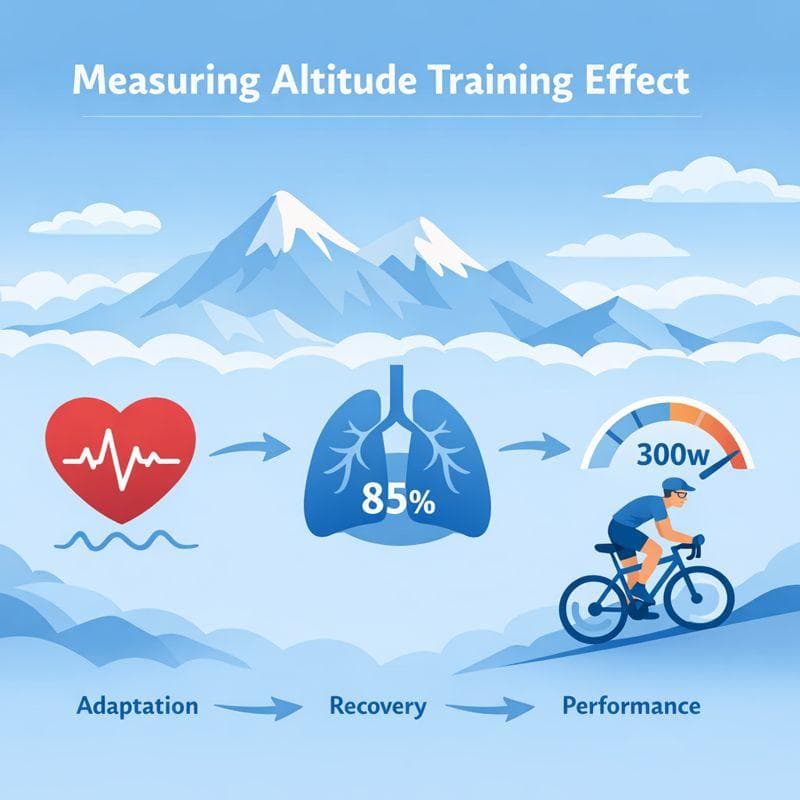
Effective altitude training does not mean feeling better every day. It means your body is measurably better at dealing with oxygen deprivation and converting that adaptation into sea level performance capacity.
That effect manifests itself on three levels:
- Physiological adaptation (such as improved oxygen uptake)
- Recovery response (how quickly your body processes stress)
- Performance output (what you can actually deliver)
You measure these levels with saturation, HRV and power respectively.
Micro-discharge: did you know?
Did you know that in successful altitude training, SpO₂ often dips before rising structurally? A temporary dip is not a failure, but often the beginning of adaptation, provided recovery markers move with it.
Oxygen saturation: the basis of hypoxic adaptation
Oxygen saturation (SpO₂) shows how much oxygen your blood actually transports. During altitude training, this is a primary measure of hypoxic stimulus and habituation.
What is important is not the absolute value, but the trend:
- Does the nocturnal SpO₂ stabilise after a few days?
- Is there less drop for the same ‘height’?
- Does the value recover faster after training days?
What this means concretely: a stable or slightly rising SpO₂ at constant settings indicates adaptation. Continued decline without recovery is a signal to stand still.
HRV: recovery, stress and adaptive capacity
Heart Rate Variability (HRV) provides insight into the balance between stress and recovery. High altitude training initially increases the stress load, which is often reflected in a decreasing HRV.
What is crucial is what happens next:
- Does HRV recover within a few days?
- Will the baseline be higher than before?
- Does HRV remain stable despite training load?
In coaching programmes, we often see that athletes with a rising HRV after week 2 cope better with hypoxic stimuli and experience less training failure.
What this means concretely: HRV doesn't tell you whether altitude training ‘works’, but whether your body can handle it. That makes it a decisive control variable.
Micro-discharge: reality check
A low HRV during altitude training is not automatically bad. It only becomes a problem when recovery fails and performance drops at the same time.
Power and pace: the ultimate translation
Ultimately, it's all about performance. Power (or pace at fixed heart rate) shows whether physiological adaptation translates into output.
Note:
- Does your wealth change at the same RPE?
- Can you maintain the same pace for longer?
- Does technique remain stable under fatigue?
Many athletes make the mistake of comparing power during the hypoxic phase to sea level. The real evaluation only follows after completion of the process.
What this means concretely: measure power especially in the weeks after altitude training. That's where you see whether the investment pays off.
Common misunderstandings in impact measurement
1. “Lower saturation means more effect.”
Incomplete. Too low values without recovery increase risk and delay adaptation.
2. “HRV should always rise”.”
Context-dependent. Temporary decline is normal; delayed recovery is not.
3. “If my power doesn't increase, it won't work.”
Incorrect. Timing and test moment determine what you see.
Two recognisable scenarios
Scenario 1: the ambitious endurance athlete
A runner notices no performance gains after two weeks of altitude training and wants to stop. SpO₂ stabilises, HRV slowly recovers.
Interpretation: adaptation is in progress, but not yet translated into output. Continuing with adjustment makes sense.
Scenario 2: the overloaded cyclist
HRV remains low, sleep deteriorates, SpO₂ drops further.
Interpretation: load exceeds recovery capacity. Adjusting or pausing prevents kickback.
Micro-discharge: mini-FAQ
Should I use all three metrics?
Ideally, they do. Together, they provide context. One value without the others often leads to wrong conclusions.
Decision moments and red flags
Continuing makes sense if:
- SpO₂ stabilises or rises slightly
- HRV recovers within 48 to 72 hours
- Subjective sense of recovery is neutral to good
Adjusting is wise at:
- Poor sleep several nights
- Falling HRV without recovery
- Stagnant power with increased RPE
Slowing down or stopping is required at:
- Persistent symptoms
- Structurally low SpO₂
- Obvious performance deterioration
The role of the altitude tent within impact measurement
An altitude tent is not a shortcut, but a tool. The primary stimulus is sleeping in normobaric hypoxia. Effect measurement makes this process controllable and planable.
In practice, we see that athletes who adjust their altitude setting incrementally based on SpO₂ and HRV achieve more consistent results than those who work by ‘feel’.
Advisory duration: minimum 4 weeks, optimal 4 to 5 weeks, maximum 6 weeks.
From measuring to guiding
Data by itself does not provide answers. Interpretation does. What usually makes the difference here is seeing consistency between metrics, load and recovery.
Good guidance translates data into decisions: when to adjust, when to persevere and when to slow down.
Conclusion: measuring gives peace of mind and direction
Altitude training works not because it feels tough, but because it is cleverly applied. HRV, saturation and power combine to form a reliable compass. They replace doubt with insight and make altitude training a manageable process.
Those willing to measure and interpret do not train harder, but smarter.


