
Altitude training for athletes: sleep high train low - what works in practice
Published 13 January 2026 · 5 min read
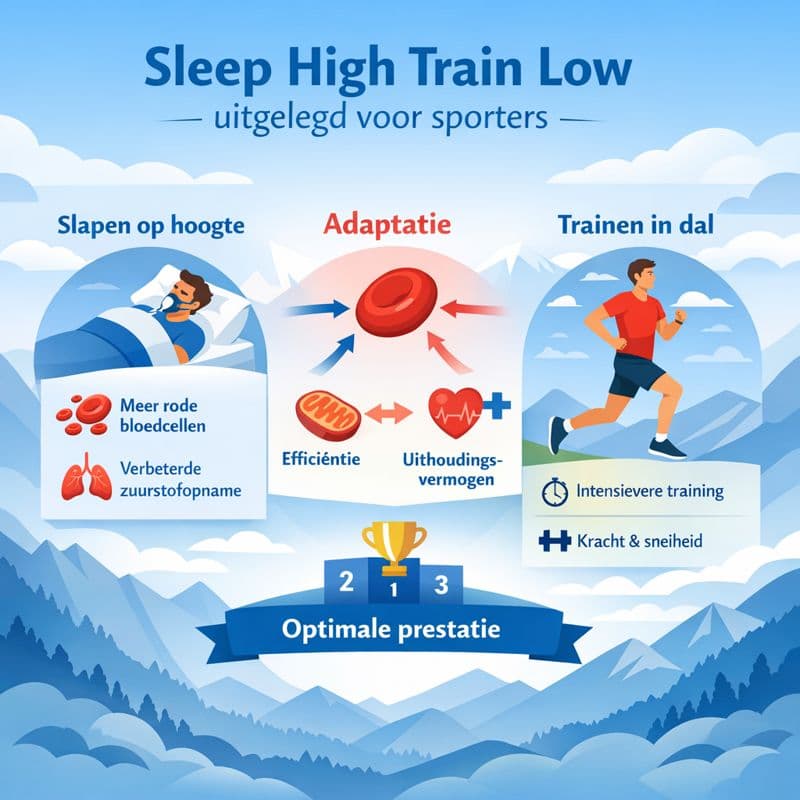
Sports performance altitude training for athletes often raises the same key question: does the principle work sleep high, train low now really, and if so, for whom and under what conditions? The short answer: yes, provided it is applied correctly, tailored individually and part of a well thought-out training and recovery plan. In this article you will read how the mechanism behind sleep high train low works, what effects you can realistically expect, where it often goes wrong in practice and how athletes can use it responsibly to improve performance.
This article is intended for critical athletes and coaches who want to look beyond the hype and look for a practical, science-based approach.
What exactly does sleep high train low mean?
Sleep high train low (SHTL) is a training strategy within altitude training in which an athlete sleeps or rests at simulated altitude while intensive training is performed at low altitude or normoxic conditions. The aim is to expose the body to hypoxia for adaptation without compromising training quality.
The concept became widely known in the late 1990s through research by Levine and Stray-Gundersen and has since been further refined. Unlike traditional altitude training, which involves both sleeping and training at altitude, SHTL combines the best of both worlds: physiological stimulus and maintenance of training intensity.
Why does sleep high train low work for sports performance?
Hypoxia as an adaptive stimulus
When you sleep in an environment with reduced oxygen levels, oxygen pressure in the blood drops. The body responds with a cascade of adaptations, including:
- Stimulation of erythropoietin (EPO)
- Increase in red blood cells and haemoglobin
- Improved oxygen transport capacity
- More efficient cellular energy management
These adaptations contribute to improved aerobic capacity and endurance, provided the stimulus is offered for a sufficiently long and consistent time.
Why training at low altitude remains crucial
Intensive training requires speed, power and neuromuscular quality. At real or simulated altitude, this is often difficult to sustain due to reduced oxygen availability. By training precisely low, you maintain:
- Training intensity and quality
- Specific match incentives
- Technical and tactical acuity
This makes SHTL especially interesting for athletes seeking performance gains without compromising their regular training schedule.
For which athletes is sleep high train low suitable?
Sleep high train low is mainly used within endurance sports, but is more widely applicable than is often thought. The effect differs depending on the sport, level and training goal.
Endurance athletes
Runners, cyclists and triathletes use SHTL to strengthen their aerobic base and improve race-specific performance. Especially for distances from 5 km up to marathon and long triathlons, the protocol is used.
Intermittent sports
Athletes from cyclocross, team sports and hybrid disciplines can also benefit, provided the application is well-tuned and does not come at the expense of explosiveness.
For whom less suitable?
SHTL is not a standard solution for everyone. Athletes with:
- Insufficient basic fitness
- Poor sleep quality
- Insufficient recovery capacity
- Iron deficiency without counselling
do well to optimise other training variables first.
What does a practical sleep high train low protocol look like?
Duration and build-up
In practice, a period of at least 4 weeks is found to be necessary to achieve meaningful adaptations. Most athletes opt for a trajectory of 4 to 5 weeks, with a maximum of 6 weeks.
Importantly, simulated altitude is not the goal in itself. In Altitude Dream, altitude is built up individually and incrementally based on measured oxygen saturation (SpO₂), not on fixed gauges.
Practical guidelines
- Start with short exposure and low hypoxia
- Build only at stable SpO₂ values
- Train intensively in normoxia
- Monitor sleep, recovery and subjective feeling
You can read more background on acclimatisation processes in the article acclimatising at home.
Common mistakes in sleep high train low
Wanting too high too soon
One of the biggest pitfalls is increasing the simulated altitude too quickly. This increases the risk of sleep problems, fatigue and suboptimal adaptation.
No focus on nutrition and iron status
Without sufficient iron, the body cannot produce additional red blood cells. Iron status and nutrition are therefore prerequisites. See also the in-depth article on iron and nutrition.
Training load not adjusted
Hypoxia is an additional stressor. Combining altitude stimulation with excessive training load increases the risk of overreaching.
Scientific foundation and nuance
Research shows that not every athlete responds to altitude training to the same extent. Responders and non-responders exist, partly due to genetic factors, training status and recovery capacity.
In addition, performance enhancement does not come exclusively from more red blood cells. Improved efficiency, buffering and mental resilience also play a role.
When do you or don't you choose sleep high train low?
Good moments
- Before an important match period
- In a stable training phase
- With sufficient recovery time
Moments to avoid
- During tough competition blocks
- In case of sleep deprivation or illness
- For unresolved feeding problems
Sleep high train low and Altitude Dream guidance
More and more athletes are choosing to apply sleep high train low with guidance to balance load, recovery and hypoxia. The focus here is not the height setting, but the individual adaptability of the body.
Sports-specific packages
For athletes who want to improve their performance through altitude training, there are several customised options:
- Bespoke - weeks of your choice
- Optimal - 4 weeks
- Maximum - 5 weeks
Check out the options by sport:
- Altitude training for runners
- Altitude training for cyclists
- Altitude training for triathletes
- Altitude training for cyclo-crossers
- Altitude training for other sports
Experiences of other athletes
Athletes often use other people's experiences as reference points. Reviews are thereby used as context and recognition, not promise.
In summary, what works in practice?
Sleep high train low can contribute to better sports performance, provided it is part of a well thought-out, individually tailored plan. It does not work as a quick trick, but as a controlled training stimulus within a broader picture of training, recovery and nutrition.
For those who want to prepare properly, it pays to look beyond standard schedules and opt for guidance that moves with the body.


