
Sleep high, train low: what really works? Scientific insights
Published 10 November 2025 · 5 min read
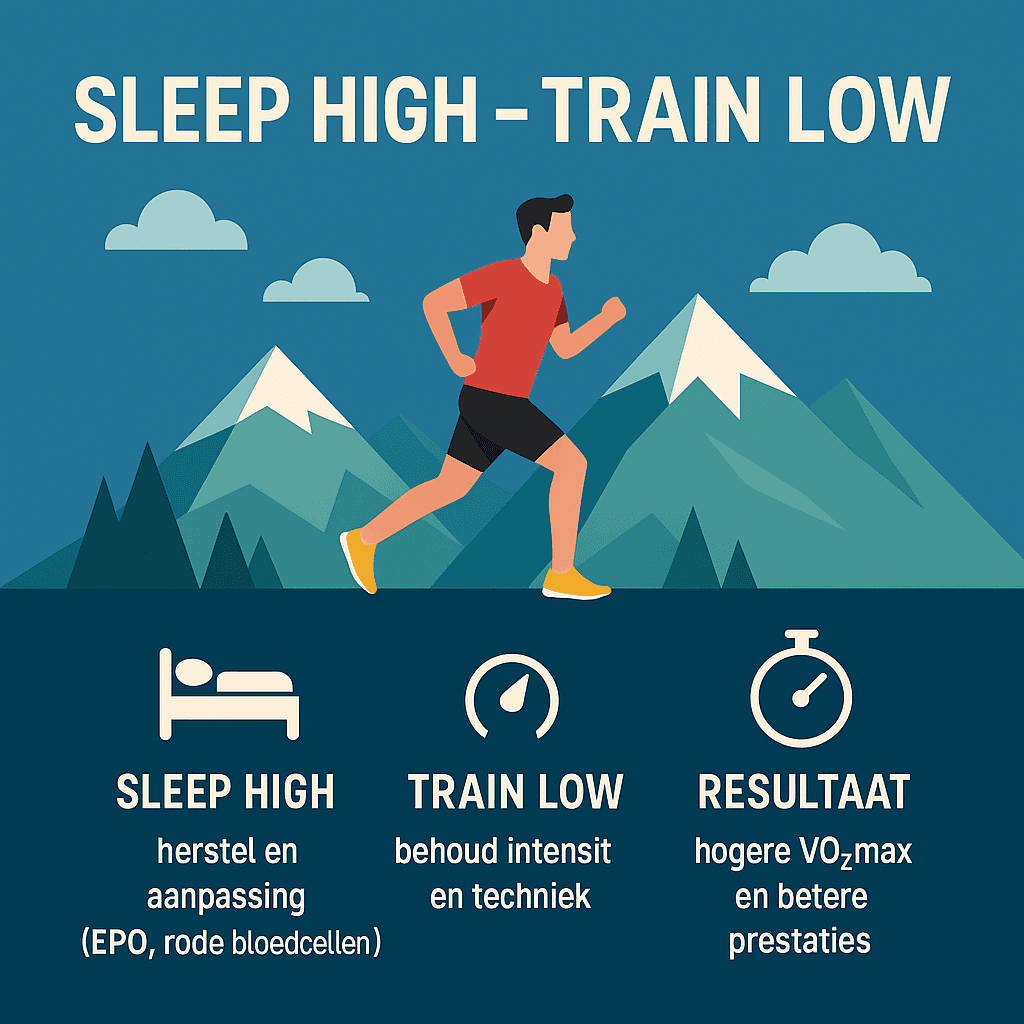
What exactly does ‘sleep high, train low’ mean?
The term refers to a training strategy in which athletes sleeping on high (or in a simulated altitude environment), but training at sea level. By doing so, they are trying to combine the best of both worlds: the physiological adaptations created by a lower oxygen supply during sleep, as well as the ability to do intensive workouts without losing performance due to oxygen deprivation.
The idea became popular in the 1990s after studies by the likes of Levine & Stray-Gundersen (1997), which showed that this combination gave significantly better results than living or training at altitude alone.
The physiological basis: what happens in your body?
When you regularly spend time in an environment with less oxygen (hypoxia), your body reacts in different ways:
- Increase in red blood cells: Increased production of EPO (erythropoietin) increases the oxygen transport capacity of your blood.
- Improved oxygen efficiency: cells learn to cope more efficiently with lower oxygen tension.
- Changes in breathing and heart rate: your ventilation and resting heart rate adjust, which has a beneficial effect on your endurance.
However, training at sea level remains essential as it allows you to keep working on speed, strength and technique at full intensity. This way, you build both a strong aerobic base and high anaerobic capacity.
What does the science say about effectiveness?
The results are convincing but not uniform - they depend heavily on duration, height and individual response. An overview of some key studies:
- Levine & Stray-Gundersen (1997): 26 elite athletes improved their VO₂max by an average of 5% after 4 weeks of ‘sleep high, train low’ (2,500m sleep, 1,250m train).
- Chapman et al (2014): identified ‘responders’ and ‘non-responders’. In particular, athletes with lower iron stores or shorter exposure showed less effect.
- Siebenmann et al (2015): confirmed that EPO increases are only temporary and that adequate iron intake is crucial for effective adaptation.
In summary, those who apply the right parameters - altitude, duration, recovery and nutrition - can achieve a marked performance improvement. Those who apply it haphazardly sometimes notice little difference.
Optimal height and duration
Most studies show that the best results are obtained at a height between 2,000 and 2,500 metres and an exposure of at least 200 to 300 hours in total. That usually means 3-4 weeks of sleeping in an altitude tent for 8-10 hours a night.
Going too high (>3,000 m) often results in more fatigue and poorer sleep quality, while going too low (<1,800 m) does not provide sufficient stimulus. At Altitude Dream we help athletes find exactly that optimal altitude, tailored to their training phase and goals.
Training intensity: why lowland remains crucial
Training at altitude sounds heroic, but it is not always effective. The lower oxygen levels reduce your power output and recovery time, which means you can provide fewer high-quality training stimuli. This is why elite athletes often choose to ‘train low’: they continue to train intensely at sea level or just a little higher (up to 1,000 m), where they can maintain their usual paces.
This combination of sleeping high and exercising low provides an optimal balance between adaptation and performance retention.
How do you apply ‘sleep high, train low’ with a high altitude tent?
Thanks to modern technology, you no longer have to travel to the Alps or Kenya to experience the benefits of altitude. With a altitude tent or Altitude Cubicle XL create the same conditions at home as at 2,000 to 3,000 metres altitude.
A standard protocol for endurance athletes often looks like this:
- Week 1: start at 1,800 m, 7-8 hours per night
- Week 2: increase to 2,200 m
- Week 3-4: sleep at 2,500 m
- Train daily at sea level or outside the tent for maximum training quality
You can perform this protocol prior to a race, a training block or in preparation for a mountain expedition. Note that your body needs time to acclimatise: so increase altitude gradually and listen for signals of fatigue.
Nutrition and iron status: often forgotten but essential
Altitude training is only effective if your body has sufficient building blocks has to make new red blood cells. Therefore, your iron status is crucial. Beforehand, have your ferritin level check and supplement this through food or supplements if necessary. Rich sources of iron include red meat, lentils, spinach and whole grain products.
In addition, vitamin B12 and folic acid a role in the production of red blood cells. A balanced diet with sufficient micronutrients significantly supports the effect of high-altitude training.
Common mistakes in ‘sleep high, train low’
- Starting too soon at too high an altitude, reducing sleep quality
- Forgetting to check ferritin levels or insufficient iron intake
- Too few hours in hypoxia per day (under 200 hours total has little effect)
- Insufficient recovery and overtraining combined with altitude exposure
Want to avoid this? Then seek advice from our specialists via the Altitude Dream contact page. We will help you create a personalised schedule.
Results in practice
At Altitude Dream, we work with top athletes and triathletes who use this method in preparation for marathons, Ironman races and mountain expeditions. They report on average:
- An increase in VO₂max between 3 and 7%
- Better heart rate recovery values
- Lower lactate levels at the same intensity
Even recreational runners often notice a tangible difference: training runs smoother and races at sea level feel ‘lighter’.
Conclusion: the power is in the combination
‘Sleep high, train low’ works - if applied correctly. Science shows that controlled exposure to altitude combined with quality lowland training leads to sustainable performance improvements. The key lies in consistency, sufficient exposure hours, good nutrition and individual tuning.
Want to know how to integrate this into your own training schedule? Book here an altitude tent or schedule a personal consultation with our team.


