
Using altitude tent: how many hours of sleep per night for effect
Published 2 February 2026 · 5 min read
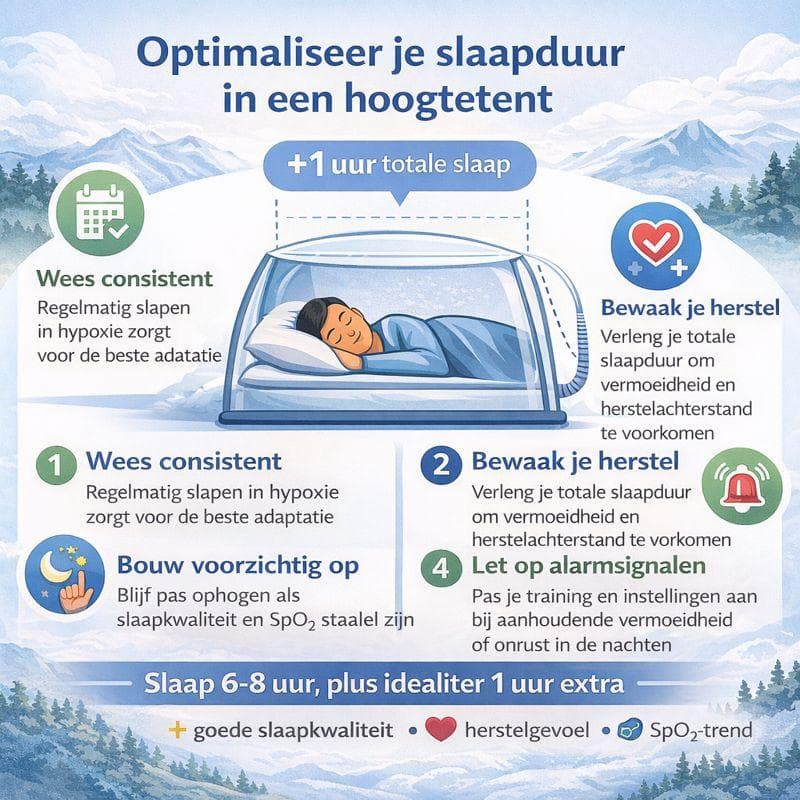
You use a altitude tent because you want effect: better prepared for altitude or stronger towards an important effort. But soon doubts arise. Am I sleeping enough hours for adaptation, or am I actually undermining my recovery? Within Altitude Dream, we always start from one starting point: you add hypoxia but protect your sleep. This article helps you understand how many hours a night works, and why one extra hour of sleep often makes all the difference.
The essentials in 30 seconds
Conclusion: The best effect usually occurs from 8 hours of sleep per night in the altitude tent, plus ideally 1 hour of extra total sleep.
Nuance: Hypoxia increases the recovery load, so your body often needs more sleep to stay rested.
Practical lead: Plan your nights so that, where possible, you sleep one hour longer than normal to support recovery and adaptation.
At the heart of the Altitude Dream vision: add incentive without losing recovery
An altitude tent is an additional physiological stimulus. That automatically means your recovery demand increases. Within Altitude Dream, we therefore look not only at how many hours you sleep in hypoxia, but also at how much total sleep your body gets to process that stimulus.
In practice, we see that users who maintain their normal sleep duration hit limits faster. Not because hypoxia doesn't work, but because the body simply needs more recovery time. Therefore, we apply as a starting point: sleep preferably one extra hour a night during a high-altitude period.
💡 Did you know? Many people feel “okay” after a few shorter nights, but unwittingly build up recovery deficits. An extra hour of sleep increases your buffer and makes the difference between adapting and forcing it.
Why sleep remains the primary stimulus
An altitude tent works via normobaric hypoxia: the oxygen percentage is reduced, not the air pressure. That lower oxygen availability activates breathing and adaptation mechanisms similar to natural acclimatisation. Sleeping is the time when this stimulus is most stable and offered without competition.
During the day, training, stress, nutrition and stimuli influence your physiology. At night, the body can fully focus on adaptation. This is precisely why sleep is the primary application, and not an afterthought. Those who combine it with sufficient total sleep time increase the chances of sustainable adaptation.
The underrated concept: hypoxic stimulus requires additional recovery
Hypoxia is not a neutral environment. It increases breathing work, affects the autonomic nervous system and can slightly disrupt sleep architecture, especially in the first few weeks. That means your body has to work harder to achieve the same level of recovery.
This is where a crucial insight arises: if you maintain your normal sleep duration, your restedness can drop even though you technically make “enough hours”. By scheduling one extra hour of sleep, you compensate for this increased load and keep your system in balance.
International Olympic Committee consensus statement on altitude training
How many hours a night in the altitude tent for effect?

For most users, an exposure of 6 to 8 hours per night in the altitude tent is most effective. This is consistent with a natural sleep cycle and provides sufficient continuous hypoxic stimulus.
But within the Altitude Dream approach, we look further. We distinguish between:
- Hours in the altitude tent: the hypoxic stimulus
- Total sleep duration: recovery capacity
Ideally, you combine 6 to 8 hours in the tent with a total of about one extra hour of sleep per night, for example by going to bed earlier or getting up later.
Why more hours of hypoxia are rarely the solution
When recovery lags, the reflex is often to do “more”: set higher or lie in the tent longer. In practice, this actually increases the problem. More hypoxia without extra sleep increases the stress load and increases the likelihood of worse nights.
It is more effective to keep the hypoxic stimulus stable and increase your recovery capacity. That is exactly where that extra sleep plays a key role.
⚠️ Reality check Your body does not adapt by restricting sleep. It adapts during sleep. Those who try to gain recovery by stimulating harder often actually lose adaptation.
What if you can't sleep an extra hour?
Not everyone can fit in an extra hour of sleep just like that. Work, family or early workouts sometimes make that impossible. In that case, prioritising becomes even more important.
If extra sleep is not feasible, it usually means:
- a more conservative height setting
- slower build-up
- steer tighter on sleep quality and sense of recovery
The goal remains the same: the stimulus must fit within what your body can process. Extra sleep is not an obligation, but it is a powerful lever if you can use it.
SpO₂, sleep and rest: deciding together
SpO₂ measurements provide insight into hypoxic load, but say nothing about how rested you wake up. That's why we always look at the overall picture: SpO₂ trends, sleep quality and subjective recovery.
Many experienced users find that their SpO₂ remains stable, but that their restfulness drops when they sleep too little. This is a signal not to go higher, but rather to create more space for recovery.
🧭 In practice Users who increase their total sleep duration often report more stable SpO₂ levels, fewer night wakings and a better sense of exercise during the day.
Decision moments: when to stay the course?
Continue
- you sleep peacefully and feel sufficiently rested during the day
- SpO₂ shows slight, stable fluctuations
- trainings remain controllable
Adjust
- you wake up structurally less rested
- you have trouble falling asleep or sleeping through
- fatigue piles up
Slow down or stop
- Persistent poor sleep despite adjustments
- distinct recovery gap
- symptoms not consistent with normal adaptation
Height tent as a guided aid
An altitude tent is not a replacement for acclimatisation, but a way to make the process controlled, measurable and planable. Within that approach, sleep is not a prerequisite, but the foundation.
Those who add hypoxia would be wise to add recovery as well. Often, one extra hour of sleep per night is the easiest and most underestimated adjustment you can make.
Summary reflection
The question of how many hours to sleep in an altitude tent cannot be separated from how rested you want to stay. Effective adaptation comes not from maximum stimulus, but from a clever balance. Six to eight hours of hypoxic sleep, combined with extra recovery time, turns out to be the key to progress without backlash for many people.
If you find yourself questioning your recovery, your sleep or your settings, it is not a sign that things are not working. Instead, it is the time to slow down, adjust and make room for guidance.
Find out how guidance and customisation help balance hypoxia and recovery
❓ Mini-FAQ Does everyone necessarily have to sleep an extra hour while using a high altitude tent? No. It is not a hard rule, but a practical starting point. Those who can build in extra sleep increase their recovery buffer and reduce the chances of relapse.
International Olympic Committee consensus statement on altitude training


