
The impact of altitude training on sleep quality
Published 30 July 2025 · 4 min read
Sleep is the foundation of physical and mental performance. During deep sleep, your body recovers, hormones are regulated and your cognitive resilience increases. Endurance athletes and high performers in particular can gain a lot by optimising their sleep.
Yet sleep is an often overlooked factor in training schedules. While nutrition and physical load are neatly monitored, sleep quality usually remains underexposed. Altitude training - or more specifically, sleeping in an altitude tent - can change this.
What happens to your body while sleeping at altitude?
When sleeping in an altitude tent, you simulate staying at an altitude between 2,000 and 3,000 metres. The air contains less oxygen, causing mild, controlled hypoxia. This situation activates several adaptation mechanisms:
- Increased EPO production (for more red blood cells)
- Improved mitochondrial function
- Increased production of growth hormone (GH)
- Increased melatonin sensitivity
These reactions make the body more efficient in recovery, oxygen transport and hormonal balance - exactly the processes that are also essential for deep, restorative sleep.
Can sleeping at altitude actually improve your sleep?
It sounds paradoxical: sleeping in air with less oxygen would improve your sleep quality? Yet several studies and user experiences point in that direction. Important though: the effects depend heavily on the way you deploy altitude training.
Positive effects when used properly:
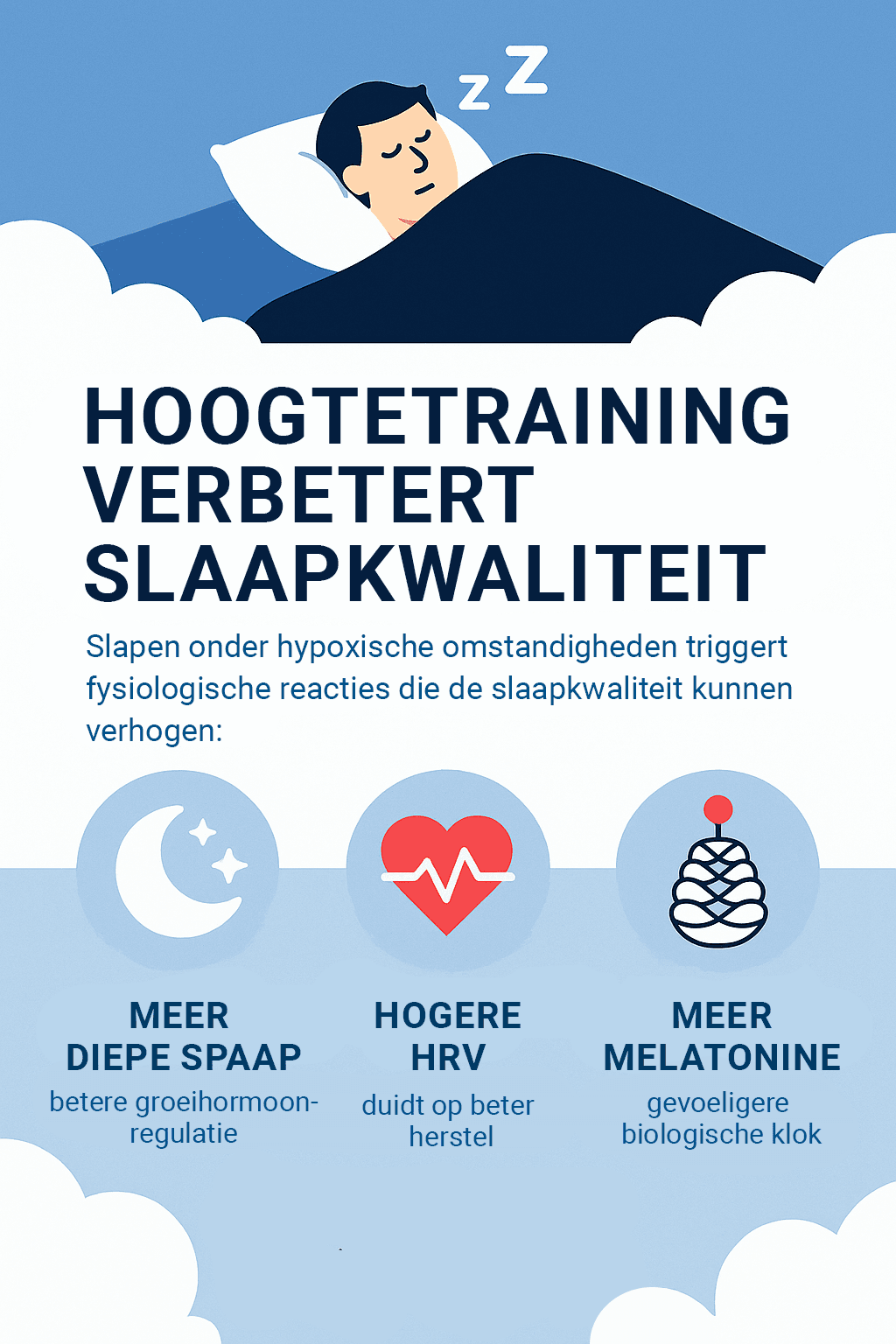
- More deep sleep: Due to enhanced growth hormone regulation, the body experiences longer slow-wave sleep (SWS).
- Higher HRV (Heart Rate Variability): Users report an increase in HRV after 7-10 days, indicating better recovery.
- Lower resting heart rate: A sign of adaptation and more efficient recovery at night.
Conditions for positive impact:
- Build up the altitude slowly (start around 2,000m)
- Use at least 6-8 hours per night
- Combine with good sleep routine (dark room, no screens, set bedtime)
Risks of misuse: temporarily worse sleep
In the first nights, the adjustment to lower oxygen saturation can lead to:
- Lighter sleep phases (REM dominance)
- Waking up at night
- Restless breathing or increased heart rate
These side effects are temporary and disappear with correct accrual. Most users sleep deeper and more consistently after 4-5 days than before.
???? Tip: Measure your sleep with an Oura Ring, Whoop or Garmin to track evolution objectively.
What does science say?
A 2016 study published in the journal Frontiers in Physiology examined sleep cycles at different altitudes. The conclusion? Individuals accustomed to sleeping at altitude exhibited:
- More slow-wave sleep (SWS)
- Higher GH production during the first few hours
- Shorter sleep time after adaptation
"Pre-sleep exposure to normobaric hypoxia improved objective sleep parameters in healthy males after a 7-day adaptation period."
Source: Front Physiol. 2016; 7: 548. doi:10.3389/fphys.2016.00548
Altitude training for biohackers and poor sleepers
Not only athletes, but also people with chronic sleep problems are discovering the power of hypoxia:
- Impaired melatonin production: Sleeping at altitude regulates the biological clock.
- Low sleep pressure: The stimulus of hypoxia increases the need for deep sleep.
- Sleep apnoea: Applied cautiously (with guidance), controlled hypoxia can train sleep apnoea structures.
Note: always consult a doctor in case of medical sleep disorders.
Frequently asked questions
1. How long should I sleep at altitude for effect?
A cycle of 2 to 4 weeks gives the best results. You often notice first effects as early as day 5.
2. What if I sleep worse in the beginning?
This is normal. Temporarily lower the altitude by 200-300 metres and build up more slowly.
3. Can I combine this with training?
Yes. Train preferably during the day at sea level or lower altitude. Use the tent at night.
4. Which tent is most suitable?
At Altitude Dream, we are happy to advise you personally. Choose between 1-person, 2-person or XL tent models, depending on your situation.
Practical tips for better sleep with altitude training
- Use the tent in a dark, cool room (16-18°C)
- Ensure good ventilation of the generator compartment
- Start with 2,000m and increase by up to 300m every 3 days
- Do not consume alcohol or heavy meals just before sleeping
- Combine with breathing exercises such as box breathing or 4-7-8
AltitudeDream high altitude tents: comfort and guidance
Our systems are designed for optimal sleeping comfort and quiet operation. You get with your installation:
- Personal intake with sleep and altitude schedule
- Choice of different tent sizes
- Quiet generators and long hose configuration
✅ Book your altitude tent or ask personal advice to.
Conclusion
Altitude tents are more than a sports gadget, they are a powerful tool to optimise your sleep, recovery and hormonal balance. If you sleep better, you perform better, both on the pitch and in life.
Want to find out if sleeping at altitude improves your sleep quality?
???? Book a free consultation now or try a rental tent via Altitude Dream.


