
Why more and more triathletes are opting for altitude training at home
Published 14 July 2025 · 3 min read
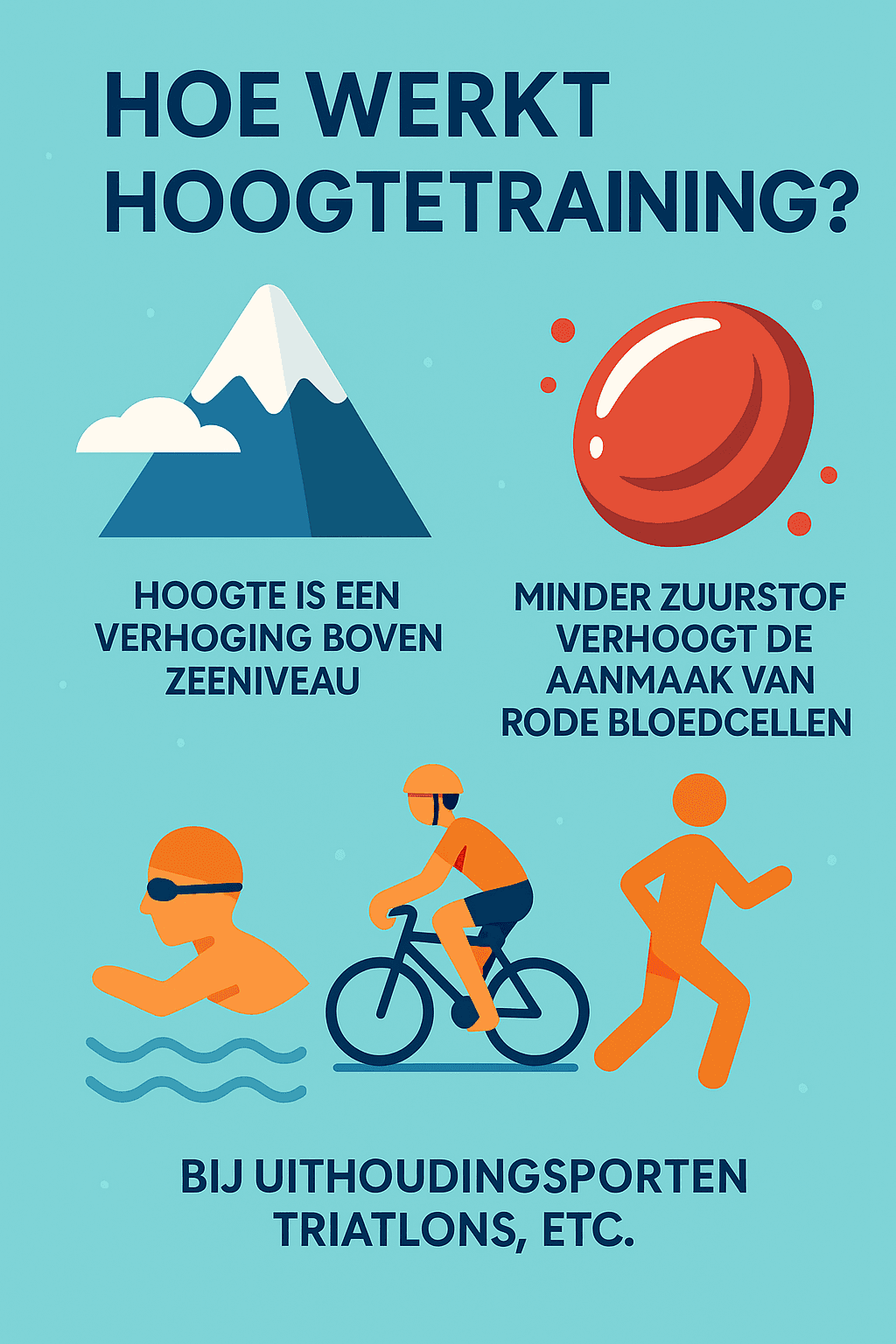
The new standard in triathlon preparation
More and more triathletes - from age groupers to professionals - are sleeping in an altitude tent at home. Why? Because it works. Altitude training increases your EPO production, stimulates red blood cell production and improves your VO2 max. That means: more oxygen, more power, better performance. And all without flipping your training schedule or work plan.
With an altitude tent or altitude chamber, you simply bring the mountains to your bedroom.
What exactly does altitude training do?
Altitude training simulates the conditions of high altitude (2,000-3,500 metres) by lowering the oxygen content in the air you breathe. As a result:
- Increases your natural EPO production
- Does your blood become richer in red blood cells
- Improves your oxygen uptake and VO2 max
- Restores your body more efficiently between workouts
These physiological adaptations are golden in a sport like triathlon, where endurance is everything.
Why do triathletes choose an altitude tent?
???? Applicable at home
No expensive internships or weeks away from home. You just sleep in your own bed.
⏱️ Time-saving
You train during the day, sleep at altitude at night. No impact on family, work or schedule.
???? Measurable result
After 2-3 weeks, many triathletes see a drop in their resting heart rate, higher threshold power and faster recovery.
???? Focused peaking
Plan your altitude training exactly leading up to an A-race (e.g. Ironman or 70.3).
How long and how high should you sleep?
A typical protocol for triathletes looks as follows:
- Height: start at 2,000 m, build up to max 3,000-3,200 m
- Duration: 3 to 5 weeks, 8 hours per night
- Timing: ideally 7 to 10 days before your peak competition
Periodisation: when do you use altitude tents in your season?
For triathletes, it is important to fit your altitude training into your training year. These are ideal times:
- ✅ During a base or build period (low volume or low intensity)
- ✅ In combination with taper towards an A-race
Use altitude training as a strategic tool, not a permanent intervention. Your body also needs periods without hypoxia for recovery.
Mental benefits of sleeping at altitude
Although often approached physically, many triathletes also report mental benefits:
- ???? More focus: sleeping in a structured protocol creates discipline
- ???? More conscious recovery: you are forced to watch your sleep and recovery time
- ???? Mental benefit: knowing you are applying a performance-enhancing intervention gives self-confidence
Common mistakes in altitude training
- Building up too fast: increase altitude gradually. Start at 2,000 m, not 3,500 m.
- Ignoring poor sleep: sleep quality always takes precedence over height.
- Sleeping high and training hard: this leads to overexertion. Keep your workouts controlled.
- Not taking measurements: Use a saturation gauge and keep a log.
Case: Tim - age grouper Ironman Frankfurt
"After four weeks of sleeping at altitude, I felt stronger than ever. My recovery after heavy cycling blocks was much faster. My resting heart rate went from 44 to 38 bpm. In Frankfurt, I finished over 12 minutes faster than the year before."
Scientifically based
Several studies show that 'Live High - Train Low' is effective for endurance athletes. Even without additional training, sleeping at altitude produces performance improvements. The key? Consistency and smart timing.
???? Also check out this study: Sleeping at altitude improves endurance performance
The AltitudeDream approach for triathletes
We guide many triathletes every year in their preparation for Ironman, half triathlon and sprint races. Our approach:
- Personal advice
- Guidance on height building
- Coaching on combination with training
- Flexible rent or buy formulas
✅ Book your altitude tent or take contact us for tailored advice.
FAQ - Altitude training for triathletes
1. Can I keep swimming during altitude training?
Yes, but keep the intensity low. Prefer not to combine interval training with new altitude building.
2. Does this also work for short-distance triathlons?
Yes. Even in sprint and Olympic distances, every % performance improvement counts.
3. Is it suitable for women?
Absolutely. Do pay extra attention to iron status. If necessary, have ferritin checked before you start.
4. Can I do this as a recreational triathlete?
Yes, definitely. Especially if you work purposefully towards a peak moment and take your performance seriously.


