
Altitude training for athletes: complete guide
Published 14 January 2026 · 4 min read
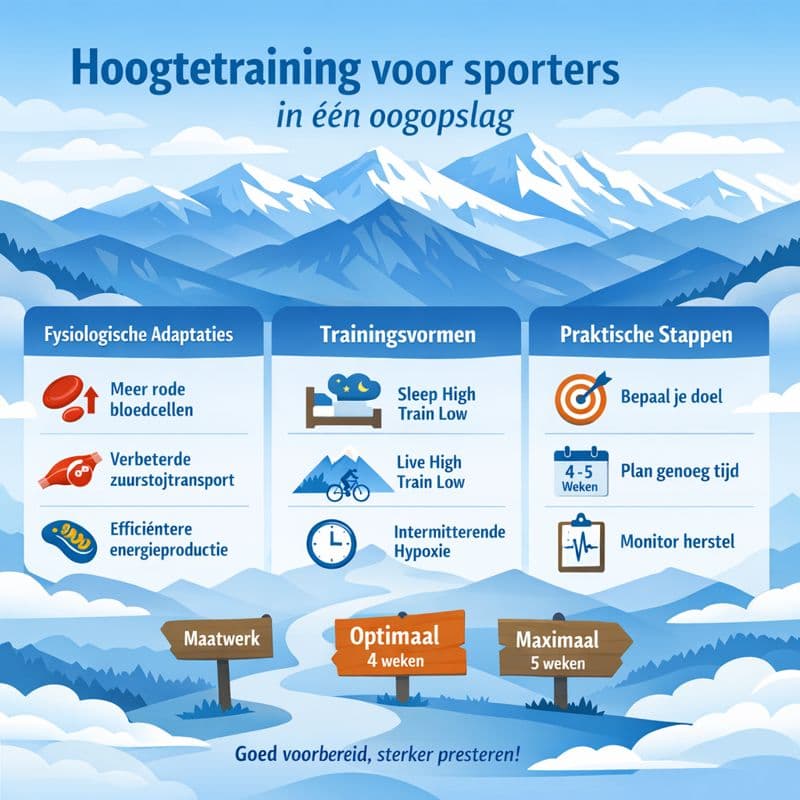
Altitude training for athletes is increasingly used to improve sports performance. Not only by professional athletes, but also by avid amateurs who want to train smarter. The key question is simple: how can controlled exposure to less oxygen contribute to better performance at sea level, and for whom does it make sense? This complete guide tells you what altitude training does physiologically, how to apply it practically, where the pitfalls are and when guidance is wise. The goal is clear: train better prepared, with realistic expectations and informed choices.
What is altitude training and why does it suit sports performance?
Altitude training is a collective term for forms of training in which the body is temporarily exposed to lower oxygen availability than at sea level. This can take place in the mountains, but also controlled at home via normobaric hypoxia (e.g. altitude tent). For athletes, it is not about altitude per se, but about the adjustments the body makes to use oxygen more efficiently.
For endurance athletes such as runners, cyclists and triathletes, it can lead to improved aerobic capacity, better oxygen uptake and a more efficient energy system. Team athletes and martial artists are also increasingly using altitude training as part of their conditioning preparation.
The physiology behind altitude training explained
What happens in the body when there is less oxygen?
When exposed to hypoxia, the oxygen pressure in the inhaled air drops. The body responds through several mechanisms:
- Stimulation of erythropoietin (EPO), which supports red blood cell production.
- Enhanced oxygen delivery in muscles through modifications in haemoglobin and capillaries.
- More efficient use of mitochondria, the power plants of the muscle cell.
These adaptations take time. Therefore, altitude training only works when the stimulus is applied for a sufficiently strong but also sufficiently long time.
Why timing and dosing are crucial
Too little hypoxic stimulus produces no effect, while too much stimulus can lead to fatigue, poorer recovery and performance loss. This explains why altitude training is not a standard recipe, but requires customisation.
Different forms of altitude training for athletes
Live High Train Low (LHTL)
In this classical approach, an athlete stays at altitude, while intensive training takes place at lower altitudes. This combines physiological adaptation while maintaining training quality.
Live Low Sleep High (LLSH)
More and more athletes are choosing to sleep in hypoxic conditions while training at sea level during the day. This makes altitude training accessible without long stays in the mountains.
Intermittent hypoxia
Short-term exposure to hypoxia, e.g. during rest or light exercise. This is sometimes used as an additional stimulus, but is less powerful as a stand-alone strategy.
For which athletes does altitude training make sense?
Altitude training is especially relevant for athletes where the aerobic system is a limiting factor. Think of:
- Runners from 5 km up to marathon and ultra distances.
- Cyclists and mountain bikers.
- Triathletes and duathletes.
- Team athletes in intense competitions with short recovery times.
For explosive strength sports, the effect is limited and often outweighs the load.
Practical steps: this is how to apply altitude training smartly
Step 1: define your goal
Is your goal a peak performance at sea level, or preparation for a race at altitude? This will determine the strategy and duration.
Step 2: choose the right shape
For most athletes, LLSH is practical and combines well with regular training. Here, the set height of the altitude generator is determined individually and built up stepwise based on the measured oxygen saturation (SpO₂).
Step 3: plan sufficient time
An effective period for altitude training is a minimum of 4 weeks and a maximum of 6 weeks. Shorter is usually insufficient for stable adaptation.
Step 4: monitor recovery and load
Monitor sleep quality, resting heart rate and subjective fatigue. Altitude training should never structurally compromise recovery.
Common mistakes and pitfalls
- Increasing the simulated height too quickly.
- Combine with too high training intensity.
- Insufficient attention to nutrition and iron status.
- Expectation that altitude training always and with everyone works.
These mistakes often lead to disappointing results or even performance loss.
Scientific nuance: what altitude training does and does not do
Research shows that altitude training produces marked performance improvements in some athletes, while others hardly respond at all. Genetic factors, iron availability and training history play a role in this. Altitude training is therefore not a guarantee, but an opportunity multiplier when applied correctly.
Advice and logical next step
For those serious about preparing for better sports performance, altitude training can be a valuable addition within a well-thought-out training plan. More and more athletes choose to do this guided and controlled, so that load and effect are well matched.
Practical packages for athletes
- Customisation: number of weeks of your choice.
- Optimal: 4 weeks of altitude training.
- Maximum: 5 weeks of altitude training.
More information on counselling and options for different sports can be found via the package overview for athletes:
View sports packages.
Experiences of other athletes
Athletes who have previously worked with altitude training share their experiences in the reviews for various sports. These real-life stories provide additional insight into how altitude training is applied in different disciplines.
Resume
Altitude training for athletes can contribute to better performance when it is targeted, sufficiently long and individually tailored. It requires knowledge of physiology, attention to recovery and realistic expectations. As part of a broader training and recovery plan, it can be a meaningful step towards sustainable performance improvement.


