From what altitude do you get altitude sickness?
Published 6 April 2026 · 9 min read
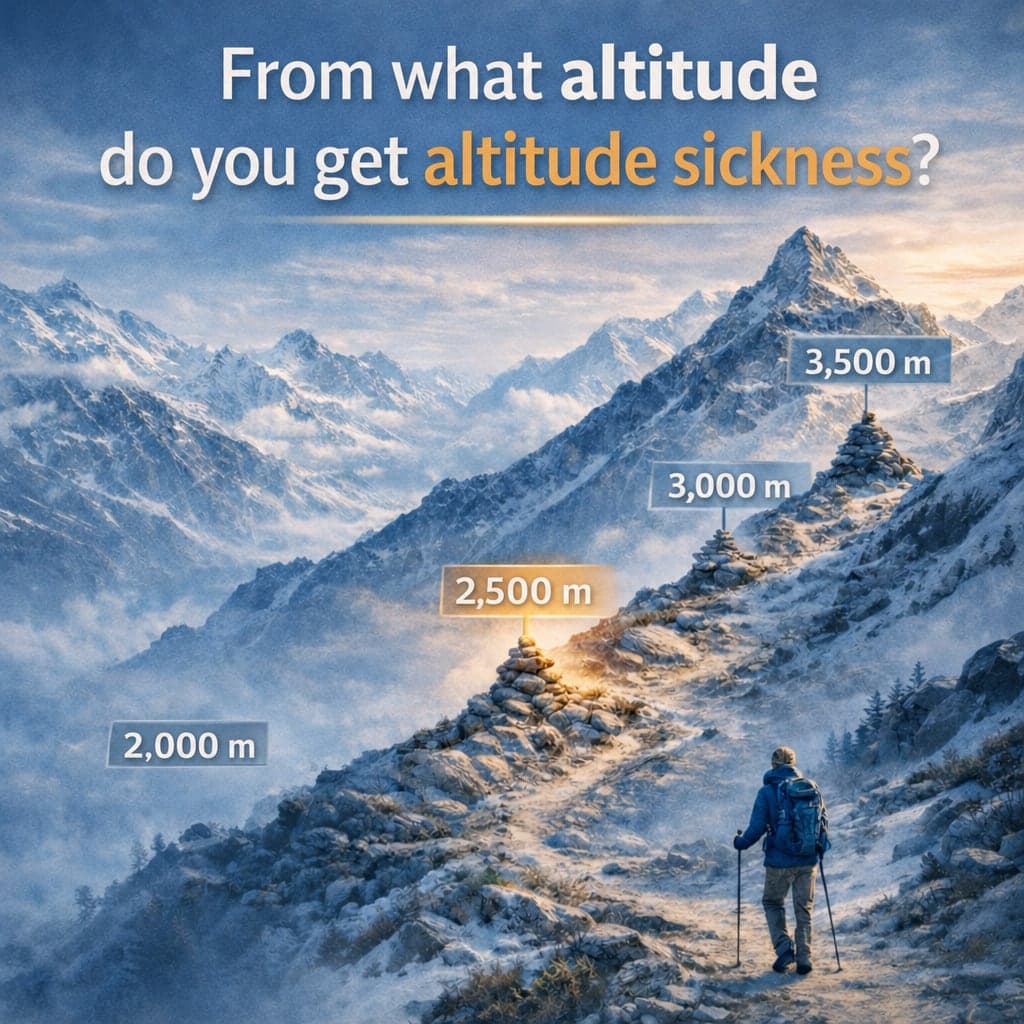
Short answer: altitude sickness usually develops from around 2,500 metres. The risk increases markedly from 3,000 metres, especially if you climb fast or sleep high. The higher you spend the night, the more seriously you should take this.
Conclusion: from around 2,500 metres, altitude sickness can really start.
Nuance: not everyone reacts the same way at the same altitude, and rapid ascent makes the risk much greater.
Practical hook: always look at your sleeping height and not just the highest peak or pass you touch during the day.
From what altitude do you really get altitude sickness?
In practice, the main threshold is around 2,500 metres. From that point onwards, you see that the body clearly starts to struggle more with the lower oxygen pressure. This does not mean that you are safe at 2,499 metres and suddenly get sick at 2,501 metres. It doesn't work that way. Altitude sickness is not an on-off switch, but an increasing risk. Those who want to know more about the basics of altitude sickness, soon notices that the same height is problem-free for one person and not for another.
The rule of thumb is serviceable though: below 2,000 metres altitude sickness is rare, between 2,000 and 2,500 metres it can already occur in susceptible people or after rapid ascent, and from 2,500 metres onwards you really have to reckon with symptoms. Above 3,000 metres, sensible acclimatisation becomes important. Above 3,500 metres, it becomes noticeably more difficult for many people without proper acclimatisation.
| Height | What does this mean in practice? | Risk of altitude sickness | What is sensible? |
|---|---|---|---|
| Up to 2,000 metres | No real problem area for most people yet | Low | Normal travel or walking is usually fine |
| 2,000 - 2,500 metres | Sensitive people may already feel headaches, restless sleep or fatigue | Low to moderate | Calm down, hydrate well, don't force anything |
| 2,500 - 3,000 metres | This is the first real risk limit for acute altitude sickness | Clearly present | Pay attention to complaints and avoid rising too fast |
| 3,000 - 3,500 metres | Many people notice complaints here without build-up | Moderate to high | Limit your sleep rise and plan an acclimatisation day |
| Above 3,500 metres | The likelihood of serious problems increases further, especially in haste | High | Tight construction, monitoring and, in case of complaints, do not continue to rise |
Up to 2,000 metres
Practice: usually no real problem area yet.
Risk: low.
Opinion: normal travel or walking is usually fine.
2,000 - 2,500 metres
Practice: Sensitive people may already have headaches or worse sleep.
Risk: low to moderate.
Opinion: come slowly and don't force anything.
2,500 - 3,000 metres
Practice: first real risk limit for altitude sickness.
Risk: clearly present.
Opinion: pay attention to complaints and don't climb too fast.
3,000 - 3,500 metres
Practice: many people notice complaints here without build-up.
Risk: moderate to high.
Opinion: Limit your sleep rise and plan rest.
Above 3,500 metres
Practice: serious problems become more likely in a hurry.
Risk: high.
Opinion: tightly acclimatised and in case of complaints not through.
Why don't you get altitude sickness at the same altitude?
Height itself is only part of the story. Equally important is why altitude sickness occurs. Your body reacts to lower oxygen pressure. How fast that stimulus comes determines a lot. If you sleep from sea level to 3,400 metres in one day, your body barely gets time to adjust. If you sleep lower for a few nights first, then exactly the same final altitude can go much better.
This is why you often see big differences within one group. The fittest hiker is not automatically the one who can best withstand altitude. Age, previous experience, sensitivity, sleep quality, illness, alcohol, dehydration and heavy exertion in the first days also play a role. So altitude sickness does not say a person is weak. It mainly says that adaptation to hypoxia was not fast enough.
⚠️ Reality check
Good fitness does not reliably protect you from altitude sickness. In fact, many sporty people make the mistake of ascending too fast because they still feel strong on day one. Physical fitness and acclimatisation are not the same thing.
Height
The higher you sleep, the greater the hypoxic stimulus. Especially from 2,500 metres, every extra step counts more heavily.
Rise rate
Rising too fast often increases the risk more than people think. Speed is often the deciding factor.
Sleeping height
Day trips uphill are usually more tolerable than high overnight. Your sleeping height is therefore crucial.
From what altitude do you get altitude sickness if you climb fast?
With rapid ascent, the risk actually shifts downwards. Someone who arrives at altitude quickly by car, gondola or flight and sleeps there immediately can develop symptoms as early as between 2,000 and 2,500 metres. This is seen, for example, at ski resorts, mountain villages, Cusco-like arrival locations or treks where the first night's stay is immediately high.
Therefore, a summit achieved during the day is not the same as an overnight stay. Just visiting a mountain pass at 3,200 metres and then sinking back to 2,100 metres is different from sleeping at 3,200 metres. Your body gets less long-term stress then.
🧭 In practice
So the question is not just: how high are you going? The better question is: at what altitude will you sleep tonight, how many metres higher is that than yesterday, and how will you feel tomorrow morning? Exactly there is the difference between travelling smart and provoking trouble.
What complaints belong to the first stage?
The first form of altitude sickness is usually acute mountain sickness, or AMS for short. It often starts with a headache. To this are then added one or more of these signs: nausea, decreased appetite, dizziness, fatigue, a heavy feeling in the body and poor sleep. This combination is especially important. A single bad night at altitude is not yet altitude sickness. Headache plus nausea and lethargy much more often is.
An additional pitfall is that mild symptoms are easily underestimated. People often think: I'm just tired from the trip, I didn't drink enough, or I need some time to recover. Sometimes this is true. But at altitude, you should always look at complaints in context. Especially if you want to ascend higher.
Checklist: signals to take seriously
- Headache that only started at altitude
- Nausea or low appetite
- Noticeable fatigue on mild exertion
- Twisting or light feeling in the head
- Poor sleep in combination with other complaints
- A distinctly worse feeling after rising further
When does it become dangerous?
Mild altitude sickness is annoying but often reversible with rest. The danger begins when symptoms worsen and you continue to climb anyway. Then altitude sickness can turn into serious forms such as pulmonary oedema or cerebral oedema. These are not symptoms you wait a night for. That's when you have to act.
Alarm signs are shortness of breath at rest, a persistent cough, wheezing or bubbling in the chest, difficulty walking straight, confusion, odd drowsiness or a severely worsening headache. In such cases, the rule is simple: do not ascend further, preferably descend immediately and seek medical attention. Altitude sickness is then no longer about comfort, but about safety.
Further rise though
Only if you have no complaints, slept well and your recovery feels normal.
Do not rise further
In case of headache with nausea, noticeable fatigue or marked deterioration after arrival at altitude.
Direct drop
In case of shortness of breath at rest, confusion, balance problems or rapidly increasing symptoms.
Here's how to avoid problems above 2,500 metres
The most important advice is boring but effective: don't go too fast. Most problems arise because people let logistics, enthusiasm or peer pressure drive their schedule. Not by what their bodies can handle. Eating sufficiently, drinking, starting slowly and limiting heavy exertion in the first few days also helps. Those who want to better understand altitude and oxygen can look into oxygen saturation at altitude, but remember that figures should always be read in context.
Protocol block: safe assembly when travelling above 2,500 metres
- Preferably arrive at a moderate altitude for 2-3 nights before sleeping higher.
- From around 3,000 metres, keep your sleep rise limited.
- Plan a rest or acclimatisation day for every extra serious ascent.
- If you have mild symptoms, stay at the same height until they improve markedly.
- If the symptoms get worse, do not ascend further and descend if necessary.
For those preparing for a trek, expedition or fast mountain journey, acclimatising in advance at home can give extra margin. It does not replace real acclimatisation, but it can make the process more controlled, measurable and plannable.
How to monitor this objectively
A good assessment at altitude is never based on one feeling or one measurement. Always look at the combination of symptoms, recovery and trend.
- SpO2 trend: look at the trend over several mornings, not one single measurement. A downward trend combined with more complaints is more relevant than a single number.
- Sleep quality: Were you constantly waking up, feeling stuffy or just having a remarkably restless night?
- Recovery: do you feel better after breakfast and gentle exercise, or do you remain languid and nauseous?
- Symptoms: If headaches increase, your appetite decreases or you become more dizzy, then that is more important than continuing tough.
A useful decision rule is this: if your symptoms are markedly worse today than yesterday, your body was not ready for another ascent. If you feel better after a rest day at the same altitude, then you are often on a safer track again.
Common misunderstandings
1. I am sporty, so I must be less at risk
Not necessarily. Good fitness does not make you immune to altitude sickness.
2. I was at 3,500 metres during the day and felt nothing, so sleeping at 3,500 metres is also possible
It doesn't have to be at all. High sleep stresses your body much longer than a short passage during the day.
3. Only extreme expeditions give altitude sickness
Regular mountain holidays, ski resorts and popular treks can also cause problems if you go up too fast.
4. Sleeping badly is always harmless
Not if it is accompanied by headaches, nausea and obvious fatigue.
Want to reduce the risk of altitude sickness smarter?
Then read our complete guide on prevention, build-up and key decision rules before heading to the mountains.
Conclusion
From what altitude do you get altitude sickness? For most people, the risk starts around 2,500 metres. Yet that is not an absolute limit. Your personal sensitivity, your sleep altitude and especially your rate of ascent determine whether you really get symptoms. Therefore, think of 2,500 metres as the point at which you should become alert, and 3,000 metres as the point at which smart acclimatisation becomes seriously important.
The best approach is simple: look not only at your summit goal, but at how you get there. Those who build up slowly, monitor objectively and don't stubbornly carry on in case of symptoms, significantly reduce the risk of altitude sickness.
FAQ
Can you get altitude sickness as early as 2,000 metres?
Yes, it is possible, but it is less common. It occurs mostly in sensitive people or after rapid rise and high sleep elevation.
Is 2,500 metres always the limit?
No. It is the main rule of thumb, not a hard medical cut. Some people develop symptoms earlier, others later.
Which weighs more heavily: top height or sleeping height?
Sleeping height. Staying at altitude for a long time, especially during the night, puts more strain on your body than getting high for a short time during the day.
How do I know if I should descend?
With worsening headaches, nausea, obvious exhaustion, shortness of breath at rest or problems with balance and clear thinking, do not continue ascending and often descend immediately.
Does an altitude tent help against altitude sickness?
An altitude tent is no substitute for real acclimatisation on the mountain, but it can support preparation in a controlled, measurable and planable way, giving extra margin.