Making artificial air: how does a height generator work at home?
Published 19 September 2012 · 13 min read
To lighten the mood Altitude Dream does not mean that we lower the air pressure in your bedroom. We controllably lower the oxygen percentage in the air going to the altitude tent or altitude chamber. This creates a stimulus comparable to altitude, while you simply stay at home sleeping or training.
This principle is called normobaric hypoxia. The air pressure remains the same, but the amount of oxygen in the inhaled air decreases. This is precisely why an altitude generator is of interest to athletes, mountaineers, and expedition participants who want to prepare measurably for less oxygen.
Short answer: A height generator creates thin air by separating some of the oxygen from normal room air. The remaining air contains relatively more nitrogen and less oxygen. This low-oxygen air is channelled into a altitude tent, sleeping environment, or training room. The air pressure remains normal, but your body experiences a controlled hypoxic stimulus.
Conclusion: Generating lower air pressure at home happens via a reduced oxygen percentage, not via lower air pressure.
Nuance: It feels physiologically similar to altitude, but it's not an exact copy of a mountain environment.
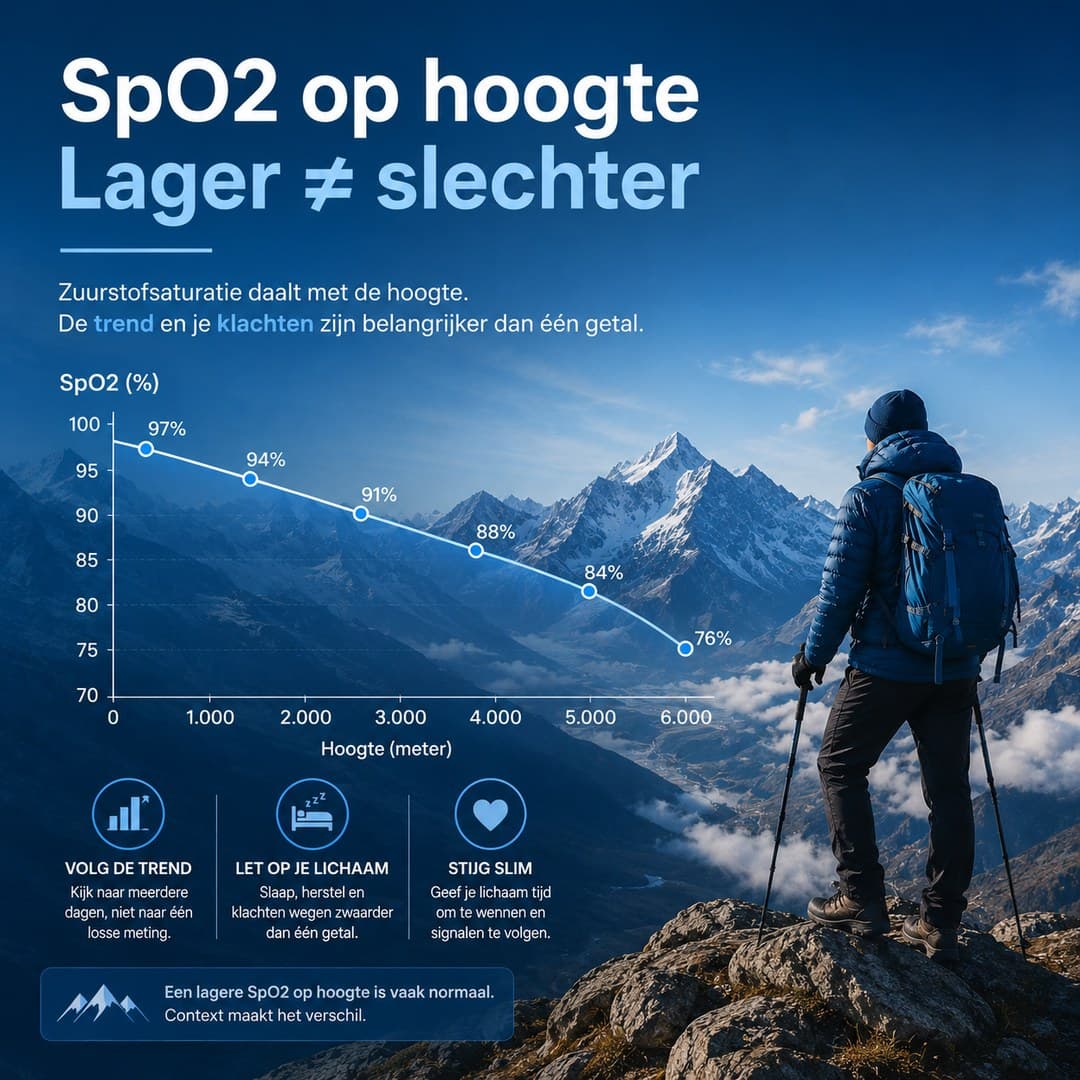
Practical hook: The correct setting is not determined by feeling, but through progress, SpO2 trend, sleep quality and complaints.
We maken ijle lucht wanneer we iets doen dat heel onwaarschijnlijk is.
In the mountains, the environment changes by itself. As you ascend, the air pressure drops. Consequently, each breath contains less available oxygen. The percentage of oxygen in the outside air remains roughly the same, but the pressure at which oxygen becomes available to your lungs decreases.
At home, we simply can't replicate that lower atmospheric pressure in a normal bedroom. That's why an altitude generator works differently. The system lowers the oxygen percentage in the airflow. So you breathe in air with less oxygen than normal room air. This creates a comparable stimulus for respiration, oxygen transport and acclimatisation.
To understand how this fits into a broader altitude training, must particularly know this distinction: real altitude lowers air pressure, while normobaric hypoxia lowers the oxygen percentage at normal air pressure.
💡 Did you know? The air at sea level contains approximately 20.9 per cent oxygen. In a height tent, that percentage is reduced. This simulates the oxygen availability for your body at a certain altitude, without the room itself being put under low pressure.
How does an altimeter make thin air?
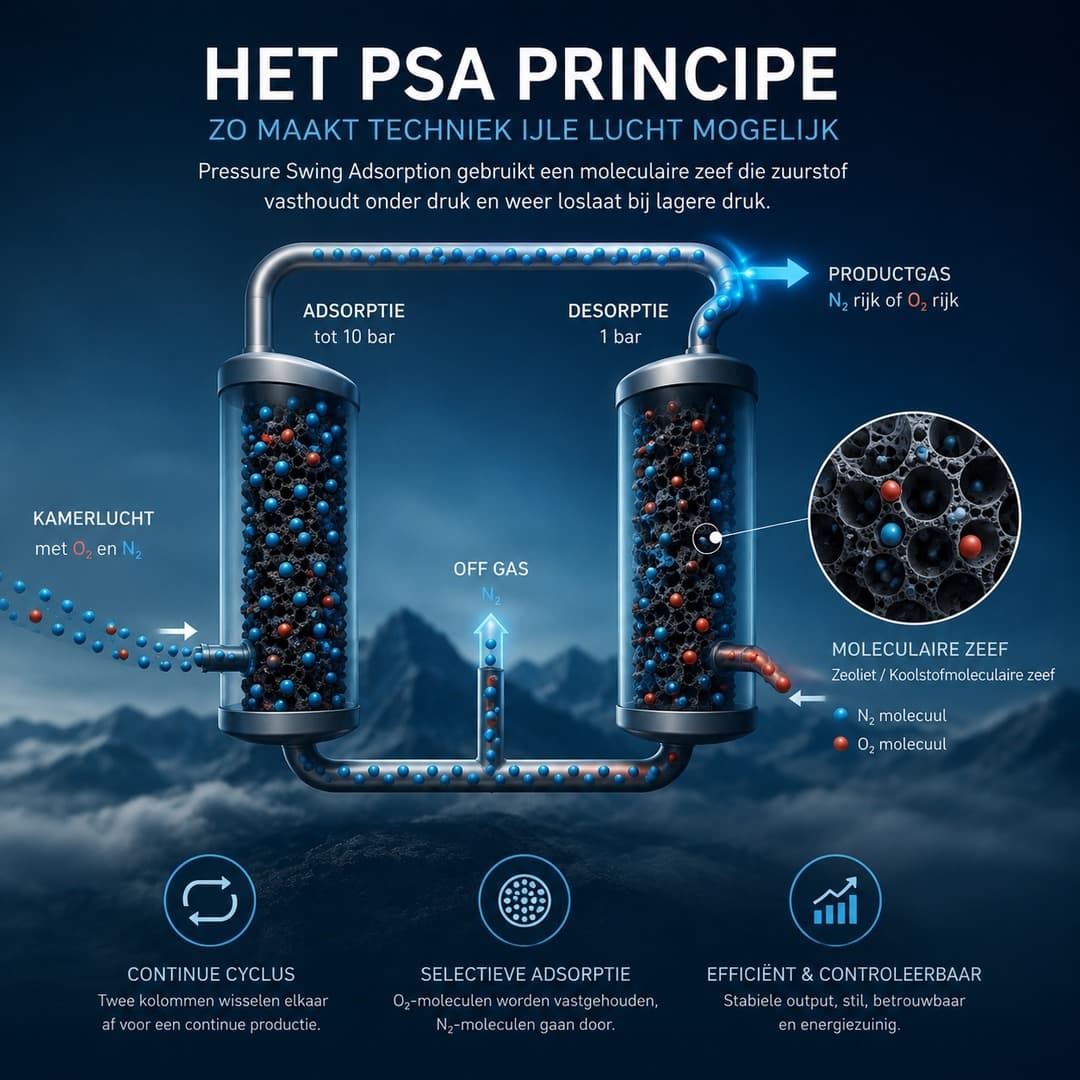
A height generator draws in normal room air. This air consists mainly of nitrogen and oxygen. The system then separates some of the oxygen from the airflow. Consequently, the air directed towards the tent or room contains less oxygen and relatively more nitrogen.
The technique behind this process is similar to pressure swing adsorption, which is a method of separating molecules based on their properties. In practical terms, the generator doesn't literally draw “mountain air” inside, but rather makes ordinary air less oxygen-rich.
The generator then blows this hypoxic air via a hose to the altitude tent, Dream Cap, sleep environment or training setup. The user then breathes in a mixture that matches the set simulated altitude.
What is changing then?
The oxygen percentage in inhaled air decreases. This means your body has to manage oxygen more efficiently. Your breathing may increase slightly, your heart rate may change, and your oxygen saturation usually drops slightly during the night.
What doesn't change?
The air pressure in your home remains the same. So, your bedroom won't become a pressure chamber. Temperature, wind, cold, UV radiation, dehydration, and exertion at altitude are also not automatically simulated. Therefore, it remains important to place altitude training at home correctly: as controlled preparation, not as a complete replacement for the mountain.
False air versus real height
The question is not whether a hypobaric chamber is “exactly the same” as sleeping at 3,000 metres in the Alps. That's too simplistic. The better question is: which stimulus do you want to artificially replicate in a controlled manner?
For pre-acclimatisation and altitude training, it's mainly about oxygen availability. Normobaric hypoxia can be very useful for this. You can gradually get used to less oxygen at home, without the burden of travel, cold nights, or logistical stress.
| Situation | What will change? | Practical significance |
|---|---|---|
| Real height | Air pressure is falling. Oxygen pressure is falling too. | You get less oxygen per breath, and you also experience cold, dryness, travel fatigue, and exertion. |
| Altitude tent | Oxygen percentage is decreasing. Air pressure remains the same. | You receive a controlled hypoxic stimulus during sleep or rest. |
| Altitude chamber | Oxygen percentage drops in a larger space. | Suitable for sleeping, resting, or light training in a controlled environment. |
| IHT | Oxygen percentage briefly drops via mask or module. | Specific stimulus in sessions, usually alongside normal training or acclimatisation. |
What will change? Air pressure is falling. Oxygen pressure is falling too.
Practical significance: You get less oxygen per breath, and you also experience cold, dryness, travel fatigue, and exertion.
What will change? Oxygen percentage is decreasing. Air pressure remains the same.
Practical significance: You receive a controlled hypoxic stimulus during sleep or rest.
What will change? Oxygen percentage drops in a larger space.
Practical significance: Suitable for sleeping, resting, or light training in a controlled environment.
What will change? Oxygen percentage briefly drops via mask or module.
Practical significance: Specific stimulus in sessions, usually alongside normal training or acclimatisation.
Why thinning the air is not the same as removing oxygen from your body
A misunderstanding is that a high-altitude tent removes oxygen from your body. That's not true. The generator only adjusts the air you breathe. Your body then reacts itself to that lower oxygen availability.
The reaction is precisely the goal. Your body must work harder to take in, transport, and utilise oxygen. Depending on the duration, altitude setting, individual sensitivity, and recovery status, this can lead to adjustments in breathing, blood values, sleep patterns, and perceived exertion.
For athletes, this can be part of a performance-oriented approach. For mountain climbers, it can help make the first few days at altitude less abrupt. Nevertheless, the basis remains the same: the stimulus must be appropriate for the goal, the person, and the time until departure.
What altitude do you simulate with less oxygen?
An altitude generator translates a lower percentage of oxygen into a simulated altitude. This makes the setting more understandable. However, “3000 metres” in a tent remains an inexact copy of 3000 metres in the mountains. It is a practical translation of oxygen availability.
That's why we don't just look at the set altitude. We primarily look at the body's reaction. This means: gradually increasing, measuring, and adjusting. Anyone who wants to know more about the relationship between altitude and oxygen can delve into the oxygen levels per altitude.
| Simulated altitude | Typical application | Interpretation | Action |
|---|---|---|---|
| 2000 to 2500 m | Sport, first acclimatisation, gentle start | Mild irritant, often well-tolerated | Use as a baseline and monitor sleep |
| 2500 to 3500 m | Performance block or pre-acclimatisation | Clearer hypoxic stimulus | Only increase if SpO2 trend and recovery remain stable |
| 3500 to 4500 m | Mountain travels and expeditions | Stronger incentive, more individual differences | Use controlled and build gradually |
| 4500 m and higher | Specific expedition preparation | Intense stimulus, not suitable for everyone | Only with clear monitoring and targeted development |
Application Sport, first acclimatisation, gentle start.
Interpretation: Mild irritant, often well tolerated.
Action: Use as a baseline and monitor sleep.
Application Performance block or pre-acclimatisation.
Interpretation: Clearer hypoxic stimulus.
Action: Increase only if SpO2 trend and recovery remain stable.
Application Mountain holidays and expeditions.
Interpretation: Stronger stimulus, more individual differences.
Action: Use controlled and build up gradually.
Application Specific expedition preparation.
Interpretation: Intense stimulus, not suitable for everyone.
Action: Only with clear monitoring and targeted development.
How to determine if thinning agents are right for you
Not everyone has the same reason for using an altitude generator. A marathon runner who wants to support altitude training has a different objective than someone who is heading to Kilimanjaro or Aconcagua. Therefore, a good approach begins not with the maximum altitude, but with the objective.
When does it make sense? Controlled hypoventilation is particularly relevant when you want your body to get used to less oxygen in a controlled manner. This can be useful for sports performance, altitude preparation, repeated high-altitude trips, or a targeted acclimatisation period at home.
When should you be reserved? When there is a significant medical history, poor sleep, unexplained shortness of breath, low resting saturation, or symptoms during previous high-altitude travel, personal advice is important. A high-altitude tent is not a medical device and does not replace medical assessment.
For mountain travellers, the main question is: how much time do you have until departure and what altitude are you going to? For athletes, the combination of training load, recovery, and timing towards the competition is most important. For both groups, the best approach remains gradual, measurable, and calm.
How to safely create a vacuum at home
The mistake many people make is wanting to sleep too much, too soon. That seems logical, but it often backfires. Too much stimulation can disrupt sleep, inhibit recovery, and trigger complaints. As a result, you lose the very benefit you're looking for.
A better approach starts lower. Then you increase step-by-step, depending on your body's reaction. So, you shouldn't choose the right height setting based on ambition, but on tolerance.
Practical construction:
- Start with a mild height setting and sleep peacefully for a few nights.
- Measure your SpO2 trend, feeling of rest and any complaints every morning.
- Increase only when sleep and recovery remain stable.
- Take small steps, usually around 300 metres at a time.
- Reduce if there are clear complaints, poor sleep, or too sharp a drop in your trend.
Anyone using a high-altitude tent can find out more about the correct practical setting via setting the correct height. Especially in the first week, rest is more important than speed.
This is how you monitor this lens
A heart rate monitor makes the stimulus measurable. However, a single measurement says little on its own. That's why you look at trends. The combination of SpO2, sleep quality, recovery, and symptoms provides a much more reliable picture than a single figure on one morning.
| Measuring point | What are you following? | Good trend | Adjust when |
|---|---|---|---|
| SpO2 trend | Morning value and multi-day development | Stable within the intended zone | Plotting plots, downward pattern or complaints included |
| Sleep quality | Falling asleep, sleeping through, feeling rested | Gradually accustom, then stable | Multiple nights of restless or clearly poorer recovery |
| Recovery | Fatigue, training response, HRV if available | Taxation remains bearable | Heavy legs, low energy, or persistent recovery loss |
| Symptoms | Headache, nausea, shortness of breath, dizziness | No or short-term mild symptoms | Complaints are increasing or not disappearing after reduction |
What are you following? Morning value and multi-day development.
Good trend Stable within the intended zone.
Adjust when: Plot, falling pattern, or complaints involved.
What are you following? Falling asleep, staying asleep, feeling rested.
Good trend Light acclimatisation, then stable.
Adjust when: Multiple nights of restless or clearly poorer recovery.
What are you following? Fatigue, training response, HRV if available.
Good trend Taxes remain bearable.
Adjust when: Heavy legs, low energy, or persistent recovery loss.
What are you following? Headache, nausea, shortness of breath, dizziness.
Good trend No or short-term mild symptoms.
Adjust when: Complaints are increasing or not disappearing after reduction.
When undertaking performance-focused altitude training, it can be beneficial to monitor the response more broadly. Consider power output, heart rate, subjective fatigue, and recovery data. More context can be found in the article on measuring altitude training effect.
Common misconceptions about thin air
Misunderstanding 1: A height tent lowers air pressure
That's not correct. A normal altitude tent works with normobaric hypoxia. The air pressure remains the same. Only the oxygen percentage in the airflow is adjusted.
Misconception 2: higher is better
A higher setting is not automatically more effective. A stimulus must be strong enough to induce adaptation, but light enough not to disrupt sleep and recovery. The best altitude is usually the highest setting you tolerate well, not the highest setting that is technically possible.
Misunderstanding 3: one night is enough to acclimatise
Your body doesn't fully adapt in a single night. Acclimatisation requires repetition. That's why a height tent is most effective when used for multiple nights, and the load is gradually increased.
Misunderstanding 4: A height tent always prevents altitude sickness
Good preparation can significantly reduce the risk of complaints, but can never entirely eliminate it. Choice of route, ascent rate, sleeping altitude, hydration, exertion and individual sensitivity remain important.
Thinning the air is especially valuable when
Creating low-oxygen environments is most valuable when preparation is otherwise difficult to plan. Many athletes cannot go on altitude training camps for weeks on end. Many mountain travellers have only limited acclimatisation days on location. Training or sleeping at home in a hypoxic environment makes the stimulus more manageable.
These are situations where it can make sense:
- You are travelling to a destination above 3,000 metres.
- You have few on-site acclimatisation days.
- You want to get used to sleeping with less oxygen at home.
- You are preparing for a high-altitude training camp, mountain race or expedition.
- You want to combine altitude training with normal training at sea level.
- You don't want to gamble on instinct, but work with measurements and adjustments.
For longer mountain trips, acclimatising at home can provide peace of mind. You leave with a body that's already slept with less oxygen more often. This often makes the transition to altitude less abrupt.
Practical tips for home use
A height generator works best when the boundary conditions are correct. Consider ventilation, hose positioning, sound placement, sleep rhythm, and monitoring. Small practical errors can make the experience unnecessarily unsettling.
- The generator is preferably placed outside the immediate sleeping area if noise is a disturbance.
- Ensure that the airflow can move freely and is not obstructed.
- Use the set height as a guideline, but your body's reaction as a guide.
- Always measure at the same time, preferably in the morning.
- Do not increase after a bad night's sleep, a period of illness, or a heavy training day.
- Combine altitude stimulus with sufficient sleep and quiet recovery.
🧭 In practice The best users don't build up the fastest. They build up most consistently. This keeps the stimulus manageable and creates room for adaptation. This is particularly important on mountain journeys, where sleep quality and recovery directly influence safety.
FAQ about creating cold air
How does an altimeter make thin air?
A altitude generator draws in normal air, separates some of the oxygen from the airflow, and blows oxygen-depleted air into the tent or room. The air pressure remains the same.
Is to get some fresh air at home the same as being in the mountains?
No. It primarily mimics lower oxygen availability. Other mountain factors such as cold, dry air, exertion, UV radiation and lower air pressure are not fully simulated.
What percentage of oxygen corresponds to which altitude?
That depends on the conversion and setting used. In practice, your reaction is especially important. Look at SpO2 trend, sleep quality, recovery and symptoms, not just the set altitude.
Is it safe to sleep in low-oxygen air?
For healthy users, a gradual, well-monitored build-up is usually well tolerated. If you have a medical history, shortness of breath, heart or lung conditions, or any doubts, personal medical advice is advisable.
Should I set it as high as possible for a faster effect?
No. Setting it too high too quickly can disrupt sleep and recovery. A gradual increase usually works better than an aggressive height adjustment.
Do you want to know which height setting suits your goal?
The technique is only one part of the story. The right build-up depends on your goal, your departure date, your sleep response and your personal sensitivity to altitude.
Conclusion: creating thin air is about control, not spectacle
Making thin air with a height generator is technically impressive, but practically most interesting because it gives control. You don't have to go straight to the mountains to let your body get used to less oxygen. You can start at home, gradually build up and measure how your body reacts.
That is also the core of responsible use. An altitude tent or altitude generator is no miracle cure and no guarantee against altitude sickness. However, it is a plannable, measurable, and well-dosable way to add a hypoxic stimulus to your preparation.
The best results don't come from sleeping as high as possible. They come from choosing the right stimulus at the right moment, sleeping well, monitoring objectively, and adjusting when your body asks for it.